
Alan Liu
banner
alanyliu.bsky.social
Alan Liu
@alanyliu.bsky.social

I'm a professor in digital humanities & English at UC Santa Barbara. For public humanities, I founded http://4Humanities.org & co-founded https://center-humanities-communication.org/. My website: https://liu.english.ucsb.edu/ .. more

Art 25%
Communication & Media Studies 17%

In the photo in my last post, the painting behind me in my dining room is one I own by artist Harry Reese, ccs.ucsb.edu/ccs-profiles...: a 61 x 47 inch oil work titled "Consensual Hallucination" in allusion to the canonical passage defining "cyberspace" in William Gibson's novel, Neuromancer.

Physical copies of our Critical Infrastructure Studies and Digital Humanities book (newest volume in Debates in DH series) arrived today just in time for the holidays! www.upress.umn.edu/978151791608... @uminnpress.bsky.social
We’re doing it, y’all!

Starting this spring @skeuomorphpress.org will sponsor a "Media Necromancy" speaker series—each talk will "unearths what @alanyliu.bsky.social describes as 'the déjá vu haunting of new by old media'"

Hoping for skeuomorphic talks about a range of time periods/locations/&c.+
“Media Necromancy” Series – Skeuomorph Press
skeuomorph.ischool.illinois.edu

Thanks, Steve ;)

To my knowledge, alt-text is plain text only. No italics & other formatting or HTML rendering—in great part because that defeats the purpose of alt-text for enabling vision-impaired readers to use screen reader devices, etc. So my underscores were improper.

Thanks! Is “Bildbeschreibung” the standard German for “alt-text” in a digital/technical context?

Reposted by Alan Liu

It’s exciting to see this long-running project, that evolved after formative conversations in Aotearoa New Zealand many years ago, coming to fruition.

I think my improvised alt-text for the book cover captures well our book's general, collective spirit toward the idea/practice of infrastructrure. The tension between systematicity & what lies beyond the system is what powers the 1st word in our title: Critical Infrastructure Studies and DH....

I had fun writing alt-text for this image of the cover of the new _Critical Infrastructure Studies & Digital Humanities book (in Debates in DH series) I co-edited. See alt-text of the image. (Book description & contents here: www.upress.umn.edu/978151791608...) @uminnpress.bsky.social.
U Minnesota Press's Spring 26 catalog, listing our new Critical Infrastructure Studies & Digital Humanities (in Debates in DH series), eds. Alan Liu, Urszula Pawlicka-Deger, @jamessmithies.bsky.social): z.umn.edu/spring26. Table of contents: www.upress.umn.edu/978151791608... @uminnpress.bsky.social

Fan letter I wrote to journalist Alina Tugend for her “Building a Thriving Humanities Program,” Chronicle of Higher Education, Sept. 25, 2025, www.chronicle.com/report/licen.... (A non-paywalled PDF here: www.cla.purdue.edu/academic/cor... )

Reposted by Alan Liu

Like many DH colleagues, I've been testing the vibe coding waters. As a case study, I ended up re-engineering Andrew Goldstone's dfr-browser for exploring topic models. github.com/scottkleinma... It has a bright new look, a lot of new features, and it's hopefully easier to use. +

Thanks, Neil. Greetings after all these years!

In general, though, Fellou is a work in progress. It definitely needs better reporting on when/why a complex job fails, & on what deliverables are recoverable. And it's really frustrating that it doesn't return credits when a job fails. I ended up opting into a paid plan to get complex jobs done.

During a job, Fellou.ai deposits interim or in-progress deliverables in the following path on a Windows machine. You might look there for what's left behind after a failed job. C:\Users\[user_name] \AppData\Roaming\Fellou\FellouUserTempFileData
Agentic AI Browser for Deep Search & Automation | Fellou
The world's first agentic AI browser that automates web and desktop-based tasks. Providing deep search, cross-app workflow automation, images, coding and even music-all with military-grade security.
Fellou.ai

Also particularly impressive about asking ChatGPT to revise my prompts for Fellou is that I ended up with prompts that required results to be returned with higher data quality (in a taxonomy & data schema formatted in JSON; deduplicated; names standardized on canonical names, etc.)

Structuring a complex agentic research task in stages has two advantages. It sequences logical operations based on dependencies (e.g., what an agentic AI needs to do first to ensure reliability of next tasks); and it sets what are essentially debuggin breakpoints so I know about where a job fails.

Asking another LLM to optimize prompts produced (quoting ChatGPT) "tightened, agent-ready" prompts asking Fellou to "work in staged passes, enforce data quality, & deliver reusable assets" with "success criteria, schemas, checklists ... so it is far likelier to finish with high-quality outputs."

I've had success making complex Fellou.ai jobs run more reliably by uploading draft prompts to ChatGPT & asking for revisions optimized for operationalization ("optimize prompt to structure & stage Fellou's research & generation of deliverables with greatest chance of success & with best results").
Agentic AI Browser for Deep Search & Automation | Fellou
The world's first agentic AI browser that automates web and desktop-based tasks. Providing deep search, cross-app workflow automation, images, coding and even music-all with military-grade security.
Fellou.ai

I agree with this from your blog post: "In the end, I might have benefited more from watching the Browser work and "think" than from the actual output it produced." Just seeing how Fellou.ai structured and staged its research gave me great ideas on how to improve my research strategy.

Reposted by Alan Liu

A portrait of influence: my ridiculously over-annotated copy of John Guillory’s _Cultural Capital: The Problem of Literary Canon Formation_. I hadn’t looked at my physical copy for years but pulled it off the shelf today to recommend to a grad student a line of thought that John develops.

Reposted by Alan Liu

Exciting book out early next year! It will be open access 6 months after print publication. I have a chapter in there on shadow libraries as infrastructure.

Edited by @alanyliu.bsky.social, Urszula Pawlicka-Deger, and James Smithies

www.upress.umn.edu/978151791608...
Critical Infrastructure Studies and Digital Humanities
How digital humanities can shape and be shaped by the infrastructures that sustain our worldCritical Infrastructure Studies and Digital Humanities reimagines...
www.upress.umn.edu

I'm getting great benefit from what might be called "adversarial generative prompting." For complex research (e.g., see my post on using Fellou.ai agentic AI: bsky.app/profile/alan...), I ask several LLMs to critique & improve my prompt in detailed ways before burning credits in running the prompt.

Fellou cited 1 article for which I was lead author but collected many items from it, in the same way it collected 14 items from 1 of Geoffrey Harpham's pieces. My post discusses this at one point (see screenshot). Re: international balance, adjusting the prompt could change that, but I haven't tried

Hi, Elisa! Yes, both literals (which would seem to be context-free) & hierarchical or other relationships (requiring context to discern) seem to be problems for some AI use cases.

Reposted by Frank Fischer

My blog post reporting on testing the use of agentic AI (the Fellou.ai browser) to start a research project on gathering definitions of the humanities: “Humanities Definitions Research Project: An Experiment with Agentic AI” (liu.english.ucsb.edu/humanities-d...).

Here's the table of contents of The Humanities Laboratory: From Design to Archaeology. I recommend the editors’ introduction, “What Goes on in Humanities Laboratories?” (9-62). It’s truly wonderful: rich, deep, thoughtful.

Putting on my infrastructure studies hat to boost this just-published book: The Humanities Laboratory: From Design to Archaeology, edited by Aleksandra Kil-Matlak, Jacek Małczyński, & Dorota Wolska. www.peterlang.com/document/161...

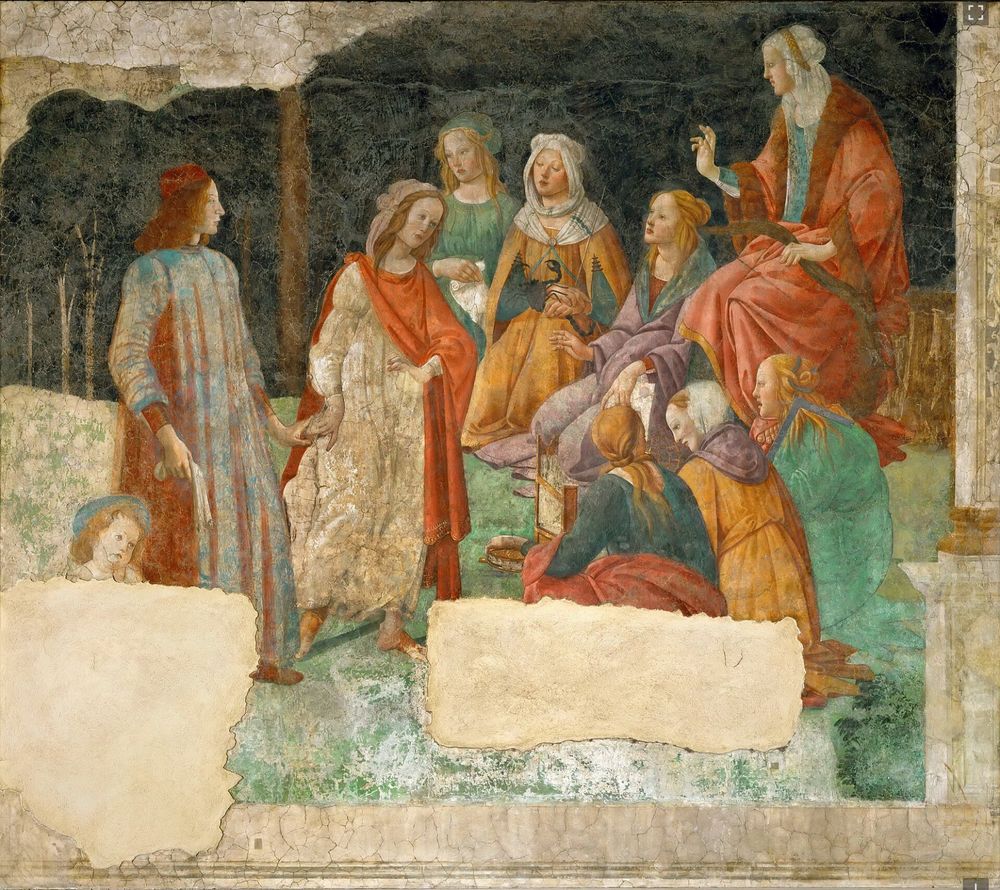
“Liberal Arts Pantocrator” works into my argument short discussions of two early pictorial illustrations (by Herrad of Landsberg & Botticelli ) of the “seven liberal arts.”