



A second planetesimal collision in the Fomalhaut system: esahubble.org/static/scien... -> Hubble Sees Asteroids Colliding at Nearby Star for First Time: www.esa.int/Science_Expl... / science.nasa.gov/missions/hub... / www.mpg.de/24356362/fom...

December 18, 2025 at 7:47 PM
A second planetesimal collision in the Fomalhaut system: esahubble.org/static/scien... -> Hubble Sees Asteroids Colliding at Nearby Star for First Time: www.esa.int/Science_Expl... / science.nasa.gov/missions/hub... / www.mpg.de/24356362/fom...
🧪⚒️Just released: Anat Shahar of Carnegie Science on what makes a planet habitable. Her work shows that water may be very common on rocky exoplanets as a result of interaction between a hydrogen atmosphere and a magma ocean. #geology #exoplanets


December 3, 2025 at 3:43 PM
🧪⚒️Just released: Anat Shahar of Carnegie Science on what makes a planet habitable. Her work shows that water may be very common on rocky exoplanets as a result of interaction between a hydrogen atmosphere and a magma ocean. #geology #exoplanets

#SciFiFri Damien suggested that the huge lava basin might have been created by the impact of just such a space object – a comet or a planetesimal that happened to strike at a weak point in the planet’s thin young crust, causing the underlying molten material to erupt.
January 31, 2025 at 4:45 PM
#SciFiFri Damien suggested that the huge lava basin might have been created by the impact of just such a space object – a comet or a planetesimal that happened to strike at a weak point in the planet’s thin young crust, causing the underlying molten material to erupt.

Detailed Calculations of the Efficiency of Planetesimal Accretion in the Core-Accretion Model -III: The Contribution of Planetesimals Beyond Saturn. Nader Haghighipour et. al. https://arxiv.org/abs/2412.07963


December 12, 2024 at 3:17 AM
Detailed Calculations of the Efficiency of Planetesimal Accretion in the Core-Accretion Model -III: The Contribution of Planetesimals Beyond Saturn. Nader Haghighipour et. al. https://arxiv.org/abs/2412.07963
#SciFiFri Damien suggested that the huge lava basin might have been created by the impact of just such a space object – a comet or a planetesimal that happened to strike at a weak point in the planet’s thin young crust, causing the underlying molten material to erupt.
August 29, 2025 at 2:18 PM
#SciFiFri Damien suggested that the huge lava basin might have been created by the impact of just such a space object – a comet or a planetesimal that happened to strike at a weak point in the planet’s thin young crust, causing the underlying molten material to erupt.
Discovery of an icy and nitrogen-rich extrasolar planetesimal. Snehalata Sahu et. al. https://arxiv.org/abs/2509.13422


September 18, 2025 at 4:58 AM
Discovery of an icy and nitrogen-rich extrasolar planetesimal. Snehalata Sahu et. al. https://arxiv.org/abs/2509.13422
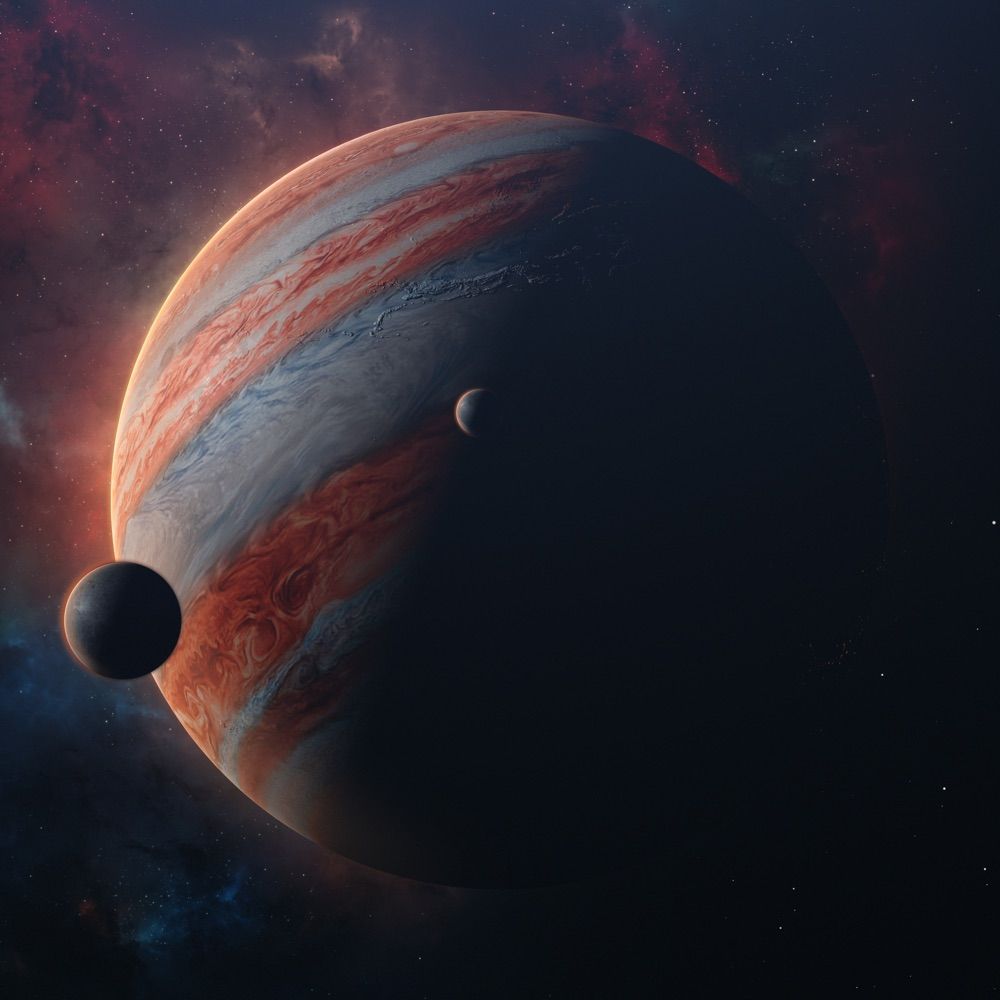
...ravity, increasing their mass. This gravitational pull also draws in smaller dust grains and pebbles, which then stick to the growing body. As a planetesimal accumulates more mass, its gravitational influence strengthens, accelerating the accretion process and allowing it to grow into a protop...
December 10, 2025 at 12:00 PM
...ravity, increasing their mass. This gravitational pull also draws in smaller dust grains and pebbles, which then stick to the growing body. As a planetesimal accumulates more mass, its gravitational influence strengthens, accelerating the accretion process and allowing it to grow into a protop...
Planetesimal formation via the streaming instability in simulations of infall dominated young disks. L.-A. Hühn et. al. https://arxiv.org/abs/2503.13606


March 19, 2025 at 2:59 AM
Planetesimal formation via the streaming instability in simulations of infall dominated young disks. L.-A. Hühn et. al. https://arxiv.org/abs/2503.13606

identified as a planetesimal belt, we derived a semi-major axis of 43 au, fractional luminosity of 1.8 x 10⁻³ , and maximum degree of polarization of 45-57 % at 1.6 $\mu$m. The spectral slope of its reflectance spectrum is red between 1.0 and 1.3 [5/8 of https://arxiv.org/abs/2504.15352v1]
April 23, 2025 at 6:06 AM
identified as a planetesimal belt, we derived a semi-major axis of 43 au, fractional luminosity of 1.8 x 10⁻³ , and maximum degree of polarization of 45-57 % at 1.6 $\mu$m. The spectral slope of its reflectance spectrum is red between 1.0 and 1.3 [5/8 of https://arxiv.org/abs/2504.15352v1]
of dust mass and of its millimeter flux. We estimate the average dust temperature in the planetesimal belt to be 74 K, and a temperature range within the whole disk from 40 to 130 K. [8/8 of https://arxiv.org/abs/2504.13679v1]
April 21, 2025 at 6:07 AM
of dust mass and of its millimeter flux. We estimate the average dust temperature in the planetesimal belt to be 74 K, and a temperature range within the whole disk from 40 to 130 K. [8/8 of https://arxiv.org/abs/2504.13679v1]

Water's Role in Exoplanet Formation Research reveals how planetesimal heating affects water content in rocky exoplanets.
Interest | Match | Feed
Interest | Match | Feed
Origin
scisimple.com
August 28, 2025 at 5:10 AM

Icy planetesimal with high nitrogen and water content discovered in white dwarf’s atmosphere
https://www.europesays.com/uk/456167/
Artist’s impression of white dwarf WD 1647+375 accreting icy planetary fragments from a pluto-like world, creating the chemical…#uk #news #uknews
https://www.europesays.com/uk/456167/
Artist’s impression of white dwarf WD 1647+375 accreting icy planetary fragments from a pluto-like world, creating the chemical…#uk #news #uknews

Icy planetesimal with high nitrogen and water content discovered in white dwarf's atmosphere - United Kingdom
Artist's impression of white dwarf WD 1647+375 accreting icy planetary fragments from a pluto-like world, creating the chemical signature idenfitifed in this
www.europesays.com
September 27, 2025 at 8:17 PM
Icy planetesimal with high nitrogen and water content discovered in white dwarf’s atmosphere
https://www.europesays.com/uk/456167/
Artist’s impression of white dwarf WD 1647+375 accreting icy planetary fragments from a pluto-like world, creating the chemical…#uk #news #uknews
https://www.europesays.com/uk/456167/
Artist’s impression of white dwarf WD 1647+375 accreting icy planetary fragments from a pluto-like world, creating the chemical…#uk #news #uknews

6/
the volatiles reveal themselves only in UV; in visible light, the white dwarf would appear "clean".
This is the first confirmed case of an icy, nitrogen-rich planetesimal accreted purely onto a white dwarf with a hydrogen-dominated atmosphere. It provides an unequivocal measurement of abundances
the volatiles reveal themselves only in UV; in visible light, the white dwarf would appear "clean".
This is the first confirmed case of an icy, nitrogen-rich planetesimal accreted purely onto a white dwarf with a hydrogen-dominated atmosphere. It provides an unequivocal measurement of abundances
September 21, 2025 at 2:56 PM
6/
the volatiles reveal themselves only in UV; in visible light, the white dwarf would appear "clean".
This is the first confirmed case of an icy, nitrogen-rich planetesimal accreted purely onto a white dwarf with a hydrogen-dominated atmosphere. It provides an unequivocal measurement of abundances
the volatiles reveal themselves only in UV; in visible light, the white dwarf would appear "clean".
This is the first confirmed case of an icy, nitrogen-rich planetesimal accreted purely onto a white dwarf with a hydrogen-dominated atmosphere. It provides an unequivocal measurement of abundances

Nice idea! What is the likely range of planetesimal sizes?
November 18, 2024 at 10:49 PM
Nice idea! What is the likely range of planetesimal sizes?
less affected by these adverse effects. Our results suggest that disks around young intermediate-mass stars may be challenging environments for planetesimal formation via SI. This may explain the dearth of planets around [8/9 of https://arxiv.org/abs/2502.17114v1]
February 25, 2025 at 6:14 AM
less affected by these adverse effects. Our results suggest that disks around young intermediate-mass stars may be challenging environments for planetesimal formation via SI. This may explain the dearth of planets around [8/9 of https://arxiv.org/abs/2502.17114v1]
...o solid particles. Beyond the snow line, volatile compounds freeze, significantly increasing the abundance of solid material available for building planets.
* **Enhanced Planetesimal Formation:** The increased density of solid particles, particularly icy grains, outside the snow line leads t...
* **Enhanced Planetesimal Formation:** The increased density of solid particles, particularly icy grains, outside the snow line leads t...
November 13, 2025 at 3:03 AM
...o solid particles. Beyond the snow line, volatile compounds freeze, significantly increasing the abundance of solid material available for building planets.
* **Enhanced Planetesimal Formation:** The increased density of solid particles, particularly icy grains, outside the snow line leads t...
* **Enhanced Planetesimal Formation:** The increased density of solid particles, particularly icy grains, outside the snow line leads t...

[2412.02571] Mitchell John Yzer et al.: Forming Earth-like and Low-Mass Rocky Exoplanets Through Pebble and Planetesimal Accretion. link
December 4, 2024 at 6:54 AM
[2412.02571] Mitchell John Yzer et al.: Forming Earth-like and Low-Mass Rocky Exoplanets Through Pebble and Planetesimal Accretion. link

o ser humano se aquecendo com uma fogueira no planetesimal que daria origem à terra


September 10, 2025 at 11:23 PM
o ser humano se aquecendo com uma fogueira no planetesimal que daria origem à terra

Meet our 2025 Awardees! Jackson Barnes from @MichiganStateU received a Graduate Fellowship award for “Assessing the long-term dynamics of primordial binary planetesimal systems".

August 6, 2025 at 5:52 PM
Meet our 2025 Awardees! Jackson Barnes from @MichiganStateU received a Graduate Fellowship award for “Assessing the long-term dynamics of primordial binary planetesimal systems".
A second planetesimal collision in the Fomalhaut system. Paul Kalas et. al. https://arxiv.org/abs/2512.15861


December 19, 2025 at 1:13 PM
A second planetesimal collision in the Fomalhaut system. Paul Kalas et. al. https://arxiv.org/abs/2512.15861

"Until now, scientists believed that MVEs were lost either because they never fully condensed in the early Solar System or escaped during planetesimal differentiation.
However, the new study reveals a different story: many of the first planetesimals held onto their MVEs..."
However, the new study reveals a different story: many of the first planetesimals held onto their MVEs..."
February 9, 2025 at 1:32 PM
"Until now, scientists believed that MVEs were lost either because they never fully condensed in the early Solar System or escaped during planetesimal differentiation.
However, the new study reveals a different story: many of the first planetesimals held onto their MVEs..."
However, the new study reveals a different story: many of the first planetesimals held onto their MVEs..."
Planetesimal formation in a pressure bump induced by infall. Haichen Zhao et. al. https://arxiv.org/abs/2501.17857


January 30, 2025 at 4:48 AM
Planetesimal formation in a pressure bump induced by infall. Haichen Zhao et. al. https://arxiv.org/abs/2501.17857

Congratulations to 1st year DPhil student Mitchell Yzer on his recent publication "Forming Earth-like and Low-Mass Rocky Exoplanets Through Pebble and Planetesimal Accretion", read it here: arxiv.org/abs/2412.02571

Forming Earth-like and Low-Mass Rocky Exoplanets Through Pebble and Planetesimal Accretion
The theory of pebble accretion (PA) has become a popular planet formation theory during the past decade. However, PA studies generally rely on large planetary embryos, much larger than those expected ...
arxiv.org
December 4, 2024 at 9:34 AM
Congratulations to 1st year DPhil student Mitchell Yzer on his recent publication "Forming Earth-like and Low-Mass Rocky Exoplanets Through Pebble and Planetesimal Accretion", read it here: arxiv.org/abs/2412.02571