



🐜⚡ These Indian jumping ants don't just jump for show – they use powerful leaps to pounce on prey like crickets. Researcher @dradriansmith.bsky.social 's slow-motion footage shows how these predatory ants hunt with the agility of much larger predators. #science #nature
👉 Learn more: zurl.co/kyQs1
👉 Learn more: zurl.co/kyQs1

September 18, 2025 at 3:15 PM
🐜⚡ These Indian jumping ants don't just jump for show – they use powerful leaps to pounce on prey like crickets. Researcher @dradriansmith.bsky.social 's slow-motion footage shows how these predatory ants hunt with the agility of much larger predators. #science #nature
👉 Learn more: zurl.co/kyQs1
👉 Learn more: zurl.co/kyQs1

November 16, 2024 at 12:34 PM
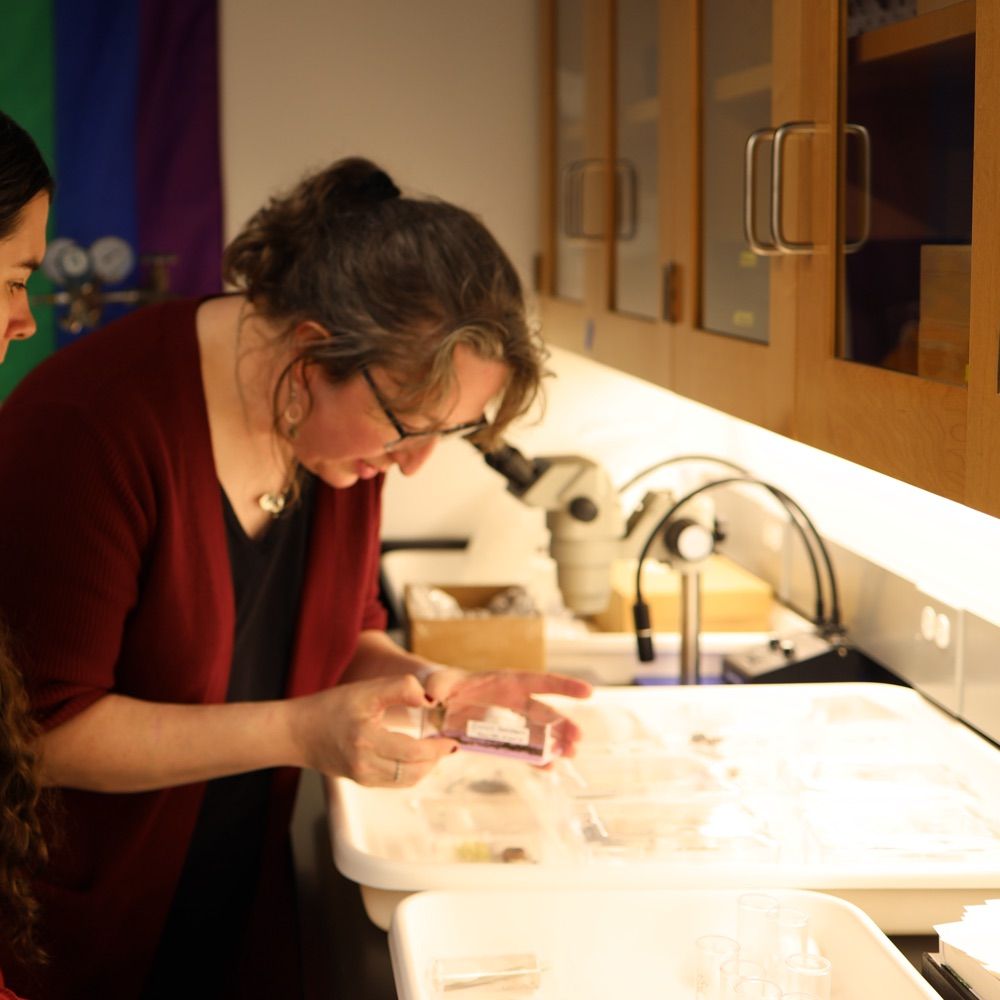
Labeling brood seems super tricky, so small and so actively groomed/tended by workers. And covered in little hairs! Maybe Clint Penick has done it with Harpegnathos?
November 16, 2024 at 5:18 PM
Labeling brood seems super tricky, so small and so actively groomed/tended by workers. And covered in little hairs! Maybe Clint Penick has done it with Harpegnathos?

New video today on one of the coolest ants, Harpegnathos! youtu.be/-hBXOAJ7l1I


August 8, 2025 at 5:21 PM
New video today on one of the coolest ants, Harpegnathos! youtu.be/-hBXOAJ7l1I

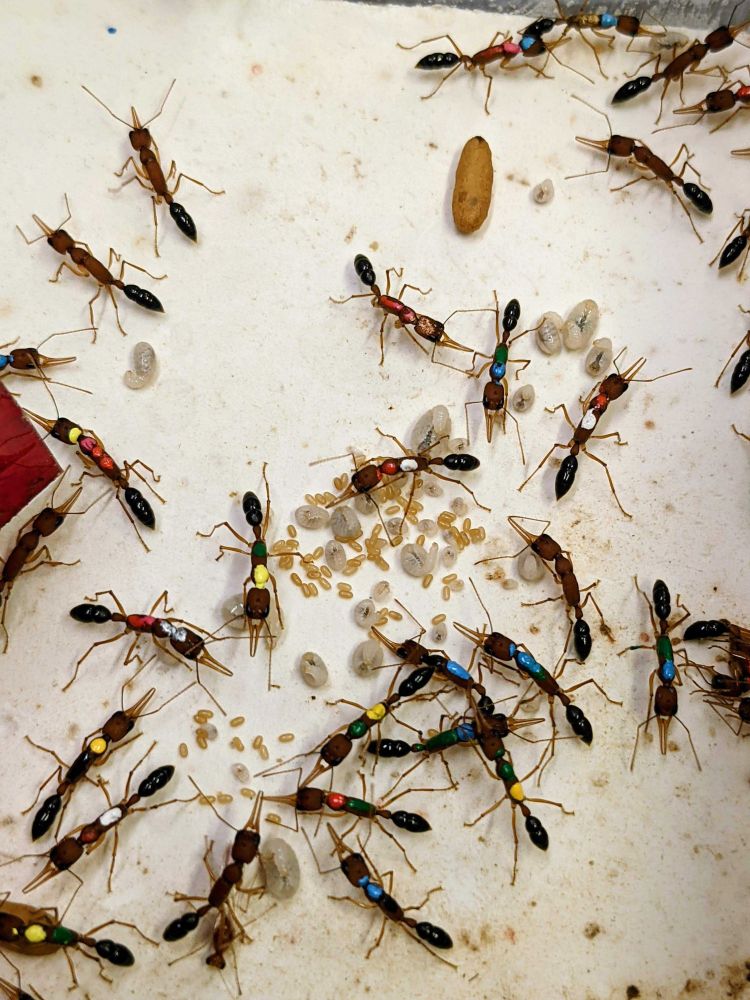
This is a lab colony of Harpegnathos ants! The smaller white individuals are brood. Adults are marked with paint for experiments 🐜🎨
December 9, 2024 at 11:09 PM
This is a lab colony of Harpegnathos ants! The smaller white individuals are brood. Adults are marked with paint for experiments 🐜🎨
Harpegnathos saltator, the ant that jumps and stings to kill its prey - They use their powerful leaps to capture prey like crickets, pouncing with the agility of a much larger predator. thekidshouldseethis.com/post/indian-... #biology #KidScience #SciEd #SciChat

Harpegnathos saltator, the ant that jumps and stings to kill its prey
"This one spectacular ant. It's called an Indian jumping ant (Harpegnathos saltator). And here, when it gets a little tap on the back, you'll see why it's
thekidshouldseethis.com
October 4, 2025 at 6:46 PM
Harpegnathos saltator, the ant that jumps and stings to kill its prey - They use their powerful leaps to capture prey like crickets, pouncing with the agility of a much larger predator. thekidshouldseethis.com/post/indian-... #biology #KidScience #SciEd #SciChat

En vidéo : l'une des deux espèces présentes dans l'espace 𝐻𝑎𝑟𝑝𝑒𝑔𝑛𝑎𝑡ℎ𝑜𝑠 𝑠𝑎𝑙𝑡𝑎𝑡𝑜𝑟 une espèce de fourmi indienne dans le nid avec œufs, larves et ouvrières.
July 11, 2025 at 9:37 AM
En vidéo : l'une des deux espèces présentes dans l'espace 𝐻𝑎𝑟𝑝𝑒𝑔𝑛𝑎𝑡ℎ𝑜𝑠 𝑠𝑎𝑙𝑡𝑎𝑡𝑜𝑟 une espèce de fourmi indienne dans le nid avec œufs, larves et ouvrières.
💁🏻♀️ ICYMI: 🐜⚡ These Indian jumping ants don't just jump for show – they use powerful leaps to pounce on prey like crickets. Researcher @dradriansmith.bsky.social 's slow-motion footage shows how these predatory ants hunt with the agility of much larger predators. #nature
👉 Learn more: zurl.co/kyQs1
👉 Learn more: zurl.co/kyQs1

September 19, 2025 at 9:00 AM
💁🏻♀️ ICYMI: 🐜⚡ These Indian jumping ants don't just jump for show – they use powerful leaps to pounce on prey like crickets. Researcher @dradriansmith.bsky.social 's slow-motion footage shows how these predatory ants hunt with the agility of much larger predators. #nature
👉 Learn more: zurl.co/kyQs1
👉 Learn more: zurl.co/kyQs1
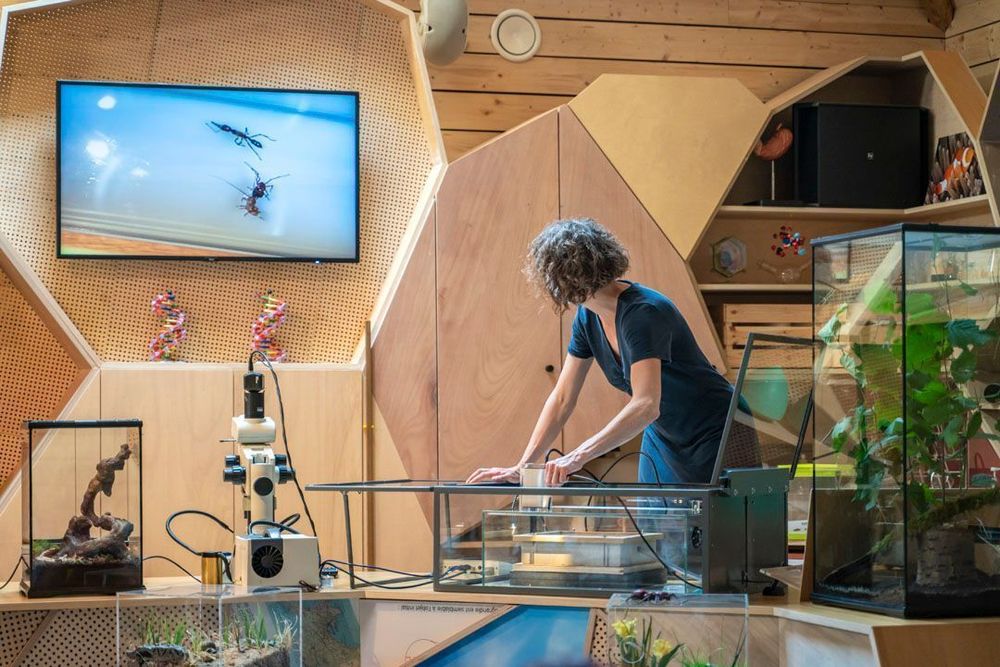
À 10h20 samedi "le monde des #fourmis" [Dès 6 ans] avec 2 espèces.
- Harpegnathos saltator, fourmis indiennes carnivores, qui n’ont pas de reine ;
- Messor barbarus, fourmis granivores du pourtour méditerranéen qui ont une seule reine.
➡️ billetterie-etincelles.palais-decouverte.fr/etincelles.h...
- Harpegnathos saltator, fourmis indiennes carnivores, qui n’ont pas de reine ;
- Messor barbarus, fourmis granivores du pourtour méditerranéen qui ont une seule reine.
➡️ billetterie-etincelles.palais-decouverte.fr/etincelles.h...


December 4, 2025 at 9:27 AM
À 10h20 samedi "le monde des #fourmis" [Dès 6 ans] avec 2 espèces.
- Harpegnathos saltator, fourmis indiennes carnivores, qui n’ont pas de reine ;
- Messor barbarus, fourmis granivores du pourtour méditerranéen qui ont une seule reine.
➡️ billetterie-etincelles.palais-decouverte.fr/etincelles.h...
- Harpegnathos saltator, fourmis indiennes carnivores, qui n’ont pas de reine ;
- Messor barbarus, fourmis granivores du pourtour méditerranéen qui ont une seule reine.
➡️ billetterie-etincelles.palais-decouverte.fr/etincelles.h...
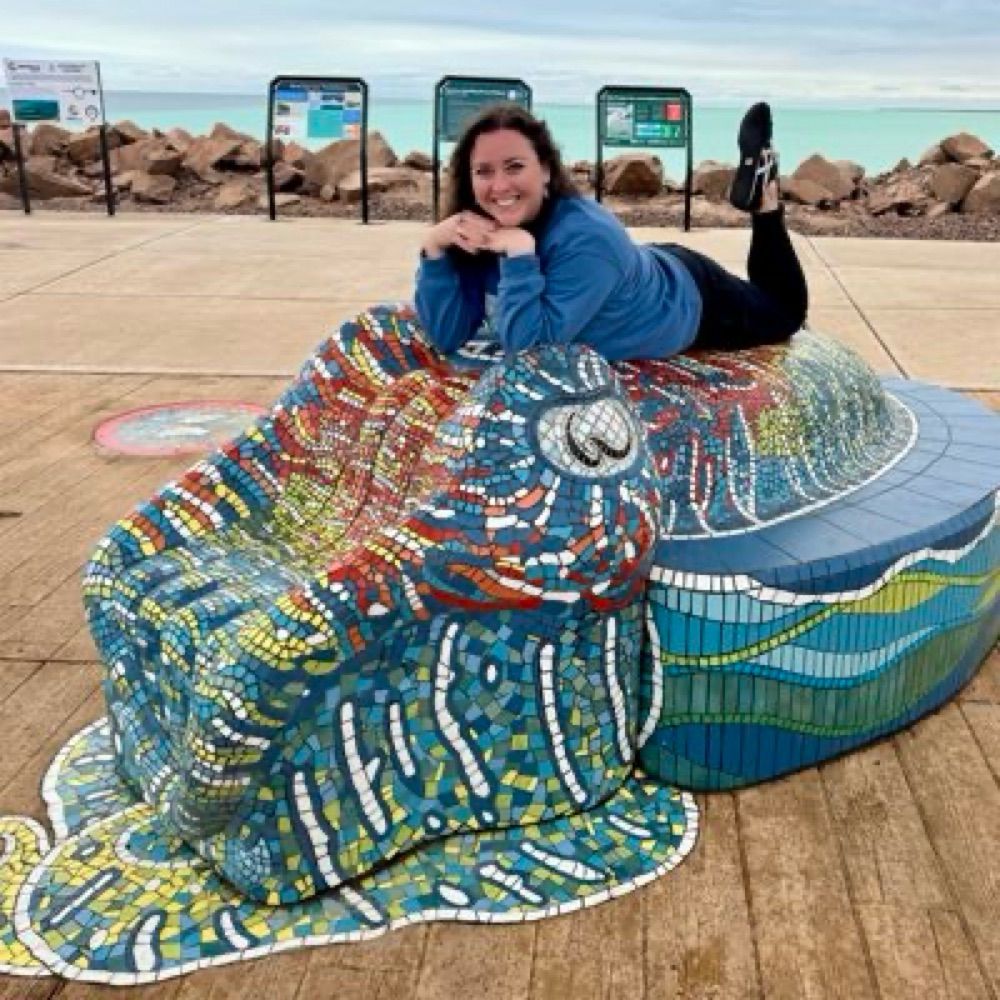
Got to hang out with @G_Pask at Bucknell last week and he showed me some of his lab's ants, Harpegnathos saltator!
December 1, 2024 at 10:25 AM
Got to hang out with @G_Pask at Bucknell last week and he showed me some of his lab's ants, Harpegnathos saltator!

Karl Glastad @Laevorotatory Harpegnathos saltator 🐜 changing #chromatin landscape & reproductive plasticity: gamergate transition #EntSoc17
December 11, 2024 at 1:12 AM
Karl Glastad @Laevorotatory Harpegnathos saltator 🐜 changing #chromatin landscape & reproductive plasticity: gamergate transition #EntSoc17



Reduced movement activity in reproductive workers of the #ant Harpegnathos saltator as part of a social insect reproductive syndrome InsSociaux

Reduced movement activity in reproductive workers of the #ant Harpegnathos saltator as part of a social insect reproductive syndrome
In social insects, active ovaries have been associated with a suite of physiological and behavioral characteristics that together can be considered to represent a social insect reproductive syndrome. Included in this syndrome is a decrease in locomotor or movement activity. In the ponerine ant, Harpegnathos saltator, workers are capable of sexual reproduction, and when a colony’s queen dies, some workers assume her role and become gamergates—workers with queen-like physiology. Though morphologically identical, behaviorally gamergates appear “inactive”, “slow”, and display “minimal movement”, while non-reproductive workers appear relatively “fast” and “active”. While these differences in movement activity have been reported anecdotally, to our knowledge, they have never been investigated experimentally. Here, we quantify and statistically compare two measures of movement activity for H. saltator gamergates and non-reproductive workers over a period of weeks to test these reported differences. We found gamergates had an average daily displacement at most two-thirds that of workers and an eighth the likelihood of being observed in transit. Our findings quantitatively demonstrate movement activity differences between H. saltator gamergates and non-reproductive workers, and verify this aspect of the social insect reproductive syndrome for the gamergates of this model ant species.
dlvr.it
July 24, 2025 at 4:33 PM
Reduced movement activity in reproductive workers of the #ant Harpegnathos saltator as part of a social insect reproductive syndrome InsSociaux

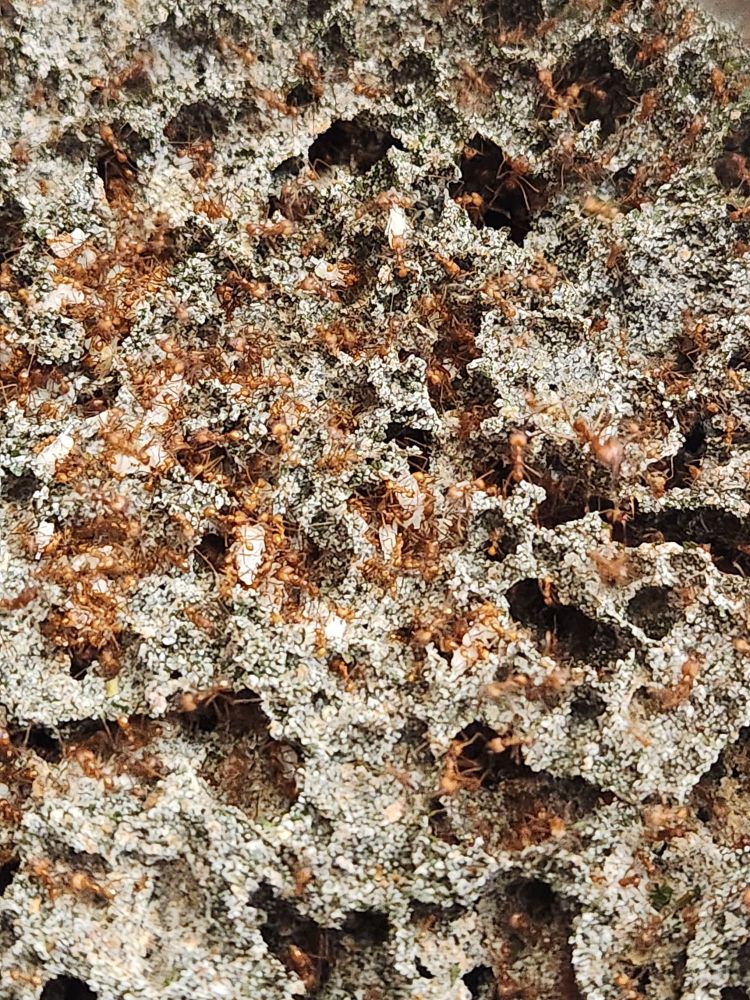
I guess I have never shared here what I actually study! These are 2 of the species of ants I'm using for my PhD research! Atta cephalotes and Harpegnathos saltator!
May 6, 2025 at 9:02 PM
I guess I have never shared here what I actually study! These are 2 of the species of ants I'm using for my PhD research! Atta cephalotes and Harpegnathos saltator!
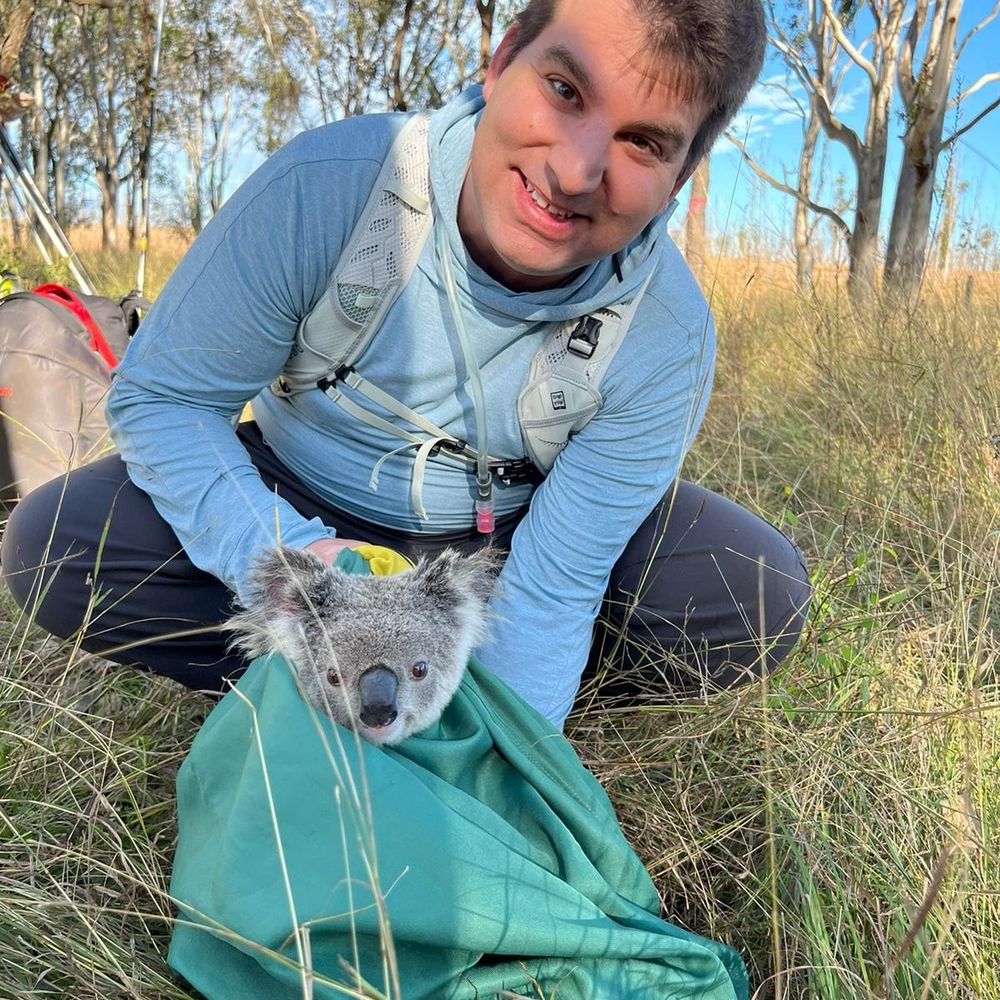
Harpegnathos! Wonderful ants!
🐜-sitting for the Glastad lab. Always loyal to #wasplove, but these girls are amazing!

December 10, 2024 at 8:52 PM
Harpegnathos! Wonderful ants!
New research article! 📰
Haight & Liebig tracked workers and gamergates quantifying movement: gamergates showed lower displacement and were less likely to move than workers 📉
🔗 doi.org/10.1007/s000...
#SocialInsects #ReproductiveSyndrome #Ant #BehavioralEcology #Harpegnathos #Queen #Plasticity
Haight & Liebig tracked workers and gamergates quantifying movement: gamergates showed lower displacement and were less likely to move than workers 📉
🔗 doi.org/10.1007/s000...
#SocialInsects #ReproductiveSyndrome #Ant #BehavioralEcology #Harpegnathos #Queen #Plasticity

August 1, 2025 at 8:08 AM
New research article! 📰
Haight & Liebig tracked workers and gamergates quantifying movement: gamergates showed lower displacement and were less likely to move than workers 📉
🔗 doi.org/10.1007/s000...
#SocialInsects #ReproductiveSyndrome #Ant #BehavioralEcology #Harpegnathos #Queen #Plasticity
Haight & Liebig tracked workers and gamergates quantifying movement: gamergates showed lower displacement and were less likely to move than workers 📉
🔗 doi.org/10.1007/s000...
#SocialInsects #ReproductiveSyndrome #Ant #BehavioralEcology #Harpegnathos #Queen #Plasticity

🧩 ¿Te animas a formar parte de la comunidad? formicidae.es
📷 Carlos del Pico Pons (@macroartist): Carebara diversa, Myopias sp., Harpegnathos venator, Odontomachus rixosus
📷 Ignacio Germán @ignaciogerman.bsky.social: Iberoformica subrufa
📷 Carlos del Pico Pons (@macroartist): Carebara diversa, Myopias sp., Harpegnathos venator, Odontomachus rixosus
📷 Ignacio Germán @ignaciogerman.bsky.social: Iberoformica subrufa

Página principal
Foro de hormigas y comunidad dedicada a la cría, hormigueros, mirmecología, taxonomía, biología del comportamiento y cualquier área relacionada con los formícid
formicidae.es
January 22, 2025 at 9:30 AM
🧩 ¿Te animas a formar parte de la comunidad? formicidae.es
📷 Carlos del Pico Pons (@macroartist): Carebara diversa, Myopias sp., Harpegnathos venator, Odontomachus rixosus
📷 Ignacio Germán @ignaciogerman.bsky.social: Iberoformica subrufa
📷 Carlos del Pico Pons (@macroartist): Carebara diversa, Myopias sp., Harpegnathos venator, Odontomachus rixosus
📷 Ignacio Germán @ignaciogerman.bsky.social: Iberoformica subrufa