


Yuanze Liu
@yuanzeliu.bsky.social
Research Professional @BoothSchoolofBusiness. Social psychology.
Reposted by Yuanze Liu

It’s grad school application season, and I wanted to give some public advice.
Caveats:
-*-*-*-*
> These are my opinions, based on my experiences, they are not secret tricks or guarantees
> They are general guidelines, not meant to cover a host of idiosyncrasies and special cases
Caveats:
-*-*-*-*
> These are my opinions, based on my experiences, they are not secret tricks or guarantees
> They are general guidelines, not meant to cover a host of idiosyncrasies and special cases
November 6, 2025 at 2:55 PM
It’s grad school application season, and I wanted to give some public advice.
Caveats:
-*-*-*-*
> These are my opinions, based on my experiences, they are not secret tricks or guarantees
> They are general guidelines, not meant to cover a host of idiosyncrasies and special cases
Caveats:
-*-*-*-*
> These are my opinions, based on my experiences, they are not secret tricks or guarantees
> They are general guidelines, not meant to cover a host of idiosyncrasies and special cases
Reposted by Yuanze Liu

In a new paper, we find that sycophantic #AI chatbots make people more extreme--operating like an echo chamber
Yet, people prefer sycophantic chatbots and see them as less biased
Only open-minded people prefer disagreeable chatbots: osf.io/preprints/ps...
Led by @steverathje.bsky.social
Yet, people prefer sycophantic chatbots and see them as less biased
Only open-minded people prefer disagreeable chatbots: osf.io/preprints/ps...
Led by @steverathje.bsky.social

October 2, 2025 at 3:55 PM
In a new paper, we find that sycophantic #AI chatbots make people more extreme--operating like an echo chamber
Yet, people prefer sycophantic chatbots and see them as less biased
Only open-minded people prefer disagreeable chatbots: osf.io/preprints/ps...
Led by @steverathje.bsky.social
Yet, people prefer sycophantic chatbots and see them as less biased
Only open-minded people prefer disagreeable chatbots: osf.io/preprints/ps...
Led by @steverathje.bsky.social
Reposted by Yuanze Liu

🚨 New preprint 🚨
Across 3 experiments (n = 3,285), we found that interacting with sycophantic (or overly agreeable) AI chatbots entrenched attitudes and led to inflated self-perceptions.
Yet, people preferred sycophantic chatbots and viewed them as unbiased!
osf.io/preprints/ps...
Thread 🧵
Across 3 experiments (n = 3,285), we found that interacting with sycophantic (or overly agreeable) AI chatbots entrenched attitudes and led to inflated self-perceptions.
Yet, people preferred sycophantic chatbots and viewed them as unbiased!
osf.io/preprints/ps...
Thread 🧵

October 1, 2025 at 3:16 PM
🚨 New preprint 🚨
Across 3 experiments (n = 3,285), we found that interacting with sycophantic (or overly agreeable) AI chatbots entrenched attitudes and led to inflated self-perceptions.
Yet, people preferred sycophantic chatbots and viewed them as unbiased!
osf.io/preprints/ps...
Thread 🧵
Across 3 experiments (n = 3,285), we found that interacting with sycophantic (or overly agreeable) AI chatbots entrenched attitudes and led to inflated self-perceptions.
Yet, people preferred sycophantic chatbots and viewed them as unbiased!
osf.io/preprints/ps...
Thread 🧵
Reposted by Yuanze Liu

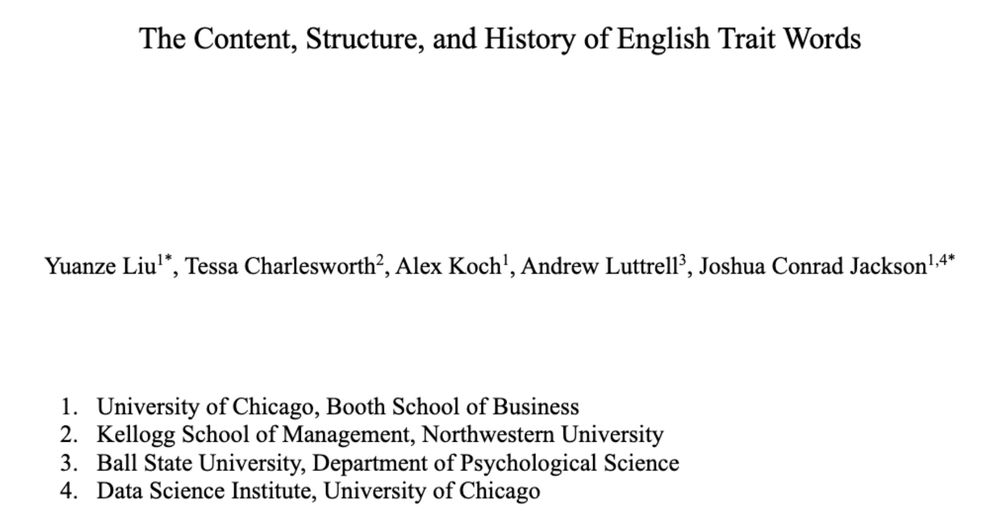
English language is filled with trait words like “caring” and “smart”
These words are the currency of personality/social psych, yet key questions remain about their evolution, function, and structure
We take on these questions in a preprint led by @yuanzeliu.bsky.social
osf.io/preprints/ps...
These words are the currency of personality/social psych, yet key questions remain about their evolution, function, and structure
We take on these questions in a preprint led by @yuanzeliu.bsky.social
osf.io/preprints/ps...
July 22, 2025 at 3:36 PM
English language is filled with trait words like “caring” and “smart”
These words are the currency of personality/social psych, yet key questions remain about their evolution, function, and structure
We take on these questions in a preprint led by @yuanzeliu.bsky.social
osf.io/preprints/ps...
These words are the currency of personality/social psych, yet key questions remain about their evolution, function, and structure
We take on these questions in a preprint led by @yuanzeliu.bsky.social
osf.io/preprints/ps...
Reposted by Yuanze Liu

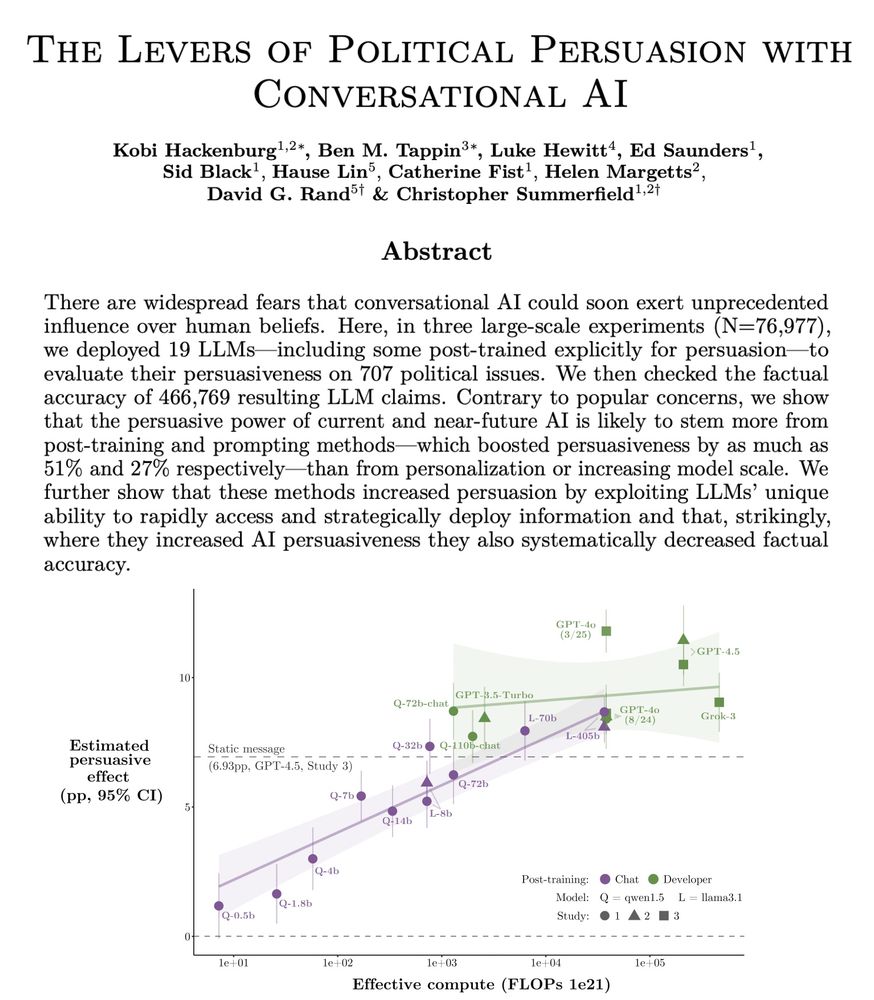
Today (w/ @ox.ac.uk @stanford @MIT @LSE) we’re sharing the results of the largest AI persuasion experiments to date: 76k participants, 19 LLMs, 707 political issues.
We examine “levers” of AI persuasion: model scale, post-training, prompting, personalization, & more!
🧵:
We examine “levers” of AI persuasion: model scale, post-training, prompting, personalization, & more!
🧵:
July 21, 2025 at 4:20 PM
Today (w/ @ox.ac.uk @stanford @MIT @LSE) we’re sharing the results of the largest AI persuasion experiments to date: 76k participants, 19 LLMs, 707 political issues.
We examine “levers” of AI persuasion: model scale, post-training, prompting, personalization, & more!
🧵:
We examine “levers” of AI persuasion: model scale, post-training, prompting, personalization, & more!
🧵:
Reposted by Yuanze Liu

On the Malleability of Democratic Attitudes: Do Citizens' Views of Democracy Vary With How They Feel?: https://osf.io/hz2mt
July 9, 2025 at 9:18 AM
On the Malleability of Democratic Attitudes: Do Citizens' Views of Democracy Vary With How They Feel?: https://osf.io/hz2mt
Reposted by Yuanze Liu
✨Did markets make Americans more cooperative❓🔍
✅YES‼️
Between 1850 and 1920, the US became the largest and most integrated economy in the world 📶🌎
We show that this shift didn’t just move goods and affect prices—it fundamentally changed culture and behavior
🧵 👇 1/17
✅YES‼️
Between 1850 and 1920, the US became the largest and most integrated economy in the world 📶🌎
We show that this shift didn’t just move goods and affect prices—it fundamentally changed culture and behavior
🧵 👇 1/17
July 17, 2025 at 7:22 AM
✨Did markets make Americans more cooperative❓🔍
✅YES‼️
Between 1850 and 1920, the US became the largest and most integrated economy in the world 📶🌎
We show that this shift didn’t just move goods and affect prices—it fundamentally changed culture and behavior
🧵 👇 1/17
✅YES‼️
Between 1850 and 1920, the US became the largest and most integrated economy in the world 📶🌎
We show that this shift didn’t just move goods and affect prices—it fundamentally changed culture and behavior
🧵 👇 1/17
Reposted by Yuanze Liu

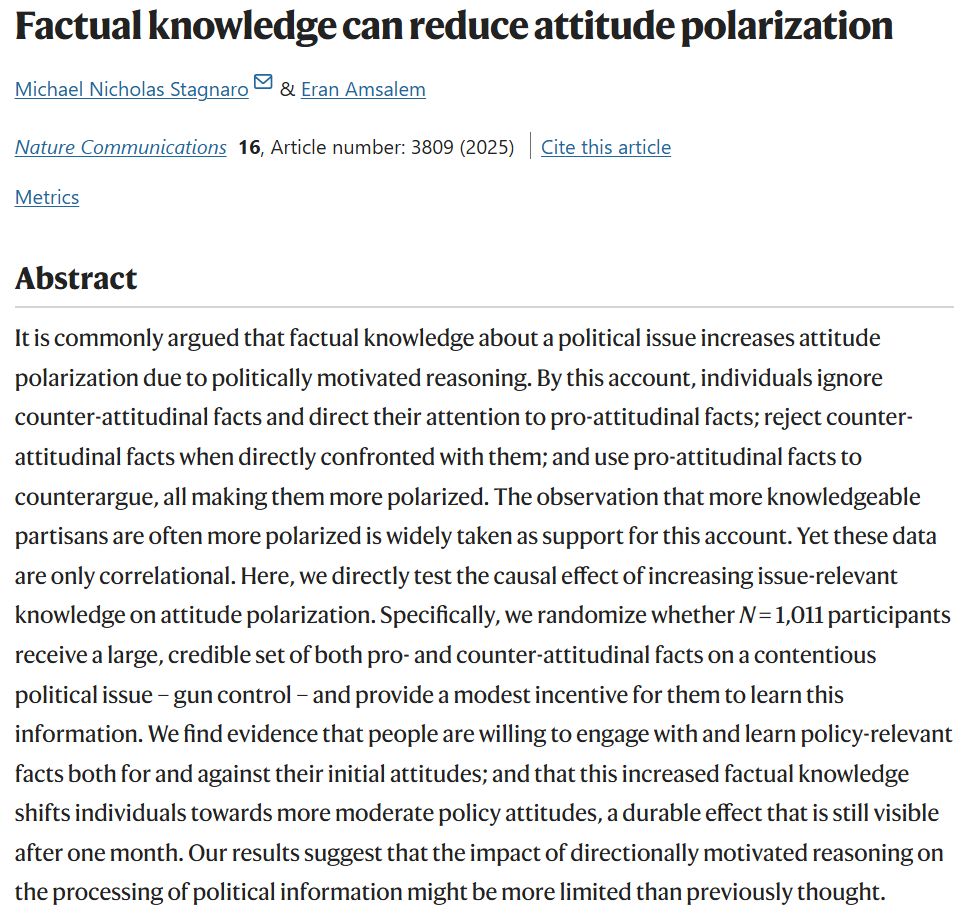
Great new paper by Stagnaro & Amsalem in NatComm:
Detailed fact-based informational module about gun control leads to persistent reductions in polarization (attitudes move towards midpoint). Seeing the evidence cited by other side makes opinions more moderate www.nature.com/articles/s41...
Detailed fact-based informational module about gun control leads to persistent reductions in polarization (attitudes move towards midpoint). Seeing the evidence cited by other side makes opinions more moderate www.nature.com/articles/s41...
April 24, 2025 at 12:29 AM
Great new paper by Stagnaro & Amsalem in NatComm:
Detailed fact-based informational module about gun control leads to persistent reductions in polarization (attitudes move towards midpoint). Seeing the evidence cited by other side makes opinions more moderate www.nature.com/articles/s41...
Detailed fact-based informational module about gun control leads to persistent reductions in polarization (attitudes move towards midpoint). Seeing the evidence cited by other side makes opinions more moderate www.nature.com/articles/s41...
Reposted by Yuanze Liu

This paper is now published. www.nature.com/articles/s44...
April 17, 2025 at 6:25 PM
This paper is now published. www.nature.com/articles/s44...
Reposted by Yuanze Liu

Want to make nice graphs with me, starting this summer? I am hiring for two PhD positions at the University of Witten/Herdecke.
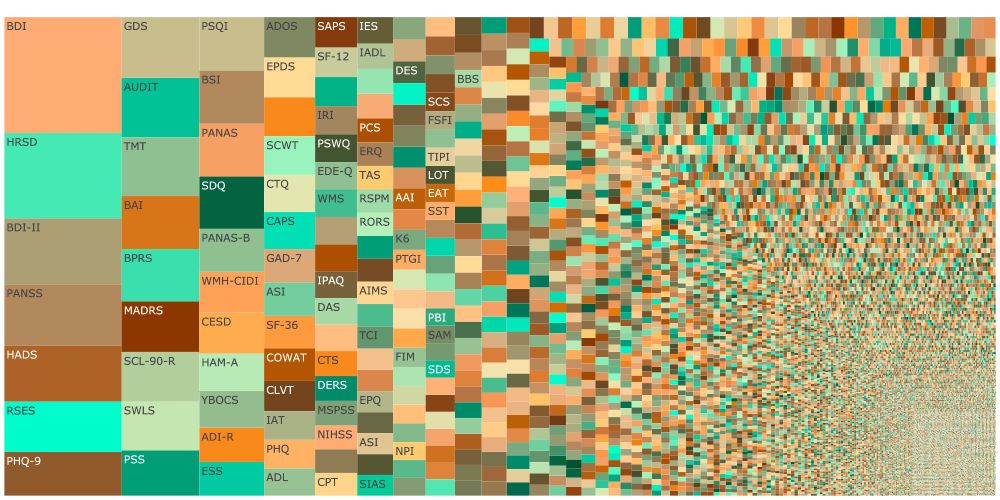
March 18, 2025 at 3:31 PM
Want to make nice graphs with me, starting this summer? I am hiring for two PhD positions at the University of Witten/Herdecke.
Reposted by Yuanze Liu
New preprint on prejudice and state centralization: osf.io/preprints/ps...
Our team of historians, psychologists, and anthropologists analyzed 90 historical societies and Chinese records from 206 BCE - 1911 CE
In both studies, we find a link btw group prejudice and historical state centralization
Our team of historians, psychologists, and anthropologists analyzed 90 historical societies and Chinese records from 206 BCE - 1911 CE
In both studies, we find a link btw group prejudice and historical state centralization

November 11, 2024 at 3:34 PM
New preprint on prejudice and state centralization: osf.io/preprints/ps...
Our team of historians, psychologists, and anthropologists analyzed 90 historical societies and Chinese records from 206 BCE - 1911 CE
In both studies, we find a link btw group prejudice and historical state centralization
Our team of historians, psychologists, and anthropologists analyzed 90 historical societies and Chinese records from 206 BCE - 1911 CE
In both studies, we find a link btw group prejudice and historical state centralization
Reposted by Yuanze Liu

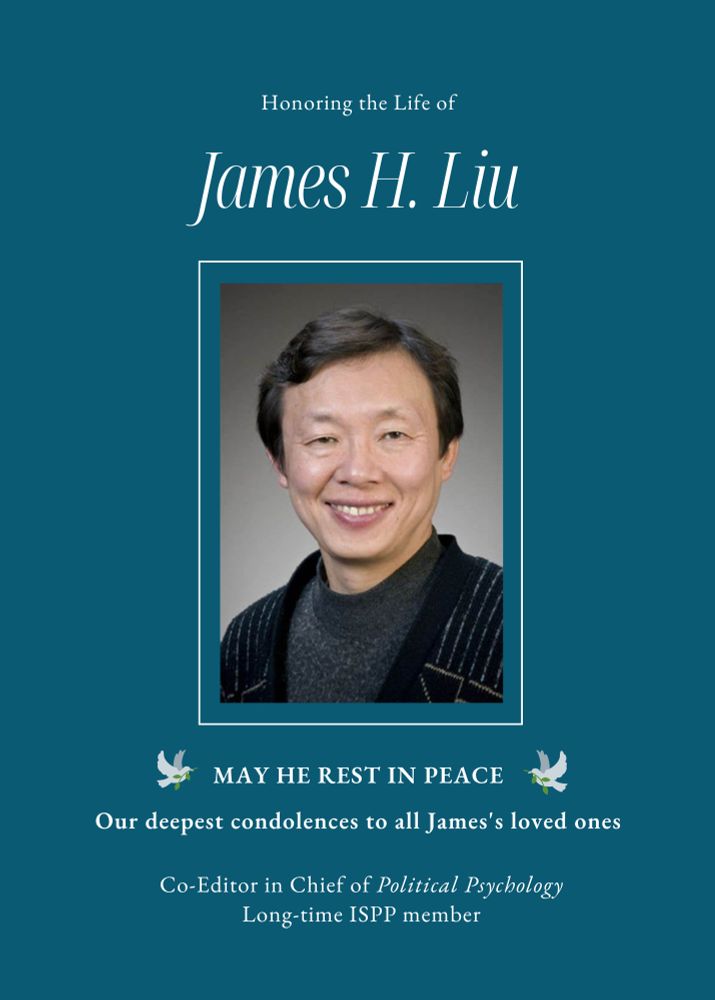
We are deeply saddened to share the passing of James Liu, Co-Editor-in-Chief of Political Psychology and long-time ISPP member. We are forever grateful for his contributions to our field. Our thoughts are with his loved ones. He will be greatly missed.
ispp.org/news/in-memo...
ispp.org/news/in-memo...
August 14, 2024 at 7:06 PM
We are deeply saddened to share the passing of James Liu, Co-Editor-in-Chief of Political Psychology and long-time ISPP member. We are forever grateful for his contributions to our field. Our thoughts are with his loved ones. He will be greatly missed.
ispp.org/news/in-memo...
ispp.org/news/in-memo...
Reposted by Yuanze Liu
It has been a challenge to identify predictors of moralization. This new study finds that perceived polarization prospectively predicts attitude moralization during the 2020 US Presidential election
psycnet.apa.org/record/2024-...
#psychology #socialpsyc #PsychSciSky #BehSci Polisky
psycnet.apa.org/record/2024-...
#psychology #socialpsyc #PsychSciSky #BehSci Polisky


June 19, 2024 at 6:34 PM
It has been a challenge to identify predictors of moralization. This new study finds that perceived polarization prospectively predicts attitude moralization during the 2020 US Presidential election
psycnet.apa.org/record/2024-...
#psychology #socialpsyc #PsychSciSky #BehSci Polisky
psycnet.apa.org/record/2024-...
#psychology #socialpsyc #PsychSciSky #BehSci Polisky