




Yourong Guo
@yrguo.bsky.social
A huge thanks to all my amazing coauthors, especially @metricsemma.bsky.social 😊
🔗 Read the full paper: www.biorxiv.org/content/10.1... 9/9
🔗 Read the full paper: www.biorxiv.org/content/10.1... 9/9

Motifs of brain cortical folding from birth to adulthood: structural asymmetry and folding-functional links
Cortical folding of brain is widely regarded as an interplay between genetic programming and biomechanical forces, closely linked to cytoarchitectonic regionalisation. Abnormal folding patterns are fr...
www.biorxiv.org
March 9, 2025 at 11:06 PM
A huge thanks to all my amazing coauthors, especially @metricsemma.bsky.social 😊
🔗 Read the full paper: www.biorxiv.org/content/10.1... 9/9
🔗 Read the full paper: www.biorxiv.org/content/10.1... 9/9
We’ve long sought to understand how genetic and biomechanical forces shape cortical folding, and how that relates to actual functional areas. Hopefully, this work takes a small step toward deeper understanding. 8/9
March 9, 2025 at 11:06 PM
We’ve long sought to understand how genetic and biomechanical forces shape cortical folding, and how that relates to actual functional areas. Hopefully, this work takes a small step toward deeper understanding. 8/9
Folding-Function links?
Aligning individual HCP task functional activation maps & multi-modal parcellations (Glasser, M. F. et al) using MSM-HT, we find that better structural alignment did not improve functional overlap. 7/9
Aligning individual HCP task functional activation maps & multi-modal parcellations (Glasser, M. F. et al) using MSM-HT, we find that better structural alignment did not improve functional overlap. 7/9

March 9, 2025 at 11:06 PM
Folding-Function links?
Aligning individual HCP task functional activation maps & multi-modal parcellations (Glasser, M. F. et al) using MSM-HT, we find that better structural alignment did not improve functional overlap. 7/9
Aligning individual HCP task functional activation maps & multi-modal parcellations (Glasser, M. F. et al) using MSM-HT, we find that better structural alignment did not improve functional overlap. 7/9
Cortical folding motifs are heritable.
Using MZ and DZ twins data from the HCP young adults, we found motifs co-occurred more frequently in MZ siblings than DZ across all lobes. 6/9
Using MZ and DZ twins data from the HCP young adults, we found motifs co-occurred more frequently in MZ siblings than DZ across all lobes. 6/9
March 9, 2025 at 11:06 PM
Cortical folding motifs are heritable.
Using MZ and DZ twins data from the HCP young adults, we found motifs co-occurred more frequently in MZ siblings than DZ across all lobes. 6/9
Using MZ and DZ twins data from the HCP young adults, we found motifs co-occurred more frequently in MZ siblings than DZ across all lobes. 6/9
Neonates vs. Adults: What changes?
We observed consistency across both age groups, with neonatal samples showing less variation. However, rightward-asymmetric folding clusters had greater temporal lobe surface area than leftward - reversed in adults. 5/9
We observed consistency across both age groups, with neonatal samples showing less variation. However, rightward-asymmetric folding clusters had greater temporal lobe surface area than leftward - reversed in adults. 5/9


March 9, 2025 at 11:06 PM
Neonates vs. Adults: What changes?
We observed consistency across both age groups, with neonatal samples showing less variation. However, rightward-asymmetric folding clusters had greater temporal lobe surface area than leftward - reversed in adults. 5/9
We observed consistency across both age groups, with neonatal samples showing less variation. However, rightward-asymmetric folding clusters had greater temporal lobe surface area than leftward - reversed in adults. 5/9
Greater asymmetry in the temporal lobe.
A higher proportion of temporal lobe clusters were leftward-asymmetric compared to other lobes. These motifs showed more anatomical heterogeneity than rightward ones, including interruptions and branching of the superior temporal sulcus. 4/9
A higher proportion of temporal lobe clusters were leftward-asymmetric compared to other lobes. These motifs showed more anatomical heterogeneity than rightward ones, including interruptions and branching of the superior temporal sulcus. 4/9

March 9, 2025 at 11:06 PM
Greater asymmetry in the temporal lobe.
A higher proportion of temporal lobe clusters were leftward-asymmetric compared to other lobes. These motifs showed more anatomical heterogeneity than rightward ones, including interruptions and branching of the superior temporal sulcus. 4/9
A higher proportion of temporal lobe clusters were leftward-asymmetric compared to other lobes. These motifs showed more anatomical heterogeneity than rightward ones, including interruptions and branching of the superior temporal sulcus. 4/9
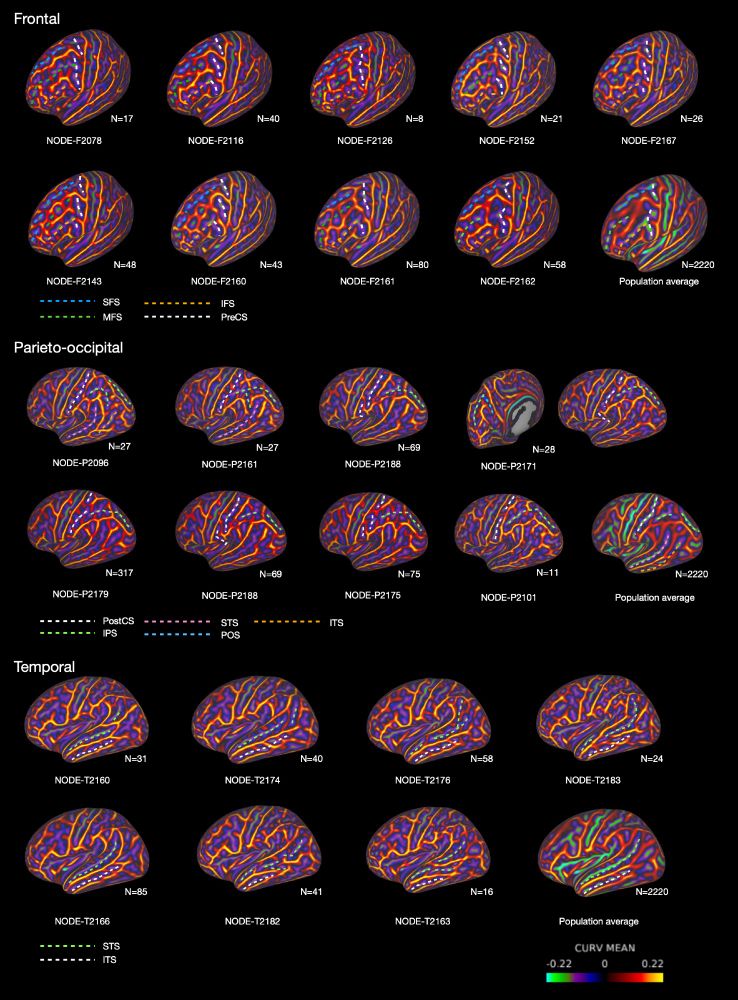
Disentangling natural cortical shape variability from clinically relevant features starts with better characterizing its scale across large populations. Here, we introduce MSM-HT to parse cortical folding variability into a representative family of distinct anatomical motifs. 3/9

March 9, 2025 at 11:06 PM
Disentangling natural cortical shape variability from clinically relevant features starts with better characterizing its scale across large populations. Here, we introduce MSM-HT to parse cortical folding variability into a representative family of distinct anatomical motifs. 3/9
🧠 What shapes cortical folding?
Cortical folding is widely regarded as an interplay between genetic programming and biomechanical forces. Abnormal folding patterns are frequently observed in neurodevelopmental conditions and psychiatric disorders. 2/9
Cortical folding is widely regarded as an interplay between genetic programming and biomechanical forces. Abnormal folding patterns are frequently observed in neurodevelopmental conditions and psychiatric disorders. 2/9
March 9, 2025 at 11:06 PM
🧠 What shapes cortical folding?
Cortical folding is widely regarded as an interplay between genetic programming and biomechanical forces. Abnormal folding patterns are frequently observed in neurodevelopmental conditions and psychiatric disorders. 2/9
Cortical folding is widely regarded as an interplay between genetic programming and biomechanical forces. Abnormal folding patterns are frequently observed in neurodevelopmental conditions and psychiatric disorders. 2/9