



vilhelmiina haavisto
@vilhelmiinah.bsky.social
phd student at eth zürich and enthusiastic science writer | she/her | 🌈 | sciencebyvilhelmiina.wixsite.com/vilhelmiina
Reposted by vilhelmiina haavisto

"If we leave writing to AI chatbots, we won't just lose a craft and the skills. Because writing is more than that. Writing is thinking", argues Giorgio Iemmolo, Director of the Language Centre at ETH and the University of Zurich.
ethz.ch/en/news-and-...
What is your opinion?
ethz.ch/en/news-and-...
What is your opinion?

Giorgio Iemmolo, is learning possible without writing?
AI chatbots are taking over writing for students and researchers. Linguist Giorgio Iemmolo explains what we are jeopardising in the interest of efficiency gains.
ethz.ch
October 2, 2025 at 8:07 AM
"If we leave writing to AI chatbots, we won't just lose a craft and the skills. Because writing is more than that. Writing is thinking", argues Giorgio Iemmolo, Director of the Language Centre at ETH and the University of Zurich.
ethz.ch/en/news-and-...
What is your opinion?
ethz.ch/en/news-and-...
What is your opinion?
Some bacteria have teeny-tiny genomes: but why? I dove into this question for @asm.org 🧹🦠 asm.org/articles/202...
Why Some Bacteria Evolve Reduced Genomes: Only the Essentials | ASM.org
Despite their already relatively small genomes, bacteria can kick out unnecessary genes to gain a competitive advantage in their environment—or adapt to a new one.
asm.org
September 22, 2025 at 1:58 PM
Some bacteria have teeny-tiny genomes: but why? I dove into this question for @asm.org 🧹🦠 asm.org/articles/202...
Reposted by vilhelmiina haavisto

🥳 New paper out!
In this work, we identified small molecule effectors modulating the activity of transcription factors in E. coli.
Using metabolomics + transcriptomics, we could parse the entire regulatory network and predict signal molecules for 41 TFs!
www.embopress.org/doi/full/10....
In this work, we identified small molecule effectors modulating the activity of transcription factors in E. coli.
Using metabolomics + transcriptomics, we could parse the entire regulatory network and predict signal molecules for 41 TFs!
www.embopress.org/doi/full/10....

Predicting input signals of transcription factors in Escherichia coli | Molecular Systems Biology
imageimageThis study developed a systematic workflow leveraging transcriptomics and metabolomics
to identify input signals for 41 transcription factors in E. coli. A systematic workflow was developed...
www.embopress.org
September 1, 2025 at 1:54 PM
🥳 New paper out!
In this work, we identified small molecule effectors modulating the activity of transcription factors in E. coli.
Using metabolomics + transcriptomics, we could parse the entire regulatory network and predict signal molecules for 41 TFs!
www.embopress.org/doi/full/10....
In this work, we identified small molecule effectors modulating the activity of transcription factors in E. coli.
Using metabolomics + transcriptomics, we could parse the entire regulatory network and predict signal molecules for 41 TFs!
www.embopress.org/doi/full/10....
Reposted by vilhelmiina haavisto

Check out our latest preprint where we show synergistic interactions between bacteria for the degradation of complex polysaccharides 🌊🦠🔺
@envsysmicro.at @akshitg.bsky.social
#MicroSky
www.biorxiv.org/content/10.1...
@envsysmicro.at @akshitg.bsky.social
#MicroSky
www.biorxiv.org/content/10.1...

A division of labor controls the degradation of fucoidans in the ocean
Fucoidans, complex polysaccharides produced by brown algae and diatoms, contribute to long-term carbon sequestration due to their resistance to microbial degradation1,2. While individual microbes can ...
www.biorxiv.org
August 14, 2025 at 11:32 AM
Check out our latest preprint where we show synergistic interactions between bacteria for the degradation of complex polysaccharides 🌊🦠🔺
@envsysmicro.at @akshitg.bsky.social
#MicroSky
www.biorxiv.org/content/10.1...
@envsysmicro.at @akshitg.bsky.social
#MicroSky
www.biorxiv.org/content/10.1...
Earlier this summer I wrote about #circularity and #sustainability in the Swiss #construction sector 🏗️🧱 with valuable inputs from Maléna Bastien-Masse and Lotte Scheder Bieschin reatch.ch/publikatione...
Umbauen, Abbauen: Circularity in Swiss construction
For every 10 apartments built in Switzerland every year, one is torn down. Construction and demolition contribute 1/3 of Switzerland’s carbon emissions and over 80% of its waste annually. Academics an...
reatch.ch
July 10, 2025 at 11:32 AM
Earlier this summer I wrote about #circularity and #sustainability in the Swiss #construction sector 🏗️🧱 with valuable inputs from Maléna Bastien-Masse and Lotte Scheder Bieschin reatch.ch/publikatione...
New article! I was inspired by a recent lab journal club to write about how bacteria could be used to reduce farmland nitrogen emissions 🦠🌾💨 asm.org/articles/202...
A Microbial Solution for Farmland Nitrogen Emissions | ASM.org
Nitrogen fertilizers are essential for modern agriculture but contribute to emissions of the greenhouse gas nitrous oxide. However, N2O-gobbling bacteria could help to reduce farmland soil emissions.
asm.org
July 10, 2025 at 11:28 AM
New article! I was inspired by a recent lab journal club to write about how bacteria could be used to reduce farmland nitrogen emissions 🦠🌾💨 asm.org/articles/202...
Reposted by vilhelmiina haavisto


Reposted by vilhelmiina haavisto

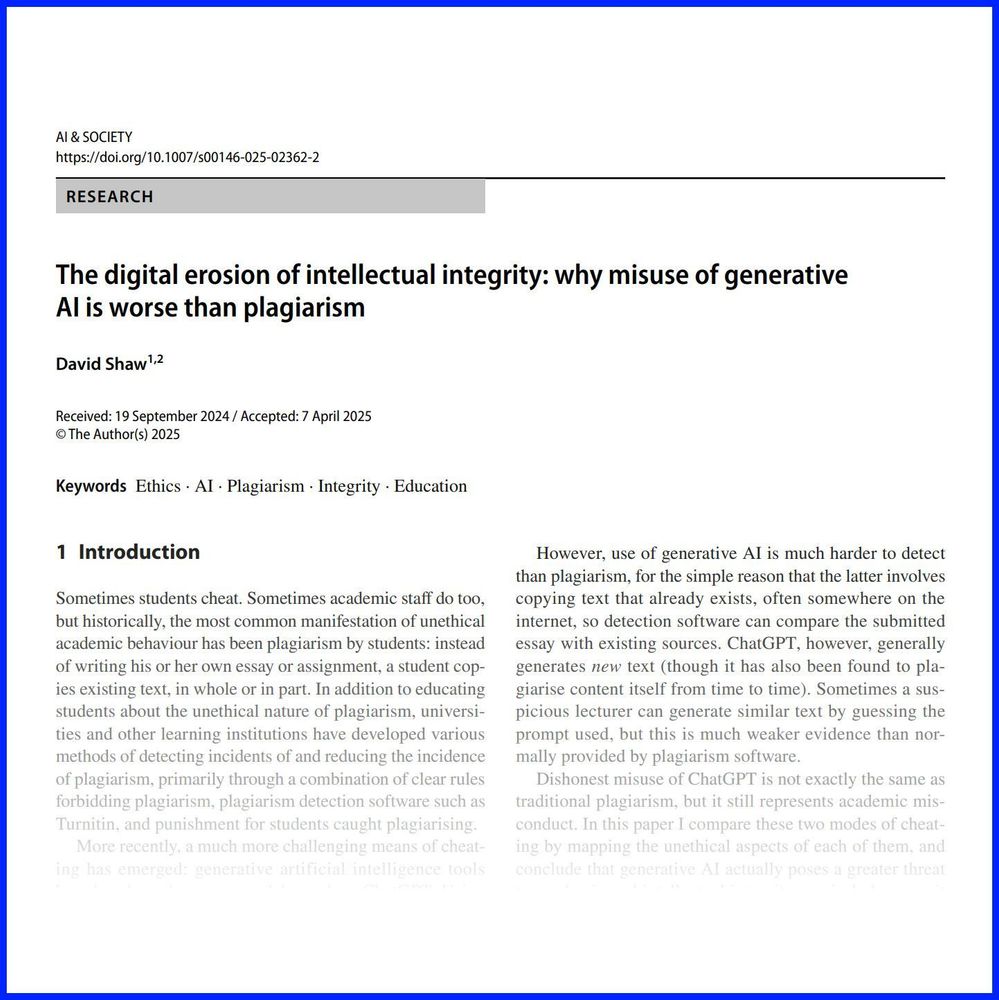
The digital erosion of intellectual integrity: why misuse of generative AI is worse than plagiarism - AI & SOCIETY buff.ly/utMR3U9
May 1, 2025 at 10:18 PM
The digital erosion of intellectual integrity: why misuse of generative AI is worse than plagiarism - AI & SOCIETY buff.ly/utMR3U9
Reposted by vilhelmiina haavisto

As scientists we must be ready to communicate the importance of vaccination wherever the discussion may come up, with family, friends or at the hair dresser. Be prepared to explain in a fact-based and accessible manner.
Combating vaccine revisionism - Nature Medicine
The scientific community must take a strong and active stand against vaccine revisionism — the false narrative that there is insufficient evidence to support the safety and efficacy of vaccines.
www.nature.com
April 22, 2025 at 10:15 AM
As scientists we must be ready to communicate the importance of vaccination wherever the discussion may come up, with family, friends or at the hair dresser. Be prepared to explain in a fact-based and accessible manner.
Reposted by vilhelmiina haavisto

Science’s big problem is a loss of influence, not a loss of trust: Evidence shows that science and scientists remain highly trusted. But genuine scientific voices are not shouting loud enough over the noise to hold sway. By Heidi Larson & David Bersoff | Nature www.nature.com/articles/d41...

Science’s big problem is a loss of influence, not a loss of trust
Evidence shows that science and scientists remain highly trusted. But genuine scientific voices are not shouting loud enough over the noise to hold sway.
www.nature.com
April 8, 2025 at 2:10 PM
Science’s big problem is a loss of influence, not a loss of trust: Evidence shows that science and scientists remain highly trusted. But genuine scientific voices are not shouting loud enough over the noise to hold sway. By Heidi Larson & David Bersoff | Nature www.nature.com/articles/d41...
Reposted by vilhelmiina haavisto

Andreas Sichert explores a @plosbiology.org study showing that a single #HGT event allowed the #diatom Nitzschia to evolve a complete enzymatic machinery to break down alginate from brown algae, unlocking a new ecological niche🧪 Paper: plos.io/41WaW8e Primer: plos.io/4j1Ovog

April 4, 2025 at 8:28 AM
Andreas Sichert explores a @plosbiology.org study showing that a single #HGT event allowed the #diatom Nitzschia to evolve a complete enzymatic machinery to break down alginate from brown algae, unlocking a new ecological niche🧪 Paper: plos.io/41WaW8e Primer: plos.io/4j1Ovog
My latest for the @asm.org blog is all about how even #bacteria can sense and adapt to seasonal change 🌱☀️🍂❄️ Have a read here: asm.org/articles/202...
Bacteria That Change With the Seasons | ASM.org
Seasons change, but do bacteria change with them? New research suggests that some bacteria can sense and adapt to seasonal changes, challenging what we thought we knew about rapidly dividing microbes.
asm.org
December 6, 2024 at 8:59 PM
My latest for the @asm.org blog is all about how even #bacteria can sense and adapt to seasonal change 🌱☀️🍂❄️ Have a read here: asm.org/articles/202...
Reposted by vilhelmiina haavisto

It's #SustainabilityTipTuesday again - today, we want to encourage everyone to turn off equipment when it's not in use to save on electricity! ⚡⚡⚡

November 19, 2024 at 11:09 AM
It's #SustainabilityTipTuesday again - today, we want to encourage everyone to turn off equipment when it's not in use to save on electricity! ⚡⚡⚡
Reposted by vilhelmiina haavisto
Happy #SustainabilityTipTuesday ! Our tip for the week is to wash, label and reuse 'single use' plastic items like weighing boats to reduce #plasticwaste in the lab ♻️ Example below..

November 12, 2024 at 1:53 PM
Happy #SustainabilityTipTuesday ! Our tip for the week is to wash, label and reuse 'single use' plastic items like weighing boats to reduce #plasticwaste in the lab ♻️ Example below..
Ever wonder what's going on inside your #sourdough starter - and whether yours is totally unique? Researchers across Europe are joining forces with citizen scientists to catalog the microbial diversity found in sourdough starters: fems-microbiology.org/femsmicroblo...

#FEMSmicroBlog: Unravelling the secrets of sourdough - FEMS
Scientists from across Europe are working together to find interesting microbes in sourdough starters. Vilhelmiina Haavisto explains for the #FEMSmicroBlog the successes and challenges of such an inte...
fems-microbiology.org
November 12, 2024 at 1:25 PM
Ever wonder what's going on inside your #sourdough starter - and whether yours is totally unique? Researchers across Europe are joining forces with citizen scientists to catalog the microbial diversity found in sourdough starters: fems-microbiology.org/femsmicroblo...
Although I love writing about #microbiology, I sometimes branch out into other topics - earlier this year, I wrote about the #RightToRepair movement in 🇨🇭 with a special focus on repair cafés 🤖 Have a read here: reatch.ch/publikatione...
Reduce, reuse, recycle – and repair?
Switzerland is a world-leader in recycling electronic waste, but in the wake of the climate crisis, reducing consumption is more important than ever. Repairing electronic devices at dedicated ‘repair ...
reatch.ch
November 12, 2024 at 1:21 PM
Although I love writing about #microbiology, I sometimes branch out into other topics - earlier this year, I wrote about the #RightToRepair movement in 🇨🇭 with a special focus on repair cafés 🤖 Have a read here: reatch.ch/publikatione...
Earlier this year I wrote about the efforts of labs at @ethzurich.bsky.social to operate more sustainably - my favourite part of this process was getting to chat with others who are passionate about #sustainablelabs 🌱
Labs at @ethzurich.bsky.social are taking action to become more sustainable, by reducing waste, energy use, and single use plastics. Read more about the efforts of 19 #LEAF certified labs here: ethambassadors.ethz.ch/2024/05/23/t...

Turning a new LEAF for lab sustainability
As a part of their Net Zero 2030 strategy, ETH Zürich is encouraging laboratories to adopt sustainable practices.
ethambassadors.ethz.ch
November 12, 2024 at 1:17 PM
Earlier this year I wrote about the efforts of labs at @ethzurich.bsky.social to operate more sustainably - my favourite part of this process was getting to chat with others who are passionate about #sustainablelabs 🌱
My latest for the ASM blog answers a question I got from a non-biologist in my life: do bacteria age? Read all about it here: asm.org/Articles/202... 🦠👵
Do Bacteria Age? | ASM.org
Bacteria live very different lives from us, but they too feel the weight of old age. Researchers are investigating molecular mechanisms of aging that affect humans and single-celled organisms alike.
asm.org
November 12, 2024 at 1:15 PM
My latest for the ASM blog answers a question I got from a non-biologist in my life: do bacteria age? Read all about it here: asm.org/Articles/202... 🦠👵