



@unknownstoday.bsky.social
Jack Smith's Testimony: 5 hours in 3 minutes
The excerpt captures Independent Special Counsel Jack Smith's sworn Congressional testimony on January 22, 2026.
He frames the Trump prosecution as non-partisan, concluding the evidence would have convicted Donald Trump beyond a reasonable doubt.
The excerpt captures Independent Special Counsel Jack Smith's sworn Congressional testimony on January 22, 2026.
He frames the Trump prosecution as non-partisan, concluding the evidence would have convicted Donald Trump beyond a reasonable doubt.
January 24, 2026 at 6:07 PM
Jack Smith's Testimony: 5 hours in 3 minutes
The excerpt captures Independent Special Counsel Jack Smith's sworn Congressional testimony on January 22, 2026.
He frames the Trump prosecution as non-partisan, concluding the evidence would have convicted Donald Trump beyond a reasonable doubt.
The excerpt captures Independent Special Counsel Jack Smith's sworn Congressional testimony on January 22, 2026.
He frames the Trump prosecution as non-partisan, concluding the evidence would have convicted Donald Trump beyond a reasonable doubt.
MAGA will lose the Latino, Hispanic vote, unless
Trump makes changes. The administration has "..failed miserably on messaging," claims Trump Latino leader, Bianca Gracia. On the next Unknowns: realclearpolitics.com/video/2025/1...
Trump makes changes. The administration has "..failed miserably on messaging," claims Trump Latino leader, Bianca Gracia. On the next Unknowns: realclearpolitics.com/video/2025/1...
December 3, 2025 at 1:24 PM
MAGA will lose the Latino, Hispanic vote, unless
Trump makes changes. The administration has "..failed miserably on messaging," claims Trump Latino leader, Bianca Gracia. On the next Unknowns: realclearpolitics.com/video/2025/1...
Trump makes changes. The administration has "..failed miserably on messaging," claims Trump Latino leader, Bianca Gracia. On the next Unknowns: realclearpolitics.com/video/2025/1...
Thanks for chatting with us @jonathanfreedland.bsky.social

November 19, 2025 at 11:53 AM
Thanks for chatting with us @jonathanfreedland.bsky.social
On the next Unknowns, Arizona Secretary of State @adrianfontes.bsky.social in conversation with host Charlie Stone. Full interviewed released on Wednesday.
September 1, 2025 at 10:01 PM
On the next Unknowns, Arizona Secretary of State @adrianfontes.bsky.social in conversation with host Charlie Stone. Full interviewed released on Wednesday.
On the next Unknowns, former Ambassador John Bolton speaks to Donald Trump's chaotic, turbulent leadership. www.realclearpolitics.com/video/2025/0...

"Unknowns" Host Charlie Stone Interviews John Bolton: Trump's Chaotic White House
In this interview on The Unknowns with host Charlie Stone, former U.S. National Security Advisor and UN Ambassador John Bolton discussed his experiences in the Trump administration, as detailed in his bestselling book The Room Where It Happened. Bolton described working under President Trump as chaotic, likening it to a "pinball machine."
He initially believed the weight of presidential responsibilities would discipline Trump's decision-making in national security, but admitted he was mistaken, as Trump resisted structured policy processes and frequently changed his mind, leading to frustration among advisors.
Bolton addressed the high turnover rate in the Trump administration, noting that 92% of high-level officials left due to Trump's lack of a coherent philosophy or grand strategy, which clashed with the expectations of career public servants aiming to advance policy. He highlighted Trump's tendency to tire of advisors, contributing to a cycle of dismissals and resignations.
On trade policy, Bolton, a self-described free trader, criticized Trump's broad tariff approach, particularly the proposed 10% baseline tariff, arguing it undermines decades of U.S. efforts to build trust with allies. He acknowledged issues like China's intellectual property theft but advocated for targeted solutions rather than disrupting the global trading system, warning of significant political and economic fallout.
Bolton also discussed personal security threats, revealing that Iran's Revolutionary Guard targeted him and other U.S. officials, including Trump. He expressed concern over the U.S.'s insufficient response to such threats, which he believes emboldens rogue states. He recounted Trump's decision to abruptly end his Secret Service protection upon resignation in 2019 and again after the 2025 inauguration, interpreting it as a vindictive act reflective of Trump's broader pattern of targeting dissenters through lawsuits, investigations, or other reprisals. Bolton warned that such actions coarsen political discourse and set dangerous precedents.
Regarding Trump's cabinet, Bolton expressed hope that figures like Marco Rubio, Mike Waltz, and Doug Burgum could provide candid advice, emphasizing the importance of honest debate to serve the president and country effectively. He critiqued Trump's Middle East diplomacy, particularly a recent trip marked by lavish praise and family business entanglements, which he believes embarrassed allies like Qatar and risked perceptions of impropriety. Bolton advocated for transparent defense-related gifts over personal financial dealings.
Reflecting on U.S. foreign policy, Bolton defended the Iraq War's initial objective of overthrowing Saddam Hussein but criticized subsequent nation-building efforts, suggesting a quicker transition to Iraqi self-governance. He lamented missed opportunities to confront Iran more aggressively in the early 2000s. On moralizing in diplomacy, he argued for prioritizing U.S. interests over lecturing allies, while noting the administration's inconsistent criticism of adversaries versus allies.
The interview concluded lightheartedly with Bolton dismissing rumors that Trump disliked his mustache and tying any hypothetical mustache-shaving to resignations by Trump and J.D. Vance. Throughout, Bolton offered a critical perspective on President Trump's leadership style, policy decisions, and their long-term implications, drawing on his extensive experience in public service.
Charlie Stone: Welcome back to the Unknowns. name is Charlie Stone and today we have John Bolton, a longtime public servant, diplomat, attorney, former UN ambassador, US national security advisor. The list goes on and on and also bestselling author of The Room Where It Happened. So ambassador, what happened in that room? Give us a little summary.
Ambassador Bolton: Well, I wrote in the book that working inside the Trump administration was like living in a pinball machine. When I took the job with Trump, people often say, well, why did you do it? Had you heard anything about him? And I said, yeah, I heard pretty much everything, I think. But I nonetheless believe that like every one of his predecessors, that the gravity of the responsibilities, the
impact of the decisions he would make, certainly in the national security space, would help discipline him. And in fact, I turned out to be completely wrong about that. And part of the struggle was to try and keep policy moving in an orderly direction along the lines he wanted, but just to try and get done what he said he wanted to get do and think about the future a little bit.
Charlie Stone: You know, if there was a Glass Door, which is the rating system for employers, 92%, it's been estimated, of high level officials have left Trump administrations. Why is that? Why does everybody sort of at some point either get fired or have had enough?
Ambassador Bolton: Well, I think a lot of people who go into the executive branch are people who have certain views of how the government should work. think they're going to try and help out, whether they're Republican side or Democratic side. They're certainly not doing it for the money. They're not running for office. It's not the political thrill. It's to go do an unglamorous bureaucratic job and help try and move the country in the policy direction that they favor.
But because Trump doesn't really have a philosophy because he doesn't, in national security, doesn't have grand strategies, he doesn't do policy the way that's conventionally understood in Washington, I think people grow frustrated. He can change his mind on a dime. He resists the discipline of orderly policy development. And I think he gets tired of people after a while. So one, maybe they get tired of him first. It depends on the...
on the circumstances, but the statistics speak for themselves. And I just had a friend who had hoped for a high level job in the new Trump administration and he didn't get it. And I said, well, what are you going to do? Stay in the private sector? He said, yeah, you know what turnover is like in a Trump administration. I'll get it soon enough.
Charlie Stone: Well, maybe y'all can start a glass door for the Trump administration. Might be interesting, some of the comments. All right. Let's talk about some of the whiplash that has occurred around tariffs, right? These are something that Trump has implemented, seemingly on his own volition. Give me a sense of how your opinion on that policy and how it was rolled out, and most importantly, how does it affect sort of hegemony, alliances, and other things that could have long-term effects?
Ambassador Bolton: Well, my general perspective is as a free trader, I thought that's what Republicans basically were. We don't like more taxes. We don't like more government regulations. We don't like the government trying to pick winners and losers. There are certainly cases where there are examples in the international trading system where we're treated unfairly. Those need to be addressed. There have been over a sustained period of time.
failures to see national security implications and some industrial patterns. And then finally, China is the major bad actor in international trade. And we definitely need to do something about that. They've stolen our intellectual property over the years and done a host of other things that are unfair to us and everybody else in the international trading system. But that doesn't mean that you break up the international trading system to deal with the problems. And particularly not in the way that Trump has done it.
in this broad scale. He calls it a 10 % baseline tariff. I I think the baseline tariff ought to be zero. That's my approach. And reciprocal tariffs that frankly people think are laughable in the way they were calculated. The economic impact I think will be substantial. We still don't know exactly. But I can tell you around the world the political impact has been devastating to decades of effort by
Americans to build up relations of trust, good faith, reliance, goodwill with other countries around the world, especially our friends who can't understand why if we've got a dispute with them, we can't talk to them about it and find a resolution. So people will debate how bad it will be economically and we'll find out in due course. the political reaction combined with some other aspects of Trump policy, Ukraine and others.
Unfortunately, I think are going to have long term impacts. I can't quantify them in dollars and cents terms, but I think they're very seriously
Charlie Stone: Former President Biden and his administration had sought sanctions or actually applied sanctions to the Iranian Guard for actually putting a fatwa on your head and to threaten to kill you. First of all, like, just as a human, when you hear something like that, some other foreign nation has sort of put things in motion to harm you, how does that just, how does that make you feel?
Ambassador Bolton: Well, not good is the short answer. You know, it's a condition of dealing with regimes like this that try to terrorize people. That's why Iran is our oldest state sponsor of terrorism. That's what they do. They do it to their opponents domestically. They do it internationally. This is actually the first time, I think, that U.S. officials have been targeted by a foreign government. Trump's at the top of the list. There are several others as well.
And it really raises a question that we fortunately haven't had to deal with as a matter of policy before is how do we react to that kind of threat? Because in a sense, the threat is what is intended to intimidate not just the people who are named, but other people who take the positions that I and others who came under that threat eventually assume. It's got to have a negative effect. And I think our inability or unwillingness to deal with that only encourages more behavior like that by other rogue states.
Charlie Stone: Well, President Biden, who you probably have a lot of policy disagreements, was instrumental in implementing those sanctions. Whereas President Trump removed your security detail, also from Pompeo and Hook. Again, at that moment, what is your thinking? These are fellow Americans telling you that you're going to have to go it alone.
Ambassador Bolton: Yeah. Well, I had had that experience with Trump before I resigned on September the 10th, 2019. Normally when the national security advisor leaves, they keep the Secret Service protection for some reasonable period of time, relatively brief, three months, six months, something like that, just to make sure some foreign government doesn't kidnap you and give you a truth serum to get out whatever secrets you remember.
Trump cut my Secret Service off the day I resigned, just to make the point. So I thought in the back of my mind when he was elected again and it was coming up on his inauguration, it might happen. I have to say, I was a little surprised I learned about it at 1130 at night on inauguration day, otherwise a pretty busy day. He still had time to pull the protection. So it tells you something about the man.
Charlie Stone: Some have indicated that there's a vindictive behavior by him. He seems to weaponize, targets those who disagree with him, either through arrest, lawsuit, deportation. How does this play out? There's this culture of fear that unless you're, as some would say, sycophant, you're not going to be valuable to Trump or the administration. So how does one in that administration deal with, you know, reprisals and political payback are common.
Ambassador Bolton: I mean, that's part of politics, as Peter Finley Dunn once wrote years back, politics ain't beanbag. For Trump, though, it's a contact sport. mean, really, retribution is a common mode of operation for him. And it's intended to intimidate people. It often has that impact. I think it coarsens the political process in the society.
I mean, there's back and forth in politics. That's a given, but he takes it to a whole new level. And unfortunately, I think as he sets new precedents in different ways, pulling people's security clearances as well as security details, signing executive orders, designating particular individuals for investigation by the Justice Department, he's laying the groundwork for future administrations to do the same thing.
And I'm worried we're already in something of a downward spiral in the civility of our politics. This is certainly gonna make it worse. He said he didn't like having the Justice Department weaponized against him, and yet his remedy for that is to weaponize it against his opponents. The only answer here is for a president who actually thinks that if he just doesn't behave in that way, he may change things, hopefully it will.
Charlie Stone: And if you look at his cabinet, do you have hope for some of those folks who will eventually sort of perhaps follow your lead and actually state an opinion that the president may disagree with? Who in that cabinet has the sort of straightforwardness and gravitas that they could do that?
Ambassador Bolton: Well, I don't want to get anybody in trouble, but I do think Marco Rubio has had a distinguished career in Congress, was presidential contender before. hope he feels free to voice his opinions. I thought Mike Waltz did too as national security advisor, and nobody should have been surprised at that. Let's look at the title of the job, national security advisor. You'd think that would mean giving opinions.
I think Doug Burgum at the Interior Department, he's been a governor, he's been an extremely successful business person. You need the president to hear opinions that are different from his, not because an administration has to be philosophically all across the board. You can have a very conservative or very liberal group of people. They're still going to have different opinions on priorities, on operationalizing decisions, on a whole range of things.
And a president who doesn't hear honest debate among his advisors is not well served by it. Trump may not like it, but he's not well served by it. And neither is the country.
Charlie Stone: We sort of have indicated his recent trip to the Middle East. Some have called it a bro fest where the president called some of the leaders magnificent, handsome, in a praise the $400 million Boeing jet. What do you make up all that? What is he doing?
Ambassador Bolton: You know, if it were any other president who didn't use some of those phrases, you would say this is a reaffirmation of 35 years plus of American policy to keep the Gulf Arab oil producing nations close to the United States, to get them to buy U.S. aerospace and defense things, tighten the relationship, find some American investment there. All that for me was just normal diplomatic good work.
What bothers me though is the taint of the family, the Trump family and its involvement and the various other things that go with it. I think actually Trump has succeeded in embarrassing the Qataris. I don't think they saw what this was gonna provoke, the reactions provoked even among very strong Trump supporters in this country. And my advice to the Qataris is,
If you want to give us a gift, help rebuild the Al Udeid Air Base, help rebuild Central Command in Tampa, help rebuild Special Operations Command in Tampa. Make it a gift to the United States, Defense Department to Defense Department. We would welcome that and it would help us plus up our military budget.
Charlie Stone: There used to be a standard, at least in my mind, of public officials, of avoiding the appearance of impropriety. Where is Trump on the appearance of impropriety and in your mind, probable impropriety?
Ambassador Bolton: Well, I think the appearance standard is, to me, I think it's a question of seamliness. mean, it's not, there's some things that you just don't do except Trump does them. Whether there's actual corruption, you know, I'm reluctant to make that judgment too quickly. I didn't see evidence of it during the first term. Maybe some things in retrospect I should have observed more closely. I think it's a little bit more blatant.
this term because of the crypto deals, because of the way the evidence of the family's involvement has been so great. But I'm also not in favor of the criminalization of politics as such. think there's a lot of stuff going on. People would point to Hunter Biden and things like that. I don't like that either. But I think it's more a characterization of weak democracies, troubled democracies.
where as soon as one party gets out of office, the new party starts prosecuting them. I'm not saying give anybody a free pass, but I just, I'm worried that this is part of the downward spiral of politics that Trump is contributing to more than his share of reprisals and retribution.
Charlie Stone: Trump did indicate that there would be no more lectures on how to live to that region. Is that the correct way to proceed? Are we letting them, are we abdicating our responsibilities, sort of our moral responsibility to ensure that people are treated fairly
Ambassador Bolton: You know, I don't think that the U.S. policy overall should be moralizing to a lot of our friends. I think it's more a question of how we treat adversaries. But what's interesting about this administration is that it doesn't comment on its adversaries. It does comment on its allies. If you listen to Vice President J.D. Vance's speech to the Munich Security Conference where he criticized
European governments for not being democratic enough. I didn't hear him criticize China or Russia. Different societies are going to perform in different ways. The Middle East is a different culture. That's a fact. We have plenty of interest of the United States around the world that are directly affected that we're not defending adequately as it is. So I don't see kind of gratuitous moralizing as being very helpful. I think it can and should be a part of our policy, but it depends on
the circumstances, how you use it. The overall question is what's in America's best interest and sometimes lecturing your friends doesn't necessarily help you get where you want to go.
Charlie Stone: I just want to jump back in time to Iraq and Afghanistan. You were a main proponent of the war, obviously. know, 7,000 dead, 53,000 injured, rise of ISIS. Upon reflection, are there regrets that you have from that period of time where you're like, ugh, I should have said something or we could have done that better?
Ambassador Bolton: Well, I think there are a lot of things that could have been done better. I separate the Iraq affair into two categories. The first is the overthrow of Saddam Hussein, which I believe was justified because of his objectives ultimately to get nuclear weapons. We knew he's been doing that for a long time since the Israelis destroyed the Osirak reactor outside of Baghdad in 1981.
And the overthrow of Saddam Hussein was accomplished in an extraordinary military success and achieved the objectives that we wanted. That's period number one. Period number two is what comes after the war. And I have to say I was never a supporter of nation building in Iraq. I think our presence there should have been to hold the ring to let the Iraqis decide for themselves what they wanted to do and to enable us to put more pressure on Iran, where there was a threat evolving as great or perhaps even greater than that in Iraq. I believe that putting Iraqis back in responsible positions sooner rather than later was the right way to go to allow them to figure out how they wanted to run their country. But overall, I don't regret overthrowing Saddam Hussein. I think it was the right thing to do. I just don't think we went far enough.
We had overthrown Al-Qaeda and the Taliban in Afghanistan. We had overthrown Saddam Hussein. There was Iran sitting there right between the two of them. The population was dissatisfied then. It's even more dissatisfied today. And they're closer to nuclear weapons than they were in the early 2000s.
Charlie Stone: Last question. There were reports that President Trump, for whatever reason, didn't like your signature mustache. Was that true?
Ambassador Bolton: He denied it and I always remembered his father had a mustache. Maybe there's something deeply Freudian there. I'm not a shrink. I don't really care. And I think for well or ill, I don't think it had any impact at all.
Charlie Stone: Well, last question. You may not like this one, but if Trump were to resign, if you shaved your mustache, would you shave your mustache?
Ambassador Bolton: If JD Vance would resign too.
Charlie Stone: Well, thank you very much, Ambassador. Appreciate your time and wish that you would come back when you have more time to share.
Ambassador Bolton: Well, thanks very much for having me. I'd like to do that.
www.realclearpolitics.com
May 20, 2025 at 10:18 PM
On the next Unknowns, former Ambassador John Bolton speaks to Donald Trump's chaotic, turbulent leadership. www.realclearpolitics.com/video/2025/0...
Emmy, Peabody award winning journalist, national correspondent Jack Ford to join team Unknowns as a co-host. Tune in to uncover the unknown.

March 31, 2025 at 1:38 PM
Emmy, Peabody award winning journalist, national correspondent Jack Ford to join team Unknowns as a co-host. Tune in to uncover the unknown.
Foe to Friend: Joining The Unknowns is @michaelcohen212.bsky.social, a name synonymous with loyalty and betrayal during his decade-long tenure as President Trump's personal attorney and fixer: "The person who controls Trump's ear last, controls the brain". youtu.be/aSjpGMT5XcI?...
March 26, 2025 at 12:07 PM
Foe to Friend: Joining The Unknowns is @michaelcohen212.bsky.social, a name synonymous with loyalty and betrayal during his decade-long tenure as President Trump's personal attorney and fixer: "The person who controls Trump's ear last, controls the brain". youtu.be/aSjpGMT5XcI?...
The truth about the war in Ukraine, from Grok 3,
Elon's self-proclaimed “maximally truth-seeking A.I.”:
"Ukraine’s actions have been defensive, responding to Russian aggression rather than initiating it."
Elon's self-proclaimed “maximally truth-seeking A.I.”:
"Ukraine’s actions have been defensive, responding to Russian aggression rather than initiating it."

February 21, 2025 at 12:59 PM
The truth about the war in Ukraine, from Grok 3,
Elon's self-proclaimed “maximally truth-seeking A.I.”:
"Ukraine’s actions have been defensive, responding to Russian aggression rather than initiating it."
Elon's self-proclaimed “maximally truth-seeking A.I.”:
"Ukraine’s actions have been defensive, responding to Russian aggression rather than initiating it."
Remarkable interview: Pete Carlson, passenger and paramedic, describes his experience from inside the
Delta @torontopearson.bsky.social plane crash. "Even as you sit here, I can smell the gas on you". youtu.be/K9paRHkZwZo?...
Delta @torontopearson.bsky.social plane crash. "Even as you sit here, I can smell the gas on you". youtu.be/K9paRHkZwZo?...

Passenger describes Toronto plane crash, rollover
YouTube video by CBC News: The National
youtu.be
February 19, 2025 at 1:41 PM
Remarkable interview: Pete Carlson, passenger and paramedic, describes his experience from inside the
Delta @torontopearson.bsky.social plane crash. "Even as you sit here, I can smell the gas on you". youtu.be/K9paRHkZwZo?...
Delta @torontopearson.bsky.social plane crash. "Even as you sit here, I can smell the gas on you". youtu.be/K9paRHkZwZo?...

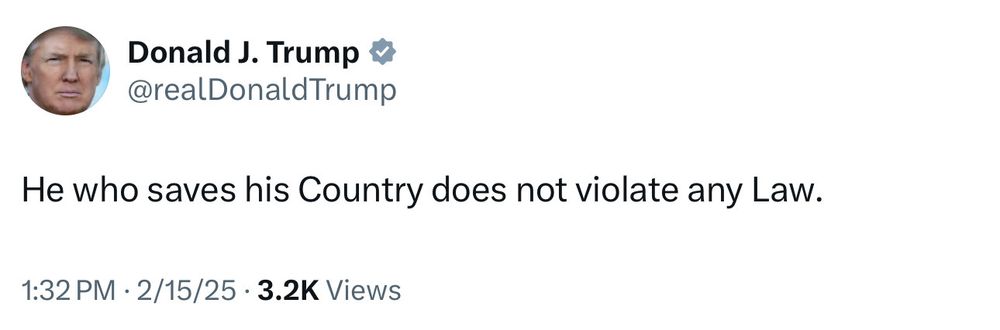
Perhaps a clarion call to all populists, constitutionalists, libertarians, liberals and conservatives to join together to rise and resist tyranny in any form. #UnionFirst

the single most un-american and anti-constitutional statement ever uttered by an american president
February 16, 2025 at 9:12 PM
Perhaps a clarion call to all populists, constitutionalists, libertarians, liberals and conservatives to join together to rise and resist tyranny in any form. #UnionFirst
Could Trump declare martial law in the next four years? Anthony @scaramucci.bsky.social discusses the probability (and his desire to serve just one more day in the
@WhiteHouse) on the next Unknowns: realclearpolitics.com/video/2025/0...
@WhiteHouse) on the next Unknowns: realclearpolitics.com/video/2025/0...
February 11, 2025 at 2:10 PM
Could Trump declare martial law in the next four years? Anthony @scaramucci.bsky.social discusses the probability (and his desire to serve just one more day in the
@WhiteHouse) on the next Unknowns: realclearpolitics.com/video/2025/0...
@WhiteHouse) on the next Unknowns: realclearpolitics.com/video/2025/0...
Why the Democrats Keep Losing? Our conversation with progressive @cenkuyger.bsky.social , founder of the @theyoungturks.bsky.social , on rampant political corruption and the need for extreme populism to unite America. His solution: @jonstewartdaily.bsky.social for President: tinyurl.com/4eknz3bk

Why the Democrats Keep Losing: A Hard Look at Establishment Politics w/ Cenk Uygur from TYT
YouTube video by The Unknowns
www.youtube.com
January 23, 2025 at 1:07 PM
Why the Democrats Keep Losing? Our conversation with progressive @cenkuyger.bsky.social , founder of the @theyoungturks.bsky.social , on rampant political corruption and the need for extreme populism to unite America. His solution: @jonstewartdaily.bsky.social for President: tinyurl.com/4eknz3bk
Today, of all days, check out "Fight Like Hell", a J6 documentary, which chronicles the events leading up to and including January 6, 2021. The documentary features never-before-seen footage. Charlie Stone interviews the creators & journalists Jon Long and Ford Fischer tinyurl.com/muetkc5y
January 7, 2025 at 2:40 AM
Today, of all days, check out "Fight Like Hell", a J6 documentary, which chronicles the events leading up to and including January 6, 2021. The documentary features never-before-seen footage. Charlie Stone interviews the creators & journalists Jon Long and Ford Fischer tinyurl.com/muetkc5y
Will alleged CEO killer Luigi Mangione plead insanity? Award winning journalist, attorney Jack Ford is our next guest on the Unknowns: tinyurl.com/59fu8j7h
Uncover more Unknowns at www.Unknowns.Today
Uncover more Unknowns at www.Unknowns.Today
December 18, 2024 at 1:19 PM
Will alleged CEO killer Luigi Mangione plead insanity? Award winning journalist, attorney Jack Ford is our next guest on the Unknowns: tinyurl.com/59fu8j7h
Uncover more Unknowns at www.Unknowns.Today
Uncover more Unknowns at www.Unknowns.Today
Upcoming Unknown guests, as seen, heard on Real Clear Politics,SiriusXM and YouTube
Comedian Roy Wood Jr., CNN, The Daily Show
Influencer Harry Sisson
Cenk Uygur, The Young Turks
Journalist, author Jack Ford
Uncover the unknown with host Charlie Stone at www.Unknowns.Today
Comedian Roy Wood Jr., CNN, The Daily Show
Influencer Harry Sisson
Cenk Uygur, The Young Turks
Journalist, author Jack Ford
Uncover the unknown with host Charlie Stone at www.Unknowns.Today

December 10, 2024 at 5:20 PM
Upcoming Unknown guests, as seen, heard on Real Clear Politics,SiriusXM and YouTube
Comedian Roy Wood Jr., CNN, The Daily Show
Influencer Harry Sisson
Cenk Uygur, The Young Turks
Journalist, author Jack Ford
Uncover the unknown with host Charlie Stone at www.Unknowns.Today
Comedian Roy Wood Jr., CNN, The Daily Show
Influencer Harry Sisson
Cenk Uygur, The Young Turks
Journalist, author Jack Ford
Uncover the unknown with host Charlie Stone at www.Unknowns.Today
Professor Allan Lichtman: Democrats treated Biden badly which impacted my prediction of the 2024 election youtu.be/lpe--bITMwc?...

Professor Allan Lichtman: Democrats treated Biden badly which impacted my prediction of the election
YouTube video by The Unknowns
youtu.be
December 1, 2024 at 11:59 PM
Professor Allan Lichtman: Democrats treated Biden badly which impacted my prediction of the 2024 election youtu.be/lpe--bITMwc?...
We spoke with Jeh Johnson, President Obama's Homeland Security Secretary, who describes Donald Trump
as the most resilient politician in US history. See the full interview here: realclearpolitics.com/video/2024/1...
as the most resilient politician in US history. See the full interview here: realclearpolitics.com/video/2024/1...
December 1, 2024 at 10:36 PM
We spoke with Jeh Johnson, President Obama's Homeland Security Secretary, who describes Donald Trump
as the most resilient politician in US history. See the full interview here: realclearpolitics.com/video/2024/1...
as the most resilient politician in US history. See the full interview here: realclearpolitics.com/video/2024/1...
Reposted

Here are five things to know about Kash Patel, President-elect Trump’s pick to lead the FBI.

Five Things to Know About Kash Patel, Trump’s Pick to Lead the F.B.I.
President-elect Donald J. Trump has long seen his bombastic national security operative as a political “enforcer.” But former colleagues question his fitness for the job.
www.nytimes.com
December 1, 2024 at 8:26 PM
Here are five things to know about Kash Patel, President-elect Trump’s pick to lead the FBI.
Reposted
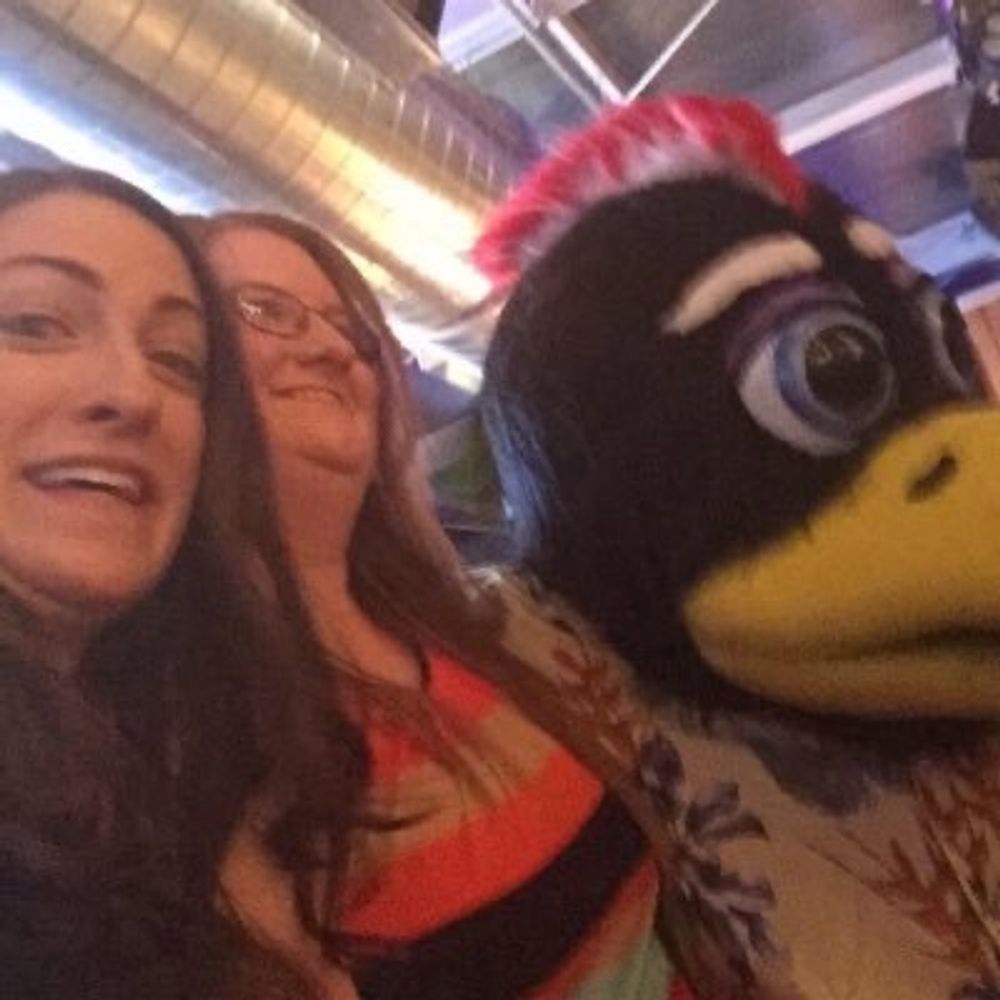
It has snowed in Chicago and YOU KNOW WHAT THAT MEANS! Time to remind everyone that we light our train tracks on fire to prevent the switches from freezing.

November 21, 2024 at 10:54 AM
It has snowed in Chicago and YOU KNOW WHAT THAT MEANS! Time to remind everyone that we light our train tracks on fire to prevent the switches from freezing.
Operation Warp Speed, a win for Trump;
Deep concerns about RFK;
Mistakes made in the handling of Covid;
My Faith in God.
--Dr. Francis Collins, Director of the NIH, 2009-2021
is our guest on the next Unkowns. realclearpolitics.com/video/2024/1...
Deep concerns about RFK;
Mistakes made in the handling of Covid;
My Faith in God.
--Dr. Francis Collins, Director of the NIH, 2009-2021
is our guest on the next Unkowns. realclearpolitics.com/video/2024/1...
December 1, 2024 at 8:31 PM
Operation Warp Speed, a win for Trump;
Deep concerns about RFK;
Mistakes made in the handling of Covid;
My Faith in God.
--Dr. Francis Collins, Director of the NIH, 2009-2021
is our guest on the next Unkowns. realclearpolitics.com/video/2024/1...
Deep concerns about RFK;
Mistakes made in the handling of Covid;
My Faith in God.
--Dr. Francis Collins, Director of the NIH, 2009-2021
is our guest on the next Unkowns. realclearpolitics.com/video/2024/1...