



Joshua Hislop
@syncelljoshua.bsky.social
Graduate student in the Ebrahimkhani lab at the University of Pittsburgh.
Macrophage-like cells, the immune cell type that will become Kupffer cells of the liver, gut macrophages, and microglia of the brain… 21/n

December 13, 2023 at 6:07 PM
Macrophage-like cells, the immune cell type that will become Kupffer cells of the liver, gut macrophages, and microglia of the brain… 21/n
Megakaryocyte-like cells, the cell type that generates platelets… 20/n

December 13, 2023 at 6:06 PM
Megakaryocyte-like cells, the cell type that generates platelets… 20/n
But not just the earliest lineages! When we followed these cells, we were able to see an incredibly diverse specification of different blood lineages, including erythroid-like cells, the progenitors to red blood cells… 18/n

December 13, 2023 at 6:06 PM
But not just the earliest lineages! When we followed these cells, we were able to see an incredibly diverse specification of different blood lineages, including erythroid-like cells, the progenitors to red blood cells… 18/n
When we looked into these blood islands, we saw these gorgeous round cells packed inside of the endothelium. These cells express markers of the earliest blood lineages that come from the yolk sac. 18/n

December 13, 2023 at 6:05 PM
When we looked into these blood islands, we saw these gorgeous round cells packed inside of the endothelium. These cells express markers of the earliest blood lineages that come from the yolk sac. 18/n
We followed our putative hemogenic cells to see if they would do the same. Over the course of 12 days (and a change of basal media), these cells will expand from small groups of cells to larger vascular areas, sandwiched between two other cell types – like a blood island! 17/n


December 13, 2023 at 6:05 PM
We followed our putative hemogenic cells to see if they would do the same. Over the course of 12 days (and a change of basal media), these cells will expand from small groups of cells to larger vascular areas, sandwiched between two other cell types – like a blood island! 17/n
We saw that alongside the organization going on between the WT and GATA6 tissues, the GATA6 tissue itself was doing some development as well. Some of the cells of the GATA6 layer began to descend below the tissue and express markers of early hemogenic cells. 15/n

December 13, 2023 at 6:04 PM
We saw that alongside the organization going on between the WT and GATA6 tissues, the GATA6 tissue itself was doing some development as well. Some of the cells of the GATA6 layer began to descend below the tissue and express markers of early hemogenic cells. 15/n
But I have saved some of the most exciting parts for last. The human yolk sac is the site of the earliest blood formation. The cool new treatment for sickle cell recently approved by the FDA? The genes they’re turning on are initially expressed in yolk sac cells! 14/n

December 13, 2023 at 6:03 PM
But I have saved some of the most exciting parts for last. The human yolk sac is the site of the earliest blood formation. The cool new treatment for sickle cell recently approved by the FDA? The genes they’re turning on are initially expressed in yolk sac cells! 14/n
This was unexpected, and exactly why this happens is something that we still need to investigate. There may be new dynamics between these domains that’s yet to be understood, but which we can learn in the future (from this model and others)! 13/n

December 13, 2023 at 6:02 PM
This was unexpected, and exactly why this happens is something that we still need to investigate. There may be new dynamics between these domains that’s yet to be understood, but which we can learn in the future (from this model and others)! 13/n
When we looked at how markers of anterior positioned alongside these polarized posterior domains, we found something unexpected; while slightly less than half of the anterior domains opposed the posterior, almost equally many had anterior and posterior positioned together. 11/n


December 13, 2023 at 5:57 PM
When we looked at how markers of anterior positioned alongside these polarized posterior domains, we found something unexpected; while slightly less than half of the anterior domains opposed the posterior, almost equally many had anterior and posterior positioned together. 11/n
When we looked at the WT, we saw the formation of posterior in many (~42%) of our embryoids. Of these, about 60% had the posterior clearly positive at only one pole of the embryoid, suggesting it was being patterned. Chances of opposing anterior seemed good! 11/n

December 13, 2023 at 5:56 PM
When we looked at the WT, we saw the formation of posterior in many (~42%) of our embryoids. Of these, about 60% had the posterior clearly positive at only one pole of the embryoid, suggesting it was being patterned. Chances of opposing anterior seemed good! 11/n
We first decided to investigate whether these embryoids made an A-P axis – whether they could arrange their head and their rear. In human embryos, the anterior is formed by the yolk sac (≈ our GATA6 tissue) and the posterior is patterned by this in the epiblast (≈ our WT) 10/n

December 13, 2023 at 5:54 PM
We first decided to investigate whether these embryoids made an A-P axis – whether they could arrange their head and their rear. In human embryos, the anterior is formed by the yolk sac (≈ our GATA6 tissue) and the posterior is patterned by this in the epiblast (≈ our WT) 10/n
With hundreds of these embryoids side-by-side, what could we learn? 9/n

December 13, 2023 at 5:53 PM
With hundreds of these embryoids side-by-side, what could we learn? 9/n
This structure and cell fate implied to us that we had a tissue that was similar to the human post-implantation embryo – if you took away the trophoblast and rolled the yolk sac out flat. 8/n

December 13, 2023 at 5:53 PM
This structure and cell fate implied to us that we had a tissue that was similar to the human post-implantation embryo – if you took away the trophoblast and rolled the yolk sac out flat. 8/n
When we stained for markers of amnion, we found that the WT cells had, completely on their own, formed amnion in exactly the right location! Moreover, we found that amnion formed in 100% (!!) of embryoids that had formed a cavity. 7/n

December 13, 2023 at 5:52 PM
When we stained for markers of amnion, we found that the WT cells had, completely on their own, formed amnion in exactly the right location! Moreover, we found that amnion formed in 100% (!!) of embryoids that had formed a cavity. 7/n
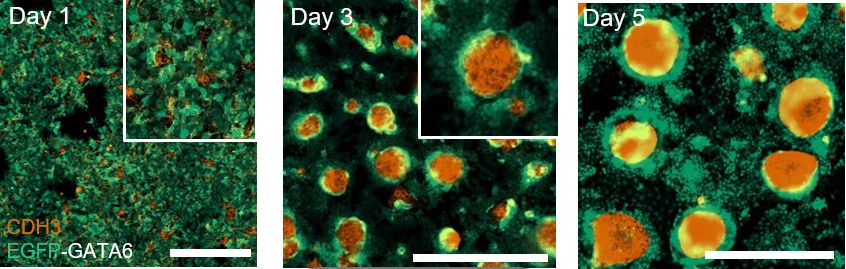
When these tissues organize together, the GATA6+ cells confine the WT, then crawl over the top of them. After this happens, the WT spontaneously form a cavity in their center. This arrangement is structurally similar to the human embryo’s bilaminar disc and amniotic cavity. 5/n


December 13, 2023 at 5:50 PM
When these tissues organize together, the GATA6+ cells confine the WT, then crawl over the top of them. After this happens, the WT spontaneously form a cavity in their center. This arrangement is structurally similar to the human embryo’s bilaminar disc and amniotic cavity. 5/n
The yolk sac-like tissue is induced from iPSCs via a GATA6 transgene; the epiblast tissue is formed from primed wild-type (WT) iPSCs. We combine these cell types at seeding in 2D, then induce the GATA6 and let the system self-organize! 4/n
December 13, 2023 at 5:48 PM
The yolk sac-like tissue is induced from iPSCs via a GATA6 transgene; the epiblast tissue is formed from primed wild-type (WT) iPSCs. We combine these cell types at seeding in 2D, then induce the GATA6 and let the system self-organize! 4/n
This paper focuses on a new embryo-like model derived from adult cells that replicate key features of early human development. This model recapitulates just two tissues of the embryo, the yolk sac and the epiblast, and models their organization and development. 3/n

December 13, 2023 at 5:46 PM
This paper focuses on a new embryo-like model derived from adult cells that replicate key features of early human development. This model recapitulates just two tissues of the embryo, the yolk sac and the epiblast, and models their organization and development. 3/n
This publication is an iteration of the original iDiscoid model, which we had shown in a preprint earlier this year. We followed the yolk sac of this model further and show the emergence of early hematopoietic populations, showing great promise for this type of modeling. 2/n

December 13, 2023 at 5:46 PM
This publication is an iteration of the original iDiscoid model, which we had shown in a preprint earlier this year. We followed the yolk sac of this model further and show the emergence of early hematopoietic populations, showing great promise for this type of modeling. 2/n
I’m very excited to share that my manuscript in Nature is out today! I am honored that our model is a part of the “method of the year” crowd, and with some exciting things to show in the full publication! (Including a new name: heX-Embryoids! I’ll explain below) rdcu.be/dtwy5 🧪 #Devbio 1/n

December 13, 2023 at 5:44 PM
I’m very excited to share that my manuscript in Nature is out today! I am honored that our model is a part of the “method of the year” crowd, and with some exciting things to show in the full publication! (Including a new name: heX-Embryoids! I’ll explain below) rdcu.be/dtwy5 🧪 #Devbio 1/n
#HiSciSky
It's great to be on! My name is Josh Hislop, and I'm a graduate student at the University of Pittsburgh doing work on developmental biology, and specifically stem cell based embryo models. I really enjoy investigating the fundamental stages of blood development and organ patterning!
It's great to be on! My name is Josh Hislop, and I'm a graduate student at the University of Pittsburgh doing work on developmental biology, and specifically stem cell based embryo models. I really enjoy investigating the fundamental stages of blood development and organ patterning!

November 25, 2023 at 11:18 PM
#HiSciSky
It's great to be on! My name is Josh Hislop, and I'm a graduate student at the University of Pittsburgh doing work on developmental biology, and specifically stem cell based embryo models. I really enjoy investigating the fundamental stages of blood development and organ patterning!
It's great to be on! My name is Josh Hislop, and I'm a graduate student at the University of Pittsburgh doing work on developmental biology, and specifically stem cell based embryo models. I really enjoy investigating the fundamental stages of blood development and organ patterning!