



@suboptimaleng.bsky.social
👨🏾💻 Indian-American Software Engineer
👾 Computer Graphics YouTuber (25k+)
❤️ Shaders, Anime, Gaming, Running
👾 Computer Graphics YouTuber (25k+)
❤️ Shaders, Anime, Gaming, Running
Setting up a new WebGPU project in C++ and realized that the API has changed since last time.
It's taking longer than I expected, but maybe I can render a triangle tomorrow.
I also ran 5 miles in 30 degree weather which was fun.
Time to take a break and play video games!
It's taking longer than I expected, but maybe I can render a triangle tomorrow.
I also ran 5 miles in 30 degree weather which was fun.
Time to take a break and play video games!

December 20, 2025 at 11:21 PM
Setting up a new WebGPU project in C++ and realized that the API has changed since last time.
It's taking longer than I expected, but maybe I can render a triangle tomorrow.
I also ran 5 miles in 30 degree weather which was fun.
Time to take a break and play video games!
It's taking longer than I expected, but maybe I can render a triangle tomorrow.
I also ran 5 miles in 30 degree weather which was fun.
Time to take a break and play video games!
Today, I reset my LeetCode progress, and solved 50 problems in C++ in 4.5 hours.
No CPP reference, no ChatGPT, no Google, no NeetCode, no nothing.
Gonna call it the "Suboptimal 50 Speedrun Challenge".
Complete 50 problems from NeetCode 150 without any hints/help.
No CPP reference, no ChatGPT, no Google, no NeetCode, no nothing.
Gonna call it the "Suboptimal 50 Speedrun Challenge".
Complete 50 problems from NeetCode 150 without any hints/help.

December 9, 2025 at 11:09 PM
Today, I reset my LeetCode progress, and solved 50 problems in C++ in 4.5 hours.
No CPP reference, no ChatGPT, no Google, no NeetCode, no nothing.
Gonna call it the "Suboptimal 50 Speedrun Challenge".
Complete 50 problems from NeetCode 150 without any hints/help.
No CPP reference, no ChatGPT, no Google, no NeetCode, no nothing.
Gonna call it the "Suboptimal 50 Speedrun Challenge".
Complete 50 problems from NeetCode 150 without any hints/help.
C++ Learning Journey Part 8
Finally completed the classic "Blind 75" problem set on LeetCode.
I don't need to constantly check the C++ reference website which is nice. Can I start calling myself an advanced-beginner now?
Finally completed the classic "Blind 75" problem set on LeetCode.
I don't need to constantly check the C++ reference website which is nice. Can I start calling myself an advanced-beginner now?

December 8, 2025 at 11:19 PM
C++ Learning Journey Part 8
Finally completed the classic "Blind 75" problem set on LeetCode.
I don't need to constantly check the C++ reference website which is nice. Can I start calling myself an advanced-beginner now?
Finally completed the classic "Blind 75" problem set on LeetCode.
I don't need to constantly check the C++ reference website which is nice. Can I start calling myself an advanced-beginner now?
I'd forgive myself if I failed to solve LeetCode 143 in an interview setting.
It combines 3 different linked list sub-problems into 1.
Slow/fast pointer to find mid point. Reversing a linked list. Merging 2 lists in an alternative order.
C++ memory leak guaranteed.
It combines 3 different linked list sub-problems into 1.
Slow/fast pointer to find mid point. Reversing a linked list. Merging 2 lists in an alternative order.
C++ memory leak guaranteed.

December 7, 2025 at 9:41 PM
I'd forgive myself if I failed to solve LeetCode 143 in an interview setting.
It combines 3 different linked list sub-problems into 1.
Slow/fast pointer to find mid point. Reversing a linked list. Merging 2 lists in an alternative order.
C++ memory leak guaranteed.
It combines 3 different linked list sub-problems into 1.
Slow/fast pointer to find mid point. Reversing a linked list. Merging 2 lists in an alternative order.
C++ memory leak guaranteed.
C++ Learning Journey Part 6/7

December 7, 2025 at 3:26 PM
C++ Learning Journey Part 6/7
C++ Learning Journey Part 6 (?)
The Pacific-Atlantic Water Flow LC question is pretty straightforward once you know the trick.
Sometimes I miss doing these in JS because I did't have to worry about types. But then I remember that frontend is a race to the bottom due to AI.
The Pacific-Atlantic Water Flow LC question is pretty straightforward once you know the trick.
Sometimes I miss doing these in JS because I did't have to worry about types. But then I remember that frontend is a race to the bottom due to AI.

December 7, 2025 at 12:08 AM
C++ Learning Journey Part 6 (?)
The Pacific-Atlantic Water Flow LC question is pretty straightforward once you know the trick.
Sometimes I miss doing these in JS because I did't have to worry about types. But then I remember that frontend is a race to the bottom due to AI.
The Pacific-Atlantic Water Flow LC question is pretty straightforward once you know the trick.
Sometimes I miss doing these in JS because I did't have to worry about types. But then I remember that frontend is a race to the bottom due to AI.
You know the tech industry is cooked when 56 engineers are practicing LeetCode HARDs on a Friday afternoon.
But I must admit that it was fun to implement the Trie data structure. I'm starting to feel comfortable with C++ after solving 60+ LC problems.
But I must admit that it was fun to implement the Trie data structure. I'm starting to feel comfortable with C++ after solving 60+ LC problems.

December 5, 2025 at 10:02 PM
You know the tech industry is cooked when 56 engineers are practicing LeetCode HARDs on a Friday afternoon.
But I must admit that it was fun to implement the Trie data structure. I'm starting to feel comfortable with C++ after solving 60+ LC problems.
But I must admit that it was fun to implement the Trie data structure. I'm starting to feel comfortable with C++ after solving 60+ LC problems.
Decided to try out the MacOS Metal API with Swift. Here's a simple ray marching example in MSL (Metal Shading Language).
Recording this on an old Mac so it's pretty laggy, but it runs well when I'm not doing screen capture.
Recording this on an old Mac so it's pretty laggy, but it runs well when I'm not doing screen capture.
November 30, 2025 at 4:53 PM
Decided to try out the MacOS Metal API with Swift. Here's a simple ray marching example in MSL (Metal Shading Language).
Recording this on an old Mac so it's pretty laggy, but it runs well when I'm not doing screen capture.
Recording this on an old Mac so it's pretty laggy, but it runs well when I'm not doing screen capture.
C++, I am inside you.

November 23, 2025 at 8:49 PM
C++, I am inside you.
You know the tech industry is cooked when 98 engineers are practicing LeetCode HARDs on a Saturday night!
Haven't attempted this problem in 2.5 years, but was able to one-shot it in C++. Though I was a little fuzzy on string <-> int conversion functions.
Haven't attempted this problem in 2.5 years, but was able to one-shot it in C++. Though I was a little fuzzy on string <-> int conversion functions.

November 22, 2025 at 11:40 PM
You know the tech industry is cooked when 98 engineers are practicing LeetCode HARDs on a Saturday night!
Haven't attempted this problem in 2.5 years, but was able to one-shot it in C++. Though I was a little fuzzy on string <-> int conversion functions.
Haven't attempted this problem in 2.5 years, but was able to one-shot it in C++. Though I was a little fuzzy on string <-> int conversion functions.
It took the brightest computer scientists 5-10 years to solve longest common subsequence (in the 1960s).
But engineers are expected to solve it in 45 minutes during a coding screen.
Has anyone invented the solution on the spot? Or do we all pretend we never saw it before?
But engineers are expected to solve it in 45 minutes during a coding screen.
Has anyone invented the solution on the spot? Or do we all pretend we never saw it before?

November 21, 2025 at 9:25 PM
It took the brightest computer scientists 5-10 years to solve longest common subsequence (in the 1960s).
But engineers are expected to solve it in 45 minutes during a coding screen.
Has anyone invented the solution on the spot? Or do we all pretend we never saw it before?
But engineers are expected to solve it in 45 minutes during a coding screen.
Has anyone invented the solution on the spot? Or do we all pretend we never saw it before?
Finally got node links (partially) working in C++ and ImNodes!
ChatGPT was very helpful, except when it started suggesting code from older versions of SFML.
Needed to create a graph data structure (with nodes and edges) to represent and store the UI state.
ChatGPT was very helpful, except when it started suggesting code from older versions of SFML.
Needed to create a graph data structure (with nodes and edges) to represent and store the UI state.
November 21, 2025 at 4:59 PM
Finally got node links (partially) working in C++ and ImNodes!
ChatGPT was very helpful, except when it started suggesting code from older versions of SFML.
Needed to create a graph data structure (with nodes and edges) to represent and store the UI state.
ChatGPT was very helpful, except when it started suggesting code from older versions of SFML.
Needed to create a graph data structure (with nodes and edges) to represent and store the UI state.
Ever wonder how to count the number of bits set to 1 in a number?
No? Yea, me neither. Until I ran into it during a C++ coding interview.
It's surprisingly easy with bit manipulation.
No? Yea, me neither. Until I ran into it during a C++ coding interview.
It's surprisingly easy with bit manipulation.

November 21, 2025 at 12:44 AM
Ever wonder how to count the number of bits set to 1 in a number?
No? Yea, me neither. Until I ran into it during a C++ coding interview.
It's surprisingly easy with bit manipulation.
No? Yea, me neither. Until I ran into it during a C++ coding interview.
It's surprisingly easy with bit manipulation.
Spent all morning fighting CMake, but I got SFML + ImGui + ImNodes working which is nice!

November 20, 2025 at 8:33 PM
Spent all morning fighting CMake, but I got SFML + ImGui + ImNodes working which is nice!
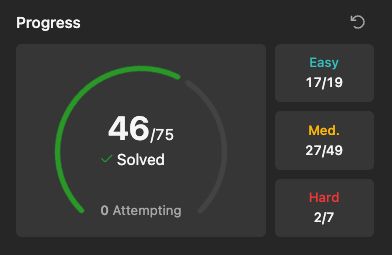
Had to take time off because I accumulated too many vacation days. Time to learn more C++!
November 19, 2025 at 9:05 PM
Had to take time off because I accumulated too many vacation days. Time to learn more C++!
Solved my first LC hard (Merge k Sorted Lists) in C++.
Nice to have the option to use the priority queue data structure which gives O(N log k) complexity.
When I practiced DSA in JS (previously), I'd usually merge two lists at a time, since JS doesn't have a built-in heap.
Nice to have the option to use the priority queue data structure which gives O(N log k) complexity.
When I practiced DSA in JS (previously), I'd usually merge two lists at a time, since JS doesn't have a built-in heap.

November 15, 2025 at 7:52 PM
Solved my first LC hard (Merge k Sorted Lists) in C++.
Nice to have the option to use the priority queue data structure which gives O(N log k) complexity.
When I practiced DSA in JS (previously), I'd usually merge two lists at a time, since JS doesn't have a built-in heap.
Nice to have the option to use the priority queue data structure which gives O(N log k) complexity.
When I practiced DSA in JS (previously), I'd usually merge two lists at a time, since JS doesn't have a built-in heap.
The best way to start learning a new programming language.

November 15, 2025 at 12:05 AM
The best way to start learning a new programming language.
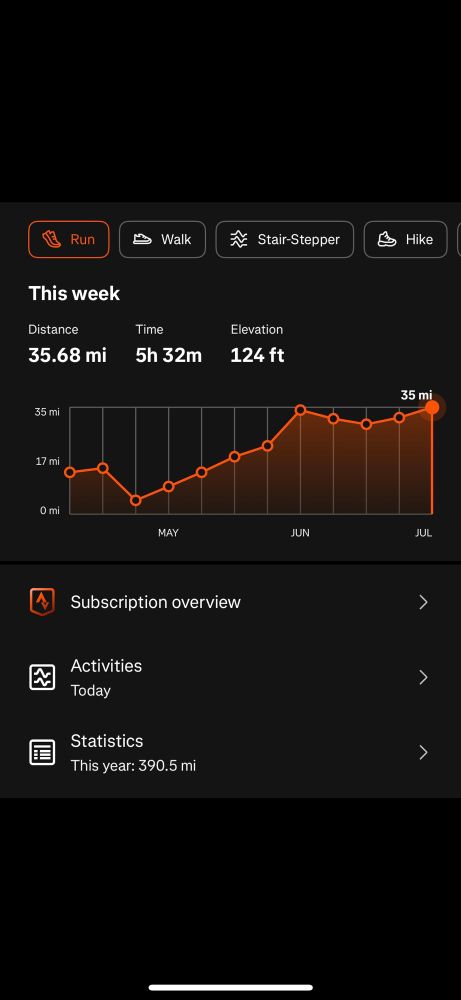
I’m locked in now. No turning back.
July 6, 2025 at 3:40 AM
I’m locked in now. No turning back.
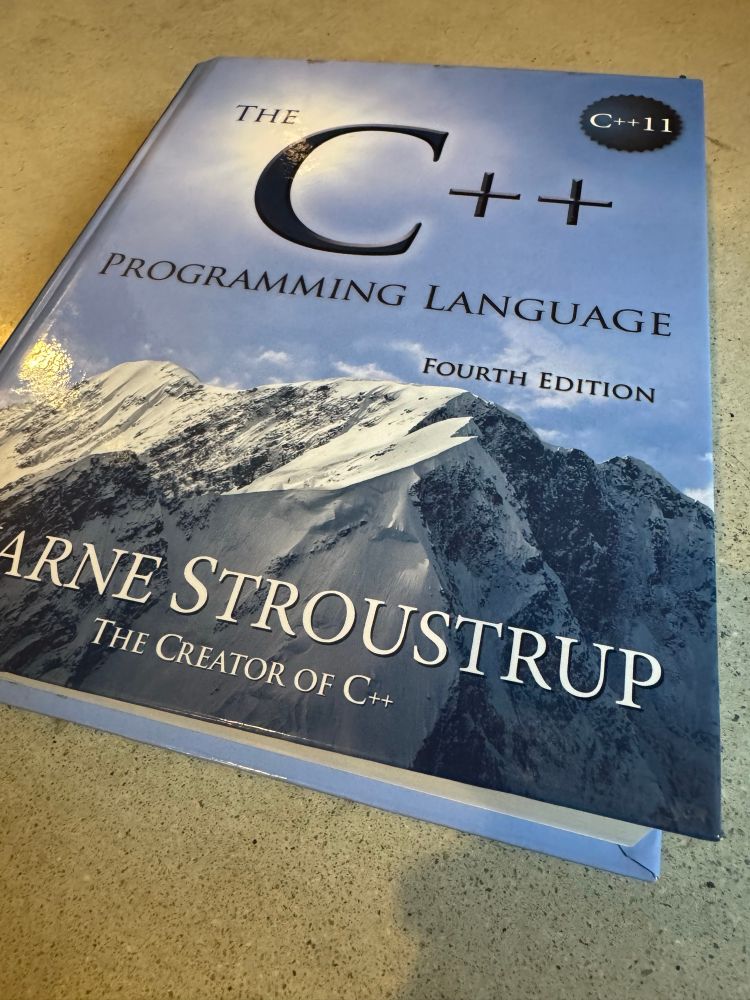
Ready to blow my whole leg off.
June 21, 2025 at 1:24 AM
Ready to blow my whole leg off.
GLSL Shader Experiment 23
Ray Marching Mouse Interaction (part 1)
Ray Marching Mouse Interaction (part 1)
June 13, 2025 at 11:26 PM
GLSL Shader Experiment 23
Ray Marching Mouse Interaction (part 1)
Ray Marching Mouse Interaction (part 1)
GLSL Shader Experiment 22
Ray Marching Procedural Terrain (part 4)
Ray Marching Procedural Terrain (part 4)
June 7, 2025 at 12:50 AM
GLSL Shader Experiment 22
Ray Marching Procedural Terrain (part 4)
Ray Marching Procedural Terrain (part 4)
GLSL Shader Experiment 21
Ray Marching Procedural Terrain (part 3)
Ray Marching Procedural Terrain (part 3)
June 6, 2025 at 3:10 AM
GLSL Shader Experiment 21
Ray Marching Procedural Terrain (part 3)
Ray Marching Procedural Terrain (part 3)
GLSL Shader Experiment 20
Procedural Terrain (part 2)
Ray marched a procedural terrain using value noise. This time, I removed the sphere SDF, colorized the terrain based on its normals, and added specular lighting.
Procedural Terrain (part 2)
Ray marched a procedural terrain using value noise. This time, I removed the sphere SDF, colorized the terrain based on its normals, and added specular lighting.
June 4, 2025 at 2:59 AM
GLSL Shader Experiment 20
Procedural Terrain (part 2)
Ray marched a procedural terrain using value noise. This time, I removed the sphere SDF, colorized the terrain based on its normals, and added specular lighting.
Procedural Terrain (part 2)
Ray marched a procedural terrain using value noise. This time, I removed the sphere SDF, colorized the terrain based on its normals, and added specular lighting.
GLSL Shader Experiment 19
Procedural Terrain (part 1)
I ray marched a procedural terrain using value noise. Decided to add distance fog, color grading, and a toon shader to give the scene some contrast.
Procedural Terrain (part 1)
I ray marched a procedural terrain using value noise. Decided to add distance fog, color grading, and a toon shader to give the scene some contrast.
June 1, 2025 at 9:28 PM
GLSL Shader Experiment 19
Procedural Terrain (part 1)
I ray marched a procedural terrain using value noise. Decided to add distance fog, color grading, and a toon shader to give the scene some contrast.
Procedural Terrain (part 1)
I ray marched a procedural terrain using value noise. Decided to add distance fog, color grading, and a toon shader to give the scene some contrast.
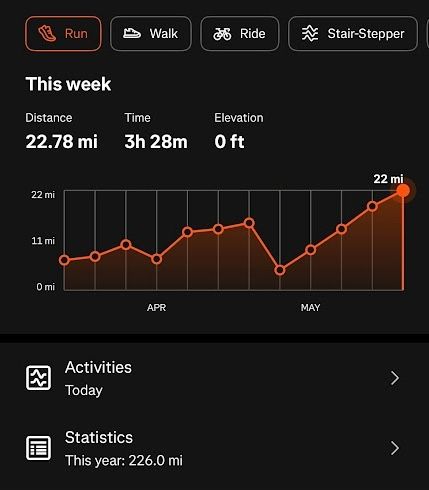
The last time I ran more than 20 miles in one week was over 5 years ago! Feels good to start running consistently again.
May 31, 2025 at 7:36 PM
The last time I ran more than 20 miles in one week was over 5 years ago! Feels good to start running consistently again.