




SNIFS Rocket
@snifs-rocket.bsky.social
Account for the SNIFS sounding rocket, built by LASP @ CU Boulder. Run by the SNIFS team
Launch info
When: Friday, July 18th 1pm MDT / 3pm EDT
Location: White Sands Missile Range
Livestream video: https://video.ibm.com/wstf-wsmr (starts 30 min before)
Launch info
When: Friday, July 18th 1pm MDT / 3pm EDT
Location: White Sands Missile Range
Livestream video: https://video.ibm.com/wstf-wsmr (starts 30 min before)
We launched at 1pm MDT and the apogee height was about 350 km, which was much higher than expected. We got about 8 minutes of good solar data.
July 19, 2025 at 3:33 AM
We launched at 1pm MDT and the apogee height was about 350 km, which was much higher than expected. We got about 8 minutes of good solar data.
See alt text for more info! (3/3)
July 17, 2025 at 8:05 PM
See alt text for more info! (3/3)
Detector A is warmer than B due to the longer copper heat strap that connects it to the heatsink. The added length slows the heat transfer, causing it to lag behind B. This plot shows that it took about 1 hour to cool both detectors down to below 0 deg C, which is our target for launch! (2/3)
July 17, 2025 at 8:05 PM
Detector A is warmer than B due to the longer copper heat strap that connects it to the heatsink. The added length slows the heat transfer, causing it to lag behind B. This plot shows that it took about 1 hour to cool both detectors down to below 0 deg C, which is our target for launch! (2/3)
When we reach T-0 we “launch” by disconnecting all the umbilical cables, switching the payload to internal power and wireless communications. Sequence tests make sure that all the parts of the #rocket are working as they should, and gives the team a chance to practice for the actual launch (2/2)
July 13, 2025 at 2:00 AM
When we reach T-0 we “launch” by disconnecting all the umbilical cables, switching the payload to internal power and wireless communications. Sequence tests make sure that all the parts of the #rocket are working as they should, and gives the team a chance to practice for the actual launch (2/2)
Remember the impressive #aurora at low latitudes during May 2024? These were caused by multiple CMEs which went toward Earth. In addition to the aurora those solar storms caused some damage to satellites, though space forecasting allowed us to shut them down beforehand and avoid the worst damage
9/9
9/9
July 12, 2025 at 5:10 PM
Remember the impressive #aurora at low latitudes during May 2024? These were caused by multiple CMEs which went toward Earth. In addition to the aurora those solar storms caused some damage to satellites, though space forecasting allowed us to shut them down beforehand and avoid the worst damage
9/9
9/9
If that bubble intersects with the Earth, it can damage spacecraft, increase radiation to dangerous levels for astronauts and planes flying over the poles, cause radio communications blackouts, and cause beautiful aurora.
8/n
8/n
July 12, 2025 at 5:08 PM
If that bubble intersects with the Earth, it can damage spacecraft, increase radiation to dangerous levels for astronauts and planes flying over the poles, cause radio communications blackouts, and cause beautiful aurora.
8/n
8/n
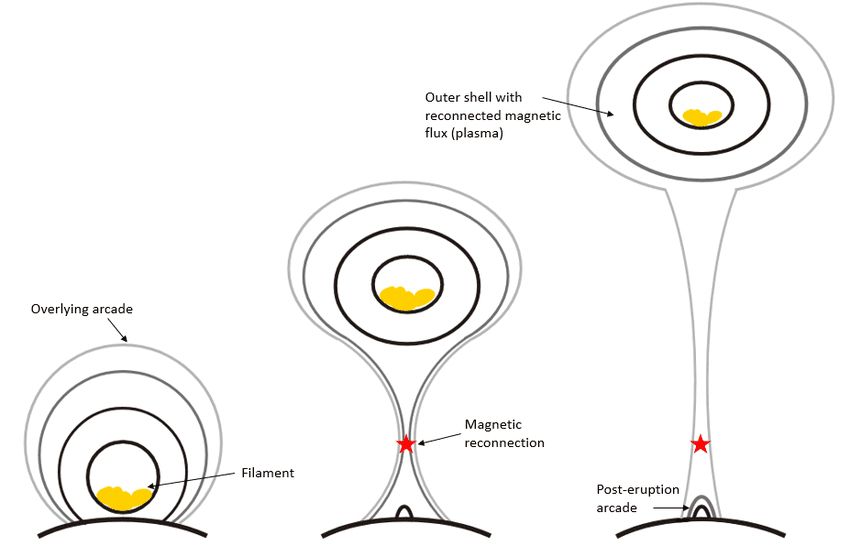
In the image below, we see that the upper legs of the magnetic loops are full of plasma. When reconnection happens, the upper legs connect to each other and form a bubble of hot plasma. The energy release shoots that bubble out from the Sun and into the solar system.
7/n
7/n
July 12, 2025 at 5:08 PM
In the image below, we see that the upper legs of the magnetic loops are full of plasma. When reconnection happens, the upper legs connect to each other and form a bubble of hot plasma. The energy release shoots that bubble out from the Sun and into the solar system.
7/n
7/n
energy release will cause the nearby plasma to heat up explosively and glow in x-ray wavelengths, which we perceive as a solar flare!
A solar flare may also be accompanied by a bubble of plasma which is expelled out of the Sun's atmosphere at high speeds.
6/n
A solar flare may also be accompanied by a bubble of plasma which is expelled out of the Sun's atmosphere at high speeds.
6/n
July 12, 2025 at 5:04 PM
energy release will cause the nearby plasma to heat up explosively and glow in x-ray wavelengths, which we perceive as a solar flare!
A solar flare may also be accompanied by a bubble of plasma which is expelled out of the Sun's atmosphere at high speeds.
6/n
A solar flare may also be accompanied by a bubble of plasma which is expelled out of the Sun's atmosphere at high speeds.
6/n