




Shirin
@smohamm1.bsky.social
Keynesian Economist
SAIS-Johns Hopkins 2012
Paris School of Economics 2024
SAIS-Johns Hopkins 2012
Paris School of Economics 2024
Reposted by Shirin

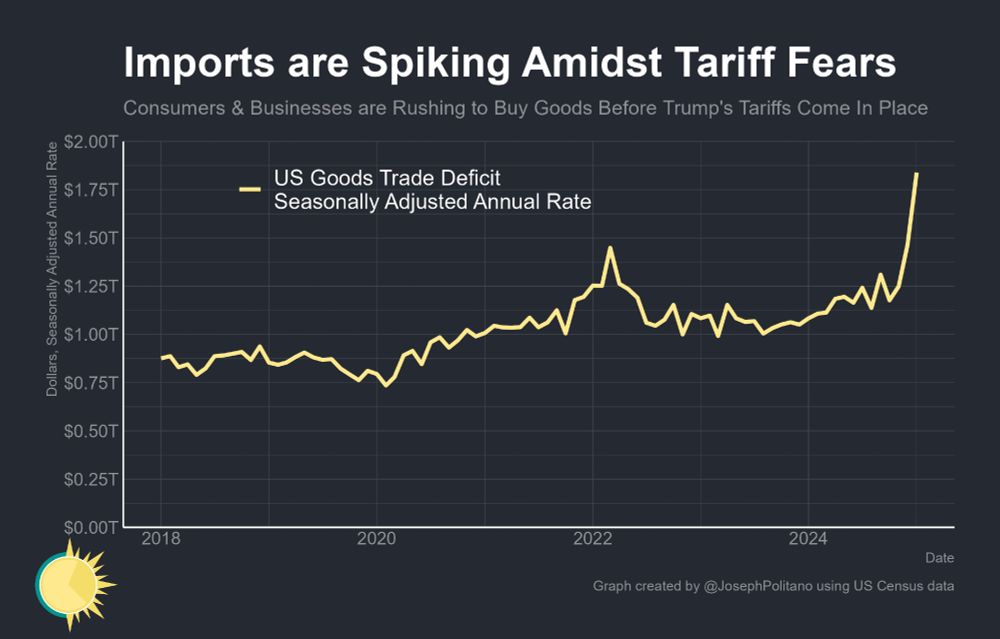
Advanced data already showed Americans were panic-importing goods in anticipation of Trump's tariffs in Jan—a trend that likely accelerated in Feb, and might continue to dominate Mar.
If these tariffs persist for any length of time, they will have massive negative impacts
If these tariffs persist for any length of time, they will have massive negative impacts
March 4, 2025 at 12:55 AM
Advanced data already showed Americans were panic-importing goods in anticipation of Trump's tariffs in Jan—a trend that likely accelerated in Feb, and might continue to dominate Mar.
If these tariffs persist for any length of time, they will have massive negative impacts
If these tariffs persist for any length of time, they will have massive negative impacts
Digging a bit deeper, foreign-born women (followed by foreign-born men) driving growth in US labor force since 2007 (data sourced from BLS)

February 11, 2025 at 8:58 PM
Digging a bit deeper, foreign-born women (followed by foreign-born men) driving growth in US labor force since 2007 (data sourced from BLS)

Labor force participation in the US has been and remains on a downward trend (hence the lower-than-many-expected unemployment rate during the latest rate hike cycle) - there’s a smaller supply of labor for employers to pool from.

February 7, 2025 at 8:35 PM
Labor force participation in the US has been and remains on a downward trend (hence the lower-than-many-expected unemployment rate during the latest rate hike cycle) - there’s a smaller supply of labor for employers to pool from.
-Women do not appear to face a racial/ethnic penalty on top of any gender penalties in earnings, although they do face lower employment probabilities than their white/native female counterparts in all three countries, even after controlling for education and experience.
December 11, 2024 at 2:55 AM
-Women do not appear to face a racial/ethnic penalty on top of any gender penalties in earnings, although they do face lower employment probabilities than their white/native female counterparts in all three countries, even after controlling for education and experience.
-In the British labor market, Black men appear to face a racial ‘glass ceiling’ effect, limiting their upward mobility prospects.
December 11, 2024 at 2:55 AM
-In the British labor market, Black men appear to face a racial ‘glass ceiling’ effect, limiting their upward mobility prospects.
-Second-generation African/Black men (alongside men from the Maghreb in France and from South Asia in the UK) earn less than their native/white counterparts on average, even after controlling for education, age, experience, sector, occupation and industry.
December 11, 2024 at 2:55 AM
-Second-generation African/Black men (alongside men from the Maghreb in France and from South Asia in the UK) earn less than their native/white counterparts on average, even after controlling for education, age, experience, sector, occupation and industry.
-The employment gaps for second-generation African/Black men (vis-à-vis native/white men) are largest in Germany, followed by France and the UK. These gaps persist and remain large even after controlling for education, age and experience – although they have narrowed over time.
December 11, 2024 at 2:54 AM
-The employment gaps for second-generation African/Black men (vis-à-vis native/white men) are largest in Germany, followed by France and the UK. These gaps persist and remain large even after controlling for education, age and experience – although they have narrowed over time.
Key takeaways:
-In all three countries, African/Black men (followed closely by men from the Maghreb and Middle East in France) face the worst labor market outcomes, even after controlling for education and other factors that typically influence labor market outcomes.
-In all three countries, African/Black men (followed closely by men from the Maghreb and Middle East in France) face the worst labor market outcomes, even after controlling for education and other factors that typically influence labor market outcomes.
December 11, 2024 at 2:54 AM
Key takeaways:
-In all three countries, African/Black men (followed closely by men from the Maghreb and Middle East in France) face the worst labor market outcomes, even after controlling for education and other factors that typically influence labor market outcomes.
-In all three countries, African/Black men (followed closely by men from the Maghreb and Middle East in France) face the worst labor market outcomes, even after controlling for education and other factors that typically influence labor market outcomes.