



The Smarter Project
@smarterproject.bsky.social
Enabling ingenious solutions for people and the planet
Pinned
Welcome to the Smarter Project, dedicated to the principle that each of us has the ability to deliver vastly more ingenuity to the world around us, benefitting ourselves and our planet. More than ever, we need to Get Smarter!
Big Tech Wants Direct Access to Our Brains www.nytimes.com/2025/11/14/m...
Nothing to worry about here, is there?!?
Nothing to worry about here, is there?!?

Big Tech Wants Direct Access to Our Brains
www.nytimes.com
November 14, 2025 at 9:18 PM
Big Tech Wants Direct Access to Our Brains www.nytimes.com/2025/11/14/m...
Nothing to worry about here, is there?!?
Nothing to worry about here, is there?!?
How A.I. and Social Media Contribute to ‘Brain Rot’ www.nytimes.com/2025/11/06/t...

How A.I. and Social Media Contribute to ‘Brain Rot’
www.nytimes.com
November 6, 2025 at 4:58 PM
How A.I. and Social Media Contribute to ‘Brain Rot’ www.nytimes.com/2025/11/06/t...
A Surprising (and Easy) Way to Boost Your Attention Span www.nytimes.com/2025/08/14/w...

A Surprising (and Easy) Way to Boost Your Attention Span
www.nytimes.com
August 18, 2025 at 12:46 PM
A Surprising (and Easy) Way to Boost Your Attention Span www.nytimes.com/2025/08/14/w...
“America’s leaders [during the Cold War] understood that a superpower rivalry is as much an intellectual contest as a military and economic one. It’s who can out-innovate whom. So they fought the Soviet threat with education, with the goal of maximizing talent on our side.” David Brooks, NYT
July 18, 2025 at 3:46 PM
“America’s leaders [during the Cold War] understood that a superpower rivalry is as much an intellectual contest as a military and economic one. It’s who can out-innovate whom. So they fought the Soviet threat with education, with the goal of maximizing talent on our side.” David Brooks, NYT
Reposted by The Smarter Project

Generative AI is simply too new for us to have any sort of useful or trustworthy scientific data on its impact on cognition, learning, memory, problem-solving or creativity.
www.axios.com/2025/07/02/c...
www.axios.com/2025/07/02/c...

AI brain rot's evidence gap
We still don't know whether genAI is making us dumb.
www.axios.com
July 3, 2025 at 1:37 PM
Generative AI is simply too new for us to have any sort of useful or trustworthy scientific data on its impact on cognition, learning, memory, problem-solving or creativity.
www.axios.com/2025/07/02/c...
www.axios.com/2025/07/02/c...
A new ISW report defines cognitive warfare as "a form of warfare that focuses on influencing the opponent's reasoning, decisions, and ultimately, actions to secure strategic objectives without fighting or with less military effort than would otherwise be required." Russia seems to be an expert.
Institute for the Study of War
Russia is a key player in the cognitive warfare space and a model for China, Iran, and North Korea. Russia has effectively used cognitive warfare to facilitate its war in Ukraine, shape Western decisi...
www.understandingwar.org
July 1, 2025 at 9:44 PM
A new ISW report defines cognitive warfare as "a form of warfare that focuses on influencing the opponent's reasoning, decisions, and ultimately, actions to secure strategic objectives without fighting or with less military effort than would otherwise be required." Russia seems to be an expert.
As early as 1999, Kathleen Mosier and Linda Skikda were using the term "automation bias" to describe "the tendency to use automation as a heuristic replacement for vigilant information seeking and processing." Today, in a world awash in AI, it may be the fastest growing of all cognitive biases.

Automation Use and Automation Bias - Kathleen L. Mosier, Linda J. Skitka, 1999
The availability of automation and automated decision aids feeds into a general human tendency to travel the road of least cognitive effort. A series of studies...
journals.sagepub.com
July 1, 2025 at 9:34 PM
As early as 1999, Kathleen Mosier and Linda Skikda were using the term "automation bias" to describe "the tendency to use automation as a heuristic replacement for vigilant information seeking and processing." Today, in a world awash in AI, it may be the fastest growing of all cognitive biases.
“To defend thought in this new era is not to reject simulation, but to remember what thought feels like. Not just what it looks like. That means restoring friction, cultivating reflection, and resisting the drift toward answers that are immediate and unexamined.”

AI and the Epistemology of the Synthetic Mind
Are we trading the friction of real thought for the fluency of artificial intelligence, mistaking seamless performance for understanding itself?
www.psychologytoday.com
June 28, 2025 at 3:03 AM
“To defend thought in this new era is not to reject simulation, but to remember what thought feels like. Not just what it looks like. That means restoring friction, cultivating reflection, and resisting the drift toward answers that are immediate and unexamined.”
Reposted by The Smarter Project
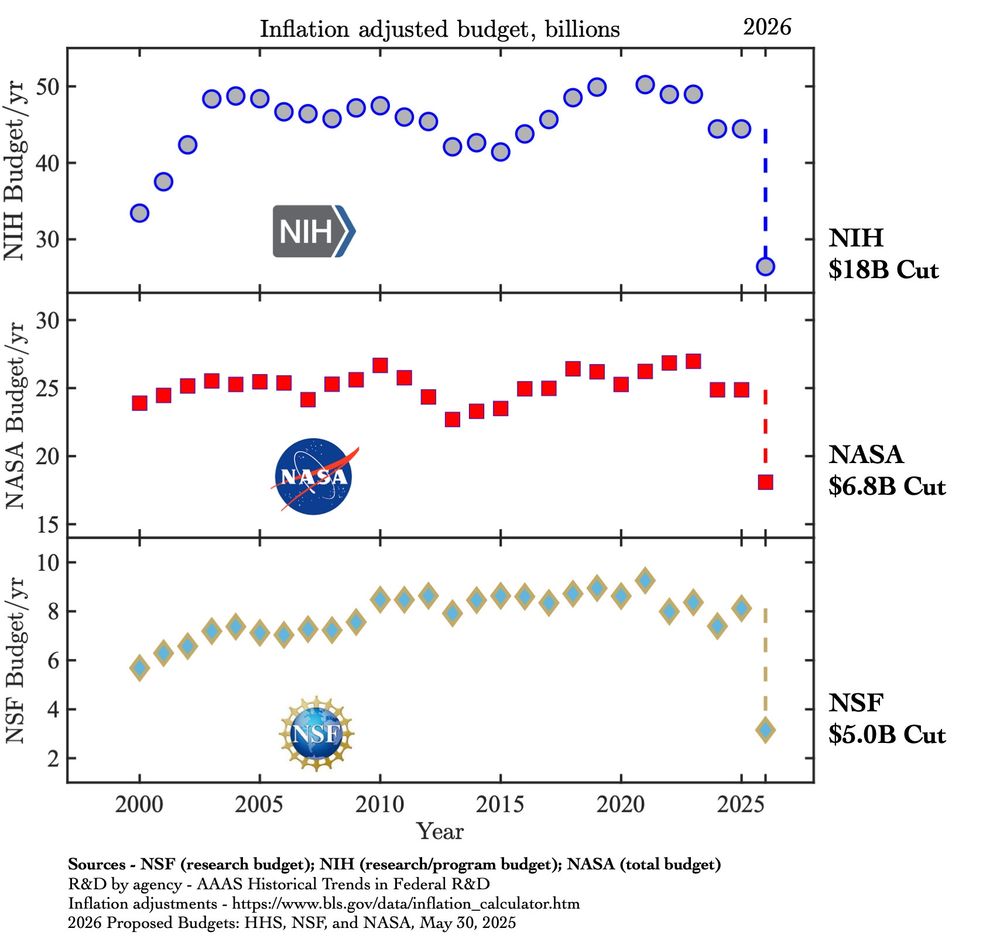
There are 2 previous historical cases of countries destroying their science and universities, crippling them for decades: Lysenkoism in the USSR and Nazi Germany. The Trump administration will be the 3rd.
It's not just budgets but research, institutions, expertise, and training the next generation.
It's not just budgets but research, institutions, expertise, and training the next generation.
May 31, 2025 at 4:43 AM
There are 2 previous historical cases of countries destroying their science and universities, crippling them for decades: Lysenkoism in the USSR and Nazi Germany. The Trump administration will be the 3rd.
It's not just budgets but research, institutions, expertise, and training the next generation.
It's not just budgets but research, institutions, expertise, and training the next generation.
Note the parallels here with the massive, forced disappearance of technical experts from Government. As American society, academia and policy making are drained of expertise, a more conducive environment is created for misinformation and for policies that serve something other than the common good.

America’s Coming Brain Drain
Trump’s war on universities could kill U.S. innovation.
www.foreignaffairs.com
May 26, 2025 at 5:55 PM
Note the parallels here with the massive, forced disappearance of technical experts from Government. As American society, academia and policy making are drained of expertise, a more conducive environment is created for misinformation and for policies that serve something other than the common good.
(Paywalled) “Civic education can help us to see that not all problems have solutions, to live with tentative answers, to accept compromise, to embrace responsibilities as well as rights—to understand that democracy is a way of living, not a settled destination.” This is the kind of Smarter we need.

Why Study History?
Civic education can help us to see that not all problems have solutions, to live with tentative answers, to accept compromise, to embrace responsibilities as well as rights—to understand that democrac...
www.theatlantic.com
May 16, 2025 at 4:10 PM
(Paywalled) “Civic education can help us to see that not all problems have solutions, to live with tentative answers, to accept compromise, to embrace responsibilities as well as rights—to understand that democracy is a way of living, not a settled destination.” This is the kind of Smarter we need.
“We will need a far better understanding of our planet’s complex systems, and much more sophisticated technologies and institutions...to achieve a relationship with our surrounding natural environment that is economically and socially sustainable. Ever greater amounts of ingenuity will be required."

April 27, 2025 at 11:15 PM
“We will need a far better understanding of our planet’s complex systems, and much more sophisticated technologies and institutions...to achieve a relationship with our surrounding natural environment that is economically and socially sustainable. Ever greater amounts of ingenuity will be required."
U. of Cambridge psychologists have developed the first “misinformation susceptibility test” (MIST) and validated the test in the journal Behavior Research Methods. Polling conducted using MIST found that younger adults are worse than older adults at identifying false headlines. Democracy beware.

How well can Americans distinguish real news headlines from fake ones? | YouGov
A YouGov survey tested Americans' susceptibility to falsehoods in news, and found that on average, they failed to correctly classify one-third of headlines as either real or fake.
today.yougov.com
April 25, 2025 at 8:21 PM
U. of Cambridge psychologists have developed the first “misinformation susceptibility test” (MIST) and validated the test in the journal Behavior Research Methods. Polling conducted using MIST found that younger adults are worse than older adults at identifying false headlines. Democracy beware.
"Mild dissosociation" (sic), eh? Ok.

April 25, 2025 at 8:08 PM
"Mild dissosociation" (sic), eh? Ok.
A lot to be learned from evolution of animal intelligence: "A series of studies published in Science in February 2025 provides the best evidence yet that birds and mammals did not inherit the neural pathways that generate intelligence from a common ancestor, but rather evolved them independently."

Intelligence Evolved at Least Twice in Vertebrate Animals | Quanta Magazine
Complex neural circuits likely arose independently in birds and mammals, suggesting that vertebrates evolved intelligence multiple times.
www.quantamagazine.org
April 21, 2025 at 10:40 PM
A lot to be learned from evolution of animal intelligence: "A series of studies published in Science in February 2025 provides the best evidence yet that birds and mammals did not inherit the neural pathways that generate intelligence from a common ancestor, but rather evolved them independently."
A new Journal of Political Economy study found a significant, positive impact of embedding working memory training in regular school teaching. Three years later, children who received training were 16% more likely to enter an advanced secondary school track www.journals.uchicago.edu/doi/10.1086/...
University of Chicago Press Journals: Cookie absent
www.journals.uchicago.edu
April 2, 2025 at 8:46 PM
A new Journal of Political Economy study found a significant, positive impact of embedding working memory training in regular school teaching. Three years later, children who received training were 16% more likely to enter an advanced secondary school track www.journals.uchicago.edu/doi/10.1086/...
Your brain on retirement.

Retirement Can Harm Your Brain. Here’s How to Keep It Healthy.
It’s challenging to stay mentally sharp and healthy through the major transition. Careful planning is key.
www.nytimes.com
March 27, 2025 at 9:06 PM
Your brain on retirement.
A new study shows microplastics and nanoplastics accumulating in human organs, particularly brains. The study notes a significant increase between 2016 and 2024 and higher levels in people with dementia. Yet another warning sign that environmental degradation is harming our brains and cognition.

Bioaccumulation of microplastics in decedent human brains - Nature Medicine
Pyrolysis gas chromatography–mass spectrometry reveals the presence of microplastics and nanoplastics in human kidney, liver and brain tissue samples from 2016 and 2024, with higher proportions found ...
www.nature.com
March 6, 2025 at 10:51 PM
A new study shows microplastics and nanoplastics accumulating in human organs, particularly brains. The study notes a significant increase between 2016 and 2024 and higher levels in people with dementia. Yet another warning sign that environmental degradation is harming our brains and cognition.
When Government, due to “resentful arrogance,” is forced to shed expertise, it becomes less capable of performing the essential functions of a modern society. This process, which may be termed a “Stupider Project”, is the antithesis of a rational, knowledge-based approach to problem solving.

The Death of Government Expertise
Why Trump and Musk are on a firing spree
www.theatlantic.com
February 17, 2025 at 3:46 PM
When Government, due to “resentful arrogance,” is forced to shed expertise, it becomes less capable of performing the essential functions of a modern society. This process, which may be termed a “Stupider Project”, is the antithesis of a rational, knowledge-based approach to problem solving.
Here is a brilliant encapsulation of a key aspect of the dilemma being highlighted by the Smarter Project: "Half the country's thinking magically". Indeed. #Calfires

‘Half the Country’s Thinking Magically’: California Fire Victims Grapple with the Political Paralysis Over Climate Change
They’re still in shock. But for now, even in a blue city in a blue state, disaster does not bring climate change to residents’ front of mind.
www.politico.com
January 13, 2025 at 6:03 PM
Here is a brilliant encapsulation of a key aspect of the dilemma being highlighted by the Smarter Project: "Half the country's thinking magically". Indeed. #Calfires
A new research paper from Caltech titled “The unbearable slowness of being” (!) estimates that humans think at a rate of 10 bits per second, even though sensory systems process a billion bits per second—100 million times faster. No wonder multitasking doesn’t work!

The Speed of Thought Why Humans Process Information So Slowly
YouTube video by Neuroscience News
youtu.be
December 31, 2024 at 9:53 PM
A new research paper from Caltech titled “The unbearable slowness of being” (!) estimates that humans think at a rate of 10 bits per second, even though sensory systems process a billion bits per second—100 million times faster. No wonder multitasking doesn’t work!
Speaking of environmental impacts on the brain and thinking...

Today’s #WomenInSTEM book of the Day is Marian Diamond’s classic 1988 Enriching Heredity detailing some of her pioneering work on how brains physically change with activity.
#NeuroSky #BookSky #HistSci
#NeuroSky #BookSky #HistSci

December 31, 2024 at 4:45 PM
Speaking of environmental impacts on the brain and thinking...
Adding to the list of environmental factors affecting ingenuity, a 2024 NEJM study of cognition and memory found "objectively measurable cognitive deficits that may persist for a year of more after Covid-19" and that "longer-term persistence of cognitive deficits...warrant ongoing surveillance."

Cognition and Memory after Covid-19 in a Large Community Sample | NEJM
Cognitive symptoms after coronavirus disease 2019 (Covid-19), the disease caused by severe acute respiratory syndrome coronavirus 2 (SARS-CoV-2), are well-recognized. Whether objectively measurable...
www.nejm.org
December 30, 2024 at 10:29 PM
Adding to the list of environmental factors affecting ingenuity, a 2024 NEJM study of cognition and memory found "objectively measurable cognitive deficits that may persist for a year of more after Covid-19" and that "longer-term persistence of cognitive deficits...warrant ongoing surveillance."
There is increasing awareness of the negative impacts of climate change on cognition. A broader irony here is that as our environmental challenges increase, human mental capacity to generate and implement solutions declines. A new effort launched in September will assess the scope of this dynamic.

Earth, Brain, Health Commission
Earth Brain Health Commission Interested in how we can address mental health challenges resulting from environmental megatrends? Then come to the launch of the Earth Brain Health Commission (mental he...
www.environmental-project.org
December 28, 2024 at 10:24 PM
There is increasing awareness of the negative impacts of climate change on cognition. A broader irony here is that as our environmental challenges increase, human mental capacity to generate and implement solutions declines. A new effort launched in September will assess the scope of this dynamic.
Deep thinking and deep work require knowledge and sustained attention. Reading books is a highly effective means of conveying knowledge and developing the ability to sustain one’s attention. So a society has a big problem when its youth get to college without ever having read an entire book.

The Elite College Students Who Can’t Read Books
To read a book in college, it helps to have read a book in high school.
www.theatlantic.com
December 21, 2024 at 2:34 PM
Deep thinking and deep work require knowledge and sustained attention. Reading books is a highly effective means of conveying knowledge and developing the ability to sustain one’s attention. So a society has a big problem when its youth get to college without ever having read an entire book.