



Felix Sigmund
@sigisupertramp.bsky.social
Project Group Leader at Helmholtz Munich and TUM (MIBE) | Formerly PostDoc/Visiting Scholar in Adam Cohen's (@adamezracohen.bsky.social) lab at Harvard | Synbio, Gene Reporters, Integrators and Recorders for High-Res Imaging and Molecular Actuators
Reposted by Felix Sigmund

A global screen for magnetically induced neuronal activity in the pigeon brain www.science.org/doi/10.1126/... - so cool! 🐦🧠

A global screen for magnetically induced neuronal activity in the pigeon brain
How animals detect the Earth’s magnetic field remains a mystery in sensory biology. Despite extensive behavioral evidence, the neural circuitry and molecular mechanisms responsible for magnetic sensin...
www.science.org
November 21, 2025 at 3:07 PM
A global screen for magnetically induced neuronal activity in the pigeon brain www.science.org/doi/10.1126/... - so cool! 🐦🧠
Reposted by Felix Sigmund

Molecular recording of cellular protein kinase activity with chemical labeling:
www.nature.com/articles/s41...
Congratulations to De-en Sun and the entire team.
www.nature.com/articles/s41...
Congratulations to De-en Sun and the entire team.
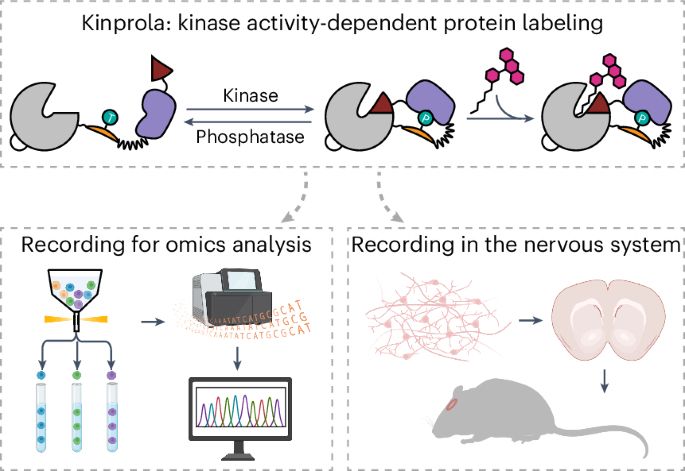
Molecular recording of cellular protein kinase activity with chemical labeling - Nature Chemical Biology
Molecular recorders based on kinase activity-dependent protein labeling track specific kinase activities to understand their link to cellular phenotypes in heterogeneous cell populations and in vivo.
www.nature.com
July 10, 2025 at 5:46 PM
Molecular recording of cellular protein kinase activity with chemical labeling:
www.nature.com/articles/s41...
Congratulations to De-en Sun and the entire team.
www.nature.com/articles/s41...
Congratulations to De-en Sun and the entire team.
Reposted by Felix Sigmund
Finally out in Nature Chem Bio:
SNAP-tag2 for faster and brighter protein labeling
www.nature.com/articles/s41...
Thank you Steffi and Veselin.
SNAP-tag2 for faster and brighter protein labeling
www.nature.com/articles/s41...
Thank you Steffi and Veselin.
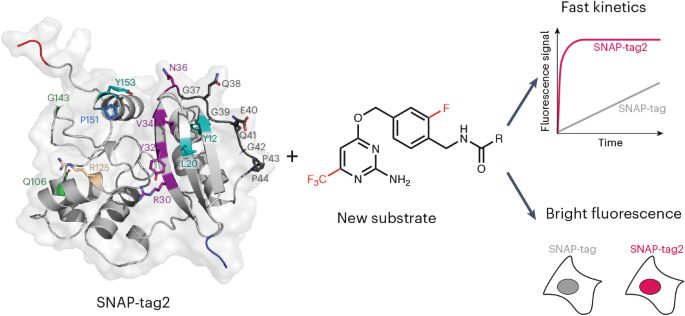
SNAP-tag2 for faster and brighter protein labeling - Nature Chemical Biology
SNAP-tag is a widespread tool for labeling protein for bioimaging. Now, Kühn et al. report SNAP-tag2 with increased labeling kinetics and brightness, which translates into a better performance in live...
www.nature.com
July 3, 2025 at 7:45 PM
Finally out in Nature Chem Bio:
SNAP-tag2 for faster and brighter protein labeling
www.nature.com/articles/s41...
Thank you Steffi and Veselin.
SNAP-tag2 for faster and brighter protein labeling
www.nature.com/articles/s41...
Thank you Steffi and Veselin.
Reposted by Felix Sigmund

Now out in JACS. pubs.acs.org/doi/full/10....
Grateful to thoughtful reviewers who found some errors in our model and encouraged us to make a better one! A renaissance in magnetobiology is coming...
Grateful to thoughtful reviewers who found some errors in our model and encouraged us to make a better one! A renaissance in magnetobiology is coming...
May 15, 2025 at 4:04 PM
Now out in JACS. pubs.acs.org/doi/full/10....
Grateful to thoughtful reviewers who found some errors in our model and encouraged us to make a better one! A renaissance in magnetobiology is coming...
Grateful to thoughtful reviewers who found some errors in our model and encouraged us to make a better one! A renaissance in magnetobiology is coming...
Reposted by Felix Sigmund
Which synapses get stronger when we form a memory? We developed a technique to tag recently potentiated synapses in live mice. Pulse-chase labeling with membrane-impermeable HaloLigand dyes distinguishes fresh AMPA receptors from old ones. www.nature.com/articles/s41...

EPSILON: a method for pulse-chase labeling to probe synaptic AMPAR exocytosis during memory formation - Nature Neuroscience
Kim and coworkers describe a technique, EPSILON, to map AMPA receptor exocytosis, a proxy for synaptic plasticity, in mice. The authors demonstrated a correlation between AMPA receptor exocytosis and ...
www.nature.com
March 31, 2025 at 9:10 PM
Which synapses get stronger when we form a memory? We developed a technique to tag recently potentiated synapses in live mice. Pulse-chase labeling with membrane-impermeable HaloLigand dyes distinguishes fresh AMPA receptors from old ones. www.nature.com/articles/s41...
Reposted by Felix Sigmund
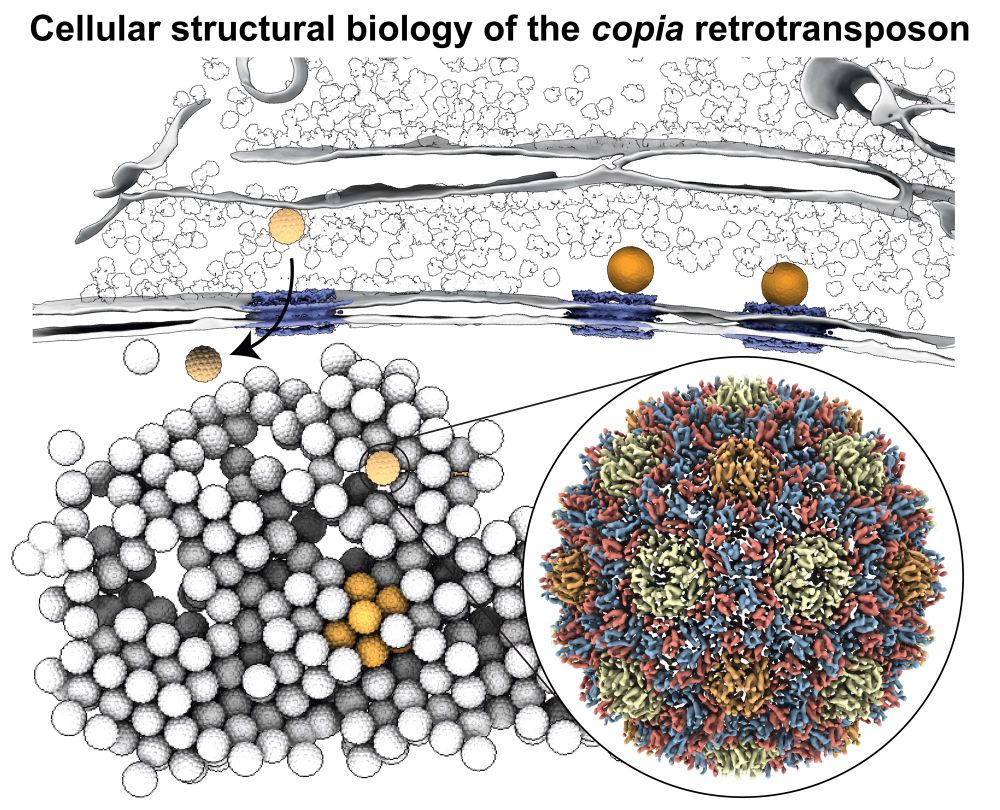
Happy to share our manuscript on the in situ visualization of the copia retrotransposon in its final form today published in @cellcellpress.bsky.social www.cell.com/cell/fulltex.... What’s new?
March 5, 2025 at 4:02 PM
Happy to share our manuscript on the in situ visualization of the copia retrotransposon in its final form today published in @cellcellpress.bsky.social www.cell.com/cell/fulltex.... What’s new?
Reposted by Felix Sigmund
How do tiny magnetic fields affect biochemistry? Overflowing with pride over Katherine Xiang's study on a giant magnetic field effect in a red fluorescent protein, www.biorxiv.org/content/10.1...

Mechanism of giant magnetic field effect in fluorescence of mScarlet3, a red fluorescent protein
Several fluorescent proteins, when expressed in E. coli, are sensitive to weak magnetic fields1. We found that mScarlet3 fluorescence in E. coli reversibly decreased by 21% in the presence of a 60 mT ...
www.biorxiv.org
February 28, 2025 at 4:00 PM
How do tiny magnetic fields affect biochemistry? Overflowing with pride over Katherine Xiang's study on a giant magnetic field effect in a red fluorescent protein, www.biorxiv.org/content/10.1...
Reposted by Felix Sigmund
The next development in photopharmacology (and "photogastronomy"). Controlling the Menthol Receptor TRPM8 with light!
onlinelibrary.wiley.com/doi/10.1002/...
onlinelibrary.wiley.com/doi/10.1002/...

December 18, 2024 at 6:04 PM
The next development in photopharmacology (and "photogastronomy"). Controlling the Menthol Receptor TRPM8 with light!
onlinelibrary.wiley.com/doi/10.1002/...
onlinelibrary.wiley.com/doi/10.1002/...