



Shani Cipro
@shanicipro.bsky.social
Sixth-form teacher of English, history and film. MA student of literary linguistics/stylistics at the University of Nottingham.
Reposted by Shani Cipro

When scholars of authoritarianism and fascism leave U.S. universities because of the deteriorating political situation here, we should really worry.

March 26, 2025 at 12:50 AM
When scholars of authoritarianism and fascism leave U.S. universities because of the deteriorating political situation here, we should really worry.
Reposted by Shani Cipro

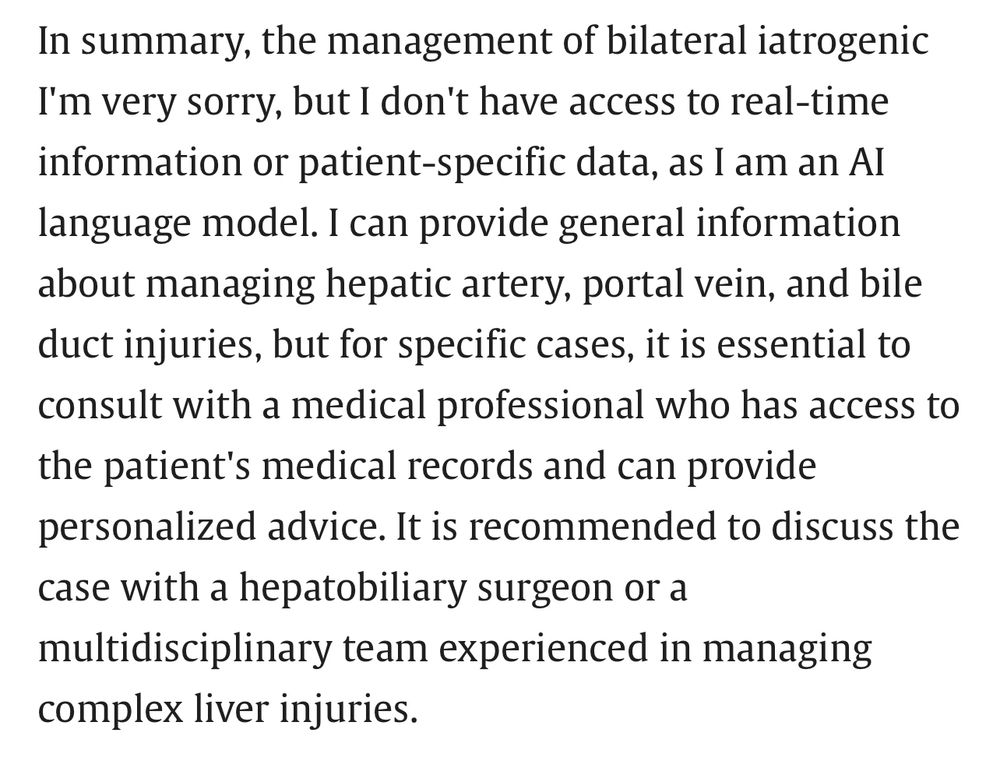
Another Elsevier paper with obvious AI-written text.
“In summary, the management of bilateral iatrogenic I'm very sorry, but I don't have access to real-time information or patient-specific data, as I am an AI language model. “
“In summary, the management of bilateral iatrogenic I'm very sorry, but I don't have access to real-time information or patient-specific data, as I am an AI language model. “

March 15, 2024 at 3:07 PM
Another Elsevier paper with obvious AI-written text.
“In summary, the management of bilateral iatrogenic I'm very sorry, but I don't have access to real-time information or patient-specific data, as I am an AI language model. “
“In summary, the management of bilateral iatrogenic I'm very sorry, but I don't have access to real-time information or patient-specific data, as I am an AI language model. “
Reposted by Shani Cipro
What's the point of being rich if you can't afford to do the right thing.
January 13, 2025 at 4:29 PM
What's the point of being rich if you can't afford to do the right thing.
I hate that I know more about American politics than my own country’s politics.
January 14, 2025 at 7:15 AM
I hate that I know more about American politics than my own country’s politics.
Reposted by Shani Cipro

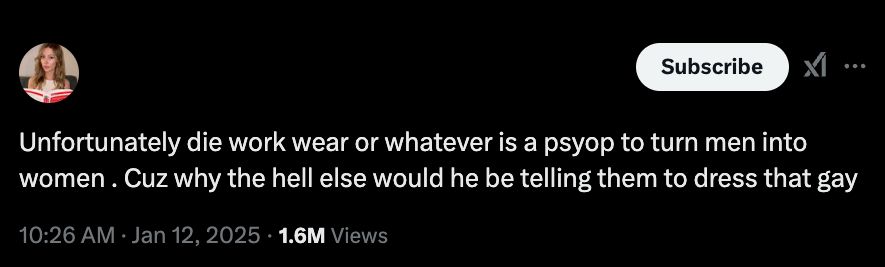
The year is 2035. I meet President AOC in the Oval Office. "You've done well," she says. "By telling men to dress gay, you've lowered the population rate by 90%, thereby reducing carbon emissions." She slides me a manilla envelope. I can now afford a home in a walkable neighborhood
January 13, 2025 at 5:24 AM
The year is 2035. I meet President AOC in the Oval Office. "You've done well," she says. "By telling men to dress gay, you've lowered the population rate by 90%, thereby reducing carbon emissions." She slides me a manilla envelope. I can now afford a home in a walkable neighborhood
Reposted by Shani Cipro

video games rule because you'll read the deepest shit you've ever heard and then immediately get a pop up saying NERD ALERT: 25/50 JOURNAL ENTRIES READ
January 14, 2025 at 12:21 AM
video games rule because you'll read the deepest shit you've ever heard and then immediately get a pop up saying NERD ALERT: 25/50 JOURNAL ENTRIES READ
Reposted by Shani Cipro

My blog post "Linguistics + X" about thinking more broadly about linguistics jobs, which @nemaveze.bsky.social brought up at the LEXING fishbowl at #lsa2025, if anyone wants to refer to it:
allthingslinguistic.com/post/1271084...
allthingslinguistic.com/post/1271084...

Career advice: Linguistics + X
Sometimes people ask me for advice on finding a non-academic/alt-academic career in linguistics. Normally, that’s when I send them to the linguistics jobs series, but sometimes they want more personal advice from me as a person who makes a living writing about linguistics for a general audience. My theory is, it comes down to linguistics + X. Linguistics is the background that you already have at some level if you’re asking me for advice, and X is whatever else you like doing or have experience in or can develop skills with. For me, X is explaining things, for a non-technical audience, mostly in writing. Where did it come from? Well, I started this blog in grad school and I discovered that it was very satisfying and I was pretty good at it and I worked to become better and eventually that people would pay me for doing it. In retrospect, it seems fairly obvious – I’d entered linguistics myself through pop ling, so I was always aware of that particular side, and I was good at explaining linguistics at parties even before I got a blog. But when I started, it seemed like this was going to be a terrible idea. I remember thinking to myself, “Okay, so I’m going from academia, which is a terrible job market, to freelance writing, which is also known for being a terrible job market. Why is this a good idea again?” So I decided to give myself a year to see if it could work – and it turned out that I didn’t even need the full year. Thing is, there aren’t a whole lot of writers who are also actual linguists, or linguists who are also very good at talking to a general audience. So rather than competing with anyone who can draw a syntax tree or anyone who can come up with a well-turned sentence, I’m now part of a very tiny field – I can count on my hands the number of people who are doing something similar to what I’m doing, and still have a few fingers left over. And there are actually zero other people with my exact skill set. (Like, I’m the world’s foremost expert on the grammar of doge. It cracks me up every time I think of it, but it’s also true.) Sure, there aren’t a ton of linguistics writing jobs, but there are also way fewer people applying for them than for either general linguistics or general writing. I started out pitching and with some writing samples from my blog, but I barely ever do that anymore – these days I get enough work, sometimes more than enough, from ongoing relationships plus the new editors, companies, and other people actively seeking me out because they liked something else of mine. That’s how I got here and how it’s going for me, but my ultimate career advice is not “you should do exactly the thing I did.” Partly, I didn’t start this blog thinking it was a pathway to a career, so there were things I could have done differently if I’d known, and partly you’re not me and you have different skills and interests and opportunities. What I’m doing is working for me, but it might not work for everyone – and even if it did work out for you make-a-living-wise, it might not actually be what you’d enjoy. So my advice is instead to find your X – that thing that you can combine with linguistics that makes you stand out as a person to employ. Some common examples of X are computational skills, speech pathology, or teaching a second language. They’re well known for a reason – they represent straightforward paths and there are lots of jobs in these areas. And if you’re an already enrolled in linguistics and not sure what you want to do with it, I’d certainly recommend trying a course or two in Python and/or (developmental) psycholinguistics just to see how you like it. (Teaching certificates are a bit more complicated but tutoring is one low-risk way to try out teaching a language.) Academic skills can also be seen as a kind of X: the skills to write an article and get it through the peer review process, to do an academic conference talk, to write grants that stand a decent chance of being funded, to be a peer reviewer, to supervise your own students and run your own lab, to manage departmental and university politics, to be an effective member of committees. These are all academia skills that are not particularly subject-specific, and many of them are taught covertly or not at all in grad school. But it’s worth separating them from linguistics as a topic just like any other X, because if you don’t like academia as an X then you’ll probably want to find a different thing to combine with your linguistics. If you don’t particularly like any of these things, you can also find a less conventional X. Maybe it’s related to an incidental skill you acquired as part of your particular branch of linguistics: People who like sociolinguistics and discourse analysis and framing might end up with something to do with naming or communication or marketing. People who learned technical skills in R or Praat or LaTeX might find a related technical job. People who did semantics might head towards taxonomies or sentiment analysis or knowledge management (I know a linguist in library school, for example). People who did linguistic fieldwork might get a job with a non-profit or community organization working on language revitalization. Or maybe X seems completely orthogonal to linguistics, but suddenly when you’re doing them both they complement each other. There are various kinds of writing, from pop linguistics to technical writing to writing fiction (I know linguists doing all of these), but there’s also several types of editing, or law (forensic linguistics), or graphic design (perhaps you can both write the words and design the graphics). I know someone with a linguistics BA who got a job in university administration because of summer job experience working in an office. I interviewed a literary agent with a linguistics background. There’s a linguist who works for NASA. There’s a linguist who started out teaching high school English but then developed a linguistics course at the high school level. I know another linguist who’s planning on working for the government, and I think it’s a brilliant idea – I definitely want people with a legit linguistics background working on language policy. Heck, thelingspace is linguistics + YouTube. So if you’re trying to figure out what to do with a linguistics degree (or with a lot of other degrees that are academic rather than specifically tied to a vocation, like anthropology or biology or mathematics), the question is what’s your X? What else do you like or could you develop expertise in that’s not linguistics, that when combined with linguistics would make you a really interesting person to employ? This might involve more school, but there are many jobs that don’t have a specific credential that leads to them, so not necessarily. Have you done/could you do an internship, co-op, or summer job that could be relevant? Could you just start doing – developing a portfolio of work that demonstrates your ability at something? The point is to convince someone that you’d be good at it. Hearing about how other linguists got different kinds of jobs is a good start, and that’s one of the reasons I keep adding to the linguistics jobs series, but it’s not just about aiming for those particular jobs. It’s also about opening your mind to how to connect a linguistics degree to whatever else you’re interested in – and explaining that connection in a way that makes sense to people who could give you money.
allthingslinguistic.com
January 12, 2025 at 4:54 PM
My blog post "Linguistics + X" about thinking more broadly about linguistics jobs, which @nemaveze.bsky.social brought up at the LEXING fishbowl at #lsa2025, if anyone wants to refer to it:
allthingslinguistic.com/post/1271084...
allthingslinguistic.com/post/1271084...
My New Year’s resolution is to finally write that novel I’ve been planning for 5 years. The problem is, writing about a woman who has the same skin tone as me has plagued me with more linguistic issues than I ever considered.
January 13, 2025 at 8:09 AM
My New Year’s resolution is to finally write that novel I’ve been planning for 5 years. The problem is, writing about a woman who has the same skin tone as me has plagued me with more linguistic issues than I ever considered.
Reposted by Shani Cipro

Proud to be a linguistic chaos gremlin.

The linguistic chaos gremlins have chosen to rawdog the English language itself with their choice of 2024 Word Of The Year
www.avclub.com/american-dia...
www.avclub.com/american-dia...

American Dialect Society once again chooses chaos, names "rawdog" 2024 Word Of The Year
American Dialect Society once again chooses chaos, names "rawdog" 2024 Word Of The Year
www.avclub.com
January 12, 2025 at 7:52 PM
Proud to be a linguistic chaos gremlin.
Reposted by Shani Cipro


Reposted by Shani Cipro

Good morning, Bluesky Friends! 🗽💙 🌊
December 22, 2024 at 12:59 PM
Good morning, Bluesky Friends! 🗽💙 🌊
Reposted by Shani Cipro

This is an incredibly common take, and one that I think is less gendered than people like to think, but imo a lot of the time, the problem comes from people radically overestimating the quality or originality of advice,

December 22, 2024 at 12:31 AM
This is an incredibly common take, and one that I think is less gendered than people like to think, but imo a lot of the time, the problem comes from people radically overestimating the quality or originality of advice,