



Seunghwan Choi
@seunghwanchoi.bsky.social
Ph.D. student @Washington University in St. Louis.
Computational and Systems Biology
Proteins and post-translational modifications
Computational and Systems Biology
Proteins and post-translational modifications
Reposted by Seunghwan Choi

DNA copy number variation is strongly buffered at the protein level.
The buffering is much stronger than at the RNA level.
The buffering is much stronger than at the RNA level.

August 8, 2025 at 11:07 AM
DNA copy number variation is strongly buffered at the protein level.
The buffering is much stronger than at the RNA level.
The buffering is much stronger than at the RNA level.
Reposted by Seunghwan Choi

New paper on transcription factor phase separation published from my colleague Aseem Ansari's and my lab: Reconciling competing models on the roles of condensates and soluble complexes in transcription factor function authors.elsevier.com/sd/article/S...
July 9, 2025 at 4:12 AM
New paper on transcription factor phase separation published from my colleague Aseem Ansari's and my lab: Reconciling competing models on the roles of condensates and soluble complexes in transcription factor function authors.elsevier.com/sd/article/S...
Reposted by Seunghwan Choi

We investigated the interfacial orientations of scaffold molecules vs. adsorbents in model condensates formed by pairs of RNA molecules with PEG. Experiments identify purine-rich RNAs as scaffolds & pyrimidine-rich RNAs as adsorbents that undergo wetting transitions.
www.nature.com/articles/s41...
www.nature.com/articles/s41...
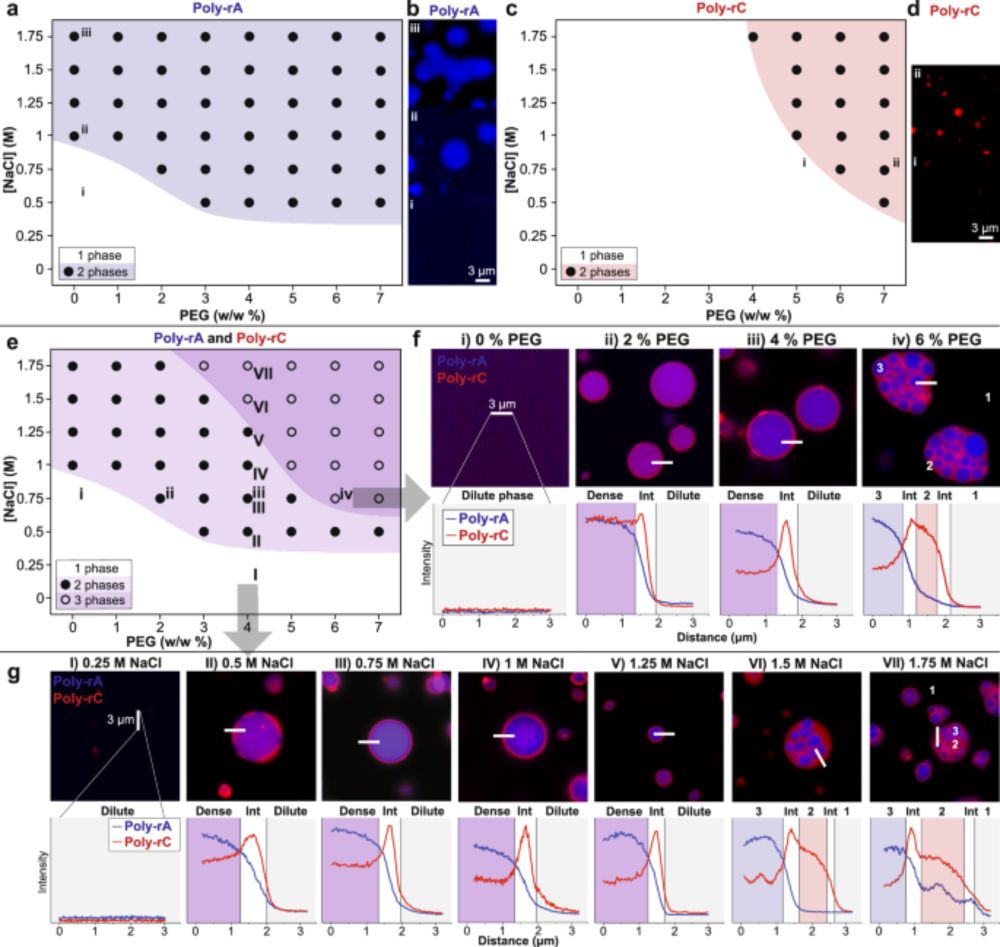
Differential interactions determine anisotropies at interfaces of RNA-based biomolecular condensates - Nature Communications
Experiments and computations show that the organization and dynamics of molecules within and at interfaces of biomolecular condensates are governed by differential interaction strengths leading to the...
www.nature.com
April 11, 2025 at 3:23 PM
We investigated the interfacial orientations of scaffold molecules vs. adsorbents in model condensates formed by pairs of RNA molecules with PEG. Experiments identify purine-rich RNAs as scaffolds & pyrimidine-rich RNAs as adsorbents that undergo wetting transitions.
www.nature.com/articles/s41...
www.nature.com/articles/s41...
Reposted by Seunghwan Choi
Are stress granules crucibles or protective against amyloid fibril formation? Read about our work at Mol Cell: "Tunable metastability of condensates reconciles their dual roles in amyloid fibril formation". Wonderful collaboration with @rohitpappu68.bsky.social and other colleagues (see next post)!
May 29, 2025 at 2:23 PM
Are stress granules crucibles or protective against amyloid fibril formation? Read about our work at Mol Cell: "Tunable metastability of condensates reconciles their dual roles in amyloid fibril formation". Wonderful collaboration with @rohitpappu68.bsky.social and other colleagues (see next post)!
Reposted by Seunghwan Choi

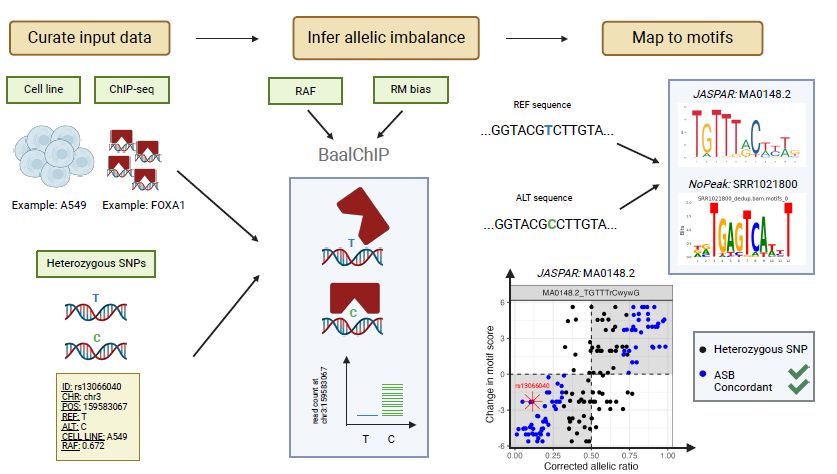
What DNA variants alter transcription factor (TF) binding affinity? Here, we describe a new workflow baal-nf. We used it to trawl through 6017 ChIP-Seq data sets for 558 TFs and 46 genotyped cell lines, finding 298,783 allele-specific binding sites (ASBs).
www.biorxiv.org/content/10.1...
1/2
www.biorxiv.org/content/10.1...
1/2
January 21, 2025 at 8:02 PM
What DNA variants alter transcription factor (TF) binding affinity? Here, we describe a new workflow baal-nf. We used it to trawl through 6017 ChIP-Seq data sets for 558 TFs and 46 genotyped cell lines, finding 298,783 allele-specific binding sites (ASBs).
www.biorxiv.org/content/10.1...
1/2
www.biorxiv.org/content/10.1...
1/2
Reposted by Seunghwan Choi

Do you want to explore the PTMs you identified in your last MS experiment in a fun, interactive way? Try it out on our PTMVision web server at ptmvision-tuevis.cs.uni-tuebingen.de and check out the new publication in JPR at doi.org/10.1021/acs....!
PTMVision
PTMVision: Interactive Visualization of Post Translational Modifications | Understanding the intricate landscape of post-translational
modifications (PTMs) is crucial for unraveling the co...
ptmvision-tuevis.cs.uni-tuebingen.de
January 21, 2025 at 4:02 PM
Do you want to explore the PTMs you identified in your last MS experiment in a fun, interactive way? Try it out on our PTMVision web server at ptmvision-tuevis.cs.uni-tuebingen.de and check out the new publication in JPR at doi.org/10.1021/acs....!
Reposted by Seunghwan Choi
Excited to share our latest preprint evaluating AlphaFold3, Boltz-1, Chai-1 and Protenix for predicting protein-ligand interactions, featuring our newly introduced benchmark dataset 🌹Runs N’ Poses🌹!
www.biorxiv.org/content/10.1...
🧵👇 (1/n)
www.biorxiv.org/content/10.1...
🧵👇 (1/n)

Have protein-ligand co-folding methods moved beyond memorisation?
Deep learning has driven major breakthroughs in protein structure prediction, however the next critical advance is accurately predicting how proteins interact with other molecules, especially small mo...
www.biorxiv.org
February 8, 2025 at 10:02 AM
Excited to share our latest preprint evaluating AlphaFold3, Boltz-1, Chai-1 and Protenix for predicting protein-ligand interactions, featuring our newly introduced benchmark dataset 🌹Runs N’ Poses🌹!
www.biorxiv.org/content/10.1...
🧵👇 (1/n)
www.biorxiv.org/content/10.1...
🧵👇 (1/n)
Reposted by Seunghwan Choi
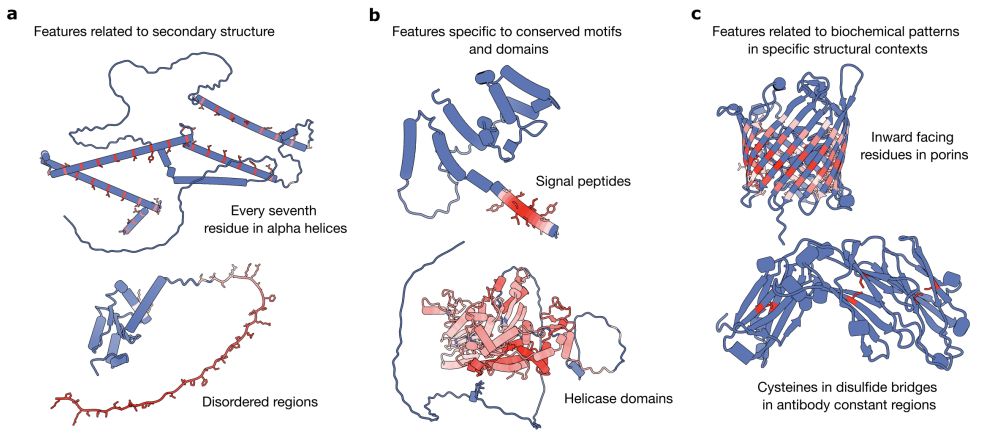
This might be the best paper on applying sparse autoencoders to protein language models. The authors identify how neural networks trained on amino acid sequences "discover" different features, some specific to individual protein families, other for substructures
www.biorxiv.org/content/10.1...
www.biorxiv.org/content/10.1...
February 10, 2025 at 12:15 PM
This might be the best paper on applying sparse autoencoders to protein language models. The authors identify how neural networks trained on amino acid sequences "discover" different features, some specific to individual protein families, other for substructures
www.biorxiv.org/content/10.1...
www.biorxiv.org/content/10.1...
Reposted by Seunghwan Choi

A perturbation proteomics-based foundation model for virtual cell construction https://www.biorxiv.org/content/10.1101/2025.02.07.637070v1
February 10, 2025 at 10:04 PM
A perturbation proteomics-based foundation model for virtual cell construction https://www.biorxiv.org/content/10.1101/2025.02.07.637070v1
Reposted by Seunghwan Choi

Reposted by Seunghwan Choi

It is always best to get scooped on a project before you put much work on it. Really cool preprint by Taylor Mighell and Ben Lehner on the effect of binder molecules on general rescue effect of destabilizing variants. Should work with protein binders as well. www.biorxiv.org/content/10.1...
www.biorxiv.org
December 3, 2024 at 9:18 AM
It is always best to get scooped on a project before you put much work on it. Really cool preprint by Taylor Mighell and Ben Lehner on the effect of binder molecules on general rescue effect of destabilizing variants. Should work with protein binders as well. www.biorxiv.org/content/10.1...
Reposted by Seunghwan Choi

We have released version 2 of AlphaPulldown - a general pipeline for high-throughput structural modeling!
Software: github.com/KosinskiLab/...
Preprint: biorxiv.org/content/10.1...
Software: github.com/KosinskiLab/...
Preprint: biorxiv.org/content/10.1...


December 4, 2024 at 10:02 AM
We have released version 2 of AlphaPulldown - a general pipeline for high-throughput structural modeling!
Software: github.com/KosinskiLab/...
Preprint: biorxiv.org/content/10.1...
Software: github.com/KosinskiLab/...
Preprint: biorxiv.org/content/10.1...
Reposted by Seunghwan Choi
We report many proteins not predicted by the genetic code.
They are stable & abundant O( 10³ ) copies / cell.
Generative mechanisms include codon-anticodon mismatches & RNA modifications.
Their abundance depends on codon frequency & protein stability.
www.biorxiv.org/content/10.1...
They are stable & abundant O( 10³ ) copies / cell.
Generative mechanisms include codon-anticodon mismatches & RNA modifications.
Their abundance depends on codon frequency & protein stability.
www.biorxiv.org/content/10.1...

Alternate RNA decoding results in stable and abundant proteins in mammals
Amino acid substitutions may substantially alter protein stability and function, but the contribution of substitutions arising from alternate translation (deviations from the genetic code) is unknown....
www.biorxiv.org
November 14, 2024 at 9:33 AM
We report many proteins not predicted by the genetic code.
They are stable & abundant O( 10³ ) copies / cell.
Generative mechanisms include codon-anticodon mismatches & RNA modifications.
Their abundance depends on codon frequency & protein stability.
www.biorxiv.org/content/10.1...
They are stable & abundant O( 10³ ) copies / cell.
Generative mechanisms include codon-anticodon mismatches & RNA modifications.
Their abundance depends on codon frequency & protein stability.
www.biorxiv.org/content/10.1...
Reposted by Seunghwan Choi

Great to be posting science again!!
Very proud of this work, thanks to a wonderful collaboration with Forest White lab at MIT, Cantley lab at DFCI, and leb by the amazingly talented @alissandra-hillis.bsky.social! Published as fully @openaccess.bsky.social in PNAS.
www.pnas.org/doi/10.1073/...
Very proud of this work, thanks to a wonderful collaboration with Forest White lab at MIT, Cantley lab at DFCI, and leb by the amazingly talented @alissandra-hillis.bsky.social! Published as fully @openaccess.bsky.social in PNAS.
www.pnas.org/doi/10.1073/...

November 17, 2024 at 7:25 AM
Great to be posting science again!!
Very proud of this work, thanks to a wonderful collaboration with Forest White lab at MIT, Cantley lab at DFCI, and leb by the amazingly talented @alissandra-hillis.bsky.social! Published as fully @openaccess.bsky.social in PNAS.
www.pnas.org/doi/10.1073/...
Very proud of this work, thanks to a wonderful collaboration with Forest White lab at MIT, Cantley lab at DFCI, and leb by the amazingly talented @alissandra-hillis.bsky.social! Published as fully @openaccess.bsky.social in PNAS.
www.pnas.org/doi/10.1073/...