



@sergfdez.bsky.social
Postdoc at @UNCChemistry. Solar Fuels, Electrocatalysis and Reaction Mechanisms. @ICIQchem and @IQCCUdG alumnus.
Reposted
New paper from the CHASE solar hub led by my friends Alex Miller (UNC) and Zahid Ertem (Brookhaven) on catalytic hydrogenation of a metal formyl to a metal carbonyl. Happy to play a small role in addressing this long standing challenge in organometallic chemistry. See pubs.acs.org/doi/full/10....
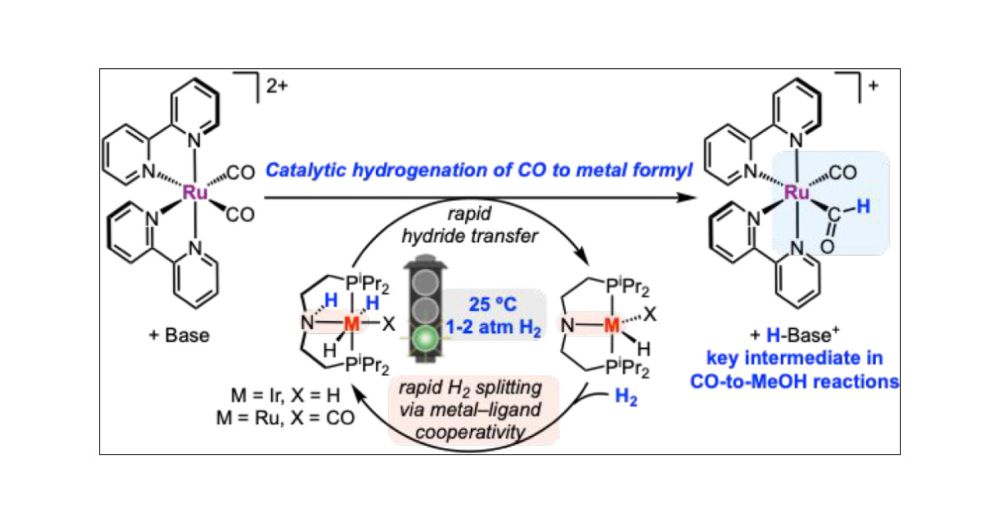
Catalytic Hydrogenation of a Ruthenium Carbonyl to Formyl Enabled by Metal–Ligand Cooperation
Metal formyl complexes are critical intermediates in the reduction of CO to valuable products such as methanol and higher alcohols/hydrocarbons, yet examples of formyl generation via the catalytic hydrogenation of transition metal carbonyl complexes under mild conditions are lacking. The catalytic hydrogenation of a ruthenium carbonyl complex with H2 to produce a formyl complex is reported here. Two classes of hydrogenation catalysts were compared: bis(diphosphine)-ligated complexes that proceed via termolecular H2 splitting with an external base and pincer-ligated complexes that proceed via an H2 splitting mechanism involving metal–ligand cooperativity. The hydride transfer and H2 splitting steps were evaluated for both classes of catalysts, revealing advantages for catalysts that utilize metal–ligand cooperativity and elucidating conditions to promote formyl generation. Only the pincer-ligated Ir and Ru complexes capable of reacting via pathways involving metal–ligand cooperativity were suitable for catalysis. Using 1–10 mol % of the catalysts (PNP)Ir(H)2 and (HPNP)Ru(H)2(CO) (PNP = (iPr2PC2H4)2N–), which use metal–ligand cooperation to activate H2, up to 10 turnovers or up to 71% yield were achieved for the conversion of [Ru(bpy)2(CO)2]2+ (bpy = 2,2′-bipyridine) to the formyl complex [Ru(bpy)2(CO)(CHO)]+. The Lewis acid B(C6F5)3 was required as an additive to achieve high yields of the formyl complex using (HPNP)Ru(H)2(CO) as a catalyst. The catalytic route avoids the use of expensive stoichiometric reagents, such as borohydride, instead generating metal formyls that are key intermediates in CO reduction schemes with H2 gas.
pubs.acs.org
July 22, 2025 at 1:07 PM
New paper from the CHASE solar hub led by my friends Alex Miller (UNC) and Zahid Ertem (Brookhaven) on catalytic hydrogenation of a metal formyl to a metal carbonyl. Happy to play a small role in addressing this long standing challenge in organometallic chemistry. See pubs.acs.org/doi/full/10....