




James Louis Smith
@scrivenersmith.hcommons.social.ap.brid.gy
Research Project Coordinator for the @kbnationalebibliotheek in #DenHaag. Researcher in #EnvironmentalHumanities, #PublicHumanities, #DH and #OA. Occasional […]
🌉 bridged from ⁂ https://hcommons.social/@scrivenersmith, follow @ap.brid.gy to interact
🌉 bridged from ⁂ https://hcommons.social/@scrivenersmith, follow @ap.brid.gy to interact
I have this really big collection of weird obscure ambient music about the deep ocean (ocean grunge, electronica etc) from my #DeepMap #bluehumanities book. I think I'm going to have to write an article about it once I've finished drafting.
December 16, 2025 at 7:43 PM
I have this really big collection of weird obscure ambient music about the deep ocean (ocean grunge, electronica etc) from my #DeepMap #bluehumanities book. I think I'm going to have to write an article about it once I've finished drafting.
Reposted by James Louis Smith

Overnight we hit 800 georeferenced maps from the State Library of Victoria! https://wragge.github.io/slv-allmaps/dashboard.html There's also a couple of new interfaces you can use to explore them.
Just click on a map to find nearby georeferenced maps: https://slv.wraggelabs.com/geomaps/
Or […]
Just click on a map to find nearby georeferenced maps: https://slv.wraggelabs.com/geomaps/
Or […]
Original post on hcommons.social
hcommons.social
December 3, 2025 at 11:20 PM
Overnight we hit 800 georeferenced maps from the State Library of Victoria! https://wragge.github.io/slv-allmaps/dashboard.html There's also a couple of new interfaces you can use to explore them.
Just click on a map to find nearby georeferenced maps: https://slv.wraggelabs.com/geomaps/
Or […]
Just click on a map to find nearby georeferenced maps: https://slv.wraggelabs.com/geomaps/
Or […]
Reposted by James Louis Smith

Free DHy zine alert! @capnpilot.bsky.social's
* "CTRL+S: Preserving Your Work for the Long Haul" (plan, preserve/archive resilient digital projects, so that when time to sunset them, is easy to preserve core attributes)
* "Web-Native Cryptids & Creatures: A Spotter’s Guide" (web safety+literacy)
* "CTRL+S: Preserving Your Work for the Long Haul" (plan, preserve/archive resilient digital projects, so that when time to sunset them, is easy to preserve core attributes)
* "Web-Native Cryptids & Creatures: A Spotter’s Guide" (web safety+literacy)
November 12, 2025 at 11:02 AM
Free DHy zine alert! @capnpilot.bsky.social's
* "CTRL+S: Preserving Your Work for the Long Haul" (plan, preserve/archive resilient digital projects, so that when time to sunset them, is easy to preserve core attributes)
* "Web-Native Cryptids & Creatures: A Spotter’s Guide" (web safety+literacy)
* "CTRL+S: Preserving Your Work for the Long Haul" (plan, preserve/archive resilient digital projects, so that when time to sunset them, is easy to preserve core attributes)
* "Web-Native Cryptids & Creatures: A Spotter’s Guide" (web safety+literacy)
Reposted by James Louis Smith
Kicking off my residency at the SLV LAB with my first blog post. Many more to come! https://updates.timsherratt.org/2025/09/22/creative-technologistinresidence-at-the-state.html #glam #libraries #digitalhumanities

Creative Technologist-in-Residence at the State Library of Victoria!
I’m very excited to be the new Creative Technologist-in-Residence at the SLV LAB. For the next few months I get to play around with metadata and images, think about online access, experiment with different technologies, and build things to help people to explore the State Library’s collections. In other words, I get to be in my happy place!
My group at the recent SLV WikiFest was thinking about ways of helping researchers find resources relating to particular locations – how do I find material about my suburb, or my street? Coincidentally, the main focus of my residency will also be place-based collections, so I get to really think through some of the possibilities. SLV staff have already pointed me to some amazing maps and photographs, such as the Committee for Urban Action collection, the Mahlstedt fire survey maps, the MMBW plans, and the Victorian parish maps.
At the same time, I’ll be using my usual GLAM hacking approach to poke around in the SLV website to try and understand what data is currently available, identify any roadblocks, and document opportunities for computational research.
The results of my residency will be shared on the SLV LAB site, in GitHub, in the SLV section of the GLAM Workbench, and of course here. As usual, I’ll be working in the open, documenting things as I go along, so please join me on the journey!
Although the residency was formally announced today, I’ve actually been working with SLV data for the last couple of weeks and I’ve already got a backlog of stuff I need to blog about. Here’s a taster – what happens when you generate bounding boxes for thousands of parish maps from the available metadata and throw them on a map…?
updates.timsherratt.org
September 22, 2025 at 1:22 PM
Kicking off my residency at the SLV LAB with my first blog post. Many more to come! https://updates.timsherratt.org/2025/09/22/creative-technologistinresidence-at-the-state.html #glam #libraries #digitalhumanities
Reposted by James Louis Smith

AI-Generated “Workslop” Is Destroying Productivity https://hbr.org/2025/09/ai-generated-workslop-is-destroying-productivity

人工智能生成的 "工作圈 "正在摧毁生产力?
AI-generated “workslop” is destroying productivity? (hbr.org)
02:07 ↑ 104 HN Points
hbr.org
September 23, 2025 at 11:01 AM
AI-Generated “Workslop” Is Destroying Productivity https://hbr.org/2025/09/ai-generated-workslop-is-destroying-productivity
Reposted by James Louis Smith

With the launch of Ghost 6.0, every publication that runs on Ghost becomes part of the #fediverse. You can follow and comment on Platformer or 404 Media articles without leaving your Mastodon feed. This is the future of social media.
Congratulations to @johnonolan and all the team at Ghost!
Congratulations to @johnonolan and all the team at Ghost!
August 4, 2025 at 2:17 PM
With the launch of Ghost 6.0, every publication that runs on Ghost becomes part of the #fediverse. You can follow and comment on Platformer or 404 Media articles without leaving your Mastodon feed. This is the future of social media.
Congratulations to @johnonolan and all the team at Ghost!
Congratulations to @johnonolan and all the team at Ghost!
Reposted by James Louis Smith
Hulk Hogan Was a Very Bad Man https://jacobin.com/2025/07/hulk-hogan-wrestling-trump-mcmahon/

Hulk Hogan Was a Very Bad Man
Hulk Hogan, who died this week at age 71, was the most important professional wrestler who ever lived. He was also a terrible human being.
jacobin.com
July 26, 2025 at 3:58 PM
Hulk Hogan Was a Very Bad Man https://jacobin.com/2025/07/hulk-hogan-wrestling-trump-mcmahon/
Reposted by James Louis Smith
Morrison's Job Ready Graduates scheme continues to damage the humanities in Australia, but Albo does nothing. Sign/share this petition from the Australian Historical Association to repeal JRG now! […]
Original post on hcommons.social
hcommons.social
July 28, 2025 at 1:01 AM
Morrison's Job Ready Graduates scheme continues to damage the humanities in Australia, but Albo does nothing. Sign/share this petition from the Australian Historical Association to repeal JRG now! […]
Reposted by James Louis Smith
For 30 years I've been experimenting with ways to see & use the online collections of libraries, archives & museums. I've made useful things, playful things, & weird things. Here's a big list of them for you to explore! https://wraggelabs.com #glam #histodons #digitalhumanities
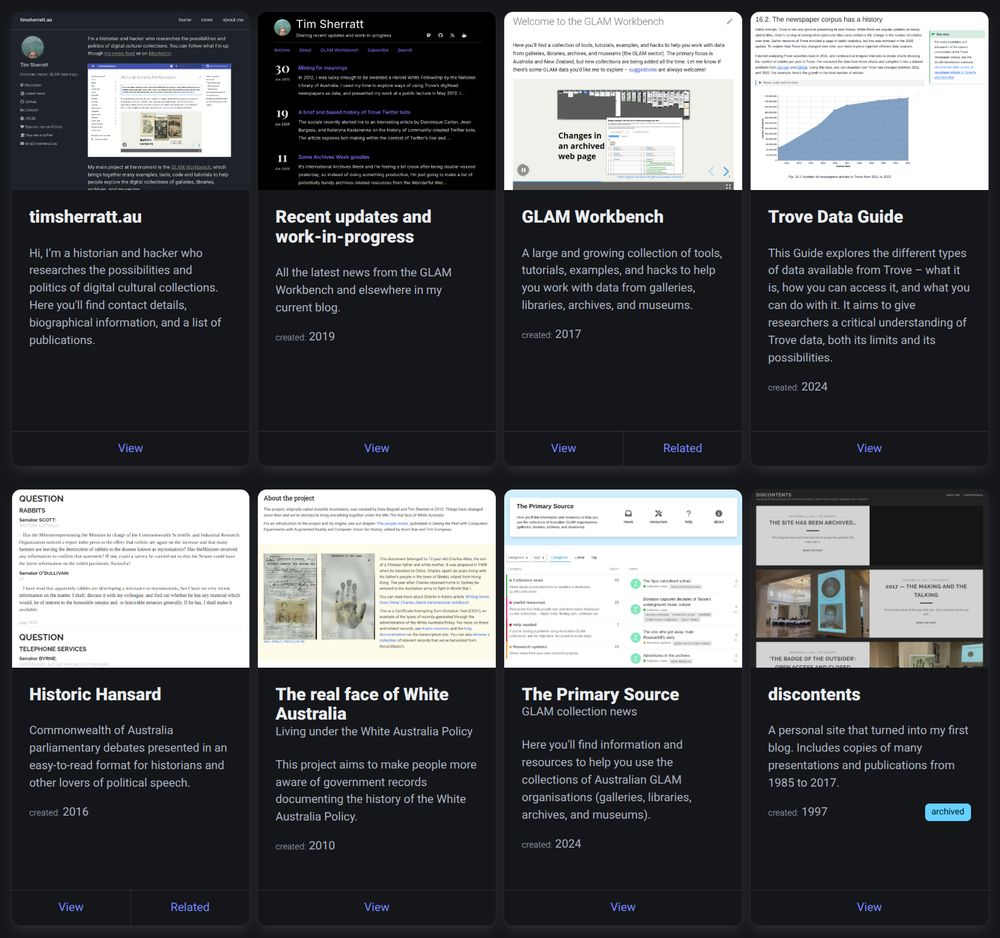
Wragge Labs
A compilation of things I've built over the last 30 years to help people see and use the online collections of libraries, archives, and museums.
wraggelabs.com
July 4, 2025 at 6:12 AM
For 30 years I've been experimenting with ways to see & use the online collections of libraries, archives & museums. I've made useful things, playful things, & weird things. Here's a big list of them for you to explore! https://wraggelabs.com #glam #histodons #digitalhumanities
Reposted by James Louis Smith
I'm digging around in old projects and (re)discovered a whole series of tiles I created from 10 x 10 pixel thumbnails of all the images in the National Museum of Australia collection.

June 26, 2025 at 1:15 PM
I'm digging around in old projects and (re)discovered a whole series of tiles I created from 10 x 10 pixel thumbnails of all the images in the National Museum of Australia collection.
Reposted by James Louis Smith
#JobAlert! Postdoctoral Research Associate in Pacific History (full-time, 3 years fixed term) at University of Sydney: https://usyd.wd105.myworkdayjobs.com/en-GB/USYD_EXTERNAL_CAREER_SITE/job/Camperdown-Campus/Postdoctoral-Research-Associate-in-Pacific-History_0134567-2 #histodons

Postdoctoral Research Associate in Pacific History
Full time, fixed term for 3 years Opportunity for research in Pacific history in the Discipline of History First Nations and Pacific Nations candidates strongly encouraged to apply Academic Level A6-8, Base Salary $109,301 - $116,679 + 17% superannuation Start January 2026 About the opportunity The School of Humanities is inviting applications for the G.C. Henderson Postdoctoral Research Fellow in Pacific History to undertake research in Pacific History. As a Postdoctoral Research Fellow Pacific History, you will conduct community-led and/or community-engaged research in Indigenous and Pacific History in the Discipline of History, aligning with our research strategy in several key areas, including imperial and colonial studies, Indigenous studies, de-colonial studies, and Asia-Pacific Studies. This role will also align with the research strategy of the Vere Gordon Childe Centre for the Study of Humanity through Time. The successful candidate will be expected to contribute to the research and teaching activities of the Discipline of History, including limited teaching responsibilities to be determined in consultation with the Chair of Discipline. This may include Honours supervision, Honours seminar teaching, or a first-year History Workshop based on your own interest. You will also contribute to outreach and engagement programs in the discipline. About you a PhD in History or a related discipline experience in conducting original research excellent oral and written communication skills experience working with First Nations or other source communities Sponsorship / work rights for Australia Visa sponsorship is available. Pre-employment checks Your employment is conditional upon the completion of all role required pre-employment or background checks in terms satisfactory to the University. Similarly, your ongoing employment is conditional upon the satisfactory maintenance of all relevant clearances and background check requirements. If you do not meet these conditions, the University may take any necessary step, including the termination of your employment. EEO statement At the University of Sydney, our shared values are trust, accountability and excellence and we strive to be a place where everyone can thrive. We are committed to creating a University community that thrives through diversity and reflects the wider community that we serve. We deliver on this through our commitment to diversity and inclusion, evidenced by our people and culture programs, as well as key strategies to increase participation and support the careers of Aboriginal and Torres Strait Islander People, women, people living with a disability, people from culturally and linguistically diverse backgrounds, and those who identify as LGBTIQ+. We welcome applications from candidates from all backgrounds. We are proud to be recognised as an Australian Workplace Equality Index (AWEI) Gold employer. Find out more about our work on diversity and inclusion. How to apply Applications can be submitted via the Apply button at the top of the page. Please supply the following documents in support of your application: CV Cover letter Names and contact details of two academic references Personal statement (1000 words) which addresses your positionality and commitment to research in Pacific History. For employees of the University or contingent workers, please login into your Workday account and navigate to the Career icon on your Dashboard. Click on USYD Find Jobs and apply. For a confidential discussion about the role, or if you require reasonable adjustment or any documents in alternate formats, please contact Lena Jiang, Recruitment Operations by email to lena.jiang@sydney.edu.au. © The University of Sydney The University reserves the right not to proceed with any appointment. Click to view the Position Description for this role. Applications Close Sunday 15 June 2025 11:59 PM Our team is expanding, and we want to hire the most talented people we can. Continued success depends on it! So once you've had a chance to explore our current open positions, apply to the ones you feel suit you best and keep track of both your progress in the selection process, and new postings that might interest you! The University values are excellence, trust and accountability. The University of Sydney is committed to diversity and social inclusion. Applications from people of culturally and linguistically diverse backgrounds; equity target groups including women, people with disabilities, people who identify as LGBTIQ; and people of Aboriginal and Torres Strait Islander descent, are encouraged. The University reserves the right not to proceed with any appointment. The University of Sydney may conduct routine pre-employment checks before an appointment is made. Want to know more about working at the University of Sydney? https://www.sydney.edu.au/about-us.html
usyd.wd105.myworkdayjobs.com
May 28, 2025 at 2:20 AM
#JobAlert! Postdoctoral Research Associate in Pacific History (full-time, 3 years fixed term) at University of Sydney: https://usyd.wd105.myworkdayjobs.com/en-GB/USYD_EXTERNAL_CAREER_SITE/job/Camperdown-Campus/Postdoctoral-Research-Associate-in-Pacific-History_0134567-2 #histodons
Reposted by James Louis Smith

Enjoying 90 mins away from the coalface with @simonxix @scrivenersmith @copim and others, to hear more about new frontiers in (scholarly) publishing, e.g. harnessing markdown, deploying Juncture, peer review via GitHub, Linked Open Data, WikiData, and other animals... Juicy! Noice! 😀 […]
Original post on code4lib.social
code4lib.social
May 23, 2025 at 1:44 PM
Enjoying 90 mins away from the coalface with @simonxix @scrivenersmith @copim and others, to hear more about new frontiers in (scholarly) publishing, e.g. harnessing markdown, deploying Juncture, peer review via GitHub, Linked Open Data, WikiData, and other animals... Juicy! Noice! 😀 […]
Reposted by James Louis Smith
For the sake of my health, I’ve decided to stop work on Trove, archive all my code repositories related to Trove, and move on. Farewell Trove... https://updates.timsherratt.org/2025/05/07/farewell-trove.html
Farewell Trove
Over the last few months I’ve been grappling with the cancellation of my Trove API keys by the National Library of Australia. It may seem like a minor technical hiccup from the outside, but it’s had a major personal impact. For the sake of my health, I’ve decided to stop work on Trove, archive all my code repositories related to Trove, and move on. Farewell Trove.
But don’t panic! All of my Trove tools and resources available through the GLAM Workbench and elsewhere will remain online. They just won’t be updated. I’ll be adding explanatory notices to the affected resources over coming weeks. All of my stuff is openly licensed, so feel free to take what’s useful and develop it further yourself.
I’ll also be adding warnings for researchers planning to use the Trove API in their projects. Given the fact that the NLA is willing to change the API terms of use to restrict access without any consultation, provides no transparency around acceptable use of full text content, and is willing to cancel API keys without warning, I can no longer recommend Trove as a reliable source for digital research. A PhD student could embark on a project in good faith, only to have the rules change mid-project.
I think this is a critical issue for the research sector, and hard questions need to be asked of the NLA. But I can’t be the one to do this any more. I’m sick of being the person calling the NLA out on its bad behaviour. I’m sick of their gaslighting.
I wanted to avoid making any dramatic gestures, but after talking it over with my partner last night, I realised my health is really suffering and I need to make a change. I also realised that even if my API keys were magically restored, I’d always be looking over my shoulder, wondering if I’d done something to offend the NLA gatekeepers. That’s not a good way to live. I’d rather spend my time working with organisations who value what I do.
updates.timsherratt.org
May 7, 2025 at 4:18 AM
For the sake of my health, I’ve decided to stop work on Trove, archive all my code repositories related to Trove, and move on. Farewell Trove... https://updates.timsherratt.org/2025/05/07/farewell-trove.html
Reposted by James Louis Smith
Who needs AI text-generation when there’s Erasmus of Rotterdam | Aeon Essays https://aeon.co/essays/who-needs-ai-text-generation-when-theres-erasmus-of-rotterdam

Who needs AI text-generation when there’s Erasmus of Rotterdam | Aeon Essays
Like today’s large language models, 16th-century humanists had techniques to automate writing – to the detriment of novelty
aeon.co
May 3, 2025 at 12:44 PM
Who needs AI text-generation when there’s Erasmus of Rotterdam | Aeon Essays https://aeon.co/essays/who-needs-ai-text-generation-when-theres-erasmus-of-rotterdam
Reposted by James Louis Smith
The National Library of Wales has shared 130,000 images of Welsh life from the 1940s to the early 70s, taken by photo-journalist Geoff Charles, through Wikimedia Commons with an open licence […]
Original post on hcommons.social
hcommons.social
April 28, 2025 at 2:33 AM
The National Library of Wales has shared 130,000 images of Welsh life from the 1940s to the early 70s, taken by photo-journalist Geoff Charles, through Wikimedia Commons with an open licence […]
Reposted by James Louis Smith
So broadly speaking, if you were creating a collaborative #digitalgarden for #Research ideas then what features would you want it to have? #Research #digitalhumanities #ideas #design #collaboration #glam #collections
March 18, 2025 at 2:19 PM
So broadly speaking, if you were creating a collaborative #digitalgarden for #Research ideas then what features would you want it to have? #Research #digitalhumanities #ideas #design #collaboration #glam #collections
Reposted by James Louis Smith
It's been four weeks now since the National Library of Australia suspended my API keys, forcing all my work on #trove to stop: https://updates.timsherratt.org/2025/02/24/years-of-work-on-trove.html #glam #openglam #histodons #digitalhumanities
15 years of work on Trove threatened by the NLA
On Friday, without warning, I received an email from the National Library of Australia informing me that my Trove API keys had been suspended. This threatens the future of 15 years of work helping people use and understand the possibilities of Trove for new types of research.
## What’s happened?
Here’s the full text of the email:
> Your recently published work on the GLAM Workbench regarding extracting metadata and text from a National e-Deposit (NED) periodical has been brought to the Library’s attention.
>
> Trove API Terms of Use specify that developers may access metadata only and do not provide extended rights. We consider the use of an API to extract and save full text as being in violation of the Terms of Use.
>
> Effective immediately, the four API keys currently registered to you: glamworkbench, headlineroulette, troveconsole and wragge will be suspended.
>
> Please feel free to get in touch for a more detailed conversation about this.
The reasons given for switching off my access don’t make any sense. While the API terms of use only mention metadata, the API, by design, delivers full text from newspapers, digitised periodicals and some books. If you interpret the terms of use as above, simply using the API **as it has been designed and documented** would be seen as a breach! Surely that’s nonsense.
In any case, the notebook they mention doesn’t even use the Trove API, so it’s hard to see how it could breach the API terms of use. I extracted the text from the periodicals simply by downloading the PDFs and using a standard PDF library. The notebook does scrape some metadata from the Trove website. This is necessary because the API has major limitations – you can’t, for example, get the members of a digitised collection. The NLA might want to argue that scraping breaches the website’s terms of use, but that’s a different point. I’d also note that I’ve been scraping data from the Trove website for 15 years without any objections (see below for more).
When I was Trove manager, I drafted a previous version of the API terms of use. It was a lot less legalistic back then, and I’ve always understood that the point of the API and website terms of use were to protect the NLA from exploitation by commercial interests, not to inhibit work done by researchers in good faith.
I developed the NED notebook in response to a request for help by a community group that uses the National eDeposit service to preserve its newsletter. I did it for free, and I documented the results in the GLAM Workbench in case it might be of use to other communities and researchers.
The ‘has been brought to the Library’s attention’ bit is also grimly amusing. Everything I do is open, and wherever possible I tag GLAM organisations on social media to let them know I’m making use of their collections. The email makes it sound like I was trying to hide what I was doing, when in fact I tagged them on Facebook and LinkedIn. I was thought they might be interested, and I suppose they were, just not in the way I hoped.
## What’s at risk?
What’s the consequence of switching off my API keys? A few long-running services were broken immediately. Others will continue to work, but I’ll be unable to maintain them over time. Obviously I won’t be able to develop new Trove-related resources, and perhaps most importantly, my ability to help researchers with their Trove problems will be severely limited.
Tools and services that were broken immediately:
* The Trove API Console – running since 2014, the API console has helped many people learn to use the API. I created it when I was Trove Manager, and it’s still linked from Trove’s Create something page.
* The Trove Newspaper Data Dashboard (and related data harvests) – running since 2022, the data dashboard enables researchers to understand how the Trove newspaper corpus changes over time. The dashboard depends on weekly data harvests that can no longer run, so there will be no further updates. Similarly other automated data harvests capturing and sharing data about Trove categories and contributors are now broken.
* @troveNewsBot – created back in 2013, the bot has survived changes to the Trove API, the demise of Twitter, and a recent forced change of Mastodon instances, but it can’t work without an API key. I’m already missing it’s regular posts.
* Headline Roulette – just a simple game, but a fun way to start a workshop and get people thinking about the possibilities of Trove, it’s been running since 2010.
Tools and resources that I won’t be able to update or maintain:
* The GLAM Workbench includes **more than 80 Jupyter notebooks** that demonstrate how to work with data from Trove. Most of these require an API key. Fortunately users will still be able to use them with their own keys, but I won’t be able to do any further development or testing. This includes tools like QueryPic that I’ve been maintaining since 2013 and is cited in the research literature.
* The GLAM Workbench also includes **more than 30 datasets** capturing information about Trove. Some document changes in things like text correction, and the use of tags, while others provide alternative entry points to important collections of digitised resources, such as oral histories and maps. I won’t be to update any of these datasets.
* The Trove Data Guide incorporates many visualisations and summaries generated from Trove data. I won’t be able to update these. There are also many API examples that link to the now broken API console.
* trove-newspaper-harvester is a Python package that’s existed in different forms since 2010. It’s used by researchers to create datasets of newspaper articles and has been cited a number of times in the research literature. It won’t be immediately affected because users supply their own API keys, but I won’t be able to maintain it into the future.
* Trove places is a map based interface to Trove’s newspapers. It’s dependent on data harvested using the API, so I won’t be able to update it.
Planned developments I won’t be able to undertake:
* I had hoped this year to automate more data harvests so I could, for example, provide regular updates on digitised collections such as books, periodicals, and maps.
* I was planning to add a number of new sections to the Trove Data Guide, including maps, photos, ephemera, and manuscripts.
* I was intending to update the trove-newspaper-harvester to make it possible to identify and capture changes in a results set.
I’m very disappointed that the automated data harvests are now broken. As I suggested in this post, I think it’s important that we capture information about online collections so that future researchers will be able to investigate their impact. I’ve been working to streamline, standardise, and automate this data collection, both through the weekly harvests and the Trove historical data collection in Zenodo. But this will now stop.
Most disappointing of all, however, is that without an API key I won’t be able to help researchers who come to me asking how to get data out of Trove. In finding solutions to their problems I often end up creating new notebooks so that the knowledge can be shared and all researchers can benefit. I won’t be able to do this any more.
The GLAM Workbench includes a list of published research articles that cite the GLAM Workbench or one of its associated tools, such as QueryPic and the Trove Newspaper Harvester. Many of these publications have used my tools to work with data from Trove. This sort of research will suffer if the tools can’t be maintained.
Of course, all of my work is openly licensed and freely available through GitHub and Zenodo. If I can’t maintain the code, hopefully others will jump in and take over.
## Trove and me
I started scraping data from the digitised newspapers in 2009, before they were even a part of Trove. In 2010, I created the first versions of QueryPic and the Trove Newspaper Harvester. There was no API then, so I built a library of screen scrapers to extract the data. I ended up publishing my own ‘unofficial’ API using the screen scrapers. I found out later that my ‘unofficial ' API was used in the design of the official version that became available in 2012.
The work I was doing analysing digitised newspapers won me the NLA’s Harold White Fellowship in 2012. In 2013, I was appointed Trove Manager. Throughout my time at the NLA I lived something of a double life – manager by day, hacker by night. I continued to build tools and demonstrations to help people understand what the API made possible. Talking about the API and the new types of research that Trove opened up was one of the favourite parts of my job.
Nothing much changed after I left the library. I continued to build tools, help researchers, and give talks and workshops on the possibilities of Trove data. In 2017, I started to bring a lot of this work together within the GLAM Workbench. In 2023-24, I worked with the Australian Research Data Commons to develop the Trove Data Guide, documenting what I knew about Trove’s intricacies and inconsistencies.
My point really is that I’ve been doing this for 15 years now. Everything has been in the open, my approach has never really changed, and some of the work was actually supported by the NLA. So what’s different now?
Certainly the NLA’s attitude has changed. When I was Trove manager we used to celebrate the interesting things that people did with the Trove API. In contrast, the NLA has never publicly acknowledged that the GLAM Workbench exists, and certainly hasn’t shared any links to it. This was taken to ludicrous extremes in 2021, when the NLA’s draft project plan for funding as part of the ARDC’s HASS Research Data Commons proposed to duplicate tools already available through the GLAM Workbench. Just a few months earlier in December 2020, the GLAM Workbench won the British Library Labs Research Award. It’s strange that there has been much more engagement with the GLAM Workbench from national libraries in Europe than Australia.
I don’t know why this is, but it has been immensely frustrating, even heart-breaking. I do the work I do to help people use and understand Trove. But how do they find out about it? You’d think that the NLA would be pleased to support researchers by pointing them to tools and resources that would help them make best use of Trove. You’d think that the NLA would be thrilled to have people spending their own time and money to build and maintain those resources. But no.
It seems to me that the NLA has become increasingly closed off and defensive in recent years. Perhaps that’s to be expected given the funding pressures they’ve faced. But in challenging times you’d think it was more important than ever to bring together your supporters.
Much of my work does involve criticism of Trove. It’s an unwieldy beast, with many problems and inconsistencies. It’s part of my job (mission? calling?) to expose these problems and help users work around them. It wouldn’t help anyone for me to ignore Trove’s shortcomings. My criticisms come with suggestions and solutions. My aim is not to undermine, but encourage – to guide people past the many pitfalls and challenges to find the treasure within.
Back in November 2016, on the day after Trump’s first election victory, I gave a short presentation at the ‘Digital Directions’ conference in Canberra. The main point of my talk, entitled ‘Caring about access’, was that GLAM organisations should embrace criticism. Here’s part of what I said:
> Access is not something that cultural institutions bestow on a grateful public. It’s a struggle for understanding and meaning. Expect to be criticised, expect problems to be found, expect your prejudices to be exposed. That’s the point.
>
> If cultural institutions want to celebrate their website hits, celebrity visits, or their latest glossy magazines – well that’s just fabulous. But I’d like them to celebrate every flaw that’s found in their data, every gap identified in their collection – that’s engagement, that’s access. We need to get beyond defensive posturing and embrace the risky, exciting possibilities that come from critical engagement with collection data – recognising hacking as a way of knowing.
>
> In this new post-truth world it’s going to be more important than ever to challenge what is given, what is ‘natural’, what is ‘inevitable’. Our cultural heritage will be a crucially important resource to be mobilised in defence of complexity, nuance, and doubt – the rich and glorious reality of simply being human.
The early part of that 2016 was dominated by the #fundTrove campaign, when Trove users mobilised to make the government aware of its importance to the Australian community. It took over my life for a while, and while many were keen to claim credit for the campaign’s ultimate success, it left me thinking that GLAM organisations need to better understand who their real friends are – the people who actually give a shit. It seems that the NLA is still struggling with that.
## So what now?
I have to admit that the NLA’s inability to acknowledge the existence of the GLAM Workbench has taken an emotional toll. At times I’ve considered giving up the work. Why bother if it’s not going to get to the people who might benefit most?
So at this moment I don’t feel like arguing with the NLA. If they think so little of my work that they’re happy to simply pull the plug and let it die, then what’s the point in trying to continue?
However, there’s a bigger issue. Whatever happens to my work, it’s important that this _type_ of work be encouraged and supported. Trove offers immense possibilities for new types of research and we need to explore and document them together. Central to this is a well-supported API. I’m worried that this little battle is actually a sign of waning commitment to the API and what it represents. Earlier this year I was shocked when the NLA suddenly decommissioned version 2 of the API without fixing major bugs in version 3. I think we need to stress that easy access to Trove data is vitally important to the future of Australian HASS research.
So if you’ve used any of my tools or resources, or value the work I’ve been doing over the last 15 years, you might like to tell the NLA about it. I don’t know if it’ll make any difference, but at least they’ll be better informed about the sorts of things people are doing with Trove data, and the types of resources that are needed to support them.
Contact options:
* Trove feedback form
* Marie-Louise Ayres, Director-General of the NLA (directorgeneral@nla.gov.au)
* Tony Burke, Minister for the Arts (tony.burke.mp@aph.gov.au)
Of course you can also share your thoughts on social media!
updates.timsherratt.org
March 21, 2025 at 3:25 AM
It's been four weeks now since the National Library of Australia suspended my API keys, forcing all my work on #trove to stop: https://updates.timsherratt.org/2025/02/24/years-of-work-on-trove.html #glam #openglam #histodons #digitalhumanities
So broadly speaking, if you were creating a collaborative #digitalgarden for #Research ideas then what features would you want it to have? #Research #digitalhumanities #ideas #design #collaboration #glam #collections
March 18, 2025 at 2:19 PM
So broadly speaking, if you were creating a collaborative #digitalgarden for #Research ideas then what features would you want it to have? #Research #digitalhumanities #ideas #design #collaboration #glam #collections
Reposted by James Louis Smith
An interview about my Markdown writing in progress for the Deep Maps: Blue Humanities project: https://doi.org/10.21428/785a6451.fd1f9fe1 @copim #markdown #experimentalpublishing #deepmaps #bluehumanities
September 25, 2024 at 1:39 PM
An interview about my Markdown writing in progress for the Deep Maps: Blue Humanities project: https://doi.org/10.21428/785a6451.fd1f9fe1 @copim #markdown #experimentalpublishing #deepmaps #bluehumanities
Reposted by James Louis Smith
Facebook Is Desperately Trying to Keep You From Learning What's in This Book https://futurism.com/facebook-stop-book

Facebook Is Desperately Trying to Keep You From Learning What's in This Book
Meta is desperately fighting to stop you from reading some bombshell allegations made against it in a new memoir — and right now, it's winning. On Wednesday, the Mark Zuckerberg-owned company prevailed in an arbitration case, the outcome of which temporarily prohibits the memoir's author, former employee Sarah Wynn-Williams, from promoting or distributing her book, the New York Times reports. The memoir, "Careless People: A Cautionary Tale of Power, Greed, and Lost Idealism," released this week, details the sexual harassment that Wynn-Williams faced from senior Meta executives, ripping into its toxic workplace culture and providing a behind the scenes look […]
futurism.com
March 14, 2025 at 5:57 AM
Facebook Is Desperately Trying to Keep You From Learning What's in This Book https://futurism.com/facebook-stop-book
A new blog post about the forthcoming experimental #github peer review project for my #experimentalpublishing #bluehumanities book: https://doi.org/10.21428/785a6451.46761718 @copim @kbnationalebibliotheek #Writing #review #design

March 14, 2025 at 3:05 PM
A new blog post about the forthcoming experimental #github peer review project for my #experimentalpublishing #bluehumanities book: https://doi.org/10.21428/785a6451.46761718 @copim @kbnationalebibliotheek #Writing #review #design
Reposted by James Louis Smith
New #openaccess special collection from the Open Library of Humanities, 'Cultural Heritage Data for Research: Opening Museum Collections, Project Data and Digital Images for Research, Query and Discovery' : https://olh.openlibhums.org/collections/905/ #glam #museums #collectionsasdata
Open Library of Humanities |
Collection:
olh.openlibhums.org
March 4, 2025 at 12:00 AM
New #openaccess special collection from the Open Library of Humanities, 'Cultural Heritage Data for Research: Opening Museum Collections, Project Data and Digital Images for Research, Query and Discovery' : https://olh.openlibhums.org/collections/905/ #glam #museums #collectionsasdata
Interested in #deepmaps and #markdown? Join us on 23 May 2025, 15:00-16:30 CET: https://copim.pubpub.org/pub/mukedux8/release/1 #experimentalpublishing #Writing #design @kbnationalebibliotheek @copim

March 3, 2025 at 1:55 PM
Interested in #deepmaps and #markdown? Join us on 23 May 2025, 15:00-16:30 CET: https://copim.pubpub.org/pub/mukedux8/release/1 #experimentalpublishing #Writing #design @kbnationalebibliotheek @copim
Reposted by James Louis Smith
Help! On Friday the National Library of Australia suspended my Trove API keys, threatening 15 year's work helping researchers use & understand Trove. If you use my tools or value my work you might like to let the NLA know. Details here […]
Original post on hcommons.social
hcommons.social
February 24, 2025 at 1:11 AM
Help! On Friday the National Library of Australia suspended my Trove API keys, threatening 15 year's work helping researchers use & understand Trove. If you use my tools or value my work you might like to let the NLA know. Details here […]
Reposted by James Louis Smith

oh-kay phew. some final cleanup, and then it's time to launch the alpha of this torrent tracker designed for rapid-response data rescue where a bunch of people each scrape chunks of a big thing and then recombine it later, where nobody can store the whole thing in one place because it's too big […]
[Video] Original post on neuromatch.social
neuromatch.social
February 23, 2025 at 7:47 AM
oh-kay phew. some final cleanup, and then it's time to launch the alpha of this torrent tracker designed for rapid-response data rescue where a bunch of people each scrape chunks of a big thing and then recombine it later, where nobody can store the whole thing in one place because it's too big […]