




Sahil Lall
@sahil-lall.bsky.social
Interested in the barrier of cellular membranes and proteins therein; ❤️ dynamics and signaling
It has been a crazy week with the publication of two (!) de novo designed ion channels.
What a diwali 😀
What a diwali 😀

October 25, 2025 at 5:46 AM
It has been a crazy week with the publication of two (!) de novo designed ion channels.
What a diwali 😀
What a diwali 😀
Our latest work is out as a preprint.

The longer transmembrane helices of class I viral fusion proteins may facilitate viral fusion https://www.biorxiv.org/content/10.1101/2025.09.25.678357v1
October 3, 2025 at 7:38 PM
Our latest work is out as a preprint.
A harpoon like fusion domain holds the host membrane while the virus fuses with the host.
How does the fusion domain engage and insert into the host cell membrane? How is the fusion harpoon stabilized? How is the harpoon stored before it can be deployed?
pubmed.ncbi.nlm.nih.gov/40555792/
How does the fusion domain engage and insert into the host cell membrane? How is the fusion harpoon stabilized? How is the harpoon stored before it can be deployed?
pubmed.ncbi.nlm.nih.gov/40555792/

June 27, 2025 at 9:41 AM
A harpoon like fusion domain holds the host membrane while the virus fuses with the host.
How does the fusion domain engage and insert into the host cell membrane? How is the fusion harpoon stabilized? How is the harpoon stored before it can be deployed?
pubmed.ncbi.nlm.nih.gov/40555792/
How does the fusion domain engage and insert into the host cell membrane? How is the fusion harpoon stabilized? How is the harpoon stored before it can be deployed?
pubmed.ncbi.nlm.nih.gov/40555792/
There are thousands of academic journals, and these numbers involve many assumptions. But, the global OA burden was around 5% (3.5 to 7%) in 2019
Roghly $1 bn of the total science scholarly publishing market $28 bn
Roghly $1 bn of the total science scholarly publishing market $28 bn
January 27, 2025 at 5:34 AM
There are thousands of academic journals, and these numbers involve many assumptions. But, the global OA burden was around 5% (3.5 to 7%) in 2019
Roghly $1 bn of the total science scholarly publishing market $28 bn
Roghly $1 bn of the total science scholarly publishing market $28 bn
Very useful "rules"
Ten simple rules for developing good reading habits during graduate school and beyond
To me, the most important are:
Read often, read broadly (incl. older papers and outside your field), and learn to read some papers in detail and others more superficially (and quickly)
To me, the most important are:
Read often, read broadly (incl. older papers and outside your field), and learn to read some papers in detail and others more superficially (and quickly)
January 27, 2025 at 3:18 AM
Very useful "rules"
In 2020, during COVID lockdown we distracted ourselves by dunking the SARS-CoV-2 spike protein in membranes (atomistic and martini)
The outcome just got published🧵👇
Sequence of the SARS-CoV-2 Spike Transmembrane Domain Encodes Conformational Dynamics
pubs.acs.org/doi/10.1021/...
The outcome just got published🧵👇
Sequence of the SARS-CoV-2 Spike Transmembrane Domain Encodes Conformational Dynamics
pubs.acs.org/doi/10.1021/...

Sequence of the SARS-CoV-2 Spike Transmembrane Domain Encodes Conformational Dynamics
The homotrimeric SARS-CoV-2 spike protein enables viral infection by undergoing a large conformational transition, which facilitates the fusion of the viral envelope with the host cell membrane. The spike protein is anchored to the SARS-CoV-2 envelope by its transmembrane domain (TMD), composed of three TM helices, each contributed by one of the protomers of spike. Although the TMD is known to be important for viral fusion, whether it is a passive anchor of the spike or actively promotes fusion remains unknown. Specifically, it is unclear if the TMD and its dynamics facilitate the prefusion to postfusion conformational transition of the spike. Here, we computationally study the dynamics and self-assembly of the SARS-CoV-2 spike TMD in homogeneous POPC and cholesterol containing membranes. Atomistic simulations of a long TM helix-containing protomer segment show that the membrane-embedded segment bobs, tilts and gains and loses helicity, locally thinning the membrane. Coarse-grained multimerization simulations using representative TM helix structures from the atomistic simulations exhibit diverse trimer populations whose architecture depends on the structure of the TM helix protomer. While a symmetric conformation reflects the symmetry of the resting spike, an asymmetric TMD conformation could promote membrane fusion through the stabilization of a fusion intermediate. Together, our simulations demonstrate that the sequence and length of the SARS-CoV-2 spike TM segment make it inherently dynamic, that trimerization does not abrogate these dynamics and that the various observed TMD conformations may enable viral fusion.
pubs.acs.org
December 19, 2024 at 8:32 AM
In 2020, during COVID lockdown we distracted ourselves by dunking the SARS-CoV-2 spike protein in membranes (atomistic and martini)
The outcome just got published🧵👇
Sequence of the SARS-CoV-2 Spike Transmembrane Domain Encodes Conformational Dynamics
pubs.acs.org/doi/10.1021/...
The outcome just got published🧵👇
Sequence of the SARS-CoV-2 Spike Transmembrane Domain Encodes Conformational Dynamics
pubs.acs.org/doi/10.1021/...
Twitter (X) highlights metric removed from bioRxiv

November 26, 2024 at 6:37 AM
Twitter (X) highlights metric removed from bioRxiv

Interesting data.. seems to match my personal experience..

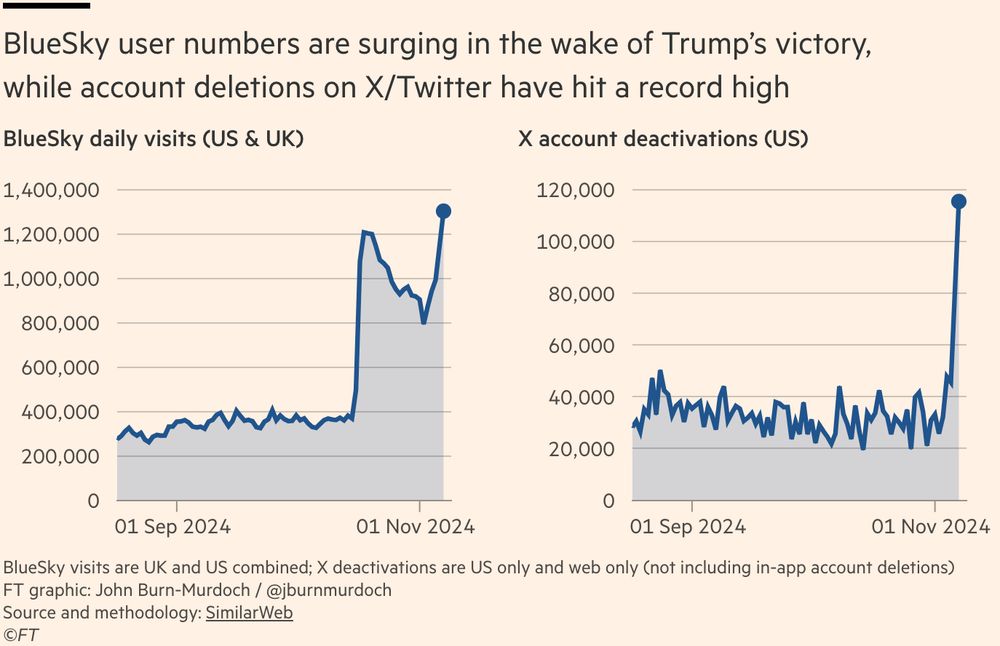
A tale of two platforms:
BlueSky user numbers have hit a new record high in recent days, while the number of people deleting their accounts on X/Twitter has rocketed 🚀
BlueSky user numbers have hit a new record high in recent days, while the number of people deleting their accounts on X/Twitter has rocketed 🚀
November 13, 2024 at 5:48 PM
Interesting data.. seems to match my personal experience..
So clearly, Twitter's (X, whatever) loss was Bsky's gain
The recent events in the US were a big nail in the ⚰️, even if not the last.
The recent events in the US were a big nail in the ⚰️, even if not the last.
November 12, 2024 at 4:11 AM
So clearly, Twitter's (X, whatever) loss was Bsky's gain
The recent events in the US were a big nail in the ⚰️, even if not the last.
The recent events in the US were a big nail in the ⚰️, even if not the last.