



Rohit Singh
@rohitsingh8080.bsky.social
Computational biologist. Faculty @DukeU. Co-founder http://martini.ai. Prev @MIT_CSAIL. Did quant investing for a while, before returning to research.
https://singhlab.net
https://singhlab.net
A poorly calibrated model might always score one kinase highly even if, on a per-kinase basis, it is accurate on substrate specificities. See this note from the preprint: 9/

May 9, 2025 at 2:40 PM
A poorly calibrated model might always score one kinase highly even if, on a per-kinase basis, it is accurate on substrate specificities. See this note from the preprint: 9/
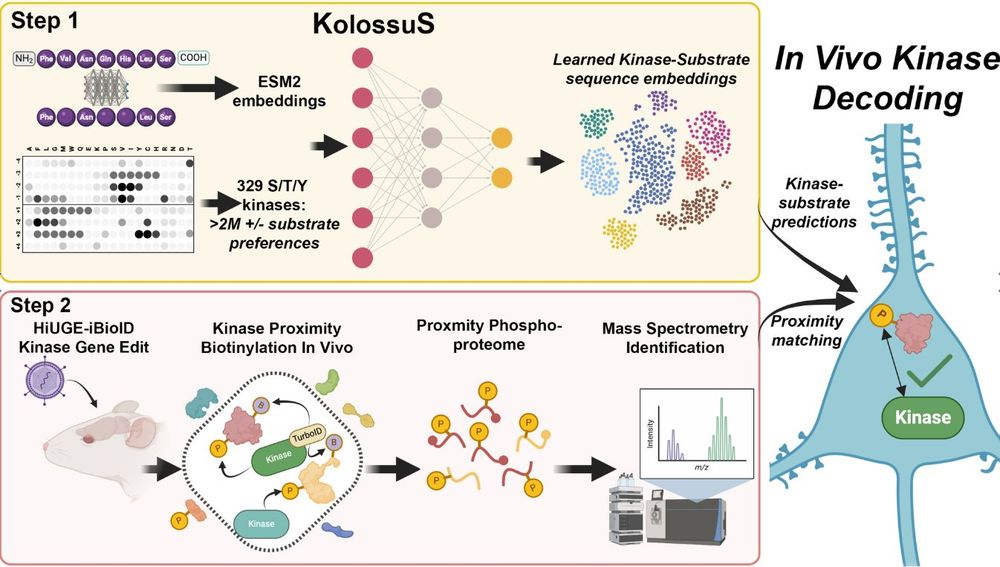
Using the ESM-2 15B model (PLM scaling worked, for once!) we predict kinase-substrate specificity by learning a co-embedding of the two.
As models go, KolossuS is relatively simple. In its design, we emphasized three aspects: breadth, calibration and interpretability. 7/
As models go, KolossuS is relatively simple. In its design, we emphasized three aspects: breadth, calibration and interpretability. 7/

May 9, 2025 at 2:40 PM
Using the ESM-2 15B model (PLM scaling worked, for once!) we predict kinase-substrate specificity by learning a co-embedding of the two.
As models go, KolossuS is relatively simple. In its design, we emphasized three aspects: breadth, calibration and interpretability. 7/
As models go, KolossuS is relatively simple. In its design, we emphasized three aspects: breadth, calibration and interpretability. 7/
As writers, the specificity of kinases is only moderately high– multiple kinases can often phosphorylate a substrate. The moderate specificity makes it easier to have signal integration but it of course leads to disease risk. 4/

May 9, 2025 at 2:40 PM
As writers, the specificity of kinases is only moderately high– multiple kinases can often phosphorylate a substrate. The moderate specificity makes it easier to have signal integration but it of course leads to disease risk. 4/
Introducing KolossuS to address a 50-year old problem: which kinases are active in your pathway of interest?
As computational biologists, our work mostly involves post-hoc analysis algorithms. KolossuS is the rare case where a ML model enables entirely new capabilities. 1/
As computational biologists, our work mostly involves post-hoc analysis algorithms. KolossuS is the rare case where a ML model enables entirely new capabilities. 1/
May 9, 2025 at 2:40 PM
Introducing KolossuS to address a 50-year old problem: which kinases are active in your pathway of interest?
As computational biologists, our work mostly involves post-hoc analysis algorithms. KolossuS is the rare case where a ML model enables entirely new capabilities. 1/
As computational biologists, our work mostly involves post-hoc analysis algorithms. KolossuS is the rare case where a ML model enables entirely new capabilities. 1/
At the same time, we don’t think the role of TADs can be explained simply by them bringing genes spatially close.
In fact, we hypothesize TADs may work by synergizing with condensate formation. Check out the Perturb-seq analysis in our preprint. 12/
In fact, we hypothesize TADs may work by synergizing with condensate formation. Check out the Perturb-seq analysis in our preprint. 12/

April 5, 2025 at 3:31 PM
At the same time, we don’t think the role of TADs can be explained simply by them bringing genes spatially close.
In fact, we hypothesize TADs may work by synergizing with condensate formation. Check out the Perturb-seq analysis in our preprint. 12/
In fact, we hypothesize TADs may work by synergizing with condensate formation. Check out the Perturb-seq analysis in our preprint. 12/
What we found was TADs and genomic proximity work in concert. Gene pairs in TADs exhibit higher contextual similarity (meaning they serve similar roles relative to other genes) but genomic proximity still matters– even within TADs 11/

April 5, 2025 at 3:31 PM
What we found was TADs and genomic proximity work in concert. Gene pairs in TADs exhibit higher contextual similarity (meaning they serve similar roles relative to other genes) but genomic proximity still matters– even within TADs 11/
Are gene location and proximity irrelevant in humans, with co-regulation controlled only by conformational variability?
Or has evolution encoded a synergy between chromatin conformation, gene location and gene function?
This is what we set out to explore quantitatively. 5/
Or has evolution encoded a synergy between chromatin conformation, gene location and gene function?
This is what we set out to explore quantitatively. 5/

April 5, 2025 at 3:31 PM
Are gene location and proximity irrelevant in humans, with co-regulation controlled only by conformational variability?
Or has evolution encoded a synergy between chromatin conformation, gene location and gene function?
This is what we set out to explore quantitatively. 5/
Or has evolution encoded a synergy between chromatin conformation, gene location and gene function?
This is what we set out to explore quantitatively. 5/
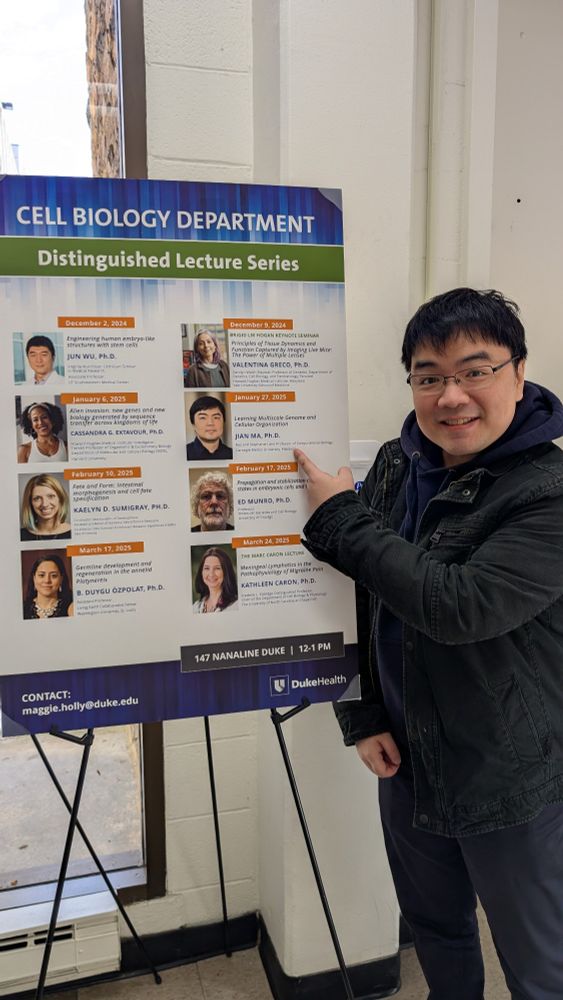
Delighted to be hosting @jianma.bsky.social as a Distinguished Speaker (Lecturer?) at Duke Cell Biology.
Great talk on a variety of foods, from Higashi and SpiceMix to Steamboat!
Also, some stuff on 3D genome.
Great talk on a variety of foods, from Higashi and SpiceMix to Steamboat!
Also, some stuff on 3D genome.
January 27, 2025 at 7:18 PM
Delighted to be hosting @jianma.bsky.social as a Distinguished Speaker (Lecturer?) at Duke Cell Biology.
Great talk on a variety of foods, from Higashi and SpiceMix to Steamboat!
Also, some stuff on 3D genome.
Great talk on a variety of foods, from Higashi and SpiceMix to Steamboat!
Also, some stuff on 3D genome.
What this lets us do is index any large database by its codes. Given any protein sequence, we predict its codes on the fly and look up the small molecules for the code. Hence the massive speedup! 8/

January 16, 2025 at 4:40 PM
What this lets us do is index any large database by its codes. Given any protein sequence, we predict its codes on the fly and look up the small molecules for the code. Hence the massive speedup! 8/
We introduce an innovation with Finite Scalar Quantization, introducing residual layers to learn hierarchical sub-spaces. A drug gets an A-B-C code where A,B,C are in 0..31.
The idea is that a 32d->32d->32d latent space is better organized than a flat 32,768-d latent space. 7/
The idea is that a 32d->32d->32d latent space is better organized than a flat 32,768-d latent space. 7/

January 16, 2025 at 4:40 PM
We introduce an innovation with Finite Scalar Quantization, introducing residual layers to learn hierarchical sub-spaces. A drug gets an A-B-C code where A,B,C are in 0..31.
The idea is that a 32d->32d->32d latent space is better organized than a flat 32,768-d latent space. 7/
The idea is that a 32d->32d->32d latent space is better organized than a flat 32,768-d latent space. 7/
The key innovation in CoNCISE comes from our small molecule representation. We organize the *entire* small molecule space hierarchically into ~32K (=32x32x32) categories. A protein can bind one or more categories, but each small molecule is mapped to just one category. 4/

January 16, 2025 at 4:40 PM
The key innovation in CoNCISE comes from our small molecule representation. We organize the *entire* small molecule space hierarchically into ~32K (=32x32x32) categories. A protein can bind one or more categories, but each small molecule is mapped to just one category. 4/
Are you studying a pathway and wish you could perturb it? With catalogs like ZINC and Enamine, billions of small molecule perturbagens are just a click away, but what to order?
Enter CoNCISE, our finite scalar quantization-based approach to identifying small molecule binders. 1/
Enter CoNCISE, our finite scalar quantization-based approach to identifying small molecule binders. 1/

January 16, 2025 at 4:40 PM
Are you studying a pathway and wish you could perturb it? With catalogs like ZINC and Enamine, billions of small molecule perturbagens are just a click away, but what to order?
Enter CoNCISE, our finite scalar quantization-based approach to identifying small molecule binders. 1/
Enter CoNCISE, our finite scalar quantization-based approach to identifying small molecule binders. 1/
This shows up beautifully in AbMAP's CDR-focused representation!
One of my favorite figures in the paper (Fig 4B,C, Fig S1) show the striking AbMAP-space convergence between immune repertoires across nine individuals from
Bryan Briney's seminal study. 8/
One of my favorite figures in the paper (Fig 4B,C, Fig S1) show the striking AbMAP-space convergence between immune repertoires across nine individuals from
Bryan Briney's seminal study. 8/

January 2, 2025 at 3:00 PM
This shows up beautifully in AbMAP's CDR-focused representation!
One of my favorite figures in the paper (Fig 4B,C, Fig S1) show the striking AbMAP-space convergence between immune repertoires across nine individuals from
Bryan Briney's seminal study. 8/
One of my favorite figures in the paper (Fig 4B,C, Fig S1) show the striking AbMAP-space convergence between immune repertoires across nine individuals from
Bryan Briney's seminal study. 8/
We argue that the crux of an antibody lies in its hypervariable regions - CDRs 1,2,3 in the heavy and light chains. The constant region matters too, but during isotype switching, the immune system swaps it out based on need while preserving the antigen-binding CDR regions. 2/

January 2, 2025 at 3:00 PM
We argue that the crux of an antibody lies in its hypervariable regions - CDRs 1,2,3 in the heavy and light chains. The constant region matters too, but during isotype switching, the immune system swaps it out based on need while preserving the antigen-binding CDR regions. 2/