



Roddy Grieves
@roddy-grieves.bsky.social
Cognition | Navigation | Behaviour
I study how the brain maps space - how this map is influenced by the environment & an animals's behaviour. Currently starting my own research group: the Neuroethology and Spatial Cognition lab @ University of Glasgow
I study how the brain maps space - how this map is influenced by the environment & an animals's behaviour. Currently starting my own research group: the Neuroethology and Spatial Cognition lab @ University of Glasgow
For some context, Tryon's maze was a massive 17-unit T-maze that took up an entire room.
It was entirely automated, with attached home cages that would rotate to train new rats sequentially, and electronic sensors in the T-maze alleyways to record errors.
Not bad for 1927.
#HistoryOfPsychology
It was entirely automated, with attached home cages that would rotate to train new rats sequentially, and electronic sensors in the T-maze alleyways to record errors.
Not bad for 1927.
#HistoryOfPsychology
November 10, 2025 at 12:12 PM
For some context, Tryon's maze was a massive 17-unit T-maze that took up an entire room.
It was entirely automated, with attached home cages that would rotate to train new rats sequentially, and electronic sensors in the T-maze alleyways to record errors.
Not bad for 1927.
#HistoryOfPsychology
It was entirely automated, with attached home cages that would rotate to train new rats sequentially, and electronic sensors in the T-maze alleyways to record errors.
Not bad for 1927.
#HistoryOfPsychology
Check out the paper here: doi.org/10.1016/j.bb...
If interested, also check out Mou and Ji, (2016): dx.doi.org/10.7554/eLif... where rats exhibited odd spinning behaviours while watching other rats run a linear track and their place cells activated in sequences corresponding to the track.
If interested, also check out Mou and Ji, (2016): dx.doi.org/10.7554/eLif... where rats exhibited odd spinning behaviours while watching other rats run a linear track and their place cells activated in sequences corresponding to the track.
October 13, 2025 at 10:25 AM
Check out the paper here: doi.org/10.1016/j.bb...
If interested, also check out Mou and Ji, (2016): dx.doi.org/10.7554/eLif... where rats exhibited odd spinning behaviours while watching other rats run a linear track and their place cells activated in sequences corresponding to the track.
If interested, also check out Mou and Ji, (2016): dx.doi.org/10.7554/eLif... where rats exhibited odd spinning behaviours while watching other rats run a linear track and their place cells activated in sequences corresponding to the track.
These results suggest that the hippocampus may underlie understanding the behavior and intentions of others, allowing animals to capitalize on observed experiences.
If this effect is due to emulation, it would also be consistent with findings that the hippcampus represents task structure and rules.
If this effect is due to emulation, it would also be consistent with findings that the hippcampus represents task structure and rules.
October 13, 2025 at 10:25 AM
These results suggest that the hippocampus may underlie understanding the behavior and intentions of others, allowing animals to capitalize on observed experiences.
If this effect is due to emulation, it would also be consistent with findings that the hippcampus represents task structure and rules.
If this effect is due to emulation, it would also be consistent with findings that the hippcampus represents task structure and rules.
However, they did find that (dorsal) hippocampus is in involved in this observation > performance enhancement, whatever the underlying mechanism.

October 13, 2025 at 10:25 AM
However, they did find that (dorsal) hippocampus is in involved in this observation > performance enhancement, whatever the underlying mechanism.
Fuentealba et al. (2025) argue this resulted from emulation (performing a behaviour required to reach the same goal) rather than imitation (copying the exact same behaviour) or local enhancement (going to the same places as the demonstrator).
I think these are very difficult to tease apart though.
I think these are very difficult to tease apart though.
October 13, 2025 at 10:25 AM
Fuentealba et al. (2025) argue this resulted from emulation (performing a behaviour required to reach the same goal) rather than imitation (copying the exact same behaviour) or local enhancement (going to the same places as the demonstrator).
I think these are very difficult to tease apart though.
I think these are very difficult to tease apart though.
Fuentealba et al. (2025) developed a dry land watermaze task where one rat could observe a conspecific solving the task.
Observing a pretrained rat (expert), led to significantly better performance than observing a naive rat (non-expert), suggesting that rats can learn through observation.
Observing a pretrained rat (expert), led to significantly better performance than observing a naive rat (non-expert), suggesting that rats can learn through observation.


October 13, 2025 at 10:25 AM
Fuentealba et al. (2025) developed a dry land watermaze task where one rat could observe a conspecific solving the task.
Observing a pretrained rat (expert), led to significantly better performance than observing a naive rat (non-expert), suggesting that rats can learn through observation.
Observing a pretrained rat (expert), led to significantly better performance than observing a naive rat (non-expert), suggesting that rats can learn through observation.
There is good evidence for social coding in the rodent hippocampus: cells representing the location of another rat (Danjo et al. 2018): doi.org/10.1126/scie...
Cells 'preplaying' a linear track, after observing another rat solving the task (Mou and Ji, 2016): dx.doi.org/10.7554/eLif...
Cells 'preplaying' a linear track, after observing another rat solving the task (Mou and Ji, 2016): dx.doi.org/10.7554/eLif...
October 13, 2025 at 10:25 AM
There is good evidence for social coding in the rodent hippocampus: cells representing the location of another rat (Danjo et al. 2018): doi.org/10.1126/scie...
Cells 'preplaying' a linear track, after observing another rat solving the task (Mou and Ji, 2016): dx.doi.org/10.7554/eLif...
Cells 'preplaying' a linear track, after observing another rat solving the task (Mou and Ji, 2016): dx.doi.org/10.7554/eLif...
If interested, also check out related experimental papers characterising this phenomenon from Kay et al. (2020) in the Frank lab:
www.cell.com/cell/fulltex...
And Vollan et al. (2025) in the Moser lab:
www.nature.com/articles/s41...
www.cell.com/cell/fulltex...
And Vollan et al. (2025) in the Moser lab:
www.nature.com/articles/s41...

Constant Sub-second Cycling between Representations of Possible Futures in the Hippocampus
Imagination, planning, and decision-making require the ability to generate representations
of hypothetical experience. Kay et. al. find that neurons in the rat hippocampus can
represent alternative hy...
www.cell.com
April 8, 2025 at 10:13 AM
If interested, also check out related experimental papers characterising this phenomenon from Kay et al. (2020) in the Frank lab:
www.cell.com/cell/fulltex...
And Vollan et al. (2025) in the Moser lab:
www.nature.com/articles/s41...
www.cell.com/cell/fulltex...
And Vollan et al. (2025) in the Moser lab:
www.nature.com/articles/s41...
Ooops, I guess copy pasting BlueSky posts doesn't capture the full URL, it is here:
doi.org/10.1016/j.ap...
Fraser, D. (2025). Two paradigms of research and their influence on the study of animal behaviour. Applied Animal Behaviour Science, 106550.
doi.org/10.1016/j.ap...
Fraser, D. (2025). Two paradigms of research and their influence on the study of animal behaviour. Applied Animal Behaviour Science, 106550.
April 4, 2025 at 2:39 PM
Ooops, I guess copy pasting BlueSky posts doesn't capture the full URL, it is here:
doi.org/10.1016/j.ap...
Fraser, D. (2025). Two paradigms of research and their influence on the study of animal behaviour. Applied Animal Behaviour Science, 106550.
doi.org/10.1016/j.ap...
Fraser, D. (2025). Two paradigms of research and their influence on the study of animal behaviour. Applied Animal Behaviour Science, 106550.
Tinbergen's four questions I think stand out historically: doi.org/10.1016/j.tr...
Recently, I also enjoyed this nice discussion and comparison of the 'natural history' and 'natural philosophy' approaches to the study of animal behaviour: www.sciencedirect.com/science/arti...
Recently, I also enjoyed this nice discussion and comparison of the 'natural history' and 'natural philosophy' approaches to the study of animal behaviour: www.sciencedirect.com/science/arti...
April 4, 2025 at 8:13 AM
Tinbergen's four questions I think stand out historically: doi.org/10.1016/j.tr...
Recently, I also enjoyed this nice discussion and comparison of the 'natural history' and 'natural philosophy' approaches to the study of animal behaviour: www.sciencedirect.com/science/arti...
Recently, I also enjoyed this nice discussion and comparison of the 'natural history' and 'natural philosophy' approaches to the study of animal behaviour: www.sciencedirect.com/science/arti...
Also check out these fantastic papers on similar topics if interested:
Tanni et al. 2022
'perceptual change model' www.cell.com/current-biol...
And Harland et al. 2021
'megaspace'
doi.org/10.1016/j.cu...
Tanni et al. 2022
'perceptual change model' www.cell.com/current-biol...
And Harland et al. 2021
'megaspace'
doi.org/10.1016/j.cu...

State transitions in the statistically stable place cell population correspond to rate of perceptual change
New work by Tanni, de Cothi, and Barry finds that place cell activity in the mammalian
hippocampus is homeostatically controlled—the distribution of firing rates in the
population is stable. During mo...
www.cell.com
April 3, 2025 at 2:24 PM
Also check out these fantastic papers on similar topics if interested:
Tanni et al. 2022
'perceptual change model' www.cell.com/current-biol...
And Harland et al. 2021
'megaspace'
doi.org/10.1016/j.cu...
Tanni et al. 2022
'perceptual change model' www.cell.com/current-biol...
And Harland et al. 2021
'megaspace'
doi.org/10.1016/j.cu...
Interesting paper/model looking at interesting problems.
But frustrating that the most direct comparison to flying bats (climbing rats) was overlooked.
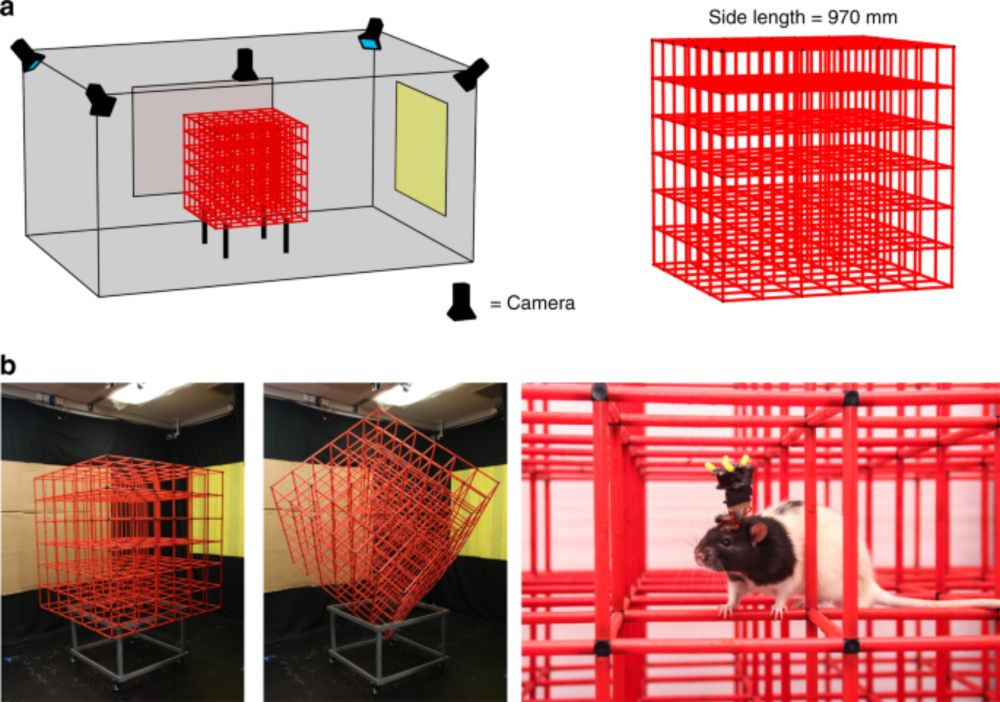
See our 3D place cells in rats here:
www.nature.com/articles/s41...
And 3D grid cells here:
www.nature.com/articles/s41...
But frustrating that the most direct comparison to flying bats (climbing rats) was overlooked.
See our 3D place cells in rats here:
www.nature.com/articles/s41...
And 3D grid cells here:
www.nature.com/articles/s41...
The place-cell representation of volumetric space in rats - Nature Communications
How the brain represents 3D space is poorly understood but important for understanding spatial cognition. Here the authors record place cells in rats climbing through a 3D environment and report that ...
www.nature.com
April 3, 2025 at 2:24 PM
Interesting paper/model looking at interesting problems.
But frustrating that the most direct comparison to flying bats (climbing rats) was overlooked.
See our 3D place cells in rats here:
www.nature.com/articles/s41...
And 3D grid cells here:
www.nature.com/articles/s41...
But frustrating that the most direct comparison to flying bats (climbing rats) was overlooked.
See our 3D place cells in rats here:
www.nature.com/articles/s41...
And 3D grid cells here:
www.nature.com/articles/s41...
Also not sure why largest fields were excluded 👇 field size & local maxima are key to the model
Rate maps in Yartsev & Ulanovsky were quite highly smoothed (adaptive & kernel smoothing) not sure how/if this was accounted for?
Small fields will adopt the shape of a smoothing kernel more readily...
Rate maps in Yartsev & Ulanovsky were quite highly smoothed (adaptive & kernel smoothing) not sure how/if this was accounted for?
Small fields will adopt the shape of a smoothing kernel more readily...

April 3, 2025 at 2:24 PM
Also not sure why largest fields were excluded 👇 field size & local maxima are key to the model
Rate maps in Yartsev & Ulanovsky were quite highly smoothed (adaptive & kernel smoothing) not sure how/if this was accounted for?
Small fields will adopt the shape of a smoothing kernel more readily...
Rate maps in Yartsev & Ulanovsky were quite highly smoothed (adaptive & kernel smoothing) not sure how/if this was accounted for?
Small fields will adopt the shape of a smoothing kernel more readily...
Or field elongation along boundaries, something repeatedly shown in rodents in 2D & 3D:
doi.org/10.1038/s414...
Could probably be achived by swapping spatial inputs to the model for 3D boundary cell inputs, but then we would have a BVC model...
www.degruyterbrill.com/document/doi...
doi.org/10.1038/s414...
Could probably be achived by swapping spatial inputs to the model for 3D boundary cell inputs, but then we would have a BVC model...
www.degruyterbrill.com/document/doi...

The Boundary Vector Cell Model of Place Cell Firing and Spatial Memory
Article The Boundary Vector Cell Model of Place Cell Firing and Spatial Memory was published on April 1, 2006 in the journal Reviews in the Neurosciences (volume 17, issue 1-2).
www.degruyterbrill.com
April 3, 2025 at 2:24 PM
Or field elongation along boundaries, something repeatedly shown in rodents in 2D & 3D:
doi.org/10.1038/s414...
Could probably be achived by swapping spatial inputs to the model for 3D boundary cell inputs, but then we would have a BVC model...
www.degruyterbrill.com/document/doi...
doi.org/10.1038/s414...
Could probably be achived by swapping spatial inputs to the model for 3D boundary cell inputs, but then we would have a BVC model...
www.degruyterbrill.com/document/doi...
However, Mainali et al.'s model doesn't capture the finding that field size scales with proximity to boundaries:
doi.org/10.1016/j.cu...
Tanni et al. - also not cited
doi.org/10.1016/j.cu...
Tanni et al. - also not cited

April 3, 2025 at 2:24 PM
However, Mainali et al.'s model doesn't capture the finding that field size scales with proximity to boundaries:
doi.org/10.1016/j.cu...
Tanni et al. - also not cited
doi.org/10.1016/j.cu...
Tanni et al. - also not cited
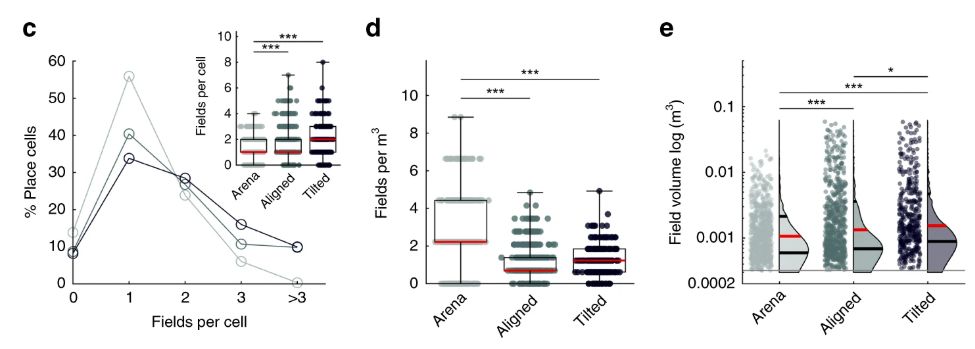
When we recorded place cells in climbing rats we found that cells exhibited fewer & larger place fields. Space was underrepresented with fewer fields per m3.
These results are consistent with 2D rodent results in large spaces and Mainali et al.'s model.
These results are consistent with 2D rodent results in large spaces and Mainali et al.'s model.
April 3, 2025 at 2:24 PM
When we recorded place cells in climbing rats we found that cells exhibited fewer & larger place fields. Space was underrepresented with fewer fields per m3.
These results are consistent with 2D rodent results in large spaces and Mainali et al.'s model.
These results are consistent with 2D rodent results in large spaces and Mainali et al.'s model.
Changing the model thresholds alters the size of the resulting place fields, so this could explain larger fields in larger environments.
Not sure how/why these thresholds would change in the brain? They would need to scale with environment size, the mechanism for that remains unexplained...
Not sure how/why these thresholds would change in the brain? They would need to scale with environment size, the mechanism for that remains unexplained...

April 3, 2025 at 2:24 PM
Changing the model thresholds alters the size of the resulting place fields, so this could explain larger fields in larger environments.
Not sure how/why these thresholds would change in the brain? They would need to scale with environment size, the mechanism for that remains unexplained...
Not sure how/why these thresholds would change in the brain? They would need to scale with environment size, the mechanism for that remains unexplained...