



Roddy Grieves
@roddy-grieves.bsky.social
Cognition | Navigation | Behaviour
I study how the brain maps space - how this map is influenced by the environment & an animals's behaviour. Currently starting my own research group: the Neuroethology and Spatial Cognition lab @ University of Glasgow
I study how the brain maps space - how this map is influenced by the environment & an animals's behaviour. Currently starting my own research group: the Neuroethology and Spatial Cognition lab @ University of Glasgow
Anecdote from Innis (1992)
To quell his anxiety, a group of Tryon's students conducted an Ocean's Eleven style operation to deconstruct and transport a huge rat maze from one building to another while a second group of students distracted him on an out of town trip.
doi.org/10.1037//000...
To quell his anxiety, a group of Tryon's students conducted an Ocean's Eleven style operation to deconstruct and transport a huge rat maze from one building to another while a second group of students distracted him on an out of town trip.
doi.org/10.1037//000...

November 10, 2025 at 12:12 PM
Anecdote from Innis (1992)
To quell his anxiety, a group of Tryon's students conducted an Ocean's Eleven style operation to deconstruct and transport a huge rat maze from one building to another while a second group of students distracted him on an out of town trip.
doi.org/10.1037//000...
To quell his anxiety, a group of Tryon's students conducted an Ocean's Eleven style operation to deconstruct and transport a huge rat maze from one building to another while a second group of students distracted him on an out of town trip.
doi.org/10.1037//000...
However, they did find that (dorsal) hippocampus is in involved in this observation > performance enhancement, whatever the underlying mechanism.

October 13, 2025 at 10:25 AM
However, they did find that (dorsal) hippocampus is in involved in this observation > performance enhancement, whatever the underlying mechanism.
Fuentealba et al. (2025) developed a dry land watermaze task where one rat could observe a conspecific solving the task.
Observing a pretrained rat (expert), led to significantly better performance than observing a naive rat (non-expert), suggesting that rats can learn through observation.
Observing a pretrained rat (expert), led to significantly better performance than observing a naive rat (non-expert), suggesting that rats can learn through observation.


October 13, 2025 at 10:25 AM
Fuentealba et al. (2025) developed a dry land watermaze task where one rat could observe a conspecific solving the task.
Observing a pretrained rat (expert), led to significantly better performance than observing a naive rat (non-expert), suggesting that rats can learn through observation.
Observing a pretrained rat (expert), led to significantly better performance than observing a naive rat (non-expert), suggesting that rats can learn through observation.
Also not sure why largest fields were excluded 👇 field size & local maxima are key to the model
Rate maps in Yartsev & Ulanovsky were quite highly smoothed (adaptive & kernel smoothing) not sure how/if this was accounted for?
Small fields will adopt the shape of a smoothing kernel more readily...
Rate maps in Yartsev & Ulanovsky were quite highly smoothed (adaptive & kernel smoothing) not sure how/if this was accounted for?
Small fields will adopt the shape of a smoothing kernel more readily...

April 3, 2025 at 2:24 PM
Also not sure why largest fields were excluded 👇 field size & local maxima are key to the model
Rate maps in Yartsev & Ulanovsky were quite highly smoothed (adaptive & kernel smoothing) not sure how/if this was accounted for?
Small fields will adopt the shape of a smoothing kernel more readily...
Rate maps in Yartsev & Ulanovsky were quite highly smoothed (adaptive & kernel smoothing) not sure how/if this was accounted for?
Small fields will adopt the shape of a smoothing kernel more readily...
However, Mainali et al.'s model doesn't capture the finding that field size scales with proximity to boundaries:
doi.org/10.1016/j.cu...
Tanni et al. - also not cited
doi.org/10.1016/j.cu...
Tanni et al. - also not cited

April 3, 2025 at 2:24 PM
However, Mainali et al.'s model doesn't capture the finding that field size scales with proximity to boundaries:
doi.org/10.1016/j.cu...
Tanni et al. - also not cited
doi.org/10.1016/j.cu...
Tanni et al. - also not cited
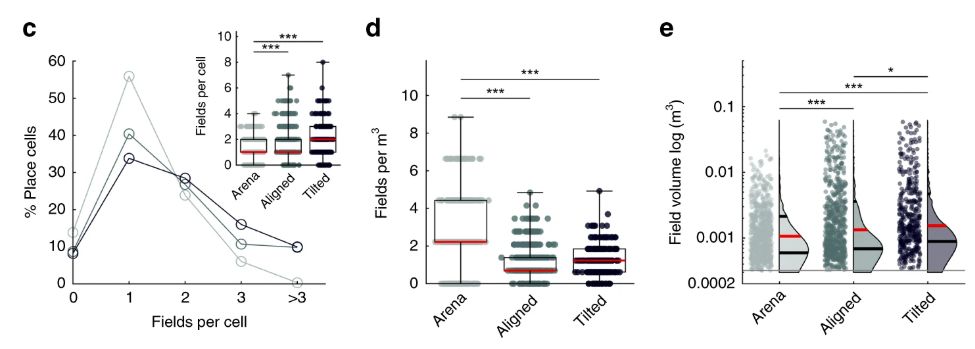
When we recorded place cells in climbing rats we found that cells exhibited fewer & larger place fields. Space was underrepresented with fewer fields per m3.
These results are consistent with 2D rodent results in large spaces and Mainali et al.'s model.
These results are consistent with 2D rodent results in large spaces and Mainali et al.'s model.
April 3, 2025 at 2:24 PM
When we recorded place cells in climbing rats we found that cells exhibited fewer & larger place fields. Space was underrepresented with fewer fields per m3.
These results are consistent with 2D rodent results in large spaces and Mainali et al.'s model.
These results are consistent with 2D rodent results in large spaces and Mainali et al.'s model.
Changing the model thresholds alters the size of the resulting place fields, so this could explain larger fields in larger environments.
Not sure how/why these thresholds would change in the brain? They would need to scale with environment size, the mechanism for that remains unexplained...
Not sure how/why these thresholds would change in the brain? They would need to scale with environment size, the mechanism for that remains unexplained...

April 3, 2025 at 2:24 PM
Changing the model thresholds alters the size of the resulting place fields, so this could explain larger fields in larger environments.
Not sure how/why these thresholds would change in the brain? They would need to scale with environment size, the mechanism for that remains unexplained...
Not sure how/why these thresholds would change in the brain? They would need to scale with environment size, the mechanism for that remains unexplained...
Mainali et al.'s model proposes place cell activity is the result of thresholded activity from multiple spatial inputs that, as far as I understand it, have 3D spherical gaussian firing fields 👇


April 3, 2025 at 2:24 PM
Mainali et al.'s model proposes place cell activity is the result of thresholded activity from multiple spatial inputs that, as far as I understand it, have 3D spherical gaussian firing fields 👇
(3) Subramanian et al. observed time 'off' cells, which have not been reported before 👇

March 28, 2025 at 5:00 PM
(3) Subramanian et al. observed time 'off' cells, which have not been reported before 👇
Some interesting points:
(1) RSC time cells were often context-dependent - firing differently depending on the animal's past trajectory, such as visiting the east or west arm of a plus-maze 👇
(1) RSC time cells were often context-dependent - firing differently depending on the animal's past trajectory, such as visiting the east or west arm of a plus-maze 👇


March 28, 2025 at 5:00 PM
Some interesting points:
(1) RSC time cells were often context-dependent - firing differently depending on the animal's past trajectory, such as visiting the east or west arm of a plus-maze 👇
(1) RSC time cells were often context-dependent - firing differently depending on the animal's past trajectory, such as visiting the east or west arm of a plus-maze 👇
And of course the usage rate of novelty terms is also highly correlated with the impact factor of a journal.

March 21, 2025 at 2:03 PM
And of course the usage rate of novelty terms is also highly correlated with the impact factor of a journal.
I think we all already know the result 😂 👇
Novelty terms have rapidly proliferated, while confirmatory terms have remained at the same usage.
The reason I love this study is that people in many different scientific fields (I'm in neuroscience) can relate to this finding.
Novelty terms have rapidly proliferated, while confirmatory terms have remained at the same usage.
The reason I love this study is that people in many different scientific fields (I'm in neuroscience) can relate to this finding.

March 21, 2025 at 2:03 PM
I think we all already know the result 😂 👇
Novelty terms have rapidly proliferated, while confirmatory terms have remained at the same usage.
The reason I love this study is that people in many different scientific fields (I'm in neuroscience) can relate to this finding.
Novelty terms have rapidly proliferated, while confirmatory terms have remained at the same usage.
The reason I love this study is that people in many different scientific fields (I'm in neuroscience) can relate to this finding.
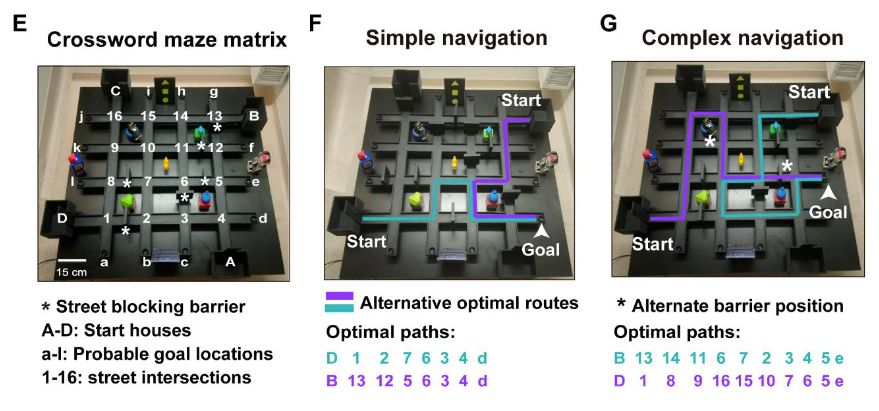
I really liked the task which consisted of a grid ('crossword') maze.
Animals navigate from different start boxes to a single goal location.
Barriers on the maze result in overlapping routes in some segments, or force the mice to take different routes in the same segments.
Animals navigate from different start boxes to a single goal location.
Barriers on the maze result in overlapping routes in some segments, or force the mice to take different routes in the same segments.
March 17, 2025 at 1:23 PM
I really liked the task which consisted of a grid ('crossword') maze.
Animals navigate from different start boxes to a single goal location.
Barriers on the maze result in overlapping routes in some segments, or force the mice to take different routes in the same segments.
Animals navigate from different start boxes to a single goal location.
Barriers on the maze result in overlapping routes in some segments, or force the mice to take different routes in the same segments.
What about these examples though? They are among the best examples of shortcuts, but they seem very indirect with many reward well checks before reaching A.
What is the chance level here?
Does this look like the result of vector computation?
What is the chance level here?
Does this look like the result of vector computation?


March 14, 2025 at 3:19 PM
What about these examples though? They are among the best examples of shortcuts, but they seem very indirect with many reward well checks before reaching A.
What is the chance level here?
Does this look like the result of vector computation?
What is the chance level here?
Does this look like the result of vector computation?
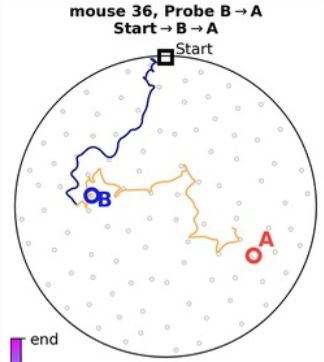
Also, some of the 'shortcuts' reported were not very convincing.
In the below example the mouse goes from start>B, upon finding no food it then goes B>A using a shortcut.
I think this is a convincing example, but it's undermined by the fact this particular mouse used the A>B route during training
In the below example the mouse goes from start>B, upon finding no food it then goes B>A using a shortcut.
I think this is a convincing example, but it's undermined by the fact this particular mouse used the A>B route during training
March 14, 2025 at 3:19 PM
Also, some of the 'shortcuts' reported were not very convincing.
In the below example the mouse goes from start>B, upon finding no food it then goes B>A using a shortcut.
I think this is a convincing example, but it's undermined by the fact this particular mouse used the A>B route during training
In the below example the mouse goes from start>B, upon finding no food it then goes B>A using a shortcut.
I think this is a convincing example, but it's undermined by the fact this particular mouse used the A>B route during training