



Rita Maravilha Marques
@ritamaravilha.bsky.social
PhD Student working on powdery mildew resistance in a savory insurance legume: grass pea.
What is an adult scientist but a kid who never lost the curiosity?-NDT
What is an adult scientist but a kid who never lost the curiosity?-NDT
Then, the biggest surprise: I was announced as the winner for the best poster! 🤩 I could hardly believe it and was beyond extatic! 🥳
The conference dinner was delicious and super fun!
I want thank The Fernand Lambein Fund from the bottom of my heart for giving me this amazing opportunity! ☺️
The conference dinner was delicious and super fun!
I want thank The Fernand Lambein Fund from the bottom of my heart for giving me this amazing opportunity! ☺️


September 19, 2025 at 2:52 PM
Then, the biggest surprise: I was announced as the winner for the best poster! 🤩 I could hardly believe it and was beyond extatic! 🥳
The conference dinner was delicious and super fun!
I want thank The Fernand Lambein Fund from the bottom of my heart for giving me this amazing opportunity! ☺️
The conference dinner was delicious and super fun!
I want thank The Fernand Lambein Fund from the bottom of my heart for giving me this amazing opportunity! ☺️
And finally, for the last day we heard about opportunities for collaboration with industry 🧑🏭, increasing legume quality and navigating the relationship with yield✨, how to meet consumer and market demands 📈, and how nitrogen fixation 🧫 can be used to modulate nutritional quality.


September 19, 2025 at 2:41 PM
And finally, for the last day we heard about opportunities for collaboration with industry 🧑🏭, increasing legume quality and navigating the relationship with yield✨, how to meet consumer and market demands 📈, and how nitrogen fixation 🧫 can be used to modulate nutritional quality.
Second conference day! Today we learned about legume biology, tackling pathogens, abiotic stress and research in several parts of the world. The day ended with a inspiring talk about John Gladstone's legacy, a late pioneer in Lupinus angustifolius breeding in Australia 😁


September 19, 2025 at 2:22 PM
Second conference day! Today we learned about legume biology, tackling pathogens, abiotic stress and research in several parts of the world. The day ended with a inspiring talk about John Gladstone's legacy, a late pioneer in Lupinus angustifolius breeding in Australia 😁
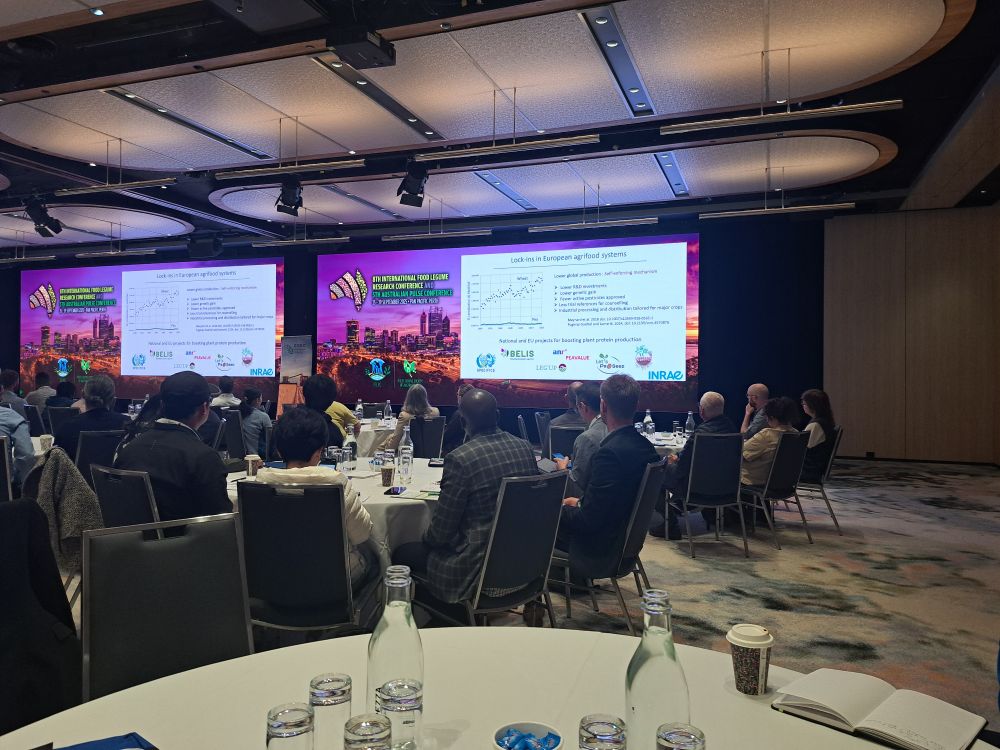
In this first packed day, we got the opportunity to listen to talks on legume genetic resources, agronomy and breeding technologies! 🫘 Lentils and chickpeas emerge as Aussie favourites! 🇦🇺❤️
They even made me feel right at home with some Portuguese pastel de nata! 😍
They even made me feel right at home with some Portuguese pastel de nata! 😍


September 16, 2025 at 10:29 AM
In this first packed day, we got the opportunity to listen to talks on legume genetic resources, agronomy and breeding technologies! 🫘 Lentils and chickpeas emerge as Aussie favourites! 🇦🇺❤️
They even made me feel right at home with some Portuguese pastel de nata! 😍
They even made me feel right at home with some Portuguese pastel de nata! 😍
And here we are! Can't believe it is finally happening! 🤩 The program of @iflrc is packed, it will be the opportunity of a lifetime! 🥹
I'm also loving Perth so far!
I'm also loving Perth so far!


September 16, 2025 at 6:22 AM
And here we are! Can't believe it is finally happening! 🤩 The program of @iflrc is packed, it will be the opportunity of a lifetime! 🥹
I'm also loving Perth so far!
I'm also loving Perth so far!
We identified host and pathogen genes involved in the L. sativus-E. pisi interaction (NLRs, effectors, antifungal proteins and cell wall reinforcement genes). These targets can support breeding programs to enhance resistance to E. pisi in L. sativus and related species 12/13

March 17, 2025 at 1:31 PM
We identified host and pathogen genes involved in the L. sativus-E. pisi interaction (NLRs, effectors, antifungal proteins and cell wall reinforcement genes). These targets can support breeding programs to enhance resistance to E. pisi in L. sativus and related species 12/13
Additionally, we identified E. pisi effectors expressed during infection. We used the dual transcriptomics data to identify potential pathogen effectors being expressed. These included genes related to cell wall hydrolysis, nutrient acquisition and virulence. 10/13

March 17, 2025 at 1:31 PM
Additionally, we identified E. pisi effectors expressed during infection. We used the dual transcriptomics data to identify potential pathogen effectors being expressed. These included genes related to cell wall hydrolysis, nutrient acquisition and virulence. 10/13
Among the DEGs, we identified 52 NLRs, crucial proteins in plant immunity. These intracellular immune receptors can recognise pathogen effectors to trigger a robust immune response. Some of these NLRs were more expressed in R and PR. 9/13

March 17, 2025 at 1:31 PM
Among the DEGs, we identified 52 NLRs, crucial proteins in plant immunity. These intracellular immune receptors can recognise pathogen effectors to trigger a robust immune response. Some of these NLRs were more expressed in R and PR. 9/13
Each accession had specific strategies. R had reinforced structural barriers, invested in epigenetic regulation, and increased oxidative stress responses. PR showed an early and biotic-stress-focused defence response, contrasting with PS’s slower and non-targeted response. 8/13

March 17, 2025 at 1:31 PM
Each accession had specific strategies. R had reinforced structural barriers, invested in epigenetic regulation, and increased oxidative stress responses. PR showed an early and biotic-stress-focused defence response, contrasting with PS’s slower and non-targeted response. 8/13
We found defence mechanisms common to all L. sativus accessions, including cell wall reinforcement (lignin), the expression of antifungal proteins (phenylpropanoids) and secondary metabolites, hormone signalling (jasmonic acid) and reactive oxygen species-mediated defence. 7/13

March 17, 2025 at 1:31 PM
We found defence mechanisms common to all L. sativus accessions, including cell wall reinforcement (lignin), the expression of antifungal proteins (phenylpropanoids) and secondary metabolites, hormone signalling (jasmonic acid) and reactive oxygen species-mediated defence. 7/13
We observed a response with two active phases: a burst of gene expression changes at 12 hai, followed by a less active period at 48 hai, and another wave of intense gene expression at 72 hai.
We identified a total of 3,109 differentially expressed genes (DEGs). 6/13
We identified a total of 3,109 differentially expressed genes (DEGs). 6/13

March 17, 2025 at 1:31 PM
We observed a response with two active phases: a burst of gene expression changes at 12 hai, followed by a less active period at 48 hai, and another wave of intense gene expression at 72 hai.
We identified a total of 3,109 differentially expressed genes (DEGs). 6/13
We identified a total of 3,109 differentially expressed genes (DEGs). 6/13
We analysed the transcriptomic response of these accessions over time and compared the expression profiles of the partially susceptible (PS), partially resistant (PR) and resistant (R) to the susceptible accession for each time point. 5/13

March 17, 2025 at 1:31 PM
We analysed the transcriptomic response of these accessions over time and compared the expression profiles of the partially susceptible (PS), partially resistant (PR) and resistant (R) to the susceptible accession for each time point. 5/13
To investigate the resistance mechanisms involved, we infected 4 L. sativus accessions with E. pisi. These accessions had different degrees of resistance to the pathogen. 4/13

March 17, 2025 at 1:31 PM
To investigate the resistance mechanisms involved, we infected 4 L. sativus accessions with E. pisi. These accessions had different degrees of resistance to the pathogen. 4/13
Erysiphe pisi is the powdery mildew causal agent in pea and L. sativus, a disease that can cause yield losses of up to 50% in pea. E. pisi also infects Medicago, Vicia, Lupinus, and Lens genera.
Breeding for disease resistance is the best way to deal with this threat. 3/13
Breeding for disease resistance is the best way to deal with this threat. 3/13

March 17, 2025 at 1:31 PM
Erysiphe pisi is the powdery mildew causal agent in pea and L. sativus, a disease that can cause yield losses of up to 50% in pea. E. pisi also infects Medicago, Vicia, Lupinus, and Lens genera.
Breeding for disease resistance is the best way to deal with this threat. 3/13
Breeding for disease resistance is the best way to deal with this threat. 3/13
Lathyrus sativus (or grass pea) is a grain legume highly valued for its nutritional and agronomic traits: its seed has high protein content, it requires little input and it’s incredibly tolerant to different stresses, including diseases caused by different pathogens. 2/13

March 17, 2025 at 1:31 PM
Lathyrus sativus (or grass pea) is a grain legume highly valued for its nutritional and agronomic traits: its seed has high protein content, it requires little input and it’s incredibly tolerant to different stresses, including diseases caused by different pathogens. 2/13