


Ramon Duran-Romaña
@ramonduran.bsky.social
Postdoc at @CBD KU Leuven 🇧🇪. Interested in translation, structural biology, ageing and everything involving proteins
Reposted by Ramon Duran-Romaña

🚨Thrilled our work is out in @NatureComm!🚨
Energetic profiling of >110 cryo-EM amyloid fibrils (IAPP, tau, α-syn) reveals how APRs + cofactors shape fibril maturation and disease-relevant polymorphs.
Read the full paper: doi.org/10.1038/s414...
Energetic profiling of >110 cryo-EM amyloid fibrils (IAPP, tau, α-syn) reveals how APRs + cofactors shape fibril maturation and disease-relevant polymorphs.
Read the full paper: doi.org/10.1038/s414...

Energetic profiling reveals thermodynamic principles underlying amyloid fibril maturation - Nature Communications
Energetic profiling of cryo-EM time series for IAPP, tau, and α-synuclein reveals how amyloid fibril maturation is driven by sequence-encoded hotspots. Rearrangement of APRs anchors growth, while cofa...
doi.org
November 18, 2025 at 4:20 PM
🚨Thrilled our work is out in @NatureComm!🚨
Energetic profiling of >110 cryo-EM amyloid fibrils (IAPP, tau, α-syn) reveals how APRs + cofactors shape fibril maturation and disease-relevant polymorphs.
Read the full paper: doi.org/10.1038/s414...
Energetic profiling of >110 cryo-EM amyloid fibrils (IAPP, tau, α-syn) reveals how APRs + cofactors shape fibril maturation and disease-relevant polymorphs.
Read the full paper: doi.org/10.1038/s414...
Cool new paper by Galmozzi et al.!
www.nature.com/articles/s41...
They show that bacterial chaperones bind regions of nascent proteins with exposed "unsatisfied residues" (segments missing key native contacts due to ongoing translation).
A shared theme with our recent work on Native Fold Delay.
www.nature.com/articles/s41...
They show that bacterial chaperones bind regions of nascent proteins with exposed "unsatisfied residues" (segments missing key native contacts due to ongoing translation).
A shared theme with our recent work on Native Fold Delay.
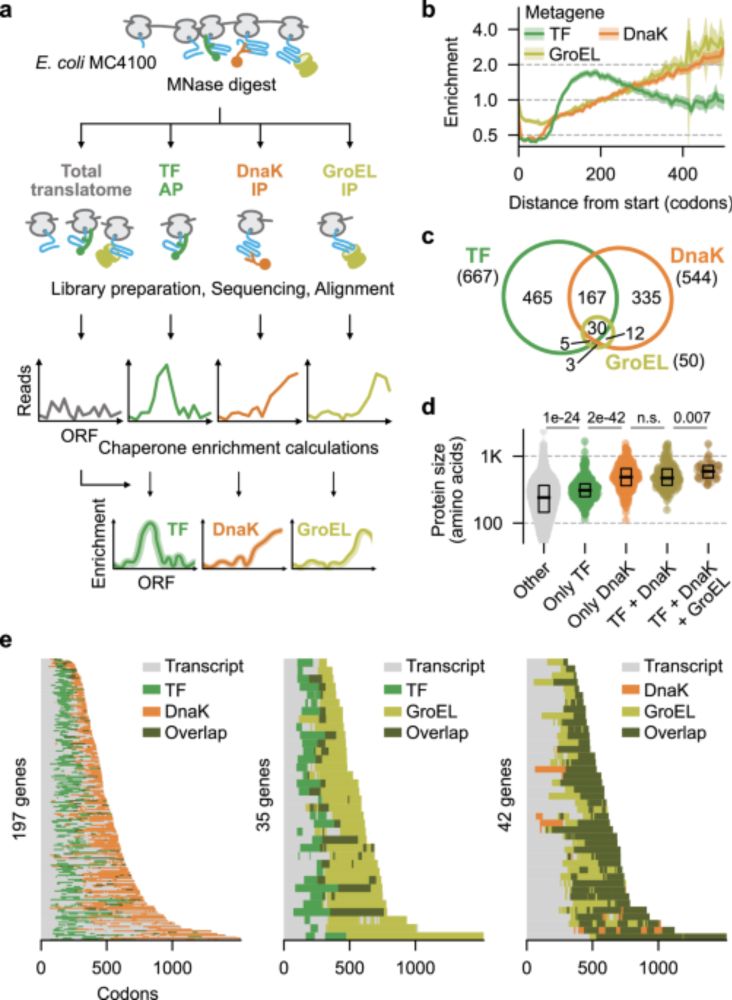
Proteome-wide determinants of co-translational chaperone binding in bacteria - Nature Communications
This study integrates ribosome profiling, single molecule methods and computational predictions to reveal that molecular chaperones bind ‘unsatisfied’ residues exposed on partial nascent folds, ration...
www.nature.com
May 19, 2025 at 1:27 PM
Cool new paper by Galmozzi et al.!
www.nature.com/articles/s41...
They show that bacterial chaperones bind regions of nascent proteins with exposed "unsatisfied residues" (segments missing key native contacts due to ongoing translation).
A shared theme with our recent work on Native Fold Delay.
www.nature.com/articles/s41...
They show that bacterial chaperones bind regions of nascent proteins with exposed "unsatisfied residues" (segments missing key native contacts due to ongoing translation).
A shared theme with our recent work on Native Fold Delay.
Reposted by Ramon Duran-Romaña
🚨New lab preprint!🚨
Thermodynamic profiling of cryoEM fibrils shows that key stabilizing motifs shuffle during amyloid maturation, while cofactors ease structural frustration to let energetically optimal polymorphs emerge.
www.biorxiv.org/content/10.1...
Thermodynamic profiling of cryoEM fibrils shows that key stabilizing motifs shuffle during amyloid maturation, while cofactors ease structural frustration to let energetically optimal polymorphs emerge.
www.biorxiv.org/content/10.1...

Energetic profiling reveals thermodynamic principles underlying amyloid fibril maturation
Amyloid fibrils adopt diverse structural polymorphs that underlie disease-specific phenotypes, but the thermodynamic principles guiding their formation and maturation remain poorly understood. Here, w...
www.biorxiv.org
May 16, 2025 at 4:31 PM
🚨New lab preprint!🚨
Thermodynamic profiling of cryoEM fibrils shows that key stabilizing motifs shuffle during amyloid maturation, while cofactors ease structural frustration to let energetically optimal polymorphs emerge.
www.biorxiv.org/content/10.1...
Thermodynamic profiling of cryoEM fibrils shows that key stabilizing motifs shuffle during amyloid maturation, while cofactors ease structural frustration to let energetically optimal polymorphs emerge.
www.biorxiv.org/content/10.1...
A new @MolecularCell paper shows that bacterial sRNAs can bind within coding sequences and enhance protein activity without affecting mRNA levels, pointing towards a new mechanism of co-translational folding regulation!
Could this be used as tool to induce translation pausing? 👀
#translation
Could this be used as tool to induce translation pausing? 👀
#translation

Modulation of protein activity by small RNA base pairing internal to coding sequences

Modulation of protein activity by small RNA base pairing internal to coding sequences
Thongdee et al. reveal that regulatory RNA pairing internal to coding sequences can lead to locally slowed translation elongation and increased enzymatic activity, likely through effects on co-translational protein folding.
dlvr.it
May 6, 2025 at 9:53 AM
A new @MolecularCell paper shows that bacterial sRNAs can bind within coding sequences and enhance protein activity without affecting mRNA levels, pointing towards a new mechanism of co-translational folding regulation!
Could this be used as tool to induce translation pausing? 👀
#translation
Could this be used as tool to induce translation pausing? 👀
#translation
Had a fantastic week at @embl.org to learn the ins and outs of ribosome profiling directly from some of the best in the field! Grateful to the amazing organisers, trainers, and fellow participants for such an enriching experience.
#ProteinTranslation #EMBORiboProf
#ProteinTranslation #EMBORiboProf

🧬 'Measuring translational dynamics by ribosome profiling' wrapped up yesterday! Huge thanks to the organisers, speakers, and participants who made it a success. Looking forward to continuing the work and seeing you all again soon! 🙌🏼 #EMBORiboProf

March 31, 2025 at 3:16 PM
Had a fantastic week at @embl.org to learn the ins and outs of ribosome profiling directly from some of the best in the field! Grateful to the amazing organisers, trainers, and fellow participants for such an enriching experience.
#ProteinTranslation #EMBORiboProf
#ProteinTranslation #EMBORiboProf
Reposted by Ramon Duran-Romaña

Very excited to share our new preprint together with @daniedaaboul.bsky.social, where we studied the gene regulatory code that hippocampal granule cells (GCs) use during synapse formation (1/n)

A dynamic gene regulatory code drives synaptic development of hippocampal granule cells https://www.biorxiv.org/content/10.1101/2025.03.27.645686v1
March 31, 2025 at 5:58 AM
Very excited to share our new preprint together with @daniedaaboul.bsky.social, where we studied the gene regulatory code that hippocampal granule cells (GCs) use during synapse formation (1/n)
Reposted by Ramon Duran-Romaña

Most proteins fold co-translationally, but what if key residues aren’t available in time? Our new study introduces Native Fold Delay, a metric that links protein topology and translation rates to quantify folding delays. ⏳
Read more here www.nature.com/articles/s41...
Read more here www.nature.com/articles/s41...
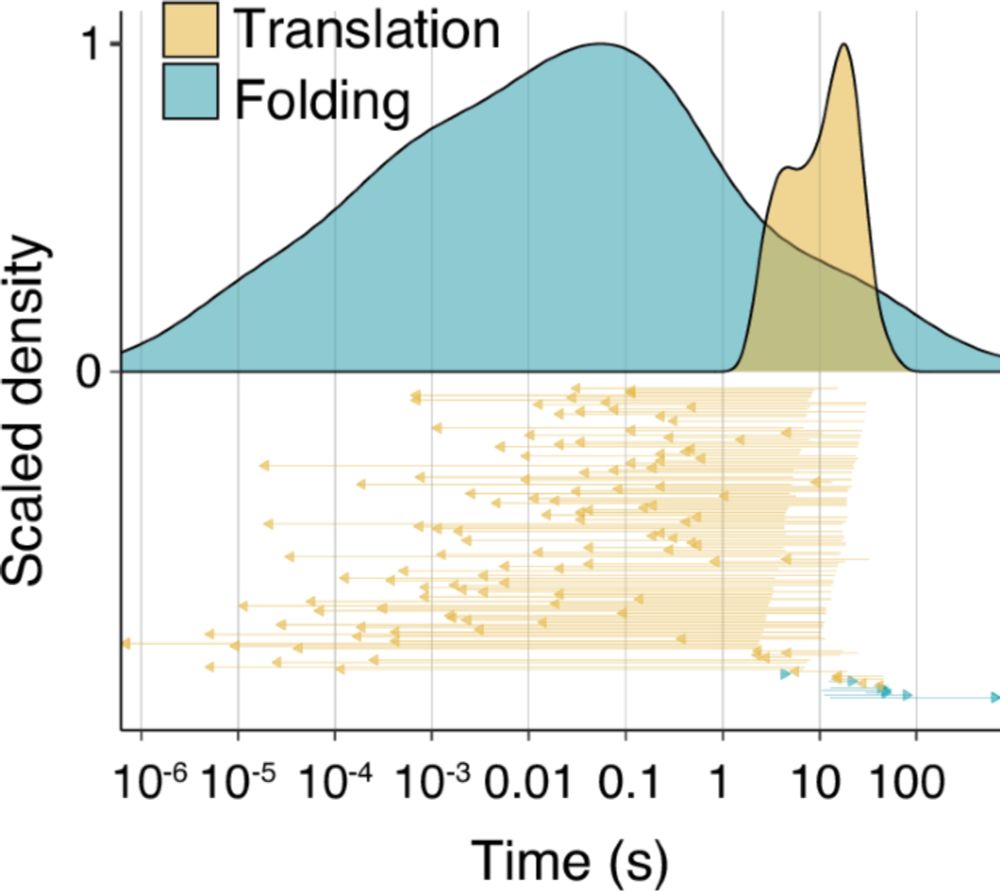
Native Fold Delay and its implications for co-translational chaperone binding and protein aggregation - Nature Communications
During vectorial protein translation, native interactions are temporarily unsatisfied. Here, authors introduce “Native Fold Delay”, integrating protein topology with translation kinetics to quantify t...
www.nature.com
February 17, 2025 at 12:22 PM
Most proteins fold co-translationally, but what if key residues aren’t available in time? Our new study introduces Native Fold Delay, a metric that links protein topology and translation rates to quantify folding delays. ⏳
Read more here www.nature.com/articles/s41...
Read more here www.nature.com/articles/s41...