



Q Cheng
@qiqicheng.bsky.social
Quantitative Research Associate @ #BeeWell | Uni of Manchester 🐝
Exploring adolescent mental health & wellbeing 📊
Causal Inference | Applied Econometrics 🌍
Exploring adolescent mental health & wellbeing 📊
Causal Inference | Applied Econometrics 🌍
Reposted by Q Cheng

One in 12 secondary pupils put in isolation rooms at least once a week, study finds

One in 12 secondary pupils put in isolation rooms at least once a week, study finds
Children with special educational needs more than twice as likely to be put in isolation, say Manchester researchers
*
‘Publicly humiliated’: parents describe difficulty of children’s isolation at school
One in 12 secondary pupils report being put into school isolation rooms at least once a week where they often spend in excess of eight hours, missing more than a full day of lessons, according to research.
Children with special educational needs were more than twice as likely to be placed in isolation, otherwise known as internal exclusion, while students from low-income backgrounds were also disproportionately affected. Continue reading...
www.theguardian.com
October 23, 2025 at 6:00 AM
One in 12 secondary pupils put in isolation rooms at least once a week, study finds
Great story in @theguardian.com sharing the latest @beewelluk.bsky.social @uomseed.bsky.social research looking at prevalence & impact of isolation in schools.
More detail in here 👉 tinyurl.com/yffvjp4x
@erthornton.bsky.social @neilhumphrey.bsky.social @olademk.bsky.social @qiqicheng.bsky.social
More detail in here 👉 tinyurl.com/yffvjp4x
@erthornton.bsky.social @neilhumphrey.bsky.social @olademk.bsky.social @qiqicheng.bsky.social
October 23, 2025 at 9:48 AM
Reposted by Q Cheng

"If we get this right, it will be the most important thing we have done in this Bill - but, at the moment, there is no measurement,” said Lord Gus O’Donnell in yesterday’s Children’s Wellbeing and Schools Bill debate.
🔗 www.ourwellbeingourvoice.org
🎥 Watch his speech below 👇
🔗 www.ourwellbeingourvoice.org
🎥 Watch his speech below 👇
September 17, 2025 at 2:19 PM
"If we get this right, it will be the most important thing we have done in this Bill - but, at the moment, there is no measurement,” said Lord Gus O’Donnell in yesterday’s Children’s Wellbeing and Schools Bill debate.
🔗 www.ourwellbeingourvoice.org
🎥 Watch his speech below 👇
🔗 www.ourwellbeingourvoice.org
🎥 Watch his speech below 👇
🏳️🌈 We know LGBTQIA+ youth urgently need effective mental health support. Our study provides an independent evidence that "Free2B," a 1:1 mentoring service, significantly improves their mental wellbeing. A very promising intervention! doi.org/10.1002/jad....
#LGBTQ #YouthMentalHealth #AcademicSky
#LGBTQ #YouthMentalHealth #AcademicSky
September 11, 2025 at 8:59 AM
🏳️🌈 We know LGBTQIA+ youth urgently need effective mental health support. Our study provides an independent evidence that "Free2B," a 1:1 mentoring service, significantly improves their mental wellbeing. A very promising intervention! doi.org/10.1002/jad....
#LGBTQ #YouthMentalHealth #AcademicSky
#LGBTQ #YouthMentalHealth #AcademicSky
Reposted by Q Cheng

LGBTQ+ young people in the UK face a severe, unequal mental health crisis.
Services like Free2Talk offer life-changing, cost-effective help, but they need greater support. 1/7
pbe.co.uk/publications...
Services like Free2Talk offer life-changing, cost-effective help, but they need greater support. 1/7
pbe.co.uk/publications...

August 27, 2025 at 8:03 AM
LGBTQ+ young people in the UK face a severe, unequal mental health crisis.
Services like Free2Talk offer life-changing, cost-effective help, but they need greater support. 1/7
pbe.co.uk/publications...
Services like Free2Talk offer life-changing, cost-effective help, but they need greater support. 1/7
pbe.co.uk/publications...
Reposted by Q Cheng
Thank you to everyone that got involved in our event yesterday to explore the latest #BeeWell findings from Greater Manchester!
It was fantastic to work with partners and young people to think about next steps to take in response to the latest data.
It was fantastic to work with partners and young people to think about next steps to take in response to the latest data.

April 17, 2025 at 12:52 PM
Thank you to everyone that got involved in our event yesterday to explore the latest #BeeWell findings from Greater Manchester!
It was fantastic to work with partners and young people to think about next steps to take in response to the latest data.
It was fantastic to work with partners and young people to think about next steps to take in response to the latest data.
Reposted by Q Cheng
To celebrate the launch of our latest #BeeWell headline findings in Greater Manchester (GM), we are sharing a new blog on youth-led action in response to #BeeWell, from across every local authority in GM!🧵
@bigchangecharity.bsky.social
@bigchangecharity.bsky.social

April 1, 2025 at 10:09 AM
To celebrate the launch of our latest #BeeWell headline findings in Greater Manchester (GM), we are sharing a new blog on youth-led action in response to #BeeWell, from across every local authority in GM!🧵
@bigchangecharity.bsky.social
@bigchangecharity.bsky.social
Reposted by Q Cheng

link 📈🤖
Quasi-Bayes in Latent Variable Models () Latent variable models are widely used to account for unobserved determinants
of economic behavior. Traditional nonparametric methods to estimate latent
heterogeneity do not scale well into multidimensional settings. Distributional
restrictions all
Quasi-Bayes in Latent Variable Models () Latent variable models are widely used to account for unobserved determinants
of economic behavior. Traditional nonparametric methods to estimate latent
heterogeneity do not scale well into multidimensional settings. Distributional
restrictions all
February 22, 2025 at 3:06 AM
link 📈🤖
Quasi-Bayes in Latent Variable Models () Latent variable models are widely used to account for unobserved determinants
of economic behavior. Traditional nonparametric methods to estimate latent
heterogeneity do not scale well into multidimensional settings. Distributional
restrictions all
Quasi-Bayes in Latent Variable Models () Latent variable models are widely used to account for unobserved determinants
of economic behavior. Traditional nonparametric methods to estimate latent
heterogeneity do not scale well into multidimensional settings. Distributional
restrictions all
Reposted by Q Cheng
“The inclusion of young people with SEND’s voices is not just a matter of good practice – it is a fundamental right...”
A new #BeeWell blog highlights the importance of involving young people with special educational needs and disabilities (SEND) in decision making.
A new #BeeWell blog highlights the importance of involving young people with special educational needs and disabilities (SEND) in decision making.


February 6, 2025 at 9:52 AM
“The inclusion of young people with SEND’s voices is not just a matter of good practice – it is a fundamental right...”
A new #BeeWell blog highlights the importance of involving young people with special educational needs and disabilities (SEND) in decision making.
A new #BeeWell blog highlights the importance of involving young people with special educational needs and disabilities (SEND) in decision making.
Reposted by Q Cheng

New #beewell open access registered report on the longitudinal links between sleep, physical activity and wellbeing in adolescence: link.springer.com/article/10.1...
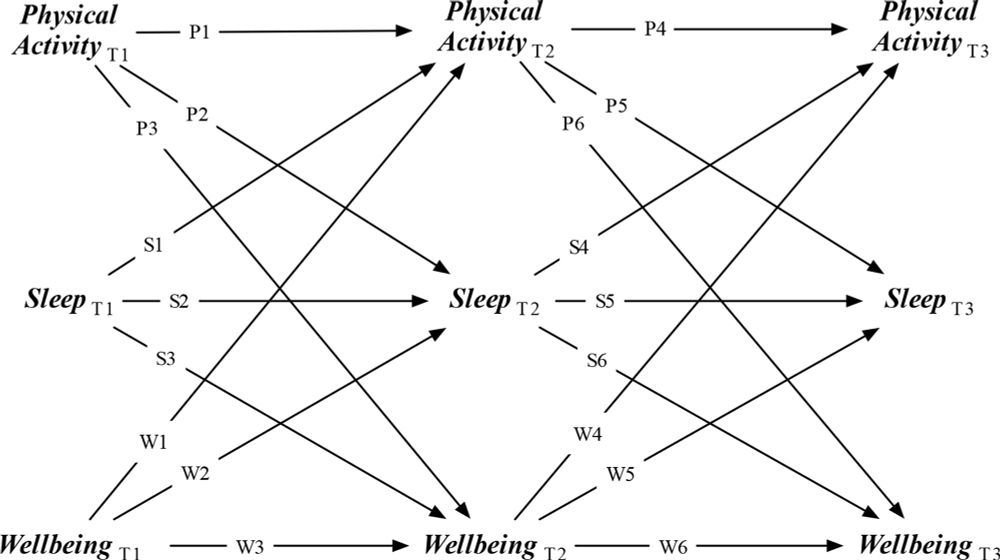
Longitudinal relationships across sleep, physical activity, and mental wellbeing in early-to-mid-adolescence: a developmental cascades investigation - Quality of Life Research
Purpose Sleep (SL), physical activity (PA), and wellbeing (WB) are three factors linked to positive development in adolescence. Despite theoretical support and some empirical evidence of developmental...
link.springer.com
January 28, 2025 at 7:01 PM
New #beewell open access registered report on the longitudinal links between sleep, physical activity and wellbeing in adolescence: link.springer.com/article/10.1...
Reposted by Q Cheng
First paper of 2025 🥳
Open access so fill yer boots
Open access so fill yer boots
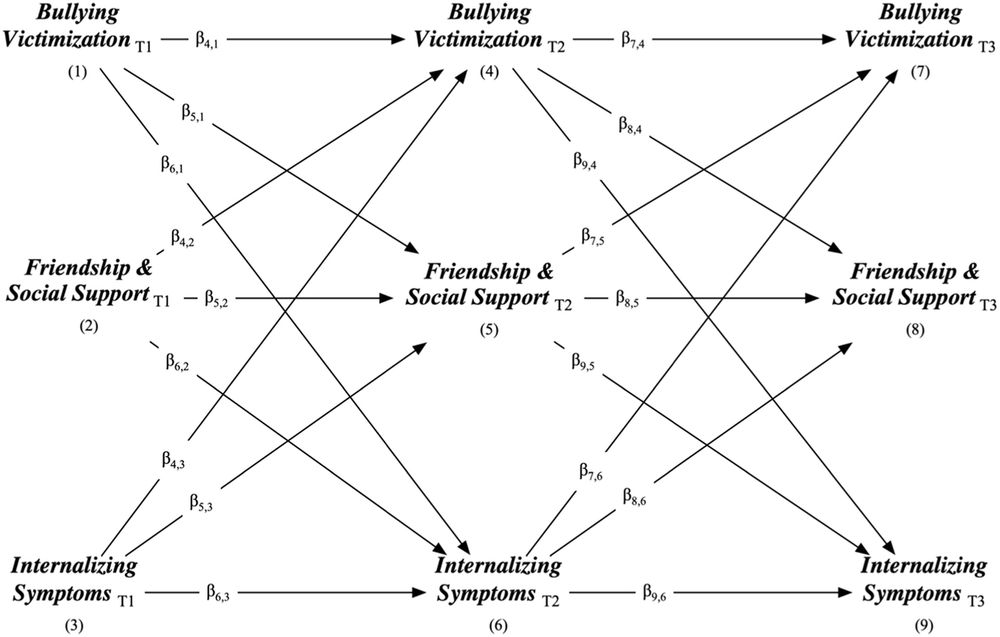
Longitudinal Relationships Across Bullying Victimization, Friendship and Social Support, and Internalizing Symptoms in Early-to-Middle Adolescence: A Developmental Cascades Investigation - Journal of ...
Current understanding of the longitudinal relationships between different aspects of peer relationships and mental health problems in early- to mid-adolescence is limited. In particular, the role play...
link.springer.com
January 18, 2025 at 1:17 PM
First paper of 2025 🥳
Open access so fill yer boots
Open access so fill yer boots
Reposted by Q Cheng

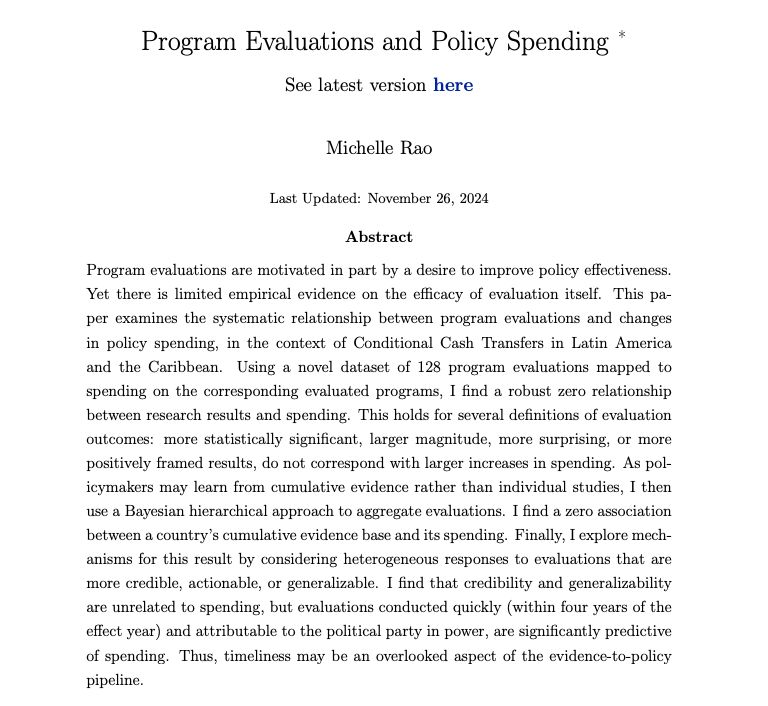
We still have a relatively poor understanding of the relationship between evidence and policy. Program evaluation in particular is often motivated by a desire to make policy better. But how effective is program evaluation itself?Michelle Rao's JMP tackles this question. www.michellerao.com/research
November 27, 2024 at 5:42 AM
We still have a relatively poor understanding of the relationship between evidence and policy. Program evaluation in particular is often motivated by a desire to make policy better. But how effective is program evaluation itself?Michelle Rao's JMP tackles this question. www.michellerao.com/research
A summary of the weak IV literature by Keane and Neal: www.annualreviews.org/content/jour...
A Practical Guide to Weak Instruments | Annual Reviews
We survey the weak instrumental variables (IV) literature with the aim of giving simple advice to applied researchers. This literature focuses heavily on the problem of size inflation in two-stage lea...
www.annualreviews.org
November 27, 2024 at 10:17 AM
A summary of the weak IV literature by Keane and Neal: www.annualreviews.org/content/jour...
Reposted by Q Cheng
1. Leave the data in levels -- no differencing. Run the pooled OLS regression across the two time periods:
Y(i,t) on W(i,t), W(i,t)*[X(i) - X1_bar], 1, D(i), X(i), D(i)*[X(i) - X1_bar], f2_t, f2_t*[X(i) - X1_bar]
Coef on W(i,t) = D(i)*f2_t is the same ATT estimate.
Y(i,t) on W(i,t), W(i,t)*[X(i) - X1_bar], 1, D(i), X(i), D(i)*[X(i) - X1_bar], f2_t, f2_t*[X(i) - X1_bar]
Coef on W(i,t) = D(i)*f2_t is the same ATT estimate.
Consider the simplest DiD setup with panel data. T = 2, controls X(i) don't change over time. D(i) is the "ever treated" indicator, f2(t) the second period time dummy. W(i,t) the time-varying treatment W(i,t) = D(i)*f2(t). The X(i) appear flexibly to allow selection and heterogeneous trends.
November 21, 2024 at 3:42 PM
1. Leave the data in levels -- no differencing. Run the pooled OLS regression across the two time periods:
Y(i,t) on W(i,t), W(i,t)*[X(i) - X1_bar], 1, D(i), X(i), D(i)*[X(i) - X1_bar], f2_t, f2_t*[X(i) - X1_bar]
Coef on W(i,t) = D(i)*f2_t is the same ATT estimate.
Y(i,t) on W(i,t), W(i,t)*[X(i) - X1_bar], 1, D(i), X(i), D(i)*[X(i) - X1_bar], f2_t, f2_t*[X(i) - X1_bar]
Coef on W(i,t) = D(i)*f2_t is the same ATT estimate.