



Hanbo Xie
@psychboyh.bsky.social
Fourth-year PhD student at NRD Lab at Gatech. Interested in how humans and AI think and reason.
Can Think-Aloud be really useful in understanding human minds? Building on our previous work, we formally propose reopening this old debate, with one of the largest Think-Aloud datasets, "RiskyThought44K," and LLM analysis, showing Think-Aloud can complement to comp cogsci.

October 2, 2025 at 3:06 AM
Can Think-Aloud be really useful in understanding human minds? Building on our previous work, we formally propose reopening this old debate, with one of the largest Think-Aloud datasets, "RiskyThought44K," and LLM analysis, showing Think-Aloud can complement to comp cogsci.
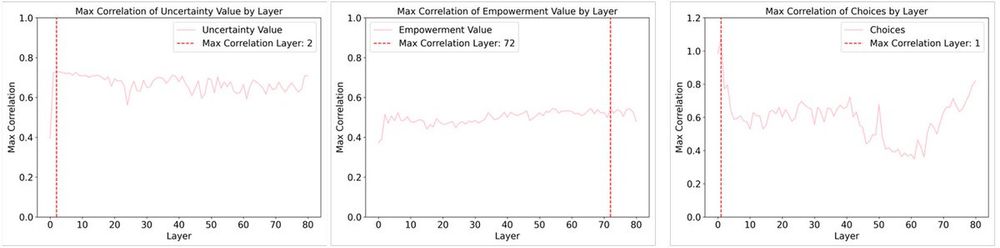
The SAE result suggests that empowerment and uncertainty strategies are represented in LLaMA-3.1 70B, with relatively strong correlations with latent neurons. However, choices and uncertainty are most correlated in early transformer blocks while empowerment is in later blocks.
January 31, 2025 at 6:50 PM
The SAE result suggests that empowerment and uncertainty strategies are represented in LLaMA-3.1 70B, with relatively strong correlations with latent neurons. However, choices and uncertainty are most correlated in early transformer blocks while empowerment is in later blocks.
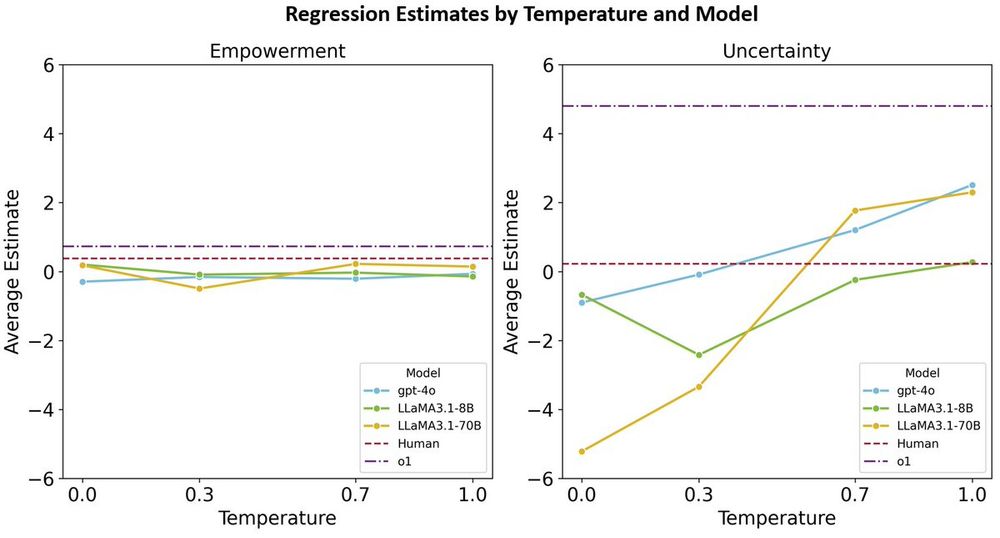
Our results suggest that humans can somehow well balance these two strategies, while traditional LLMs mainly use uncertainty-driven strategies rather than empowerment, which only yields short-term competence when the action space is small. o1 uses both strategies more than humans
January 31, 2025 at 6:50 PM
Our results suggest that humans can somehow well balance these two strategies, while traditional LLMs mainly use uncertainty-driven strategies rather than empowerment, which only yields short-term competence when the action space is small. o1 uses both strategies more than humans
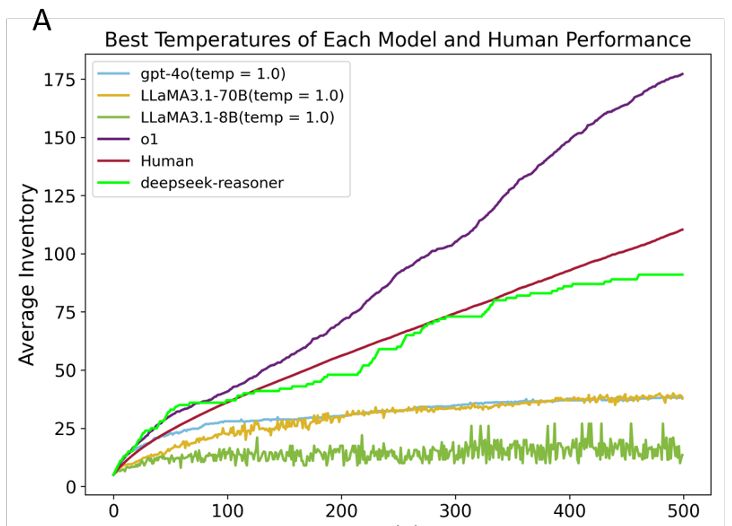
The result is intriguing. For traditional LLMs (GPT-4o, LLaMA-3.1 8B, 70B), their performance is far worse than humans, while for reasoning models like o1 and the popular deepseek-R1 (see appendix), they can surpass or reach human-level performance.
January 31, 2025 at 6:50 PM
The result is intriguing. For traditional LLMs (GPT-4o, LLaMA-3.1 8B, 70B), their performance is far worse than humans, while for reasoning models like o1 and the popular deepseek-R1 (see appendix), they can surpass or reach human-level performance.
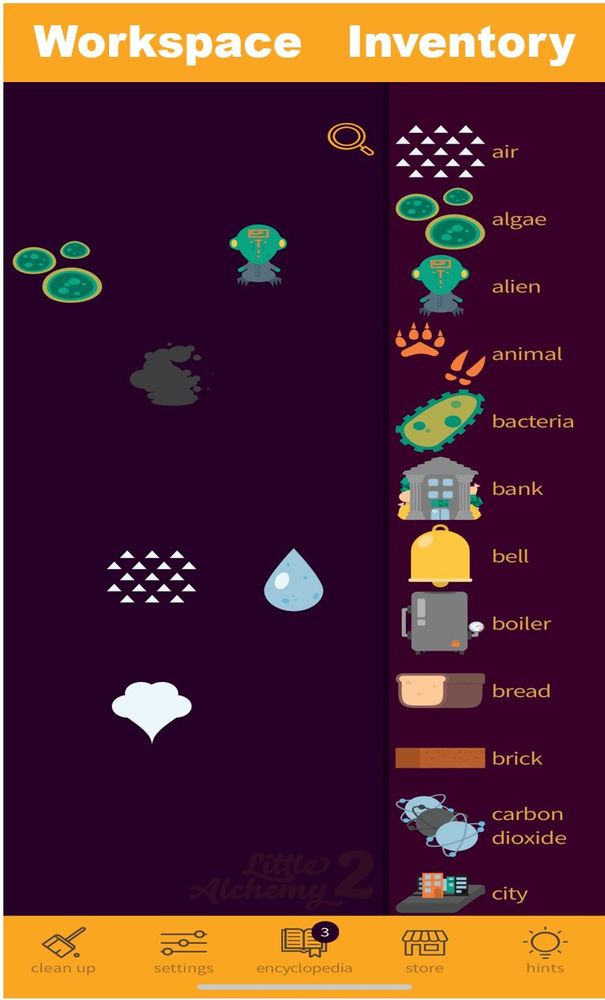
Therefore, we borrowed a paradigm with human data from a game-like experiment-'Little Alchemy 2', where agents combine known elements to invent novel ones. We wonder (1) whether LLMs can do better than humans. (2) what strategies and (3) what mechanisms explain the performance?
January 31, 2025 at 6:50 PM
Therefore, we borrowed a paradigm with human data from a game-like experiment-'Little Alchemy 2', where agents combine known elements to invent novel ones. We wonder (1) whether LLMs can do better than humans. (2) what strategies and (3) what mechanisms explain the performance?