




PRIMA probe
@prima-probe.bsky.social
PRIMA is a far-IR probe concept for the 2030s that will reveal how abundant elements are built up in galaxies over cosmic time, and follow them as they become the molecular building blocks of new planets! https://prima.ipac.caltech.edu/
It also features an additional 30 papers from the broader scientific community from both US-based scientists and from scientists around the world.
September 3, 2025 at 8:49 PM
It also features an additional 30 papers from the broader scientific community from both US-based scientists and from scientists around the world.
This special JATIS issue is focused on the PRIMA mission concept and features authors from the PRIMA team and wider scientific community. The PRIMA team led eight papers in the issue, covering an overview of the mission, its instruments, and key science goals.
www.spiedigitallibrary.org
September 3, 2025 at 8:49 PM
This special JATIS issue is focused on the PRIMA mission concept and features authors from the PRIMA team and wider scientific community. The PRIMA team led eight papers in the issue, covering an overview of the mission, its instruments, and key science goals.
PRIMA will fill an essential gap between ALMA and JWST for understanding disk structure and dissipation

May 19, 2025 at 7:06 PM
PRIMA will fill an essential gap between ALMA and JWST for understanding disk structure and dissipation
Understanding the radiation environment in disks and its role in their evaporation is key to understanding disk evolution. PRIMA will provide essential information on high-energy radiation through multiple lines like OI, greatly expanding on samples of a few lines measured with Herschel

May 19, 2025 at 7:04 PM
Understanding the radiation environment in disks and its role in their evaporation is key to understanding disk evolution. PRIMA will provide essential information on high-energy radiation through multiple lines like OI, greatly expanding on samples of a few lines measured with Herschel
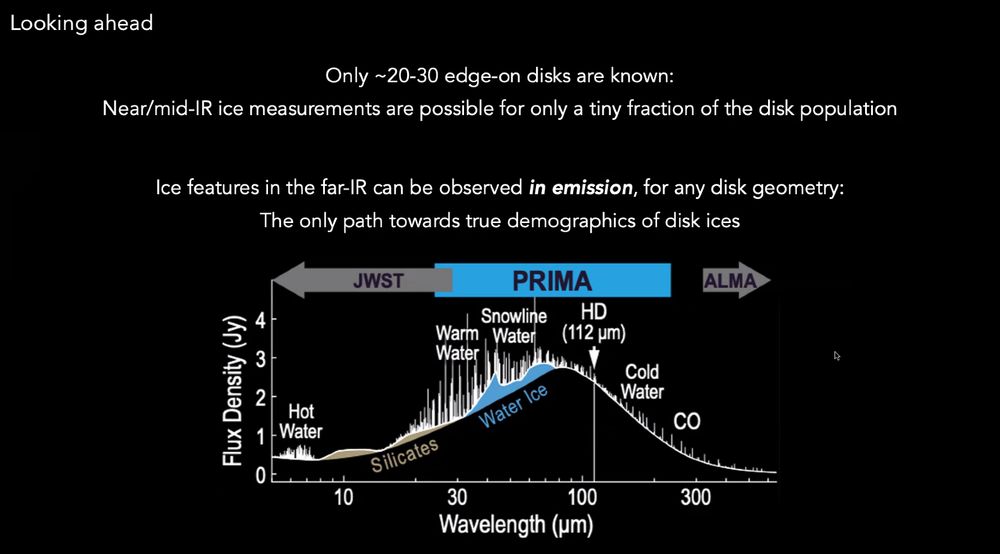
However, the sample of edge-on disks available for these studies is limited and intrinsically biased. Far-IR observations, which are not restricted to edge-on disks, offer a unique path to a gaining complete understanding of the demographics of icy disks.
May 19, 2025 at 6:36 PM
However, the sample of edge-on disks available for these studies is limited and intrinsically biased. Far-IR observations, which are not restricted to edge-on disks, offer a unique path to a gaining complete understanding of the demographics of icy disks.
The shape of these protostellar disk ice spectra can yield detailed information about the quantity of ice and its chemical composition and environment.

May 19, 2025 at 6:36 PM
The shape of these protostellar disk ice spectra can yield detailed information about the quantity of ice and its chemical composition and environment.
Near- and mid-IR spectra of disks are revealing ice properties, but these disks must be observed edge-on. Interpretations of these observations are very sensitive to radiative transfer, and require good models of disks and accurate lab measurements of optical ice properties.
May 19, 2025 at 6:36 PM
Near- and mid-IR spectra of disks are revealing ice properties, but these disks must be observed edge-on. Interpretations of these observations are very sensitive to radiative transfer, and require good models of disks and accurate lab measurements of optical ice properties.
ALMA is making great progress characterizing the dust grain content, but we are currently missing a way to characterize the icy component of disks, which carries the bulk of planet-forming materials, including key ingredients like volatiles and prebiotic molecules

May 19, 2025 at 6:23 PM
ALMA is making great progress characterizing the dust grain content, but we are currently missing a way to characterize the icy component of disks, which carries the bulk of planet-forming materials, including key ingredients like volatiles and prebiotic molecules
As always, we want YOU! There are many, many ways to get involved, and we want to hear your voice! Contact us directly at our new e-mail prima.questions@jpl.nasa.gov

May 19, 2025 at 4:42 PM
As always, we want YOU! There are many, many ways to get involved, and we want to hear your voice! Contact us directly at our new e-mail prima.questions@jpl.nasa.gov
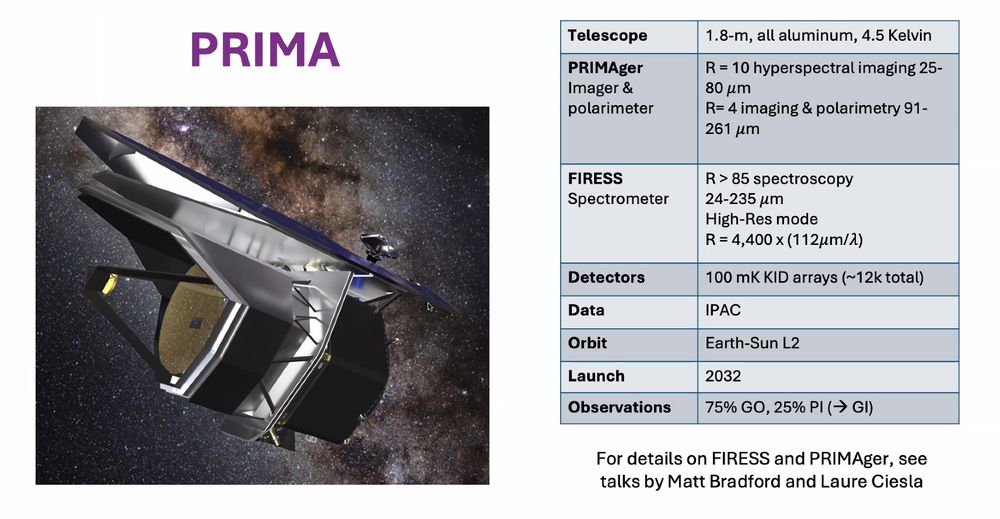
PRIMA's capabilities are defined by a PI science program, but they are ultimately designed to deliver a powerful and flexible community resource, with 75% of PRIMA's observing time (~32,000 hours over 5 years) open to astronomers everywhere

May 19, 2025 at 4:31 PM
PRIMA's capabilities are defined by a PI science program, but they are ultimately designed to deliver a powerful and flexible community resource, with 75% of PRIMA's observing time (~32,000 hours over 5 years) open to astronomers everywhere
Decades of NASA investment have enabled this enormous technological leap forward, yielding an orders of magnitudes increase in observing capabilities in the far-infrared that is equivalent to observing at optical wavelengths at night vs. day

May 19, 2025 at 4:25 PM
Decades of NASA investment have enabled this enormous technological leap forward, yielding an orders of magnitudes increase in observing capabilities in the far-infrared that is equivalent to observing at optical wavelengths at night vs. day
Next, deputy science lead Tiffany Kataria is presenting the science enabled by PRIMA
May 19, 2025 at 4:25 PM
Next, deputy science lead Tiffany Kataria is presenting the science enabled by PRIMA
First up at 9:10 PDT is an overview of PRIMA, followed by more detailed presentations of General Observer science and the PRIMA instruments
May 19, 2025 at 3:49 PM
First up at 9:10 PDT is an overview of PRIMA, followed by more detailed presentations of General Observer science and the PRIMA instruments