




PRIMA probe
@prima-probe.bsky.social
PRIMA is a far-IR probe concept for the 2030s that will reveal how abundant elements are built up in galaxies over cosmic time, and follow them as they become the molecular building blocks of new planets! https://prima.ipac.caltech.edu/
PRIMA will fill an essential gap between ALMA and JWST for understanding disk structure and dissipation

May 19, 2025 at 7:06 PM
PRIMA will fill an essential gap between ALMA and JWST for understanding disk structure and dissipation
Understanding the radiation environment in disks and its role in their evaporation is key to understanding disk evolution. PRIMA will provide essential information on high-energy radiation through multiple lines like OI, greatly expanding on samples of a few lines measured with Herschel

May 19, 2025 at 7:04 PM
Understanding the radiation environment in disks and its role in their evaporation is key to understanding disk evolution. PRIMA will provide essential information on high-energy radiation through multiple lines like OI, greatly expanding on samples of a few lines measured with Herschel
Next up at #PRIMA2025 is BU prof @catherineespaillat.bsky.social talking about how PRIMA can fill in the gaps in our understanding of protoplanetary disk evolution

May 19, 2025 at 6:43 PM
Next up at #PRIMA2025 is BU prof @catherineespaillat.bsky.social talking about how PRIMA can fill in the gaps in our understanding of protoplanetary disk evolution
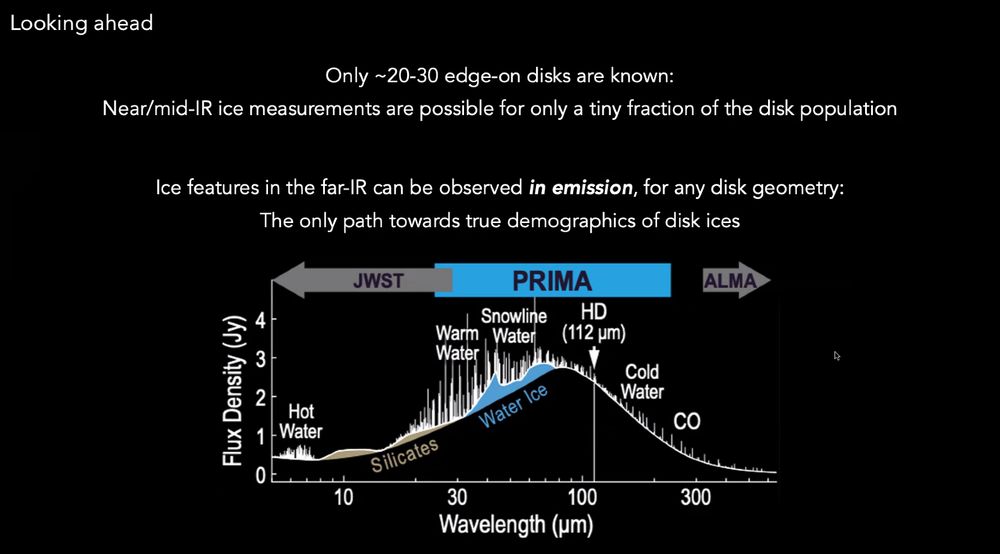
However, the sample of edge-on disks available for these studies is limited and intrinsically biased. Far-IR observations, which are not restricted to edge-on disks, offer a unique path to a gaining complete understanding of the demographics of icy disks.
May 19, 2025 at 6:36 PM
However, the sample of edge-on disks available for these studies is limited and intrinsically biased. Far-IR observations, which are not restricted to edge-on disks, offer a unique path to a gaining complete understanding of the demographics of icy disks.
The shape of these protostellar disk ice spectra can yield detailed information about the quantity of ice and its chemical composition and environment.

May 19, 2025 at 6:36 PM
The shape of these protostellar disk ice spectra can yield detailed information about the quantity of ice and its chemical composition and environment.
ALMA is making great progress characterizing the dust grain content, but we are currently missing a way to characterize the icy component of disks, which carries the bulk of planet-forming materials, including key ingredients like volatiles and prebiotic molecules

May 19, 2025 at 6:23 PM
ALMA is making great progress characterizing the dust grain content, but we are currently missing a way to characterize the icy component of disks, which carries the bulk of planet-forming materials, including key ingredients like volatiles and prebiotic molecules
A great afternoon of talks at #PRIMA2025 kicking off with Berkeley prof Jenny Bergner giving us an exciting sneak peek into what PRIMA can do for studies of planet formation

May 19, 2025 at 6:19 PM
A great afternoon of talks at #PRIMA2025 kicking off with Berkeley prof Jenny Bergner giving us an exciting sneak peek into what PRIMA can do for studies of planet formation
As always, we want YOU! There are many, many ways to get involved, and we want to hear your voice! Contact us directly at our new e-mail prima.questions@jpl.nasa.gov

May 19, 2025 at 4:42 PM
As always, we want YOU! There are many, many ways to get involved, and we want to hear your voice! Contact us directly at our new e-mail prima.questions@jpl.nasa.gov
PRIMA's capabilities are defined by a PI science program, but they are ultimately designed to deliver a powerful and flexible community resource, with 75% of PRIMA's observing time (~32,000 hours over 5 years) open to astronomers everywhere

May 19, 2025 at 4:31 PM
PRIMA's capabilities are defined by a PI science program, but they are ultimately designed to deliver a powerful and flexible community resource, with 75% of PRIMA's observing time (~32,000 hours over 5 years) open to astronomers everywhere
Decades of NASA investment have enabled this enormous technological leap forward, yielding an orders of magnitudes increase in observing capabilities in the far-infrared that is equivalent to observing at optical wavelengths at night vs. day

May 19, 2025 at 4:25 PM
Decades of NASA investment have enabled this enormous technological leap forward, yielding an orders of magnitudes increase in observing capabilities in the far-infrared that is equivalent to observing at optical wavelengths at night vs. day
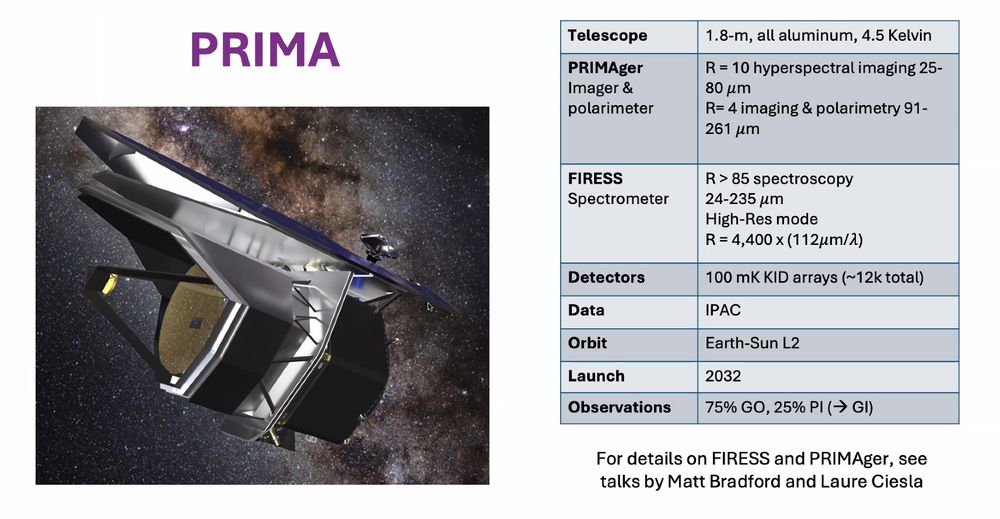
Next, deputy science lead Tiffany Kataria is presenting the science enabled by PRIMA
May 19, 2025 at 4:25 PM
Next, deputy science lead Tiffany Kataria is presenting the science enabled by PRIMA
PRIMA PI Jason Glenn leading off with an overview, showing the timeline for the genesis of the technology and science that has led to the development of the current probe concept

May 19, 2025 at 4:18 PM
PRIMA PI Jason Glenn leading off with an overview, showing the timeline for the genesis of the technology and science that has led to the development of the current probe concept

Talk slides and recording from today's P-CAST talk (Jason Glen giving an overview of the PRIMA concept) will be posted on our webpage! prima.ipac.caltech.edu/page/p-cast

January 27, 2025 at 5:17 PM
Talk slides and recording from today's P-CAST talk (Jason Glen giving an overview of the PRIMA concept) will be posted on our webpage! prima.ipac.caltech.edu/page/p-cast
Check out our Winter 2025 newsletter for all the latest PRIMA news and events! Lots of upcoming workshops, conferences, and opportunities to get involved! prima.ipac.caltech.edu/page/newslet...

January 16, 2025 at 7:37 PM
Check out our Winter 2025 newsletter for all the latest PRIMA news and events! Lots of upcoming workshops, conferences, and opportunities to get involved! prima.ipac.caltech.edu/page/newslet...