




Ondřej Hasník
@ondrejhasnik.bsky.social
Student of Chemistry at @vschtpraha.bsky.social
Interested in computational chemistry in @orca-qc-official.bsky.social
Linux fan
Interested in computational chemistry in @orca-qc-official.bsky.social
Linux fan
Reposted by Ondřej Hasník

We are proud to announce that ORCA 6.1.1 has been released and is available here:
orcaforum.kofo.mpg.de/app.php/dlex...
This is strictly a bugfix release that takes care of the problems that have been reported since the release of ORCA 6.1. The manual has also been updated.
orcaforum.kofo.mpg.de/app.php/dlex...
This is strictly a bugfix release that takes care of the problems that have been reported since the release of ORCA 6.1. The manual has also been updated.
ORCA Forum - Downloads
orcaforum.kofo.mpg.de
December 2, 2025 at 1:50 PM
We are proud to announce that ORCA 6.1.1 has been released and is available here:
orcaforum.kofo.mpg.de/app.php/dlex...
This is strictly a bugfix release that takes care of the problems that have been reported since the release of ORCA 6.1. The manual has also been updated.
orcaforum.kofo.mpg.de/app.php/dlex...
This is strictly a bugfix release that takes care of the problems that have been reported since the release of ORCA 6.1. The manual has also been updated.
Reposted by Ondřej Hasník

#CASSCF and (TD-)DFT are well-established components of #ORCA's method portfolio. Check out the new paper by Krewald et al., who use both for tuning the photoreactivity of Fe(III)-azido complexes.
doi.org/10.1002/cptc...
CASSCF in ORCA: www.faccts.de/docs/orca/6....
#ORCAqc #CompChem #QuantumChem
doi.org/10.1002/cptc...
CASSCF in ORCA: www.faccts.de/docs/orca/6....
#ORCAqc #CompChem #QuantumChem

Ligand Field Tuning of Photoreactivity: Contrasting Low‐Spin and High‐Spin Fe(III)‐Azido Complexes
Why do near-identical Fe(III)-azido complexes exhibit different photoreactivity profiles? Linking spin states and key normal modes to wavelength-dependent photoreductive and photooxidative reaction p...
doi.org
December 9, 2025 at 10:42 AM
#CASSCF and (TD-)DFT are well-established components of #ORCA's method portfolio. Check out the new paper by Krewald et al., who use both for tuning the photoreactivity of Fe(III)-azido complexes.
doi.org/10.1002/cptc...
CASSCF in ORCA: www.faccts.de/docs/orca/6....
#ORCAqc #CompChem #QuantumChem
doi.org/10.1002/cptc...
CASSCF in ORCA: www.faccts.de/docs/orca/6....
#ORCAqc #CompChem #QuantumChem
Reposted by Ondřej Hasník

Signal polls are here!
Find the best time for your group chat to hang out, choose a vacation destination, or ask if you should give yourself a haircut at 1 AM. Now in the latest version of Signal for iOS, Android, and Desktop.
signal.org/blog/polls/
Find the best time for your group chat to hang out, choose a vacation destination, or ask if you should give yourself a haircut at 1 AM. Now in the latest version of Signal for iOS, Android, and Desktop.
signal.org/blog/polls/

Signal Polls: Yes, no, maybe (yes!)
Signal polling: An easier way to see what your group chat really thinks and feels.
signal.org
November 20, 2025 at 12:21 AM
Signal polls are here!
Find the best time for your group chat to hang out, choose a vacation destination, or ask if you should give yourself a haircut at 1 AM. Now in the latest version of Signal for iOS, Android, and Desktop.
signal.org/blog/polls/
Find the best time for your group chat to hang out, choose a vacation destination, or ask if you should give yourself a haircut at 1 AM. Now in the latest version of Signal for iOS, Android, and Desktop.
signal.org/blog/polls/
Reposted by Ondřej Hasník
Check out the latest release of QCxMS2 by @jogorges.bsky.social (@grimmelab.bsky.social) introducing CID. Thank you, Johannes, for interfacing it with ORCA as a QM engine!
#ORCAqc #ORCA6 #massspectrometry #CID #CompChem #ChemSky #CompChemSky
#ORCAqc #ORCA6 #massspectrometry #CID #CompChem #ChemSky #CompChemSky

QCxMS2 can now also simulate CID mass spectra.
Just published in #JASMS : doi.org/10.1021/jasms.5c00234
Grateful to my coauthors Stefan Grimme @grimmelab.bsky.social & Marianne Engeser @unibonn.bsky.social - this is the last project of my PhD and completes my work on QCxMS2!
#MassSpec #compchem
Just published in #JASMS : doi.org/10.1021/jasms.5c00234
Grateful to my coauthors Stefan Grimme @grimmelab.bsky.social & Marianne Engeser @unibonn.bsky.social - this is the last project of my PhD and completes my work on QCxMS2!
#MassSpec #compchem
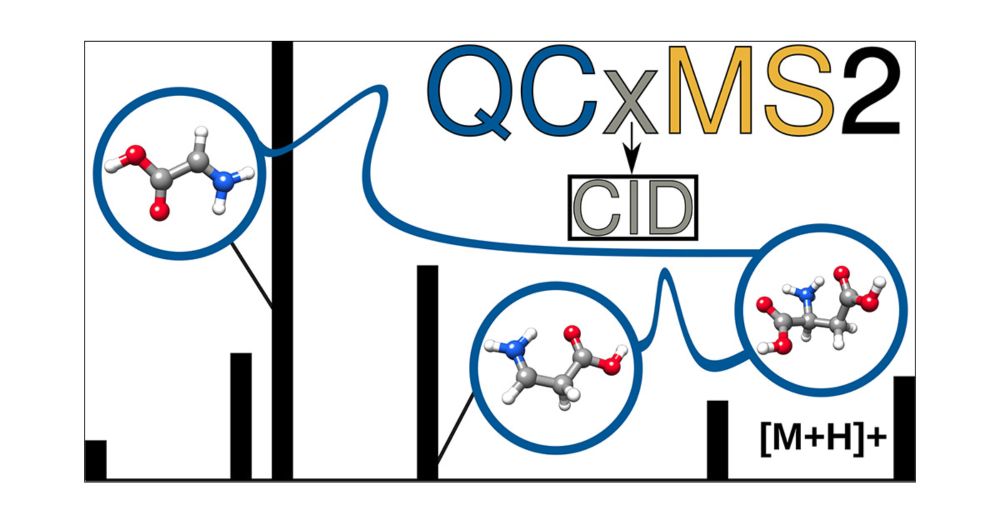
Evaluation of the QCxMS2 Method for the Calculation of Collision-Induced Dissociation Spectra via Automated Reaction Network Exploration
Collision-induced dissociation mass spectrometry (CID-MS) is an important tool in analytical chemistry for the structural elucidation of unknown compounds. The theoretical prediction of the CID spectra plays a critical role in supporting and accelerating this process. To this end, we adapt the recently developed QCxMS2 program originally designed for the calculation of electron ionization (EI) spectra to enable the computation of CID-MS. To account for the fragmentation conditions characteristic of CID within the automated reaction network discovery approach of QCxMS2 we adapted the internal energy distribution to match the experimental conditions. This distribution can be adjusted via a single parameter to approximate various activation settings, thereby eliminating the need for explicit simulations of the collisional process. We evaluate our approach on a test set of 13 organic molecules with diverse functional groups, compiled specifically for this study. All reference spectra were recorded consistently under the same measurement conditions, including both CID and higher-energy collisional dissociation (HCD) modes. Overall, QCxMS2 achieves a good average entropy similarity score (ESS) of 0.687 for the HCD spectra and 0.773 for the CID spectra. The direct comparison to experimental data demonstrates that the QCxMS2 approach, even without explicit modeling of collisions, is generally capable of computing both CID and HCD spectra with reasonable accuracy and robustness. This highlights its potential as a valuable tool for integration into structure elucidation workflows in analytical mass spectrometry.
doi.org
September 9, 2025 at 11:53 AM
Check out the latest release of QCxMS2 by @jogorges.bsky.social (@grimmelab.bsky.social) introducing CID. Thank you, Johannes, for interfacing it with ORCA as a QM engine!
#ORCAqc #ORCA6 #massspectrometry #CID #CompChem #ChemSky #CompChemSky
#ORCAqc #ORCA6 #massspectrometry #CID #CompChem #ChemSky #CompChemSky
Reposted by Ondřej Hasník
Hot off the press: “A Two-Level Preconditioner for the CASSCF Linear-Response Equations” by our scientific advisor Benjamin Helmich-Paris (@orca-qc-official.bsky.social). Its already part of ORCA 6.1, check it out!
doi.org/10.1021/acs....
#ORCA #ORCAqc #CompChem #QuantumChem #TheoChem #CASSCF
doi.org/10.1021/acs....
#ORCA #ORCAqc #CompChem #QuantumChem #TheoChem #CASSCF

A Two-Level Preconditioner for the CASSCF Linear-Response Equations
We present an efficient two-level strategy to accelerate the solution of the CASSCF linear-response eigenvalue problem using a customized Davidson algorithm. By identifying a subset of important response-vector components─the so-called P space─we compute and diagonalize full Hessian and metric matrix elements while treating the remaining Q-space components with a diagonal approximation. This approach decouples the orbital and configuration responses, enabling independent preconditioning of each component. Computational cost is further reduced through the resolution-of-the-identity approximation. We demonstrate significant performance gains across a diverse set of molecules, achieving speedups of up to 2.05 compared to the standard diagonal preconditioning. The largest efficiency gains are observed for MCTDA calculations involving many excited states and relatively small response-vector lengths. The two-level strategy is available in ORCA 6.1 and paves the way for extensions to dynamic polarizabilities, which require solving large-scale linear equations, as well as to time-dependent density functional theory and CI singles.
doi.org
August 25, 2025 at 9:20 AM
Hot off the press: “A Two-Level Preconditioner for the CASSCF Linear-Response Equations” by our scientific advisor Benjamin Helmich-Paris (@orca-qc-official.bsky.social). Its already part of ORCA 6.1, check it out!
doi.org/10.1021/acs....
#ORCA #ORCAqc #CompChem #QuantumChem #TheoChem #CASSCF
doi.org/10.1021/acs....
#ORCA #ORCAqc #CompChem #QuantumChem #TheoChem #CASSCF