




Nicolae Sapoval
@nsapoval.bsky.social
Lost in between mathematics, computer science and biology. Hoping to find myself one day.
https://nsapoval.github.io/
https://nsapoval.github.io/
[4/4] Our approach is by design a meta-method: you can use it with your favorite single-cell RNA-based GRN inference tool, and squeeze more insights out of your data! Check us out GitHub: github.com/aliaaz99/GRN....
#singlecell #GRN #LLM
#singlecell #GRN #LLM

GitHub - aliaaz99/GRNITE
Contribute to aliaaz99/GRNITE development by creating an account on GitHub.
github.com
November 28, 2025 at 9:49 PM
[4/4] Our approach is by design a meta-method: you can use it with your favorite single-cell RNA-based GRN inference tool, and squeeze more insights out of your data! Check us out GitHub: github.com/aliaaz99/GRN....
#singlecell #GRN #LLM
#singlecell #GRN #LLM
[3/4] We use these embeddings to construct a prior graph and then further refine it with some known TF-target interactions as pre-training targets. Finally, we use this augmented prior graph jointly with a GRN inferred by *any* other method, in order to produce a final prediction.
November 28, 2025 at 9:49 PM
[3/4] We use these embeddings to construct a prior graph and then further refine it with some known TF-target interactions as pre-training targets. Finally, we use this augmented prior graph jointly with a GRN inferred by *any* other method, in order to produce a final prediction.
[2/4] We use gene descriptions from NCBI Gene database and embed them into a high-dimensional space with a LLM (Qwen3-8B). This idea was inspired by GenePT (pubmed.ncbi.nlm.nih.gov/37905130/) and a great study on gene embeddings from @vyao.bsky.social's group (www.biorxiv.org/content/10.1...).

GenePT: A Simple But Effective Foundation Model for Genes and Cells Built From ChatGPT - PubMed
There has been significant recent progress in leveraging large-scale gene expression data to develop foundation models for single-cell biology. Models such as Geneformer and scGPT implicitly learn gene and cellular functions from the gene expression profiles of millions of cells, which requires exte …
pubmed.ncbi.nlm.nih.gov
November 28, 2025 at 9:49 PM
[2/4] We use gene descriptions from NCBI Gene database and embed them into a high-dimensional space with a LLM (Qwen3-8B). This idea was inspired by GenePT (pubmed.ncbi.nlm.nih.gov/37905130/) and a great study on gene embeddings from @vyao.bsky.social's group (www.biorxiv.org/content/10.1...).
Reposted by Nicolae Sapoval

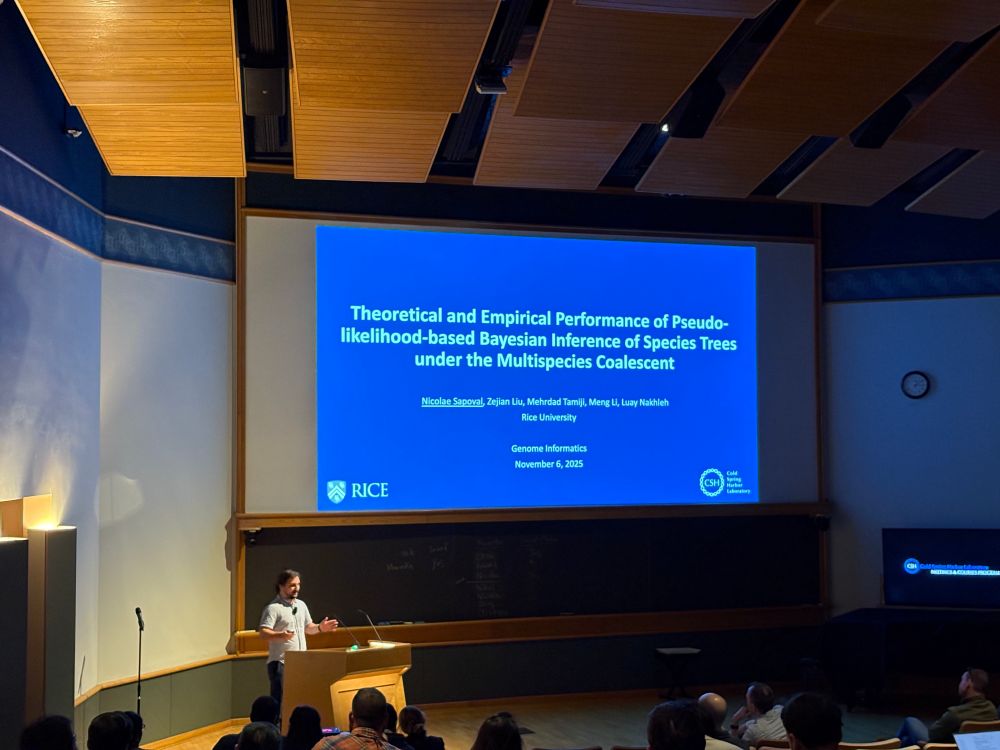
Nicolae Sapoval @nsapoval.bsky.social presented "Theoretical and empirical performance of pseudo-likelihood- based Bayesian inference of species trees under the multispecies coalescent"
A fantastic theory talk, offering intuitive insights!
Paper: doi.org/10.1101/2025.01.28.635282
A fantastic theory talk, offering intuitive insights!
Paper: doi.org/10.1101/2025.01.28.635282


November 6, 2025 at 8:28 PM
Nicolae Sapoval @nsapoval.bsky.social presented "Theoretical and empirical performance of pseudo-likelihood- based Bayesian inference of species trees under the multispecies coalescent"
A fantastic theory talk, offering intuitive insights!
Paper: doi.org/10.1101/2025.01.28.635282
A fantastic theory talk, offering intuitive insights!
Paper: doi.org/10.1101/2025.01.28.635282
As the next step, we aim to develop rigorous corrections to the pseudo-likelihood-based credibility intervals in order to further improve scalability and applicability of Baeysian phylogenomic inference.
February 2, 2025 at 12:11 AM
As the next step, we aim to develop rigorous corrections to the pseudo-likelihood-based credibility intervals in order to further improve scalability and applicability of Baeysian phylogenomic inference.
In our work we explore suitability of pseudo-likelihood for Bayesian phylogenomic inference. We show that using pseudo-likelihood greatly reduces the computational burden of the Bayesian inference. However, the inferred credibility intervals are overconfident.
February 2, 2025 at 12:11 AM
In our work we explore suitability of pseudo-likelihood for Bayesian phylogenomic inference. We show that using pseudo-likelihood greatly reduces the computational burden of the Bayesian inference. However, the inferred credibility intervals are overconfident.
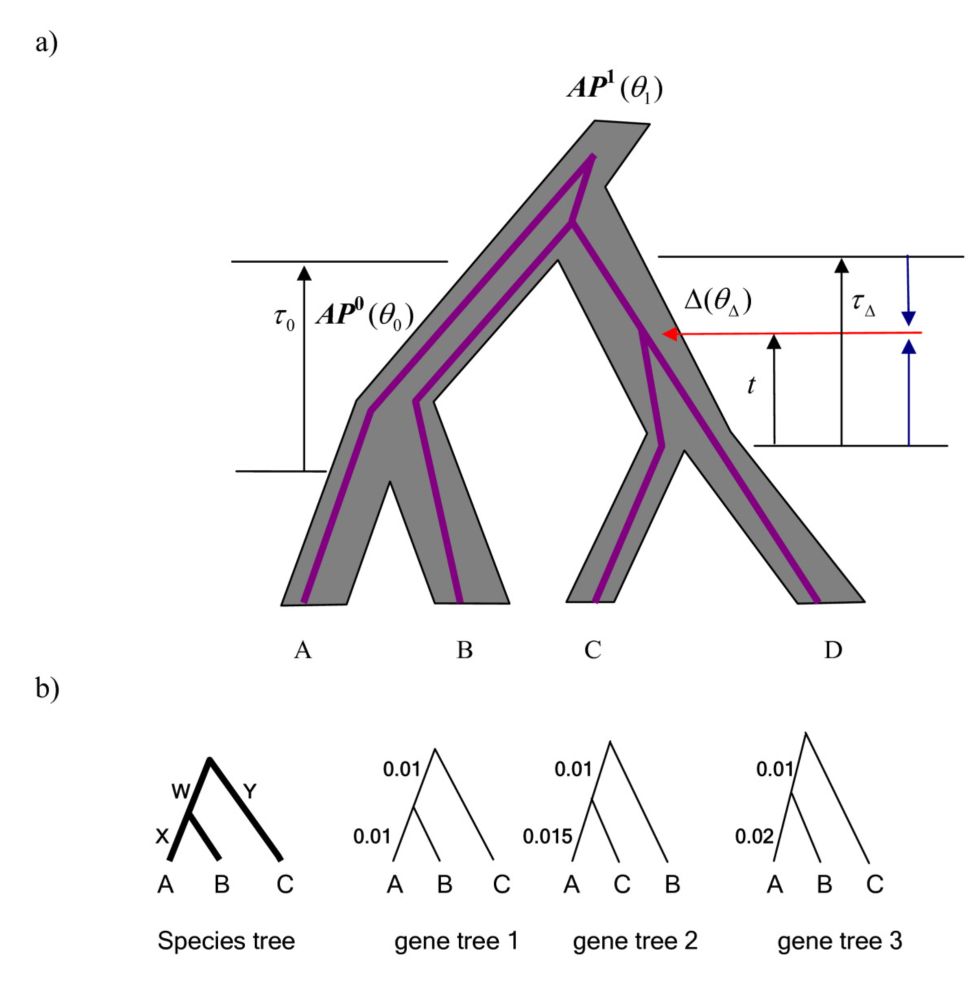
Likelihood-based phylogenomic inference is common, but it faces scalability issues. Hence, pseudo-likelihood has been previously proposed as a statistically consistent (for topology estimation) and scalable alternative: doi.org/10.1186/1471...
A maximum pseudo-likelihood approach for estimating species trees under the coalescent model - BMC Ecology and Evolution
Background Several phylogenetic approaches have been developed to estimate species trees from collections of gene trees. However, maximum likelihood approaches for estimating species trees under the c...
doi.org
February 2, 2025 at 12:11 AM
Likelihood-based phylogenomic inference is common, but it faces scalability issues. Hence, pseudo-likelihood has been previously proposed as a statistically consistent (for topology estimation) and scalable alternative: doi.org/10.1186/1471...
In case if you lose the URL (it’s not pretty), I have linked this on my website (nsapoval.github.io) as well.
Nicolae Sapoval
A simple, whitespace theme for academics. Based on [*folio](https://github.com/bogoli/-folio) design.
nsapoval.github.io
January 1, 2025 at 6:48 PM
In case if you lose the URL (it’s not pretty), I have linked this on my website (nsapoval.github.io) as well.
This is aimed primarily at the people who are just starting their thesis-based masters or a PhD. However, it’s also an evolving document, so suggestions and ideas are welcome!
January 1, 2025 at 6:48 PM
This is aimed primarily at the people who are just starting their thesis-based masters or a PhD. However, it’s also an evolving document, so suggestions and ideas are welcome!