



National Labor Relations Board
@nlrbgov.bsky.social
National Labor Relations Board
For NLRB General Counsel: @nlrbgc.bsky.social
For NLRB General Counsel: @nlrbgc.bsky.social
"Returning to the clear and unmistakable waiver standard better serves the pro-bargaining policy of the Act." — Chairman Lauren McFerran.

December 10, 2024 at 7:56 PM
"Returning to the clear and unmistakable waiver standard better serves the pro-bargaining policy of the Act." — Chairman Lauren McFerran.
The Board explained that the return to the “clear and unmistakable waiver” standard better accomplishes the central statutory policy goal of the National Labor Relations Act: to promote industrial peace by “encouraging the practice and procedure of collective bargaining.”
December 10, 2024 at 7:56 PM
The Board explained that the return to the “clear and unmistakable waiver” standard better accomplishes the central statutory policy goal of the National Labor Relations Act: to promote industrial peace by “encouraging the practice and procedure of collective bargaining.”
In Endurance, the Board overruled MV Transportation, Inc., 368 NLRB No. 66 (2019), in which an earlier Board had adopted the “contract coverage” test, which made it easier for employers to avoid engaging in collective bargaining over workplace changes.
December 10, 2024 at 7:56 PM
In Endurance, the Board overruled MV Transportation, Inc., 368 NLRB No. 66 (2019), in which an earlier Board had adopted the “contract coverage” test, which made it easier for employers to avoid engaging in collective bargaining over workplace changes.
Today’s decision in Endurance Environmental Solutions, LLC restores that standard, previously followed by the Board for more than 70 years and endorsed by the Supreme Court.
December 10, 2024 at 7:56 PM
Today’s decision in Endurance Environmental Solutions, LLC restores that standard, previously followed by the Board for more than 70 years and endorsed by the Supreme Court.
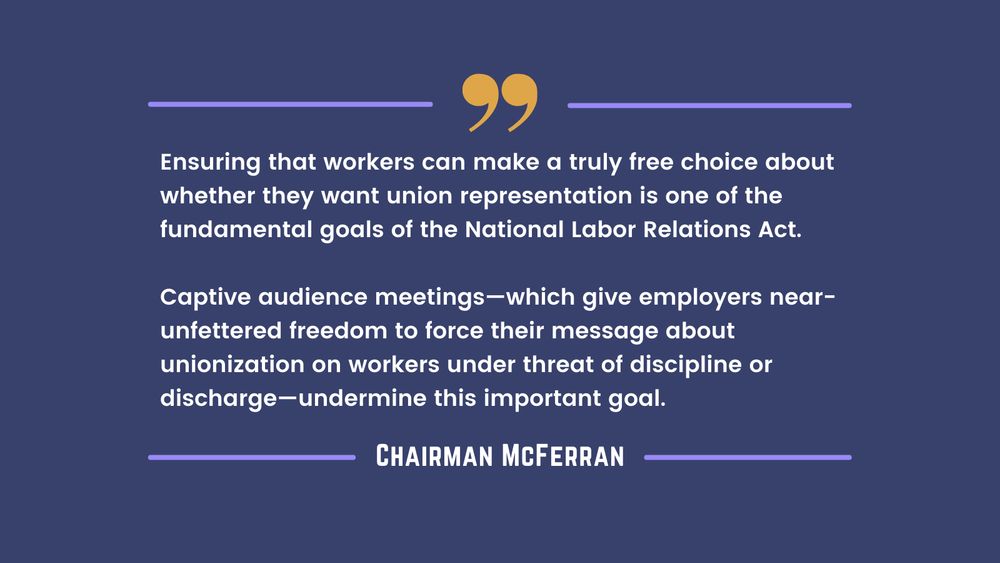
“Today’s decision better protects workers’ freedom to make their own choices in exercising their rights under the Act, while ensuring that employers can convey their views about unionization in a noncoercive manner.”-Chairman McFerran
November 13, 2024 at 6:00 PM
“Today’s decision better protects workers’ freedom to make their own choices in exercising their rights under the Act, while ensuring that employers can convey their views about unionization in a noncoercive manner.”-Chairman McFerran
Employers are, however, free to hold meetings expressing their views on unionization so long as workers are informed in advance about the topic of the meeting, that the meeting is voluntary, and that no attendance will be taken.

November 13, 2024 at 5:59 PM
Employers are, however, free to hold meetings expressing their views on unionization so long as workers are informed in advance about the topic of the meeting, that the meeting is voluntary, and that no attendance will be taken.
3️⃣: Required attendance lends a coercive character to the message regarding unionization that employees are forced to receive. It demonstrates the employer’s economic power and reasonably tends to inhibit employees from acting freely in exercising their rights.
November 13, 2024 at 5:59 PM
3️⃣: Required attendance lends a coercive character to the message regarding unionization that employees are forced to receive. It demonstrates the employer’s economic power and reasonably tends to inhibit employees from acting freely in exercising their rights.
2️⃣: Captive audience meetings provide a mechanism for an employer to observe and surveil employees as it addresses the exercise of employees’ Section 7 rights.
November 13, 2024 at 5:58 PM
2️⃣: Captive audience meetings provide a mechanism for an employer to observe and surveil employees as it addresses the exercise of employees’ Section 7 rights.
The Board explained why captive audience meeting interfere with employees’ rights 👇
1️⃣: They violate an employee’s right under Section 7 of the Act to freely decide whether, when, and how to participate in a debate concerning union representation, or refrain from doing so.
1️⃣: They violate an employee’s right under Section 7 of the Act to freely decide whether, when, and how to participate in a debate concerning union representation, or refrain from doing so.
November 13, 2024 at 5:58 PM
The Board explained why captive audience meeting interfere with employees’ rights 👇
1️⃣: They violate an employee’s right under Section 7 of the Act to freely decide whether, when, and how to participate in a debate concerning union representation, or refrain from doing so.
1️⃣: They violate an employee’s right under Section 7 of the Act to freely decide whether, when, and how to participate in a debate concerning union representation, or refrain from doing so.
“The rule that we return to today brings greater consistency to the Board’s approach in evaluating potentially threatening statements,” said Chairman Lauren McFerran.

November 8, 2024 at 4:41 PM
“The rule that we return to today brings greater consistency to the Board’s approach in evaluating potentially threatening statements,” said Chairman Lauren McFerran.
If an employer’s prediction is not grounded in objective fact or predicts negative consequences that would result from the employer’s own actions, it is “no longer a reasonable prediction based on available facts, but a threat of retaliation based on misrepresentation and coercion.”
November 8, 2024 at 4:40 PM
If an employer’s prediction is not grounded in objective fact or predicts negative consequences that would result from the employer’s own actions, it is “no longer a reasonable prediction based on available facts, but a threat of retaliation based on misrepresentation and coercion.”
The Board will analyze such statements under the same longstanding test it uses to evaluate other potentially threatening or coercive statements. This approach is grounded in the Supreme Court’s decision in NLRB v. Gissel Packing Co.
November 8, 2024 at 4:40 PM
The Board will analyze such statements under the same longstanding test it uses to evaluate other potentially threatening or coercive statements. This approach is grounded in the Supreme Court’s decision in NLRB v. Gissel Packing Co.
The Board overruled Tri-Cast, which had deemed most employer statements about the impact of unionization on the relationship between individual employees and their employer to be categorically lawful. Now 👇
November 8, 2024 at 4:40 PM
The Board overruled Tri-Cast, which had deemed most employer statements about the impact of unionization on the relationship between individual employees and their employer to be categorically lawful. Now 👇