



nisaki
@nisaki04.bsky.social
Ph.D. student (comparative politics, UK Labour). JPN.
https://researchmap.jp/nisaki
https://researchmap.jp/nisaki
Reposted by nisaki

How effective is protesting? According to historians and political scientists: very
www.theguardian.com/us-news/2025...
www.theguardian.com/us-news/2025...

How effective is protesting? According to historians and political scientists: very
From emancipation to women’s suffrage, civil rights and BLM, mass movement has shaped the arc of US history
www.theguardian.com
December 28, 2025 at 1:25 AM
How effective is protesting? According to historians and political scientists: very
www.theguardian.com/us-news/2025...
www.theguardian.com/us-news/2025...
Reposted by nisaki

Important read 👇

Check out this great article by @ashifakassam.bsky.social, featuring yours truly and the fab @gretajasser.bsky.social!
www.theguardian.com/world/2025/d...
www.theguardian.com/world/2025/d...

‘It’s frightening’: How far right is infiltrating everyday culture
Extremist messaging now woven into music and YouTube videos, with one expert saying: ‘You can be radicalised sitting on your couch’
www.theguardian.com
December 28, 2025 at 10:44 AM
Important read 👇
Reposted by nisaki

What can 40 years of song lyrics tell us about society?
I analysed the lyrics of 1,600 pop songs going back to 1985.
Our music appears to be getting gloomier, less future-looking and more self-obsessed
1/6
I analysed the lyrics of 1,600 pop songs going back to 1985.
Our music appears to be getting gloomier, less future-looking and more self-obsessed
1/6

December 28, 2025 at 11:55 AM
What can 40 years of song lyrics tell us about society?
I analysed the lyrics of 1,600 pop songs going back to 1985.
Our music appears to be getting gloomier, less future-looking and more self-obsessed
1/6
I analysed the lyrics of 1,600 pop songs going back to 1985.
Our music appears to be getting gloomier, less future-looking and more self-obsessed
1/6
Reposted by nisaki

Interesting how 50%+1 politics went in a decade from “don’t alienate the 1“ to ”say the wildest things possible about the 49 to maximize libidinal glee”
December 26, 2025 at 12:09 AM
Interesting how 50%+1 politics went in a decade from “don’t alienate the 1“ to ”say the wildest things possible about the 49 to maximize libidinal glee”
Reposted by nisaki

I looked at worldwide surveys on democracy: adamprzeworski.substack.com/p/worldwide-surveys-about-democracy

Worldwide surveys about democracy
I studied worldwide surveys about approval of different political regimes and could not figure out what they are intended to reveal or what they do reveal.
adamprzeworski.substack.com
December 16, 2025 at 11:18 AM
I looked at worldwide surveys on democracy: adamprzeworski.substack.com/p/worldwide-surveys-about-democracy
Reposted by nisaki
A very good article on worlwide surveys on democracy is Dahlberg, Stefan & Ulf Mörkenstam (2024) "Exploring Popular Conceptions of Democracy Through Media Discourse." Democratization. 31:8. DOI: doi.org/10.1080/1351...

Exploring popular conceptions of democracy through media discourse: analysing dimensions of democracy from online media data in 93 countries using a distributional semantic model
Survey studies show that popular support for democracy is strong in democratic and non-democratic countries. Naturally, the question is if democracy actually means the same thing in different lingu...
doi.org
December 19, 2025 at 3:37 PM
A very good article on worlwide surveys on democracy is Dahlberg, Stefan & Ulf Mörkenstam (2024) "Exploring Popular Conceptions of Democracy Through Media Discourse." Democratization. 31:8. DOI: doi.org/10.1080/1351...
Reposted by nisaki

One of the Europeans "sanctioned" received the Bundesverdienstkreuz, Germany's highest recognition of work for the common good, by the country's president in October.

US bars five Europeans it says pressured tech firms to censor American viewpoints online
The State Department is barring five Europeans it accuses of leading efforts to pressure U.S. tech firms to censor or suppress American viewpoints.
apnews.com
December 23, 2025 at 11:06 PM
One of the Europeans "sanctioned" received the Bundesverdienstkreuz, Germany's highest recognition of work for the common good, by the country's president in October.
Reposted by nisaki

M. Rooduijn and B. Burgoon. “The Paradox of Well-being. Do Unfavorable Socioeconomic and Sociocultural Contexts Deepen or Dampen Radical Left and Right Voting Among the Less Well-Off?” In: Comparative Political Studies 51.13 (2018), pp. 1720-1753.

December 8, 2025 at 7:00 AM
M. Rooduijn and B. Burgoon. “The Paradox of Well-being. Do Unfavorable Socioeconomic and Sociocultural Contexts Deepen or Dampen Radical Left and Right Voting Among the Less Well-Off?” In: Comparative Political Studies 51.13 (2018), pp. 1720-1753.
Reposted by nisaki

As Duncan says, this article was a lot of fun.
There's so much to it - the funky method, in-depth case studies, the nuancing of a well-established party organisation theory, spatial regressions, maps...
There's so much to it - the funky method, in-depth case studies, the nuancing of a well-established party organisation theory, spatial regressions, maps...

🎁 Christmas has come early for @ammassarisofia.bsky.social & me with the publication of our article "The geography of the party on the ground: Local branches in Italy and Sweden in the late twentieth century" in @politicalgeography.bsky.social:
www.sciencedirect.com/science/arti...
www.sciencedirect.com/science/arti...

The geography of the party on the ground: Local branches in Italy and Sweden in the late twentieth century
The idea that the presence of Western European political parties at grassroots level rose and fell in the twentieth century is central to some of the …
www.sciencedirect.com
December 8, 2025 at 7:49 AM
As Duncan says, this article was a lot of fun.
There's so much to it - the funky method, in-depth case studies, the nuancing of a well-established party organisation theory, spatial regressions, maps...
There's so much to it - the funky method, in-depth case studies, the nuancing of a well-established party organisation theory, spatial regressions, maps...
Reposted by nisaki

Partisan voters can reward candidates who stick to the party line even on unpopular issues. Under uncertainty, voters infer that ideologically rigid candidates are also more likely to back the party's other, more popular positions academic.oup.com/sf/advance-a...

Why moderate voters choose extreme candidates: voter uncertainty as a driver of elite polarization
Abstract. Representative democracy depends on elected officials reflecting voters’ policy preferences. Yet, US elected officials are more ideologically ext
academic.oup.com
December 8, 2025 at 7:23 AM
Partisan voters can reward candidates who stick to the party line even on unpopular issues. Under uncertainty, voters infer that ideologically rigid candidates are also more likely to back the party's other, more popular positions academic.oup.com/sf/advance-a...
Reposted by nisaki

"It’s not that previous generations were more engaged in their work because jobs back then were thrilling, it’s that applying oneself at work used to be a means to an end. With the reward of owning your own home yanked out of reach, the whole thing feels futile." Spot on, @jburnmurdoch.ft.com

The housing crisis is pushing Gen Z into crypto and economic nihilism
Locked out of home ownership, young adults are turning to risky financial behaviour
www.ft.com
November 29, 2025 at 3:49 PM
"It’s not that previous generations were more engaged in their work because jobs back then were thrilling, it’s that applying oneself at work used to be a means to an end. With the reward of owning your own home yanked out of reach, the whole thing feels futile." Spot on, @jburnmurdoch.ft.com
Reposted by nisaki
"Addressing the issue of economic insecurity could stem the tide of Labour defections across the political spectrum. A hardline approach to immigration is likely to only appease the smaller group who are going to Reform (around 10% of 2024 Labour voters)."
Not sure it will even appease even them!
Not sure it will even appease even them!

Why economic insecurity – not immigration – should be Labour’s top electoral priority
Feelings of economic insecurity serve as a signal of poor government performance.
theconversation.com
December 2, 2025 at 7:26 AM
"Addressing the issue of economic insecurity could stem the tide of Labour defections across the political spectrum. A hardline approach to immigration is likely to only appease the smaller group who are going to Reform (around 10% of 2024 Labour voters)."
Not sure it will even appease even them!
Not sure it will even appease even them!
Reposted by nisaki
I wonder about G Elliot Morris's findings. Are the concern about economic well-being and ideology mutually exclusive? In France a few years ago 71% of respondents agreed that "the notions of the Left and the Right are obsolete," but 94% were still able to locate themselves on this dimension.
November 20, 2025 at 3:37 PM
I wonder about G Elliot Morris's findings. Are the concern about economic well-being and ideology mutually exclusive? In France a few years ago 71% of respondents agreed that "the notions of the Left and the Right are obsolete," but 94% were still able to locate themselves on this dimension.
Reposted by nisaki
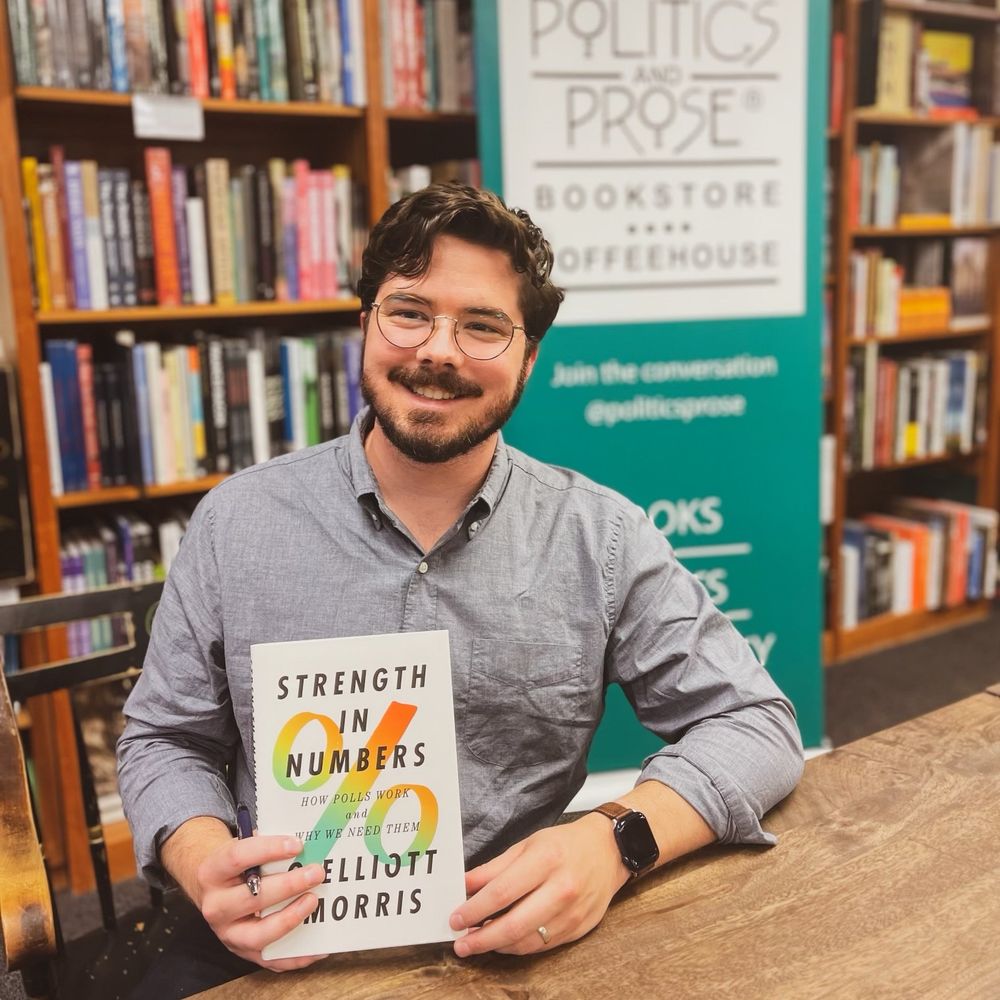
Good morning. I've got a banger new post out today that develops a new method for placing voters on the left-right ideological spectrum, and adds a new, "non-ideological"/affordability axis to usual way we chart & think about US voters (esp swing voters). www.gelliottmorris.com/p/not-just-l...

Not just left vs right: Most voters think about affordability and material wellbeing, not in ideological terms
Most voters want a party that emphasizes cost of living issues and makes the world a better place. Few Americans think in solidly ideologically terms. "Moderates" are mostly non-ideological.
www.gelliottmorris.com
November 20, 2025 at 1:00 PM
Good morning. I've got a banger new post out today that develops a new method for placing voters on the left-right ideological spectrum, and adds a new, "non-ideological"/affordability axis to usual way we chart & think about US voters (esp swing voters). www.gelliottmorris.com/p/not-just-l...
Reposted by nisaki
Two new polls show learning about Trump's policies moves public opinion toward Democrats
www.gelliottmorris.com/p/two-new-po...
www.gelliottmorris.com/p/two-new-po...

Two new polls show learning about Trump's policies moves public opinion toward Democrats
Your weekly political data roundup for November 13, 2025
www.gelliottmorris.com
November 23, 2025 at 2:36 PM
Two new polls show learning about Trump's policies moves public opinion toward Democrats
www.gelliottmorris.com/p/two-new-po...
www.gelliottmorris.com/p/two-new-po...
Reposted by nisaki

In a new paper we present a framework for thinking about online radicalization where some people acquire extremist beliefs on social media (path A) whereas for others SM simply reinforces existing extremist beliefs (path B). Both can lead to support for violence.
www.frontiersin.org/journals/soc...
www.frontiersin.org/journals/soc...

November 23, 2025 at 8:49 PM
In a new paper we present a framework for thinking about online radicalization where some people acquire extremist beliefs on social media (path A) whereas for others SM simply reinforces existing extremist beliefs (path B). Both can lead to support for violence.
www.frontiersin.org/journals/soc...
www.frontiersin.org/journals/soc...
Reposted by nisaki

👀ICYMI: "Increasing support for climate action does not require sophisticated, ethically questionable or costly communication systems"
@miriamsorace.bsky.social @simonhix.bsky.social @fresejoris.bsky.social
#CilmateAction #SciComm #COP30
@miriamsorace.bsky.social @simonhix.bsky.social @fresejoris.bsky.social
#CilmateAction #SciComm #COP30

Nano-targeting or mass appeal, what makes persuasive climate communications? - Impact of Social Sciences
Are nano-targeting tools capable of creating more persuasive climate communications, or broad appeal messages still the best way to move audiences on climate?
blogs.lse.ac.uk
November 17, 2025 at 4:10 PM
👀ICYMI: "Increasing support for climate action does not require sophisticated, ethically questionable or costly communication systems"
@miriamsorace.bsky.social @simonhix.bsky.social @fresejoris.bsky.social
#CilmateAction #SciComm #COP30
@miriamsorace.bsky.social @simonhix.bsky.social @fresejoris.bsky.social
#CilmateAction #SciComm #COP30
Reposted by nisaki

Now online is PS's symposium on Political Parties & Democratic Deliberation ft. works by Gherghina, Mokre, Şahin, Mitru, Akallah, Tap, Tapia, & Paulis!
Check it out here, free to access through the end of the year: shorturl.at/R7WH4
#polisky #academisky #politics #politicaldeliberation
Check it out here, free to access through the end of the year: shorturl.at/R7WH4
#polisky #academisky #politics #politicaldeliberation

November 18, 2025 at 6:55 PM
Now online is PS's symposium on Political Parties & Democratic Deliberation ft. works by Gherghina, Mokre, Şahin, Mitru, Akallah, Tap, Tapia, & Paulis!
Check it out here, free to access through the end of the year: shorturl.at/R7WH4
#polisky #academisky #politics #politicaldeliberation
Check it out here, free to access through the end of the year: shorturl.at/R7WH4
#polisky #academisky #politics #politicaldeliberation
Reposted by nisaki
"Trump is purging the higher ranks based on his prejudices and demands for loyalty; the military is being turned into a partisan instrument and a political prop; more dangerous still, the president is instilling the logic of impunity that has come to characterize his entire approach to governance."

Trump is turning the US military into a political prop | Jan-Werner Müller
The military has been recast in a partisan, performative mold – all according to the president’s logic of impunity
www.theguardian.com
November 18, 2025 at 5:22 PM
"Trump is purging the higher ranks based on his prejudices and demands for loyalty; the military is being turned into a partisan instrument and a political prop; more dangerous still, the president is instilling the logic of impunity that has come to characterize his entire approach to governance."
Reposted by nisaki

A little food for thought (and an army of straw men) #AcademicChatter

Quantitative political science shouldn’t favour tools over theory - Impact of Social Sciences
estimated reading time: 6 min Publication in highly ranked political science journals has increasingly become defined by the use of complex quantitative methods. Silje Synnøve Lyder Hermansen argues the fetishization of quantitative tools has obscured the wider context and meaning of research in the field. Political science isn’t short on new methods. But too often, our publishing culture is a slot machine: pull the lever enough times and someone will hit the jackpot. That’s how we end up mistaking noise for knowledge. We live in an age of data abundance: easy access, cheap software, and a generation skilled enough to “let the data speak”. Out of this, two academic fads emerge. The p-hacking boom. Ten researchers sample from the same population and test whether X is correlated with Y. The rule: publish if p < 0.1, quit if not. Inevitably, someone gets “lucky”. A tidy theory is retrofitted, a few anecdotes sprinkled in, maybe even a citation. To look more comprehensive, we frame it as settling a debate between theories A and B. Let’s be honest: political science has argued in all directions before. Both theories are compelling and internally coherent. Voilà: new “truth” established. The “correction” race. The community has learned. Data access, software, and training have all expanded. Now twice as many researchers sample from the same population. The rule: publish only if the result is significant in the opposite direction. Replications are boring, non-significant results inconclusive. Surprise is the only currency. Inevitably—with the same probability as before—someone gets “lucky.” Voilà: new, opposite “truth” established. But the underlying reality never changed: the true correlation is zero. We’ve built orthodoxy on statistical fluke. So what have we learned? Less than nothing. We’re wrong, and we’ve grown confident about being wrong. Worse yet, we’ve done it eyes wide shut; armed with the very statistical training that tells us the game is rigged. That’s the danger of one-correlation papers in a publishing culture that fetishizes originality. Now, let me be clear: I’m not sneering from the sidelines. I’m a compulsive scraper; I get my kicks from the three-star slot machine of regression analysis. I love reading new research, and I want to publish too. How do we fix this? We can always demand stricter p-values before we’re impressed. But the core problem doesn’t go away. At best, we reset the slot machine odds to where they used to be: bigger data, stricter cutoffs – same game. As our scraped datasets balloon, the machine continues to spit jackpots. Can causal inference fix the problem? In some ways, yes: it pins down where an effect occurs, and it feels rigorous. But theory is too often left by the wayside, reduced to claims about ‘real-life data’ and the absence of obvious confounders – precisely where alternative theories tend to live. The toolkit is fantastic for public policy questions. What was the effect of our latest reform? Data is available, and the question is bounded. But external validity becomes the stumbling block. Can we reproduce those conditions in the future? Can we resolve bigger societal problems with another reform? Without theory that specifies fairly general scope conditions, the answers don’t travel. But what are we actually measuring? If all we do is describe ourselves, how does that teach us why we behave as we do? We could go all in on the experimental ideal: pre-registration, conjoint survey experiments, lab-in-field. These methods double down on falsifiability. Pre-registration forces us to commit before pulling the lever. They require careful planning and let us test competing theories head-to-head. There’s a real boldness in this turn: no more hand-waving; the question is framed, the die is cast. But bold is still bounded. Conjoints show how people trade off attributes in a survey, but the selection effect looms large. How much do we rely on convenience samples – MTurk, YouGov, undergrads? And even if we limit our claims to that group, we may still construct trade-offs our respondents would never perceive in the real world. Then there’s the newest darling: text analysis and prediction. Data science masquerades as political method. We scrape massive corpora of speeches, manifestos, TikTok feeds, or laws, run them through embeddings, topic models, or large language models (LLMs). They’re magical at approximating meaning. They mirror us back to ourselves – endlessly. But what are we actually measuring? If all we do is describe ourselves, how does that teach us why we behave as we do? Then we move on to prediction. If we can forecast 80% of coups or measure “policy distance” to six decimals, who wouldn’t be impressed? Out-of-sample accuracy shows a model describes our data, but rarely why. Prediction is not explanation, unless the model maps onto a data-generating process we can actually theorise. I don’t snark at these advances. I admire them! I’m often baffled at how cleverly confounders can be designed away. I’m in absolute awe at the ballsiness of preregistration and prediction. My stupor is endless when text models make intuitive sense. I might be a jaded millennial, but I recognise progress. But these are tools – powerful tools – not methods. And certainly not theory. There is no such thing as a perfect paper, but we can make them better. One way is to measure the same thing in different ways. That boosts construct validity and rules out obvious p-hacking, but still doesn’t test theory itself. For that, we need imagination: to nerd out on the data-generating process. If what we claim is true, what else would we observe? What other empirical implications follow from our theoretical models? It’s an old trick, but it still works with the flashiest of tools. In my opening parable, a false finding struck once in ten attempts. If the true correlation is zero, one out of ten researchers still gets a significant result by chance. If we demand two distinct tests of the same theory, then the odds of a false positive drop to one in a hundred. Every extra implication strengthens the test exponentially. The tools we employ and the research designs we devise have multiplied. We truly live in exciting times. But they don’t replace our human brains. And here’s the bigger point. We’re often asked to justify our “lush” life on taxpayers’ dime by proving “societal impact”. Somehow this has come to mean media outreach. Fine. But we’re not the engineers. We’re knowledge providers for decision makers: the people (taxable or not) and their representatives. What we need is a research agenda that carefully dissects – paper by paper – how democracy fails, what behaviors our institutions induce, how opinions are formed, and how they translate into policies. This begins with research and ends with teaching. Political science isn’t in the business of theorising about Life, the Universe, and Everything. Our task is no less urgent: to study power – how it’s won, wielded, constrained, and lost. Too often we debate whether 42 was correctly estimated, rather than carefully specifying the question up front. That’s the jackpot worth chasing. 📨Enjoying this blogpost? Sign up to our mailing list and receive all the latest LSE Impact Blog news direct to your inbox 📨 The content generated on this blog is for information purposes only. This Article gives the views and opinions of the authors and does not reflect the views and opinions of the Impact of Social Science blog (the blog), nor of the London School of Economics and Political Science. Please review our comments policy if you have any concerns on posting a comment below. Image Credit: mihalec on Shutterstock.
blogs.lse.ac.uk
November 18, 2025 at 9:10 PM
A little food for thought (and an army of straw men) #AcademicChatter
Reposted by nisaki

Exclusive: ‘Deeply shocking’: Nigel Farage faces fresh claims of racism and antisemitism at school
Bafta-winning director among contemporaries urging contrition and apology from Reform UK leader, who denies the allegations
w/ Dan Boffey and @drblacklock.bsky.social
Bafta-winning director among contemporaries urging contrition and apology from Reform UK leader, who denies the allegations
w/ Dan Boffey and @drblacklock.bsky.social

‘Deeply shocking’: Nigel Farage faces fresh claims of racism and antisemitism at school
Bafta-winning director among contemporaries urging contrition and apology from Reform UK leader, who denies the allegations
www.theguardian.com
November 18, 2025 at 3:05 PM
Exclusive: ‘Deeply shocking’: Nigel Farage faces fresh claims of racism and antisemitism at school
Bafta-winning director among contemporaries urging contrition and apology from Reform UK leader, who denies the allegations
w/ Dan Boffey and @drblacklock.bsky.social
Bafta-winning director among contemporaries urging contrition and apology from Reform UK leader, who denies the allegations
w/ Dan Boffey and @drblacklock.bsky.social
Reposted by nisaki
Pro Tip:
As the label "post-liberal" is swiftly becoming embarrassing in the US (not necessarily in the UK), deploy horseshoe theory and claim that Mamdani and Trump are both "post-liberals"...
As the label "post-liberal" is swiftly becoming embarrassing in the US (not necessarily in the UK), deploy horseshoe theory and claim that Mamdani and Trump are both "post-liberals"...

Opinion | What Is Post-Liberalism, Anyway?
www.nytimes.com
November 18, 2025 at 11:23 PM
Pro Tip:
As the label "post-liberal" is swiftly becoming embarrassing in the US (not necessarily in the UK), deploy horseshoe theory and claim that Mamdani and Trump are both "post-liberals"...
As the label "post-liberal" is swiftly becoming embarrassing in the US (not necessarily in the UK), deploy horseshoe theory and claim that Mamdani and Trump are both "post-liberals"...
Reposted by nisaki
Sighs of (relative) relief from universities across the country.

What the graduate unemployment story gets wrong
People with a degree are faring better, not worse than their non-graduate counterparts
www.ft.com
October 10, 2025 at 9:09 AM
Sighs of (relative) relief from universities across the country.
Reposted by nisaki
Enjoyed doing this @ukandeu.bsky.social event with my #BGE2024 co-author @psurridge.bsky.social - and 👏 to @jillongovt.bsky.social for coping admirably with the 'two-Tims-problem'!

UKICE Lunch Hour: the state of the right - UK in a changing Europe
UK in a Changing Europe is bringing together a team of experts to understand the developments in right-wing politics. Join us online to hear their analysis of the state of the right.
ukandeu.ac.uk
October 10, 2025 at 10:19 AM
Enjoyed doing this @ukandeu.bsky.social event with my #BGE2024 co-author @psurridge.bsky.social - and 👏 to @jillongovt.bsky.social for coping admirably with the 'two-Tims-problem'!
Reposted by nisaki
One of my best (former) MA students, ever 👇
T. Sprang. “Radical Weakness-Do Radical Parties Receive Fewer Ministries?” In: Comparative Political Studies online first (2025), pp. 1-38. http://dx.doi.org/10.1177/00104140251349670.

Radical Weakness—Do Radical Parties Receive Fewer Ministries? - Timo Sprang, 2025
Radical parties’ electoral surge has intensified debates about their inclusion in government coalitions. This article presents the most extensive analysis of mi...
journals.sagepub.com
October 9, 2025 at 12:12 PM
One of my best (former) MA students, ever 👇