



Nicolas Alexandre
@nicmalexandre.bsky.social
That’s a good question! Let me look into my publishing agreement and see if there’s something I can do! But in the meantime, send me an email!
May 25, 2025 at 2:13 AM
That’s a good question! Let me look into my publishing agreement and see if there’s something I can do! But in the meantime, send me an email!
Send me an email nmalexan@ucsc.edu
Big fan by the way!❤️
Big fan by the way!❤️
May 25, 2025 at 2:09 AM
Send me an email nmalexan@ucsc.edu
Big fan by the way!❤️
Big fan by the way!❤️
TL;DR:
Feeders are associated with population growth, and morphological change in hummingbird beaks
Read it here 👉 dx.doi.org/10.1111/gcb....
#ornithology #evolution #climatechange
Feeders are associated with population growth, and morphological change in hummingbird beaks
Read it here 👉 dx.doi.org/10.1111/gcb....
#ornithology #evolution #climatechange
Supplemental Feeding as a Driver of Population Expansion and Morphological Change in Anna's Hummingbirds
Bird beaks are highly adaptable, with the potential to undergo rapid morphological shifts in response to environmental change such as climatic variation or food availability. Anna's Hummingbirds (Cal...
dx.doi.org
May 21, 2025 at 1:24 PM
TL;DR:
Feeders are associated with population growth, and morphological change in hummingbird beaks
Read it here 👉 dx.doi.org/10.1111/gcb....
#ornithology #evolution #climatechange
Feeders are associated with population growth, and morphological change in hummingbird beaks
Read it here 👉 dx.doi.org/10.1111/gcb....
#ornithology #evolution #climatechange
Finally I wanted to thank the Museum of Vertebrate Zoology (Shoutout to curator Carla Cicero), the U.S. Census, Christmas Bird Count, PRISM Climate Group, and Newspapers.com for the resources that have been made available.

Historical Newspapers from the 1700's-2000s
The largest online newspaper archive. Used by millions every month for historical research, family history, crime investigations, journalism, and more.
Newspapers.com
May 21, 2025 at 1:24 PM
Finally I wanted to thank the Museum of Vertebrate Zoology (Shoutout to curator Carla Cicero), the U.S. Census, Christmas Bird Count, PRISM Climate Group, and Newspapers.com for the resources that have been made available.
I also want to thank our fearless mentor, Prof. Alejo Rico-Guevara who has kept the passion alive throughout. And thank you to the best co-leads authors ever, PhD students Simon English and Faye Romero who made this process fun!
May 21, 2025 at 1:24 PM
I also want to thank our fearless mentor, Prof. Alejo Rico-Guevara who has kept the passion alive throughout. And thank you to the best co-leads authors ever, PhD students Simon English and Faye Romero who made this process fun!
We are so grateful to Prof. Laura Stein for her advice on modeling, and to CJ Battey @cjbattey.bsky.social for his help with data acquisition and analysis. We are indebted to Grieg et al. & Battey et al. for their foundational work that inspired this project.
May 21, 2025 at 1:24 PM
We are so grateful to Prof. Laura Stein for her advice on modeling, and to CJ Battey @cjbattey.bsky.social for his help with data acquisition and analysis. We are indebted to Grieg et al. & Battey et al. for their foundational work that inspired this project.
Huge thanks to undergrads who made this work possible: Timothy Barnes, Audrey E. Smith, Saron Akalu, Haarini Sridhar, Gillian Montross & Ezra Collins.👏👏
May 21, 2025 at 1:23 PM
Huge thanks to undergrads who made this work possible: Timothy Barnes, Audrey E. Smith, Saron Akalu, Haarini Sridhar, Gillian Montross & Ezra Collins.👏👏
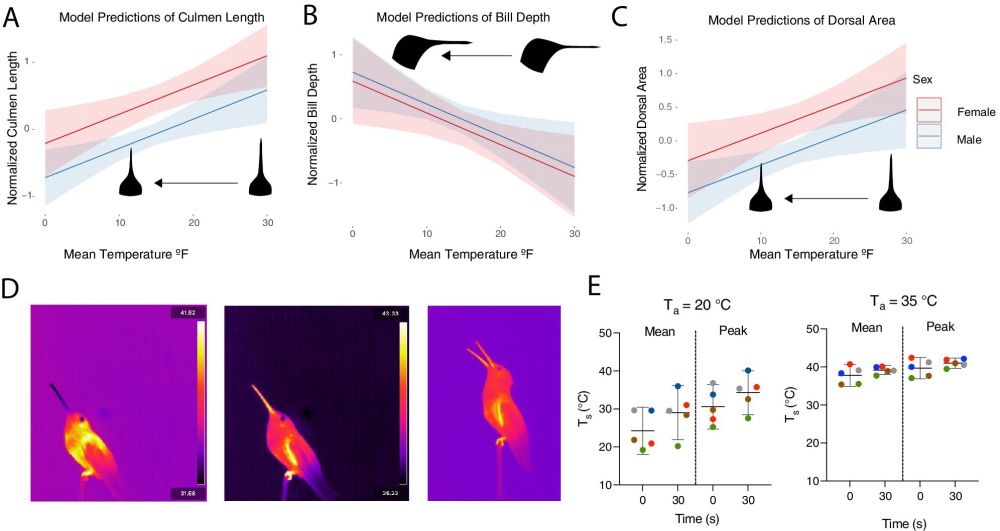
To test this, Prof. Don Powers @lampornis.bsky.social showed hummingbirds actively heat their beaks after flight. Turns out, the bill helps dissipate heat during perching! 🔥➡️💨

May 21, 2025 at 1:23 PM
To test this, Prof. Don Powers @lampornis.bsky.social showed hummingbirds actively heat their beaks after flight. Turns out, the bill helps dissipate heat during perching! 🔥➡️💨
But climate matters too. Using PRISM data, we found that in cooler areas in the north, beaks are shorter, smaller, and deeper, consistent with thermoregulation theory. ❄️☀️
May 21, 2025 at 1:23 PM
But climate matters too. Using PRISM data, we found that in cooler areas in the north, beaks are shorter, smaller, and deeper, consistent with thermoregulation theory. ❄️☀️
Collaborating with Prof. Zoe Migicovsky @zoemig.bsky.social , Alejandro Rico-Guevara, Felipe Garzón-Agudelo & Kevin Epperly, we used 2D & 3D shape data to show:
Beaks are getting more slender, tapered, and in males, pointier! 🐦
Beaks are getting more slender, tapered, and in males, pointier! 🐦

May 21, 2025 at 1:22 PM
Collaborating with Prof. Zoe Migicovsky @zoemig.bsky.social , Alejandro Rico-Guevara, Felipe Garzón-Agudelo & Kevin Epperly, we used 2D & 3D shape data to show:
Beaks are getting more slender, tapered, and in males, pointier! 🐦
Beaks are getting more slender, tapered, and in males, pointier! 🐦
Co-first author Faye Romero and I modelled bill changes of Anna’s hummingbirds in the Museum of Vertebrate Zoology’s collection (dating to 1860). 📏
We found bill length and maxillary surface area increased with feeder density.
We found bill length and maxillary surface area increased with feeder density.
May 21, 2025 at 1:21 PM
Co-first author Faye Romero and I modelled bill changes of Anna’s hummingbirds in the Museum of Vertebrate Zoology’s collection (dating to 1860). 📏
We found bill length and maxillary surface area increased with feeder density.
We found bill length and maxillary surface area increased with feeder density.
Building on that, co-first author Simon English showed that feeder abundance was the best predictor of Anna’s hummingbird population growth, especially in the north, where Grieg et al. showed that birds rely more on feeders.

May 21, 2025 at 1:21 PM
Building on that, co-first author Simon English showed that feeder abundance was the best predictor of Anna’s hummingbird population growth, especially in the north, where Grieg et al. showed that birds rely more on feeders.
It started with newspaper archives 📜:
Prof. Eliza Grames tracked hummingbird feeder mentions by county in California from 1860 on. She found feeder use rose rapidly, especially from southern to northern CA.
Prof. Eliza Grames tracked hummingbird feeder mentions by county in California from 1860 on. She found feeder use rose rapidly, especially from southern to northern CA.

May 21, 2025 at 1:21 PM
It started with newspaper archives 📜:
Prof. Eliza Grames tracked hummingbird feeder mentions by county in California from 1860 on. She found feeder use rose rapidly, especially from southern to northern CA.
Prof. Eliza Grames tracked hummingbird feeder mentions by county in California from 1860 on. She found feeder use rose rapidly, especially from southern to northern CA.