




Nicholas Hadler
@nichadler.bsky.social
PhD candidate in the Hartwig Group.
Working on combining transition-metal catalysis with data science, machine learning, and high-throughput experimentation to accelerate discovery in synthetic chemistry.
Working on combining transition-metal catalysis with data science, machine learning, and high-throughput experimentation to accelerate discovery in synthetic chemistry.
Reposted by Nicholas Hadler

Check out this post by @dereklowe.bsky.social where he uses our new method from our recent @jacs.acspublications.org paper! Thanks for trying it out!
December 5, 2025 at 12:31 AM
Check out this post by @dereklowe.bsky.social where he uses our new method from our recent @jacs.acspublications.org paper! Thanks for trying it out!
Reposted by Nicholas Hadler
Excited to share our new method for Pd-catalyzed C–N cross-coupling, now published in @jacs.acspublications.org!
This method utilizes an inexpensive, mild, and soluble base suitable for small & large scales with excellent functional group tolerance across chemical space.
doi.org/10.1021/jacs...
This method utilizes an inexpensive, mild, and soluble base suitable for small & large scales with excellent functional group tolerance across chemical space.
doi.org/10.1021/jacs...

Unleashing the Power of Potassium 2-Ethylhexanoate as a Mild and Soluble Base for Pd-Catalyzed C–N Cross-Coupling
The formation of C–N bonds by Pd-catalyzed cross-coupling is one of the most widely practiced reactions in chemical synthesis. Typical reaction conditions involve either a strong base, which limits the scope of substrates, or an insoluble, inorganic base, which complicates running reactions on a large scale. Reaction conditions for C–N couplings with a base that is both mild and soluble are needed. We report the discovery of a combination of a phosphorinane ligand (L147) and a soluble carboxylate base, potassium 2-ethylhexanoate (K-2-EH), which leads to the coupling of a wide range of base-sensitive coupling partners. To explore the enhanced substrate scope of the reaction with this base and catalyst, we evaluated the scope using representative reactants selected from published partners, using chemical descriptors and clustering to ensure their chemical diversity. These results show that the combination of this phosphorinane ligand and K-2-EH can couple primary aliphatic amines, amides, sulfonamides, and heteroaromatic nucleophiles as well as acidic secondary nitrogen nucleophiles, such as arylamines, heteroarylamines, and amides, with a range of electrophiles. A side-by-side comparison to form selected coupling products in the presence of a range of previously reported bases and ligands showed that the products that decomposed under standard reaction conditions were stable with K-2-EH as a base. Finally, models of quantitative structure–reactivity relationships, trained on ligand screening data, were developed to help reveal the structural features that engender reactivity.
pubs.acs.org
December 2, 2025 at 7:55 PM
Excited to share our new method for Pd-catalyzed C–N cross-coupling, now published in @jacs.acspublications.org!
This method utilizes an inexpensive, mild, and soluble base suitable for small & large scales with excellent functional group tolerance across chemical space.
doi.org/10.1021/jacs...
This method utilizes an inexpensive, mild, and soluble base suitable for small & large scales with excellent functional group tolerance across chemical space.
doi.org/10.1021/jacs...
Reposted by Nicholas Hadler
Congratulations to our amazing new doctors this year! Jeremy Nicolai, RJ Conk, Isaac Joyner, John Brunn, Christina Pierson, and Nico Ciccia! 🎓🎉🎓

May 20, 2025 at 2:06 AM
Congratulations to our amazing new doctors this year! Jeremy Nicolai, RJ Conk, Isaac Joyner, John Brunn, Christina Pierson, and Nico Ciccia! 🎓🎉🎓
Reposted by Nicholas Hadler
Join us to see John discuss some of our current work combining #MachineLearning with transition metal catalysis!

Join us on 22 May 2025 for a free webinar highlighting cutting-edge digital innovations from the laboratory of John F Hartwig and the Digital Innovation group at Merck KGaA, Darmstadt, Germany.

Accelerating chemical synthesis: digital innovations from lab to industrial scale
Join us on 22 May to explore how digital chemistry is advancing synthetic chemical development and enhancing innovation
www.chemistryworld.com
May 15, 2025 at 9:55 PM
Join us to see John discuss some of our current work combining #MachineLearning with transition metal catalysis!
Reposted by Nicholas Hadler

Unleashing the Power of Potassium 2-Ethylhexanoate as a Mild and Soluble Base for Pd-catalyzed C-N Cross-Coupling
Authors: William Lambert, Stephanie Felten, Nicholas Hadler, N. Ian Rinehart, Rafal Swiatowiec, Gregory Storer, Jeremy Henle, Mark Servos, ...
DOI: 10.26434/chemrxiv-2025-59c10
Authors: William Lambert, Stephanie Felten, Nicholas Hadler, N. Ian Rinehart, Rafal Swiatowiec, Gregory Storer, Jeremy Henle, Mark Servos, ...
DOI: 10.26434/chemrxiv-2025-59c10
February 25, 2025 at 6:52 AM
Unleashing the Power of Potassium 2-Ethylhexanoate as a Mild and Soluble Base for Pd-catalyzed C-N Cross-Coupling
Authors: William Lambert, Stephanie Felten, Nicholas Hadler, N. Ian Rinehart, Rafal Swiatowiec, Gregory Storer, Jeremy Henle, Mark Servos, ...
DOI: 10.26434/chemrxiv-2025-59c10
Authors: William Lambert, Stephanie Felten, Nicholas Hadler, N. Ian Rinehart, Rafal Swiatowiec, Gregory Storer, Jeremy Henle, Mark Servos, ...
DOI: 10.26434/chemrxiv-2025-59c10
Reposted by Nicholas Hadler

Late to post this but it turns out that I am a PhD candidate now. Thanks to everyone in the Hartwig Group from their help and mentorship, particularly John. And a huge shoutout to my collaborators in the Keasling Lab and Jay for their support!


November 28, 2024 at 7:48 PM
Late to post this but it turns out that I am a PhD candidate now. Thanks to everyone in the Hartwig Group from their help and mentorship, particularly John. And a huge shoutout to my collaborators in the Keasling Lab and Jay for their support!


Reposted by Nicholas Hadler
Definitely a must read Amazing work from the @HartwigGroup out in @J_A_C_S
Air stable Ir precat for C-H borylation with large scope and 1-pot Borylation-Suzuki, bromination or Chan-Lam
Super paper and will be of high use in med chem #ChemSky
Air stable Ir precat for C-H borylation with large scope and 1-pot Borylation-Suzuki, bromination or Chan-Lam
Super paper and will be of high use in med chem #ChemSky
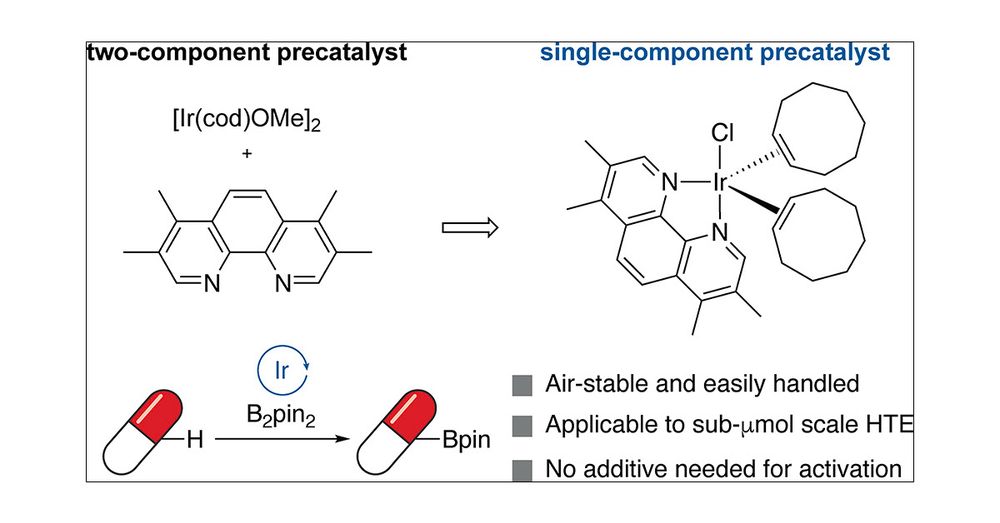
An Air-Stable, Single-Component Iridium Precatalyst for the Borylation of C–H Bonds on Large to Miniaturized Scales
The functionalization of C–H bonds enables the modification of complex molecules, often with the intention of forming compound libraries. The borylation of aryl C–H bonds is a widely used class of C–H...
pubs.acs.org
November 14, 2024 at 8:05 PM
Definitely a must read Amazing work from the @HartwigGroup out in @J_A_C_S
Air stable Ir precat for C-H borylation with large scope and 1-pot Borylation-Suzuki, bromination or Chan-Lam
Super paper and will be of high use in med chem #ChemSky
Air stable Ir precat for C-H borylation with large scope and 1-pot Borylation-Suzuki, bromination or Chan-Lam
Super paper and will be of high use in med chem #ChemSky