



Mychel Morais
@mychelmorais.bsky.social
Reposted by Mychel Morais

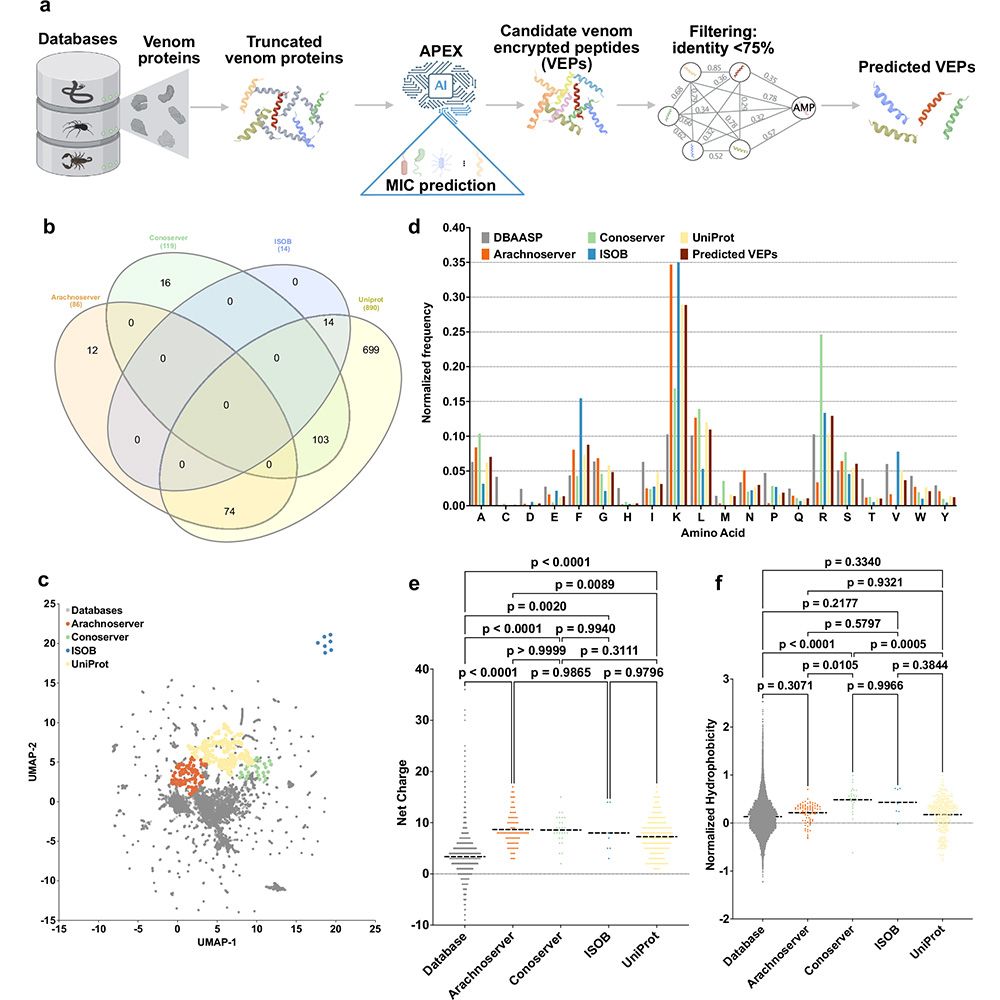
A study in Nature Communications used AI to mine global venom proteomes and discovered novel peptides with antimicrobial activity. Several candidates showed efficacy against drug-resistant bacteria in laboratory and animal tests. go.nature.com/4f0zYb4 #medsky 🧪
July 26, 2025 at 1:16 AM
A study in Nature Communications used AI to mine global venom proteomes and discovered novel peptides with antimicrobial activity. Several candidates showed efficacy against drug-resistant bacteria in laboratory and animal tests. go.nature.com/4f0zYb4 #medsky 🧪
Reposted by Mychel Morais
The largest harmonized proteomic dataset of plasma, serum and cerebrospinal fluid samples across major neurodegenerative diseases reveals both disease-specific and transdiagnostic proteomic signatures, according to a paper in Nature Medicine. go.nature.com/44MOu1l #neuroskyence #medsky 🧪

July 28, 2025 at 1:51 AM
The largest harmonized proteomic dataset of plasma, serum and cerebrospinal fluid samples across major neurodegenerative diseases reveals both disease-specific and transdiagnostic proteomic signatures, according to a paper in Nature Medicine. go.nature.com/44MOu1l #neuroskyence #medsky 🧪
Reposted by Mychel Morais

ProtFun: A Protein Function Prediction Model Using Graph Attention Networks with a Protein Large Language Model www.biorxiv.org/cont...
---
#proteomics #prot-preprint
---
#proteomics #prot-preprint

May 19, 2025 at 4:00 PM
ProtFun: A Protein Function Prediction Model Using Graph Attention Networks with a Protein Large Language Model www.biorxiv.org/cont...
---
#proteomics #prot-preprint
---
#proteomics #prot-preprint
Reposted by Mychel Morais

PLM-OMG: Protein Language Model-Based Ortholog Detection for Cross-Species Cell Type Mapping https://www.biorxiv.org/content/10.1101/2025.05.30.657127v1
June 3, 2025 at 5:53 AM
PLM-OMG: Protein Language Model-Based Ortholog Detection for Cross-Species Cell Type Mapping https://www.biorxiv.org/content/10.1101/2025.05.30.657127v1
Reposted by Mychel Morais
A study published in Discover Artificial Intelligence aims to enhance protein sequence classification using natural language processing (NLP) techniques while addressing the impact of sequence similarity on model performance.
bit.ly/4kEQwqu
#STS
bit.ly/4kEQwqu
#STS

June 3, 2025 at 3:30 PM
A study published in Discover Artificial Intelligence aims to enhance protein sequence classification using natural language processing (NLP) techniques while addressing the impact of sequence similarity on model performance.
bit.ly/4kEQwqu
#STS
bit.ly/4kEQwqu
#STS
Reposted by Mychel Morais

Predicting the Evolutionary and Functional Landscapes of Viruses with a Unified Nucleotide-Protein Language Model: LucaVirus
www.biorxiv.org/content/10.1...
www.biorxiv.org/content/10.1...
doi.org
June 23, 2025 at 4:48 PM
Predicting the Evolutionary and Functional Landscapes of Viruses with a Unified Nucleotide-Protein Language Model: LucaVirus
www.biorxiv.org/content/10.1...
www.biorxiv.org/content/10.1...
Reposted by Mychel Morais

A contextualised protein language model reveals the functional syntax of bacterial evolution | bioRxiv https://www.biorxiv.org/content/10.1101/2025.07.20.665723v1

A contextualised protein language model reveals the functional syntax of bacterial evolution
Bacteria have evolved a vast diversity of functions and behaviours which are currently incompletely understood and poorly predicted from DNA sequence alone. To understand the syntax of bacterial evolution and discover genome-to-phenotype relationships, we curated over 1.3 million genomes spanning bacterial phylogenetic space, representing each as an ordered sequence of proteins which collectively were used to train a transformer-based, contextualised protein language model, Bacformer. By pretraining the model to learn genome-wide evolutionary patterns, Bacformer captures the compositional and positional relationships of proteins and can accurately: predict protein-protein interactions, operon structure (which we validated experimentally), and protein function; infer phenotypic traits and identify likely causal genes; and design template synthethic genomes with desired properties. Thus, Bacformer represents a new foundation model for bacterial genomics that provide biological insights and a framework for prediction, inference, and generative tasks. ### Competing Interest Statement The authors have declared no competing interest. Wellcome Trust, 226602/Z/22/Z LifeArc, IH001 Ineos (United Kingdom), Oxbridge AMR Doctoral training programme NIHR Cambridge Biomedical Research Centre Cambridge Centre for AI in Medicine (CCAIM) doctoral training programme Swiss National Science Foundation, TMSGI2_226252/1, IC00I0_23192 Peter und Traudl Engelhorn Foundation Engineering and Physical Sciences Research Council, EP/T022159/1 Science and Technology Facilities Council, DiRAC
www.biorxiv.org
July 21, 2025 at 7:56 AM
A contextualised protein language model reveals the functional syntax of bacterial evolution | bioRxiv https://www.biorxiv.org/content/10.1101/2025.07.20.665723v1
Reposted by Mychel Morais

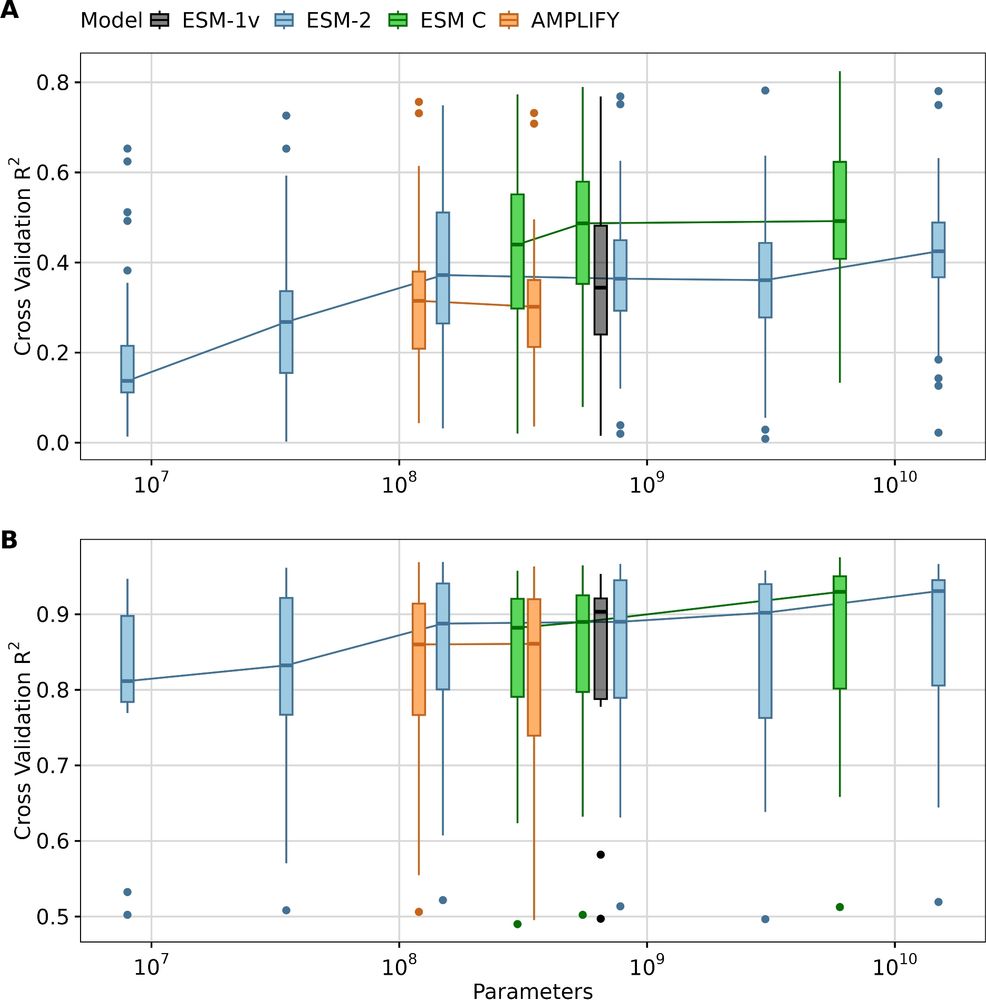
Now published: Systematic comparison of protein language models for transfer learning.
Key points:
- You don't need gigantic models. The two smaller ESM C variants work great.
- There is huge variability in performance across datasets. We have no idea why.
www.nature.com/articles/s41...
Key points:
- You don't need gigantic models. The two smaller ESM C variants work great.
- There is huge variability in performance across datasets. We have no idea why.
www.nature.com/articles/s41...

July 1, 2025 at 11:34 PM
Now published: Systematic comparison of protein language models for transfer learning.
Key points:
- You don't need gigantic models. The two smaller ESM C variants work great.
- There is huge variability in performance across datasets. We have no idea why.
www.nature.com/articles/s41...
Key points:
- You don't need gigantic models. The two smaller ESM C variants work great.
- There is huge variability in performance across datasets. We have no idea why.
www.nature.com/articles/s41...