



Reposted by Jason Radcliff

As details trickle out it cannot be understated how serious a violation this could be.
www.kpbs.org/news/militar...
www.kpbs.org/news/militar...


December 5, 2025 at 3:30 AM
As details trickle out it cannot be understated how serious a violation this could be.
www.kpbs.org/news/militar...
www.kpbs.org/news/militar...
Reposted by Jason Radcliff

Reposted by Jason Radcliff

This is like if Tyson stopped selling consumer chicken. RAM is about to cost as much as a brand new pc. The cost of everything from tablets, to phones, to laptops will skyrocket. All because AI data centers are consuming all the available RAM they can get.
www.pcgamer.com/hardware/the...
www.pcgamer.com/hardware/the...

Crucial memory will soon be a memory itself as Micron abandons consumers in favor of AI data centers
The RAM crisis is just getting started.
www.pcgamer.com
December 4, 2025 at 10:12 AM
This is like if Tyson stopped selling consumer chicken. RAM is about to cost as much as a brand new pc. The cost of everything from tablets, to phones, to laptops will skyrocket. All because AI data centers are consuming all the available RAM they can get.
www.pcgamer.com/hardware/the...
www.pcgamer.com/hardware/the...
Meanwhile, Kevin Patullo: “What if all five of you ran six yards and then turned around at the same time!”

December 2, 2025 at 5:53 AM
Meanwhile, Kevin Patullo: “What if all five of you ran six yards and then turned around at the same time!”
Reposted by Jason Radcliff

And this is an ideal angle of the play. Not every manager would let a winger make this move, but it happened and it produced a terrific goal.
bsky.app/profile/ourg...
bsky.app/profile/ourg...

December 2, 2025 at 3:17 AM
And this is an ideal angle of the play. Not every manager would let a winger make this move, but it happened and it produced a terrific goal.
bsky.app/profile/ourg...
bsky.app/profile/ourg...
Reposted by Jason Radcliff

“we failed a veteran” is the ultimate story here and if I were a soldier currently being asked to do war crimes on Trump’s behalf I would consider this instructive

Suspect in National Guard attack struggled with 'dark isolation' as community raised concerns
Emails obtained by the Associated Press show that the Afghan man accused of shooting two National Guard members near the White House had been unraveling for years.
www.latimes.com
December 1, 2025 at 5:12 PM
“we failed a veteran” is the ultimate story here and if I were a soldier currently being asked to do war crimes on Trump’s behalf I would consider this instructive
Hmm. Ive been eating spaghetti and flying coach for 39.8 years. Maybe there’s something else I’m doing wrong?

The secret to early retirement; dine out rarely, fly economy and be a Google employee making $390,000/year married to a fellow Google employee 17 years older than you who likely makes twice as much as you.

37-year-old quit her $390,000 Google job after saving up $1.5 million—see the 'no buy checklist' that helps her spend less
She left a $390,000-a-year job and now uses a simple set of rules to make her savings last in Switzerland.
www.cnbc.com
December 1, 2025 at 4:41 AM
Hmm. Ive been eating spaghetti and flying coach for 39.8 years. Maybe there’s something else I’m doing wrong?
AJ beats his defender clean off the line, Jalen throws the CB right back into the play. Shoulda been a walk-in TD, instead AJ has to slam on the brakes and Moss the defender.
November 28, 2025 at 9:58 PM
AJ beats his defender clean off the line, Jalen throws the CB right back into the play. Shoulda been a walk-in TD, instead AJ has to slam on the brakes and Moss the defender.
Flyers game just started. They might outscore the Eagles today
November 28, 2025 at 9:00 PM
Flyers game just started. They might outscore the Eagles today
Smugglers don’t take two trips to smuggle drugs and then smuggle people, they do it all at once. If you can track them enough to blow them up, you can track them enough to send in the coast guard.

It was the 11th known time the Trump administration has launched strikes against alleged drug-carrying boats in recent months.

Pete Hegseth says 14 people were killed in strikes on alleged drug-carrying boats in the Pacific Ocean
It was the 11th known time the Trump administration has launched strikes against alleged drug-carrying boats in recent months.
nbcnews.to
October 30, 2025 at 5:59 AM
Smugglers don’t take two trips to smuggle drugs and then smuggle people, they do it all at once. If you can track them enough to blow them up, you can track them enough to send in the coast guard.
No way…BVS @bowulf.bsky.social @ej-smith.bsky.social @denizselman33.bsky.social @phlyeagles.bsky.social
September 5, 2025 at 12:26 AM
I’ve never felt more alive than listening to @bowulf.bsky.social read the eagles practice squad to @ej-smith.bsky.social today on @phlyeagles.bsky.social
August 28, 2025 at 3:17 AM
I’ve never felt more alive than listening to @bowulf.bsky.social read the eagles practice squad to @ej-smith.bsky.social today on @phlyeagles.bsky.social
There was a lot going on this hole: @619sports.bsky.social doing his radio hit with Ben And Woods (and still giving himself a chip and putt for par), ‘yotes looking for breakfast. Never a dull moment at Carlton Oaks
June 17, 2025 at 11:57 PM
There was a lot going on this hole: @619sports.bsky.social doing his radio hit with Ben And Woods (and still giving himself a chip and putt for par), ‘yotes looking for breakfast. Never a dull moment at Carlton Oaks
Reposted by Jason Radcliff

Deep Blue is 30 years old and was capable of defeating chess grand champions. It could be housed in a single cabinet.
ChatGPT spans untold data centers devouring massive amounts of electricity and it got its ass whipped by an 8 bit gaming console from the 1970s.
ChatGPT spans untold data centers devouring massive amounts of electricity and it got its ass whipped by an 8 bit gaming console from the 1970s.

ChatGPT Lost a Chess Game to an Atari 2600
And on the 'Beginner' difficulty level, too.
www.extremetech.com
June 11, 2025 at 12:29 AM
Deep Blue is 30 years old and was capable of defeating chess grand champions. It could be housed in a single cabinet.
ChatGPT spans untold data centers devouring massive amounts of electricity and it got its ass whipped by an 8 bit gaming console from the 1970s.
ChatGPT spans untold data centers devouring massive amounts of electricity and it got its ass whipped by an 8 bit gaming console from the 1970s.
Reposted by Jason Radcliff

consider, they picked whichever Pope would piss off Vance the most

May 8, 2025 at 5:24 PM
consider, they picked whichever Pope would piss off Vance the most
Reposted by Jason Radcliff

*Camera pans to a group of fans outside of the Vatican in pope jerseys, going nuts even though most of them haven’t heard of the pick before last week*
May 8, 2025 at 4:49 PM
*Camera pans to a group of fans outside of the Vatican in pope jerseys, going nuts even though most of them haven’t heard of the pick before last week*
Remember that time that Roy from Siegfried and Roy got mauled by his tiger?

May 7, 2025 at 6:23 AM
Remember that time that Roy from Siegfried and Roy got mauled by his tiger?
He is so good at redirecting attention from his burning of the constitution. Any reporter worth a darn needs to turn away from the spectacle and and look for what he's trying to divert attention from because whatever it is, THAT'S the actual story.

Reporter: How did you decide to reopen Alcatraz?
Trump: I was supposed to be a movie maker… Nobody ever escaped. One person almost got there but they found his clothing rather badly ripped up, a lot of shark bites…
Trump: I was supposed to be a movie maker… Nobody ever escaped. One person almost got there but they found his clothing rather badly ripped up, a lot of shark bites…
May 5, 2025 at 7:13 PM
He is so good at redirecting attention from his burning of the constitution. Any reporter worth a darn needs to turn away from the spectacle and and look for what he's trying to divert attention from because whatever it is, THAT'S the actual story.
Reposted by Jason Radcliff

Breakfast belt-tightening worries McDonald's. #finsky

McDonalds saying consumers are cutting back on breakfast is not an encouraging signal — because that daypart has historically been seen as a proxy for employment.
$MCD
$MCD
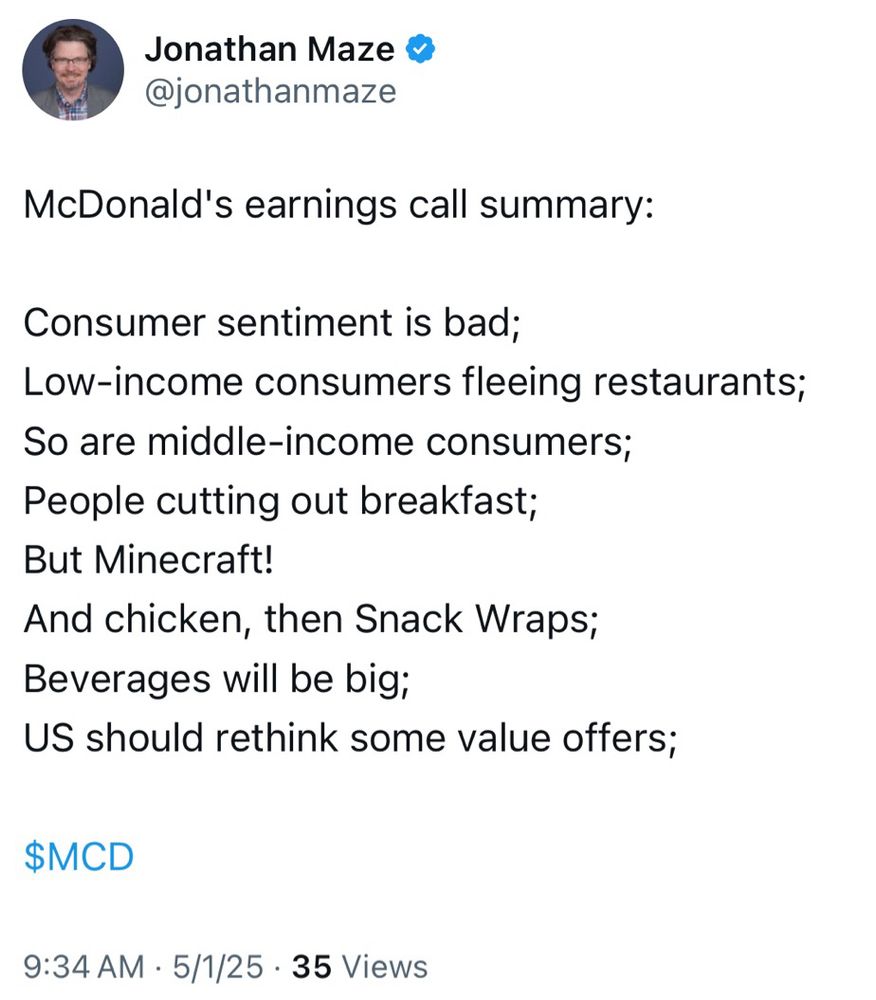
May 1, 2025 at 1:50 PM
Breakfast belt-tightening worries McDonald's. #finsky
Reposted by Jason Radcliff

Any company that can replace a tariffed product with an American made is going to flourish. Can’t get tomatoes or avocados, twinkies and Ho-Hos are made in US bakeries and are the perfect replacement !!! Pay no attention to the price increase. They never go bad !
This deserves some good coverage: tariffs giving “cover” for other price hikes that are unrelated to trade.

The gas station I pass on my way to work has raised the price of breakfast sandwiches by like $1.50 in the last month. It's affecting things that aren't even imported
May 1, 2025 at 3:52 PM
Any company that can replace a tariffed product with an American made is going to flourish. Can’t get tomatoes or avocados, twinkies and Ho-Hos are made in US bakeries and are the perfect replacement !!! Pay no attention to the price increase. They never go bad !
Reposted by Jason Radcliff

Breaking: George Santos, who conned his way to Congress before his colleagues expelled him, is headed to prison.
👉 politi.co/3RC8OMW
👉 politi.co/3RC8OMW

April 25, 2025 at 4:14 PM
Breaking: George Santos, who conned his way to Congress before his colleagues expelled him, is headed to prison.
👉 politi.co/3RC8OMW
👉 politi.co/3RC8OMW
Reposted by Jason Radcliff

A federal judge has sentenced former Congressman George Santos to 87 months in prison over multiple wire fraud and identity theft charges in connection with his 2022 run for Congress. (via @wshupublicradio.bsky.social)

Former Congressman George Santos to serve 7 years in federal prison
A federal judge in Central Islip sentenced the ex-congressman Friday to the maximum sentence of 87 months in prison over multiple wire fraud and identity theft charges in connection with his 2022 run ...
www.wshu.org
April 25, 2025 at 4:43 PM
A federal judge has sentenced former Congressman George Santos to 87 months in prison over multiple wire fraud and identity theft charges in connection with his 2022 run for Congress. (via @wshupublicradio.bsky.social)
Reposted by Jason Radcliff

experts ring alarm bells as America's strategic reserves of GOMBOOGUS Pro V9 4K Support Self Focus Projector with WiFi 6 and Bluetooth 5.2, 600 ANSI Native 1080P Outdoor Movie Projector, Auto 6D Keystone & 50% Zoom, Home Theater Projector for Phone/TV Stick/PC dwindle to dangerous lows
April 24, 2025 at 3:20 PM
experts ring alarm bells as America's strategic reserves of GOMBOOGUS Pro V9 4K Support Self Focus Projector with WiFi 6 and Bluetooth 5.2, 600 ANSI Native 1080P Outdoor Movie Projector, Auto 6D Keystone & 50% Zoom, Home Theater Projector for Phone/TV Stick/PC dwindle to dangerous lows
Reposted by Jason Radcliff

Oh yes there is a clip
www.youtube.com/watch?v=YwOa...
www.youtube.com/watch?v=YwOa...

Vice President JD Vance drops Ohio State's national championship trophy at White House event
YouTube video by TheColumbusDispatch
www.youtube.com
April 14, 2025 at 7:54 PM
Oh yes there is a clip
www.youtube.com/watch?v=YwOa...
www.youtube.com/watch?v=YwOa...