




Mohith M. Varma (Mo)
@mohithvarma.bsky.social
PhD Student at MRC CBU, University of Cambridge | Research Interests: Memory Control, Emotion Regulation, Reward Decision-Making, Mental Health
🧵8/8
Special thanks to our reviewers, Kirsi Peltonen and Sarah Schäfer, and the editorial team at @nathumbehav.nature.com for their rigorous review, which helped significantly enhance the quality of our work :)
Special thanks to our reviewers, Kirsi Peltonen and Sarah Schäfer, and the editorial team at @nathumbehav.nature.com for their rigorous review, which helped significantly enhance the quality of our work :)
May 24, 2025 at 6:31 AM
🧵8/8
Special thanks to our reviewers, Kirsi Peltonen and Sarah Schäfer, and the editorial team at @nathumbehav.nature.com for their rigorous review, which helped significantly enhance the quality of our work :)
Special thanks to our reviewers, Kirsi Peltonen and Sarah Schäfer, and the editorial team at @nathumbehav.nature.com for their rigorous review, which helped significantly enhance the quality of our work :)
🧵7/8
Massive thanks to an awesome team of collaborators, namely, co-first author Shengzi Zeng, Laura Singh, Emily A. Holmes, Jingyun Huang, Man Hey Chiu, and Xiaoqing Hu for their contributions to this project!
Massive thanks to an awesome team of collaborators, namely, co-first author Shengzi Zeng, Laura Singh, Emily A. Holmes, Jingyun Huang, Man Hey Chiu, and Xiaoqing Hu for their contributions to this project!
May 24, 2025 at 6:30 AM
🧵7/8
Massive thanks to an awesome team of collaborators, namely, co-first author Shengzi Zeng, Laura Singh, Emily A. Holmes, Jingyun Huang, Man Hey Chiu, and Xiaoqing Hu for their contributions to this project!
Massive thanks to an awesome team of collaborators, namely, co-first author Shengzi Zeng, Laura Singh, Emily A. Holmes, Jingyun Huang, Man Hey Chiu, and Xiaoqing Hu for their contributions to this project!
🧵6/8
Complementing our study, we have created an interactive website with tools for in-depth exploration of our rich dataset, encouraging further research in trauma memory modulation:
intrusivememory.shinyapps.io/shinymeta/
Complementing our study, we have created an interactive website with tools for in-depth exploration of our rich dataset, encouraging further research in trauma memory modulation:
intrusivememory.shinyapps.io/shinymeta/
May 24, 2025 at 6:29 AM
🧵6/8
Complementing our study, we have created an interactive website with tools for in-depth exploration of our rich dataset, encouraging further research in trauma memory modulation:
intrusivememory.shinyapps.io/shinymeta/
Complementing our study, we have created an interactive website with tools for in-depth exploration of our rich dataset, encouraging further research in trauma memory modulation:
intrusivememory.shinyapps.io/shinymeta/
🧵5/8
This framework, while preliminary, is a first step towards a deeper understanding of the underlying processes for techniques like Trauma Reminder + Tetris gameplay that show promise in reducing trauma intrusions both immediately and at delayed timepoint after trauma.
This framework, while preliminary, is a first step towards a deeper understanding of the underlying processes for techniques like Trauma Reminder + Tetris gameplay that show promise in reducing trauma intrusions both immediately and at delayed timepoint after trauma.
May 24, 2025 at 6:29 AM
🧵5/8
This framework, while preliminary, is a first step towards a deeper understanding of the underlying processes for techniques like Trauma Reminder + Tetris gameplay that show promise in reducing trauma intrusions both immediately and at delayed timepoint after trauma.
This framework, while preliminary, is a first step towards a deeper understanding of the underlying processes for techniques like Trauma Reminder + Tetris gameplay that show promise in reducing trauma intrusions both immediately and at delayed timepoint after trauma.
🧵4/8
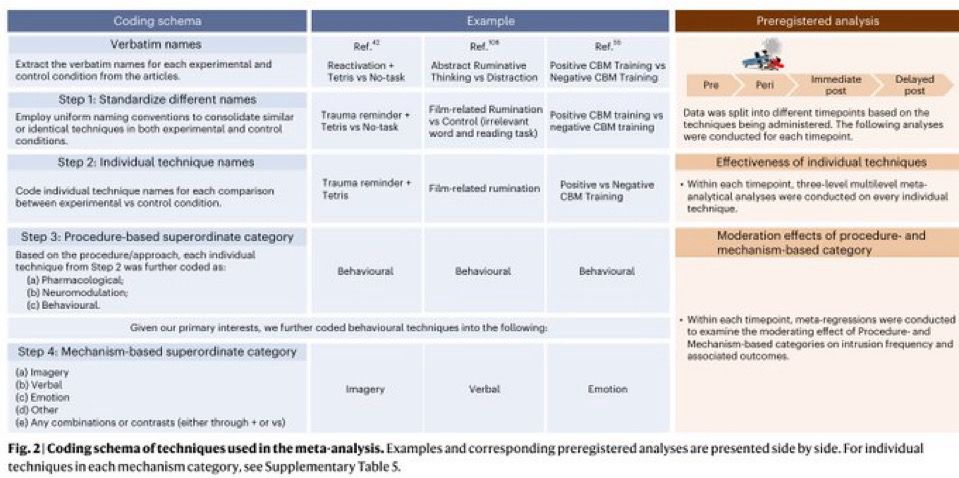
To grasp the HOW, we developed a categorization system based on each technique’s procedures and hypothesized mechanism.
To probe the WHEN, we split the techniques based on their time of administration and examined their effect sizes within each timepoint.
To grasp the HOW, we developed a categorization system based on each technique’s procedures and hypothesized mechanism.
To probe the WHEN, we split the techniques based on their time of administration and examined their effect sizes within each timepoint.
May 24, 2025 at 6:28 AM
🧵4/8
To grasp the HOW, we developed a categorization system based on each technique’s procedures and hypothesized mechanism.
To probe the WHEN, we split the techniques based on their time of administration and examined their effect sizes within each timepoint.
To grasp the HOW, we developed a categorization system based on each technique’s procedures and hypothesized mechanism.
To probe the WHEN, we split the techniques based on their time of administration and examined their effect sizes within each timepoint.
🧵3/8
Our work is guided by 2 pivotal questions:
HOW these techniques work?
WHEN are they effective?
Insights from these Qs are crucial for both basic science and translational research into development of effective therapeutic interventions for trauma symptoms.
Our work is guided by 2 pivotal questions:
HOW these techniques work?
WHEN are they effective?
Insights from these Qs are crucial for both basic science and translational research into development of effective therapeutic interventions for trauma symptoms.
May 24, 2025 at 6:28 AM
🧵3/8
Our work is guided by 2 pivotal questions:
HOW these techniques work?
WHEN are they effective?
Insights from these Qs are crucial for both basic science and translational research into development of effective therapeutic interventions for trauma symptoms.
Our work is guided by 2 pivotal questions:
HOW these techniques work?
WHEN are they effective?
Insights from these Qs are crucial for both basic science and translational research into development of effective therapeutic interventions for trauma symptoms.
🧵2/8
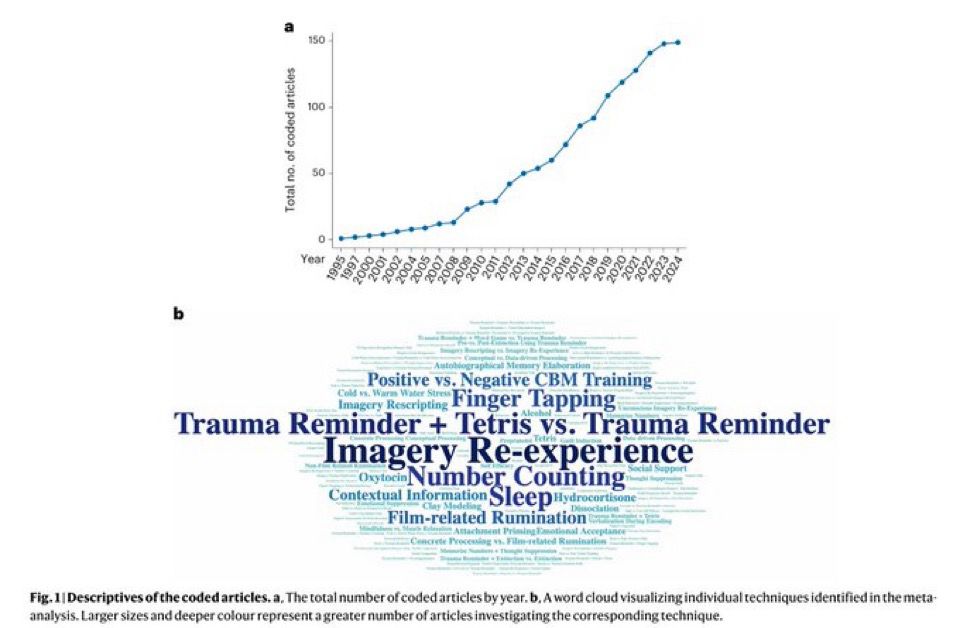
Synthesizing data across 134 articles covering 131 techniques on trauma intrusion modulation, spanning ~30 years of research, we assess how these techniques alter (i.e. increase or decrease) intrusions and associated outcomes, namely intrusion-related distress and symptoms.
Synthesizing data across 134 articles covering 131 techniques on trauma intrusion modulation, spanning ~30 years of research, we assess how these techniques alter (i.e. increase or decrease) intrusions and associated outcomes, namely intrusion-related distress and symptoms.
May 24, 2025 at 6:27 AM
🧵2/8
Synthesizing data across 134 articles covering 131 techniques on trauma intrusion modulation, spanning ~30 years of research, we assess how these techniques alter (i.e. increase or decrease) intrusions and associated outcomes, namely intrusion-related distress and symptoms.
Synthesizing data across 134 articles covering 131 techniques on trauma intrusion modulation, spanning ~30 years of research, we assess how these techniques alter (i.e. increase or decrease) intrusions and associated outcomes, namely intrusion-related distress and symptoms.