




Margaret Gold
@mobilemaggie.mastodon.social.ap.brid.gy
🇨🇦 🇳🇱 Migrant. Mostly tooting about #OpenSource #CitizenScience #OpenScience and transition topics
[bridged from https://mastodon.social/@MobileMaggie on the fediverse by https://fed.brid.gy/ ]
[bridged from https://mastodon.social/@MobileMaggie on the fediverse by https://fed.brid.gy/ ]
Ik heb net ondertekend https://actie.degoedezaak.org/petitions/stop-de-amerikaanse-overname-digid - dit moeten wij echt stoppen...
Stop de Amerikaanse overname DigiD!
|
DeGoedeZaak
actie.degoedezaak.org
December 19, 2025 at 12:06 PM
Ik heb net ondertekend https://actie.degoedezaak.org/petitions/stop-de-amerikaanse-overname-digid - dit moeten wij echt stoppen...
Reposted by Margaret Gold

«if you have to choose a “pedia” to trust, you might choose the one assembled by a bunch of pedantic nerds saying “well, ACTUALLY” to each other until the heat death of the universe, over the one assembled by an LLM controlled by an insecure Nazi salute-throwing billionaire»
A Review of […]
A Review of […]
Original post on scholar.social
scholar.social
November 1, 2025 at 1:21 AM
«if you have to choose a “pedia” to trust, you might choose the one assembled by a bunch of pedantic nerds saying “well, ACTUALLY” to each other until the heat death of the universe, over the one assembled by an LLM controlled by an insecure Nazi salute-throwing billionaire»
A Review of […]
A Review of […]
what a great post @gedankenstuecke I completely agree https://tzovar.as/motivations/ - it reminds me of discussions at the Zooniverse about the user experience of Snapshot Serengeti if removing empty photos by ML also removed the joy of discovery

Being Social: Motivations in Citizen Science
**tl;dr: People’s motivations to engage with online citizen science are complex and change over time**
Apparently, last week _iNaturalist_ released a blog post, demoing their mock-up of how they envision using LLMs to process user-contributed wildlife observation data. Back in June, when they (or rather their funder Google) announced this project, it led to substantial backlash among their community, which largely went unheard by the powers that be - i.e. run _iNaturalist_.
The current blog post seems to do little to address most of those concerns, talking about putting _people at the center_ , alongside publishing some numbers on the allegedly-low environmental impact they seem to have copied from straight _Google_ ’s internal “research”1. As I noted on Mastodon during the weekend: In some way, it’s par for the course for those organizations that “professionalize” — and thus (“need to”) put their primary focus on paying their own salaries and thus raising funds.2 So far, that’s (unfortunately) all as expected. But what struck me when reading through the responses to this post was this comment by a user:
> Every time I read that AI is better, faster etc. it lowers my motivation to identify. It makes me feel that what I do when identifying (mostly unknowns) is not going to be useful any longer
Which aligns with some of my predictions from a manuscript on the impact of AI on citizen science, as well as the larger academic literature about the motivations of volunteers generally - and in citizen science in particular. And one big part of that could be summarised as: _People come for the mission but they**STAY** for the community._
Back in 2022, we published a study on the motivations (and shared goals/values) of self-researchers who participate in an online community and joint-citizen science effort we did3 as part of Open Humans. For this, we modeled our qualitative code-book in part after two other studies that looked at citizen science motivations: _Variations in the Motivations of Environmental Citizen Scientists_ and _Motivations, learning and creativity in online citizen science_.
What’s shared among all of these is the assumption that people have a rich and complex network of motivations. Some of which will be intrinsic (_“I want to help science”_ , _It’s valuable to do_ , _I want to learn something new_), others extrinsic (“ _This will help me my career_). But importantly, they also outline that people’s motivations aren’t static, but can and do evolve over time. While initial motivations might be driven by a general interest in the topic, feeling aligned with the mission of an effort, or a desire to contribute to research, this does not mean that those motivations stay the same. In fact, the reasoning for sustained participation often is different.
While a continued interest in a topic – and alignment with a mission are a necessary precondition, they aren’t by themselves sufficient. Factors like a sense of achievement or increased ability, continued time do play big roles. But so do social factors: Participants in those studies called out the importance of the sense of belonging and being part of a community, often leading to people taking up extra responsibilities outside the main “tasks” of a citizen science project - which in turn deepens a sense of belonging while also helping to improve the overall community.
In fact, in our work with self-researchers we found that the social dimension developed through online meetings over time, and was a key factor for an engagement over time, that also helped deepen and reinforce the community norms and values. Or put simpler: People continued to engage with these efforts, because they were looking forward to meeting their peers and friends again, often quite literally week after week - in some cases literally logging on to the regular online video calls to chime in “ _Hello my online friends!_ ”. And while we didn’t study the motivations of community members for our more recent work with _AutSPACEs_ in detail, at least anecdotally I’d say we saw the same there: As time went on, people showed up as much for the social interactions as for the scientific interest and other dynamics.
And this brings me back to the initial quote of that person who says their motivation will be lower to contribute if “AI” is brought in to replace them. Beyond identifying that it feels like it will replace their contributions or make them superfluous, there is also an aspect of how a big motivating factor is to interact with other human beings, who give their advice and share their learnings. Maybe “AI” can give such advice more _efficiently_ or _at scale_ (though I doubt it), but it can’t replace the social aspects of learning from each other. And I think that is an aspect that deserves to be kept in mind when designing and implementing citizen science projects: Holding a space for humans; to work with each other, learn from each other and laugh with each other; is as much part of science - and citizen science - as collecting the data.
_iNaturalist_ states that their mission is to use the _power of technology to connect people to nature_. But I think it misses out on an important but overlooked bit, which is using technology to _connect people to people, alongside and nature_.
## References
1. Aitkenhead, G., Fantoni, S., Scott, J., Batchelor, S., Duncan, H., Llewellyn-Jones, D., … Greshake Tzovaras, B. (2024). How to co-create content moderation policies: the case of the AutSPACEs project. Data & Policy, 6, e28. doi:10.1017/dap.2024.21
2. Borda, Ann and Greshake Tzovaras, Bastian, Perspectives on Crowdsourced Citizen Science and the Data Governance of AI Applications (March 13, 2025). https://dx.doi.org/10.2139/ssrn.5291262
3. Greshake Tzovaras, B. (2025, June 12). Generative ‘AI’ in citizen science: the iNaturalist backlash. Bastian Greshake Tzovaras. https://doi.org/10.59350/7ykzb-dkx88
4. Greshake Tzovaras, B. (2025, June 18). Power-sharing in online communities. Bastian Greshake Tzovaras. https://doi.org/10.59350/jpevj-h4y27
5. Greshake Tzovaras, B. (2025, March 31). Sunsetting openSNP - a personal retrospective. Bastian Greshake Tzovaras. https://doi.org/10.59350/8se4t-tmx68
6. Jennett, C., Kloetzer, L., Schneider, D., Iacovides, I., Cox, A., Gold, M., Fuchs, B., Eveleigh, A., Mathieu, K., Ajani, Z. and Talsi, Y. (2016). Motivations, learning and creativity in online citizen science JCOM 15(03), A05. https://doi.org/10.22323/2.15030205
7. Senabre Hidalgo, E., Ball, M.P., Opoix, M. et al. Shared motivations, goals and values in the practice of personal science: a community perspective on self-tracking for empirical knowledge. Humanit Soc Sci Commun 9, 182 (2022). https://doi.org/10.1057/s41599-022-01199-0
8. Seltzer, Carrie (2025, October 15). Exploring New Ways to Learn from iNaturalist’s Community Expertise. https://www.inaturalist.org/blog/118695-exploring-new-ways-to-learn-from-inaturalist-s-community-expertise
9. West, S, Dyke, A and Pateman, R. 2021. Variations in the Motivations of Environmental Citizen Scientists. Citizen Science: Theory and Practice, 6(1): 14, pp. 1–18. https:// doi.org/10.5334/cstp.370
## Footnotes
1. Which has an obvious incentive to low-ball those figures - and completely ignores the environmental and social impact of the actual training, as opposed to the individual prompts. ↩
2. I’m even somewhat sympathetic to that, in my academic life I’ve been in the position of having to raise research funding quite often. But it always comes with moral trade-offs, and it’s why I’m so happy that we had the luck to not have to do that with openSNP. ↩
3. And still do! ↩
tzovar.as
November 3, 2025 at 4:47 PM
what a great post @gedankenstuecke I completely agree https://tzovar.as/motivations/ - it reminds me of discussions at the Zooniverse about the user experience of Snapshot Serengeti if removing empty photos by ML also removed the joy of discovery
Two magpies have just found the acorns that the Jay hid in my front yard, and have meticulously moved then to a new location 🤣
October 18, 2025 at 12:47 PM
Two magpies have just found the acorns that the Jay hid in my front yard, and have meticulously moved then to a new location 🤣
Reposted by Margaret Gold

For pete's sake, @mozilla : if you want to measure whether the AI/ML features are worth a damn, put a big green "disable all AI in my browser" button on the version update screen and put some telemetry around how many people instantly click it.
Just about everyone I know who has taken the 142 […]
Just about everyone I know who has taken the 142 […]
Original post on mastodon.social
mastodon.social
August 22, 2025 at 8:31 PM
For pete's sake, @mozilla : if you want to measure whether the AI/ML features are worth a damn, put a big green "disable all AI in my browser" button on the version update screen and put some telemetry around how many people instantly click it.
Just about everyone I know who has taken the 142 […]
Just about everyone I know who has taken the 142 […]
Reposted by Margaret Gold

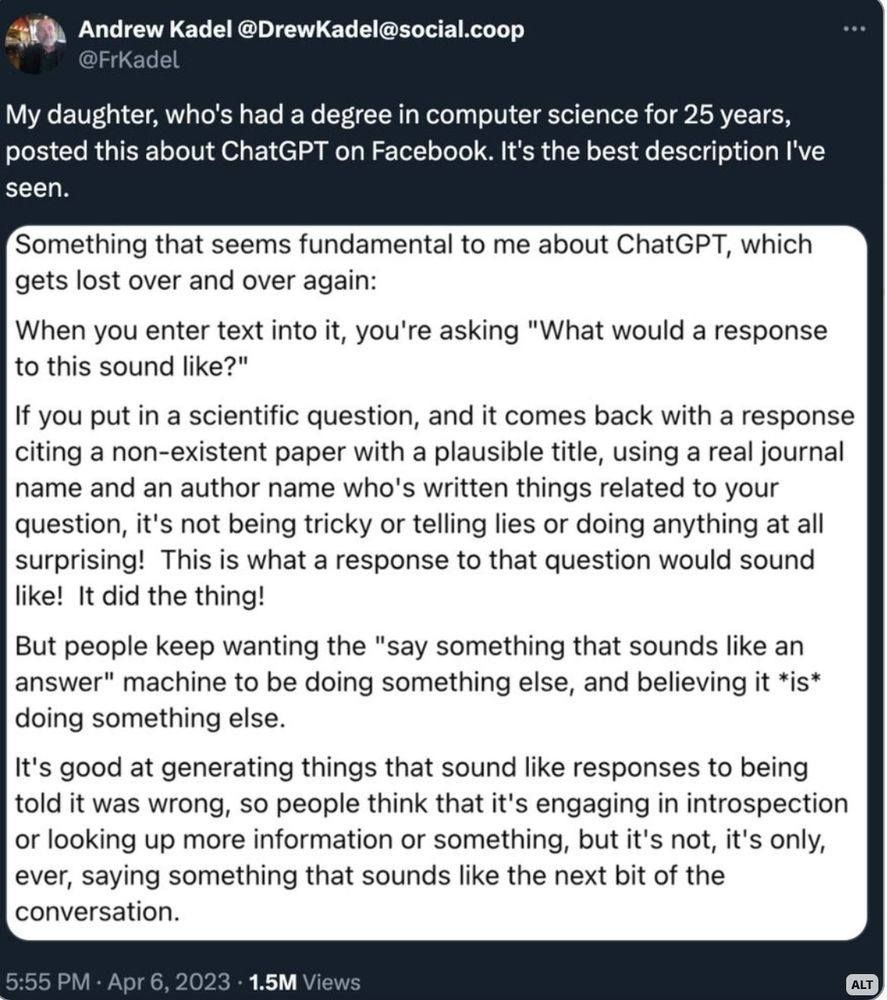
The only thing ChatGPT ever does.
August 14, 2025 at 7:35 PM
The only thing ChatGPT ever does.
We're excited to have a joint job opening in the Citizen Science Lab and Faculty of Governance and Public Affairs at Leiden University. Do you have experience with #citizenscience and #PublicEngagement approaches, and are you passionate about the #energytransition? Then this one could be for […]
Original post on mastodon.social
mastodon.social
July 25, 2025 at 11:24 AM
We're excited to have a joint job opening in the Citizen Science Lab and Faculty of Governance and Public Affairs at Leiden University. Do you have experience with #citizenscience and #PublicEngagement approaches, and are you passionate about the #energytransition? Then this one could be for […]
I am now officially allergic to the phrase "like never before" - instant disbelief of whatever it is you are claiming.
July 24, 2025 at 11:01 AM
I am now officially allergic to the phrase "like never before" - instant disbelief of whatever it is you are claiming.
This is quite the budget announcement, but it leaves me with lots of questions about the financing of it...
https://ec.europa.eu/commission/presscorner/detail/en/STATEMENT_25_1851
https://ec.europa.eu/commission/presscorner/detail/en/STATEMENT_25_1851

Statement by President von der Leyen on the next long-term EU budget
”Check against delivery”\nToday, the College adopted the Commission\'s proposal for the next Multiannual Financial Framework: the budget for 2028-2034. It is a 2 trillion budget for a new era. A budget
ec.europa.eu
July 16, 2025 at 3:27 PM
This is quite the budget announcement, but it leaves me with lots of questions about the financing of it...
https://ec.europa.eu/commission/presscorner/detail/en/STATEMENT_25_1851
https://ec.europa.eu/commission/presscorner/detail/en/STATEMENT_25_1851
can someone point me to a reputable news source with a no-Trump filter? I'm really sick of this b* dominating the news - that particular daily soap opera doesn't provide me with ANY useful information.
July 14, 2025 at 7:28 AM
can someone point me to a reputable news source with a no-Trump filter? I'm really sick of this b* dominating the news - that particular daily soap opera doesn't provide me with ANY useful information.
So looking forward to seeing both @cubicgarden and @andypiper at @pubconf this coming Friday! #socialmedia #publicstack
June 10, 2025 at 6:28 PM
So looking forward to seeing both @cubicgarden and @andypiper at @pubconf this coming Friday! #socialmedia #publicstack
Reposted by Margaret Gold

Anybody know of maps that reconstruct land use patterns in Europe over the past 1000 years or so?
Boosts welcome.
#askfedi #geography #environment
Boosts welcome.
#askfedi #geography #environment
June 2, 2025 at 9:41 AM
Anybody know of maps that reconstruct land use patterns in Europe over the past 1000 years or so?
Boosts welcome.
#askfedi #geography #environment
Boosts welcome.
#askfedi #geography #environment
I only just now learned that Steve O'Hear passed away last fall. He was central to the entire London tech scene for more than a decade, and the absolute sharpist tack in the box. My condolences to any close friends, family and colleagues on the fediverse […]
Original post on mastodon.social
mastodon.social
June 2, 2025 at 12:20 PM
I only just now learned that Steve O'Hear passed away last fall. He was central to the entire London tech scene for more than a decade, and the absolute sharpist tack in the box. My condolences to any close friends, family and colleagues on the fediverse […]
Shout out to the founders of the #citizenscience Lab at Leiden University as part of our 450 jubileum: https://top450.universiteitleiden.nl/en/items/citizen-science-lab Do give them some love!! @cwts

Citizen Science Lab
Science & Society Together - the founding of the Citizen Science Lab in 2018 is a classic Leiden story of academic grassroots…
top450.universiteitleiden.nl
May 20, 2025 at 3:36 PM
Shout out to the founders of the #citizenscience Lab at Leiden University as part of our 450 jubileum: https://top450.universiteitleiden.nl/en/items/citizen-science-lab Do give them some love!! @cwts
Het #citynaturechallenge van Leiden is vandaag van start! https://waarneming.nl/bioblitz/17420/leiden-cnc-2025/ Iedereen die tot en met maandag Obsidentify gebruikt om soorten waar te nemen maakt een belangrijke contributie aan onze stadsnatuur kennis #expeditiestadsnatuurleiden

Leiden CNC 2025
waarneming.nl
April 25, 2025 at 10:34 AM
Het #citynaturechallenge van Leiden is vandaag van start! https://waarneming.nl/bioblitz/17420/leiden-cnc-2025/ Iedereen die tot en met maandag Obsidentify gebruikt om soorten waar te nemen maakt een belangrijke contributie aan onze stadsnatuur kennis #expeditiestadsnatuurleiden
Reposted by Margaret Gold

A mention of @SafeguardingResearch in the BBC 🥳
"Multiple organisations including the Internet Archive, a non-profit, Safeguarding Research and Culture, and the Data Rescue Project, are now engaged in activities alongside the OEDP to rescue this data from oblivion."
Featuring quotes from our […]
"Multiple organisations including the Internet Archive, a non-profit, Safeguarding Research and Culture, and the Data Rescue Project, are now engaged in activities alongside the OEDP to rescue this data from oblivion."
Featuring quotes from our […]
Original post on fedihum.org
fedihum.org
April 23, 2025 at 7:13 PM
A mention of @SafeguardingResearch in the BBC 🥳
"Multiple organisations including the Internet Archive, a non-profit, Safeguarding Research and Culture, and the Data Rescue Project, are now engaged in activities alongside the OEDP to rescue this data from oblivion."
Featuring quotes from our […]
"Multiple organisations including the Internet Archive, a non-profit, Safeguarding Research and Culture, and the Data Rescue Project, are now engaged in activities alongside the OEDP to rescue this data from oblivion."
Featuring quotes from our […]
Nice list of tech-provider alternatives by the @waag https://waag.org/nl/article/15-apps-die-beter-zijn-voor-je-privacy-en-welzijn/ (why not ProtonMail though?... I've been thinking of moving there)

Waag Futurelab (@waag@waag.social)
785 Berichten, 449 Volgend, 4,41K Volgers · Technology = culture Waag Futurelab is a public research institute and cultural space in Amsterdam's medieval city gate.
waag.social
April 24, 2025 at 9:36 AM
Nice list of tech-provider alternatives by the @waag https://waag.org/nl/article/15-apps-die-beter-zijn-voor-je-privacy-en-welzijn/ (why not ProtonMail though?... I've been thinking of moving there)
Proud that @universiteitleiden has chosen the 'Expeditie Stadsnatuur Leiden' city-wide #bioblitz #citynaturechallenge as the home page news today!! https://www.universiteitleiden.nl/ All of Leiden invited to monitor our city #biodiversity together this month. #citizenscience

Universiteit Leiden (@universiteitleiden@mastodon.nl)
204 Posts, 46 Following, 330 Followers · Officieel Mastodon-account van de Universiteit Leiden. Over wetenschap, opleidingen, evenementen en studentenleven. http://universiteitleiden.nl
mastodon.nl
April 22, 2025 at 3:07 PM
Proud that @universiteitleiden has chosen the 'Expeditie Stadsnatuur Leiden' city-wide #bioblitz #citynaturechallenge as the home page news today!! https://www.universiteitleiden.nl/ All of Leiden invited to monitor our city #biodiversity together this month. #citizenscience
Reposted by Margaret Gold

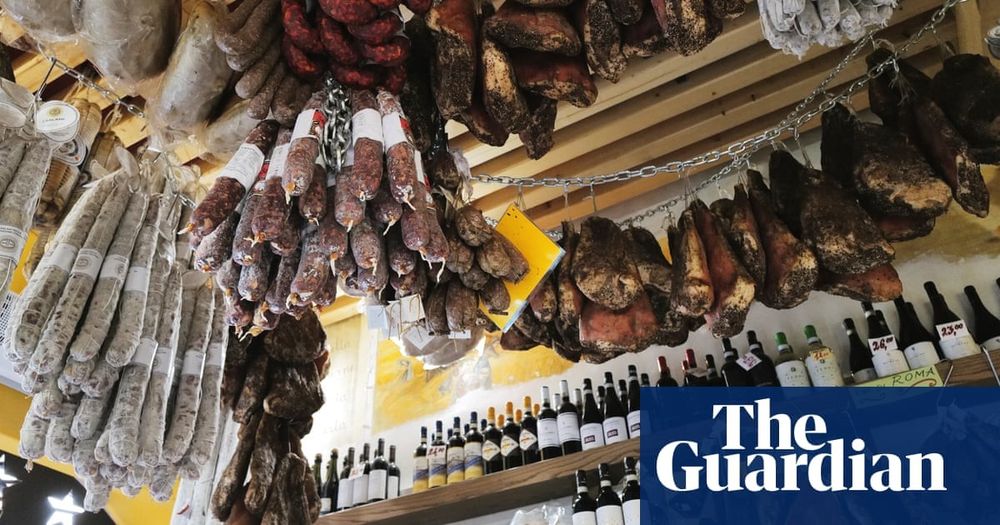
Travellers arriving in Great Britain face import ban on EU meat and dairy | Foot-and-mouth disease | @TheGuardian
https://www.theguardian.com/world/2025/apr/12/travellers-arriving-in-great-britain-import-ban-eu-meat-and-dairy
> Government introduces measure to […]
[Original post on mas.to]
https://www.theguardian.com/world/2025/apr/12/travellers-arriving-in-great-britain-import-ban-eu-meat-and-dairy
> Government introduces measure to […]
[Original post on mas.to]
April 15, 2025 at 4:14 AM
Travellers arriving in Great Britain face import ban on EU meat and dairy | Foot-and-mouth disease | @TheGuardian
https://www.theguardian.com/world/2025/apr/12/travellers-arriving-in-great-britain-import-ban-eu-meat-and-dairy
> Government introduces measure to […]
[Original post on mas.to]
https://www.theguardian.com/world/2025/apr/12/travellers-arriving-in-great-britain-import-ban-eu-meat-and-dairy
> Government introduces measure to […]
[Original post on mas.to]
Reposted by Margaret Gold

The @oecdinnovation.bsky.social report on #CitizenScience is out today: Embedding citizen science into research policy www.oecd.org/en/publicati... #ResearchPolicy #ParticipatoryResearch

April 8, 2025 at 4:57 PM
The @oecdinnovation.bsky.social report on #CitizenScience is out today: Embedding citizen science into research policy www.oecd.org/en/publicati... #ResearchPolicy #ParticipatoryResearch
Reposted by Margaret Gold

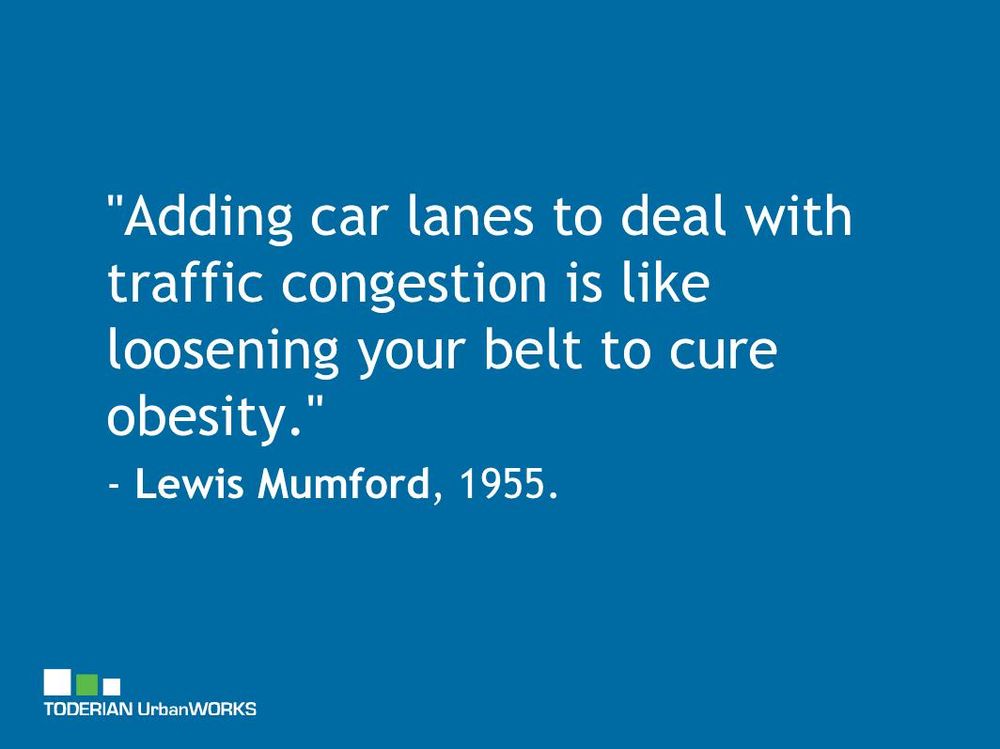
It’s still a goal of mine to help make this the most famous, well-known and UNDERSTOOD quote about cities in history.
Please share it as much as you can.
Please share it as much as you can.
April 2, 2025 at 4:49 AM
It’s still a goal of mine to help make this the most famous, well-known and UNDERSTOOD quote about cities in history.
Please share it as much as you can.
Please share it as much as you can.
Reposted by Margaret Gold

It's also why they don't like democracy. And democracy is flawed too.
But, if we can start from "everyone can edit" and "everyone should have a say" we at least have a slim chance of hearing all voices. We at least have a chance at arriving at a self-aware stance that recognizes its own […]
But, if we can start from "everyone can edit" and "everyone should have a say" we at least have a slim chance of hearing all voices. We at least have a chance at arriving at a self-aware stance that recognizes its own […]
Original post on sauropods.win
sauropods.win
April 7, 2025 at 10:32 AM
It's also why they don't like democracy. And democracy is flawed too.
But, if we can start from "everyone can edit" and "everyone should have a say" we at least have a slim chance of hearing all voices. We at least have a chance at arriving at a self-aware stance that recognizes its own […]
But, if we can start from "everyone can edit" and "everyone should have a say" we at least have a slim chance of hearing all voices. We at least have a chance at arriving at a self-aware stance that recognizes its own […]
Mooi artikel over het belang van het archiveren van websites, en de rol van @kbnationalebibliotheek https://www.nrc.nl/nieuws/2025/04/07/het-grootste-web-archief-ter-wereld-wordt-bedreigd-door-procederende-uitgevers-zegt-oprichter-a4889079 @martijnkleppe

KB nationale bibliotheek (@kbnationalebibliotheek@mastodon.social)
30 Posts, 22 Following, 914 Followers · 📚 De nationale bibliotheek van Nederland 🔍 Ontdek onze collectie online én in Den Haag 📖 Open voor bezoekers: kom studeren, lezen en onderzoeken
mastodon.social
April 7, 2025 at 2:45 PM
Mooi artikel over het belang van het archiveren van websites, en de rol van @kbnationalebibliotheek https://www.nrc.nl/nieuws/2025/04/07/het-grootste-web-archief-ter-wereld-wordt-bedreigd-door-procederende-uitgevers-zegt-oprichter-a4889079 @martijnkleppe
If you are a man whose only posts are saying hi to women, then I'm blocking you immediately.
April 7, 2025 at 6:57 AM
If you are a man whose only posts are saying hi to women, then I'm blocking you immediately.