




Lubartworld
@lubartworld.bsky.social
This project proposes to study the relations between migration and Holocaust from the 1920's to the 1950's, from Lubartów to the world.
About the project: https://lubartworld.cnrs.fr/
About the project: https://lubartworld.cnrs.fr/
On the lists of deportees from Mechelen transit camp, she appears as born uin "Lubatow".

June 13, 2025 at 10:53 AM
On the lists of deportees from Mechelen transit camp, she appears as born uin "Lubatow".
On June 29 1948, a “notification of departure of a foreigner” form is completed by the city of Antwerp, indicating that the place of departure is “unknown” (onbekend): they are therefore struck off the city’s population register. In this Belgian police archive, Feiga is said to be born in “Lubaton“.

June 13, 2025 at 10:53 AM
On June 29 1948, a “notification of departure of a foreigner” form is completed by the city of Antwerp, indicating that the place of departure is “unknown” (onbekend): they are therefore struck off the city’s population register. In this Belgian police archive, Feiga is said to be born in “Lubaton“.
Feiga and her husband Salomon would also have passed through the Netherlands, as they are recorded in a population register in The Hague in 1913.

June 13, 2025 at 10:53 AM
Feiga and her husband Salomon would also have passed through the Netherlands, as they are recorded in a population register in The Hague in 1913.
Lubartów, really? Not so sure… Place names in history can be a problem. Fejga Nathanson is a case in point. She did arrive in Antwerp in 1912, but declared her place of birth as “Lubatöw”, specifying “Brody, Galicia”, which would indicate that she did not come from Lubartów in the Lublin region.

June 13, 2025 at 10:53 AM
Lubartów, really? Not so sure… Place names in history can be a problem. Fejga Nathanson is a case in point. She did arrive in Antwerp in 1912, but declared her place of birth as “Lubatöw”, specifying “Brody, Galicia”, which would indicate that she did not come from Lubartów in the Lublin region.
Followed by an afternoon of debriefing on the contributions and results of the Lubartworld project 🌐
Come one, come all!
Come one, come all!

May 21, 2025 at 5:25 PM
Followed by an afternoon of debriefing on the contributions and results of the Lubartworld project 🌐
Come one, come all!
Come one, come all!
The program includes a morning devoted to collective research on the Holocaust and migrations, and to hybrid forms of research dissemination and organization 💬✍️


May 21, 2025 at 5:25 PM
The program includes a morning devoted to collective research on the Holocaust and migrations, and to hybrid forms of research dissemination and organization 💬✍️
Save the date 🗓️ ! Join us in two weeks at the conference “Migration and the Holocaust across the world in the 20th century” !
📍 Friday, June 6, 2025, 9am-5pm, at ENS Paris, Dussane Room, 45 rue d'Ulm.
@normalesup.bsky.social @ihmc.bsky.social @ehess.fr @erc.europa.eu @pierresalmon.bsky.social
📍 Friday, June 6, 2025, 9am-5pm, at ENS Paris, Dussane Room, 45 rue d'Ulm.
@normalesup.bsky.social @ihmc.bsky.social @ehess.fr @erc.europa.eu @pierresalmon.bsky.social

May 21, 2025 at 5:25 PM
Save the date 🗓️ ! Join us in two weeks at the conference “Migration and the Holocaust across the world in the 20th century” !
📍 Friday, June 6, 2025, 9am-5pm, at ENS Paris, Dussane Room, 45 rue d'Ulm.
@normalesup.bsky.social @ihmc.bsky.social @ehess.fr @erc.europa.eu @pierresalmon.bsky.social
📍 Friday, June 6, 2025, 9am-5pm, at ENS Paris, Dussane Room, 45 rue d'Ulm.
@normalesup.bsky.social @ihmc.bsky.social @ehess.fr @erc.europa.eu @pierresalmon.bsky.social
Puis une après-midi d'ouvertures et de bilans sur les apports et les résultats du projet Lubartworld 🌐
Soyez nombreux.ses !
Soyez nombreux.ses !

May 21, 2025 at 5:10 PM
Puis une après-midi d'ouvertures et de bilans sur les apports et les résultats du projet Lubartworld 🌐
Soyez nombreux.ses !
Soyez nombreux.ses !
Au programme, une matinée consacrée aux recherches collectives croisant Shoah et migrations, et aux formes hybrides de diffusion et d'organisation des recherches 💬✍️


May 21, 2025 at 5:10 PM
Au programme, une matinée consacrée aux recherches collectives croisant Shoah et migrations, et aux formes hybrides de diffusion et d'organisation des recherches 💬✍️
Save the date 🗓️ Rejoignez-nous dans deux semaines au colloque « Migrations et Shoah dans le monde au 20e siècle » !
📍 Vendredi 6 juin 2025, 9h–17h, à l'ENS Paris, salle Dussane, 45 rue d’Ulm, Paris 5.
@normalesup.bsky.social @ihmc.bsky.social @ehess.fr @erc.europa.eu @pierresalmon.bsky.social
📍 Vendredi 6 juin 2025, 9h–17h, à l'ENS Paris, salle Dussane, 45 rue d’Ulm, Paris 5.
@normalesup.bsky.social @ihmc.bsky.social @ehess.fr @erc.europa.eu @pierresalmon.bsky.social

May 21, 2025 at 5:10 PM
Save the date 🗓️ Rejoignez-nous dans deux semaines au colloque « Migrations et Shoah dans le monde au 20e siècle » !
📍 Vendredi 6 juin 2025, 9h–17h, à l'ENS Paris, salle Dussane, 45 rue d’Ulm, Paris 5.
@normalesup.bsky.social @ihmc.bsky.social @ehess.fr @erc.europa.eu @pierresalmon.bsky.social
📍 Vendredi 6 juin 2025, 9h–17h, à l'ENS Paris, salle Dussane, 45 rue d’Ulm, Paris 5.
@normalesup.bsky.social @ihmc.bsky.social @ehess.fr @erc.europa.eu @pierresalmon.bsky.social
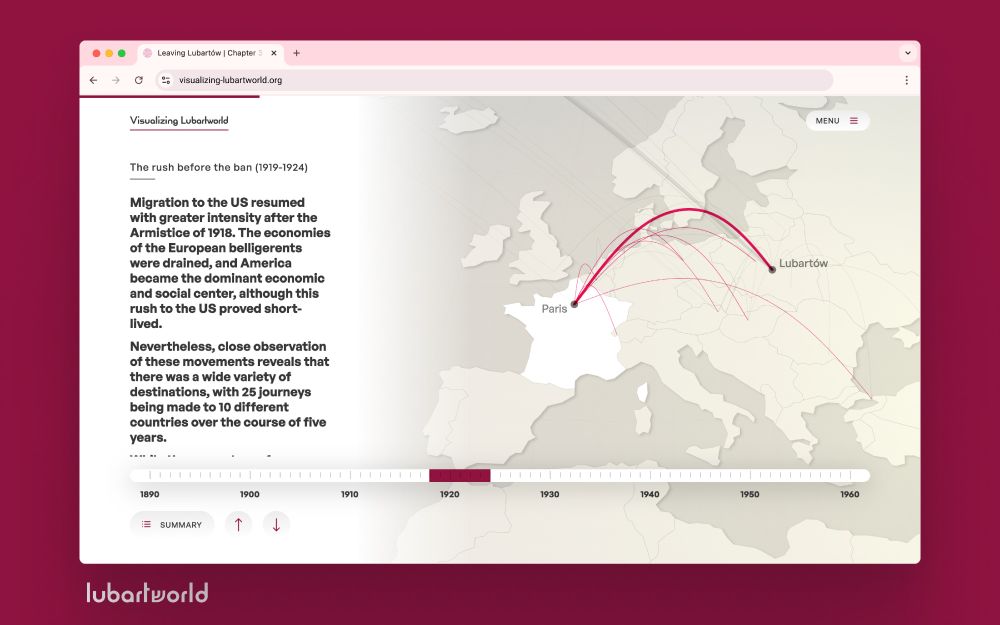
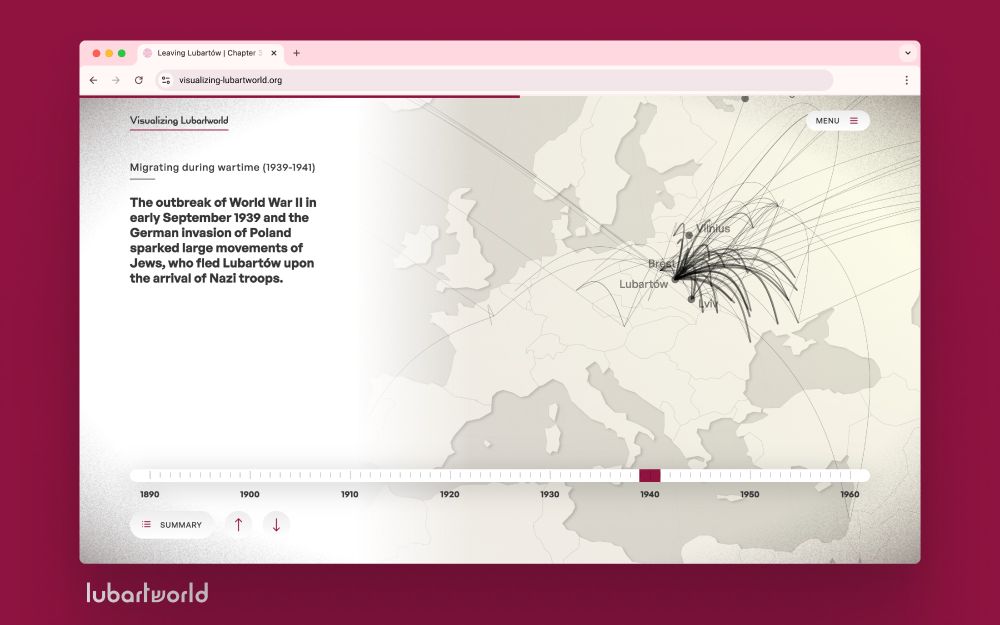
How can we combine the history of the Holocaust with the history of migrations?
More on visualizing-lubartworld.org !
More on visualizing-lubartworld.org !
May 16, 2025 at 4:07 PM
How can we combine the history of the Holocaust with the history of migrations?
More on visualizing-lubartworld.org !
More on visualizing-lubartworld.org !
Enfin, 3️⃣ comment rendre compte des destinations de migrations des habitant·es de Lubartów des années 1900 aux années 1960 ? Nous présentons ici les différents « âges » de l’émigration lubartówienne vers le reste du monde.

May 15, 2025 at 9:29 PM
Enfin, 3️⃣ comment rendre compte des destinations de migrations des habitant·es de Lubartów des années 1900 aux années 1960 ? Nous présentons ici les différents « âges » de l’émigration lubartówienne vers le reste du monde.
Ensuite : 2️⃣ Le temps de la disparition : Lubartów dans la Shoah. Comment les Juif·ves de Lubartów font-ils et elles face à la persécution, des campagnes anti-juives, puis des rafles, des déportations et de la Shoah ?

May 15, 2025 at 9:29 PM
Ensuite : 2️⃣ Le temps de la disparition : Lubartów dans la Shoah. Comment les Juif·ves de Lubartów font-ils et elles face à la persécution, des campagnes anti-juives, puis des rafles, des déportations et de la Shoah ?
Trois fils directeurs : 1️⃣ Un portrait social d’une ville polonaise composée pour moitié de Juif·ves, à l’aube des années 30 : qui vit à côté de qui ? Comment s’organisent les réseaux de parenté ? À quel type de ségrégation a-t-on affaire ?

May 15, 2025 at 9:29 PM
Trois fils directeurs : 1️⃣ Un portrait social d’une ville polonaise composée pour moitié de Juif·ves, à l’aube des années 30 : qui vit à côté de qui ? Comment s’organisent les réseaux de parenté ? À quel type de ségrégation a-t-on affaire ?
Qui, parmi eux, reste ? Comment s’articulent les choix de départ et de destinations au fil des guerres, des persécutions et des politiques migratoires internationales ? « Vizualizing Lubartworld » répond à toutes ces questions, en anglais, par un outil d’humanités numériques accessible à tous·tes 🖥️.

May 15, 2025 at 9:29 PM
Qui, parmi eux, reste ? Comment s’articulent les choix de départ et de destinations au fil des guerres, des persécutions et des politiques migratoires internationales ? « Vizualizing Lubartworld » répond à toutes ces questions, en anglais, par un outil d’humanités numériques accessible à tous·tes 🖥️.
Finally, 3️⃣ how can we account for the migration destinations of Lubartów's inhabitants from the 1900s to the 1960s? We present the different “eras” of emigration from Lubartów to the rest of the world.

May 15, 2025 at 9:13 PM
Finally, 3️⃣ how can we account for the migration destinations of Lubartów's inhabitants from the 1900s to the 1960s? We present the different “eras” of emigration from Lubartów to the rest of the world.
Then: 2️⃣ The time of disappearance: Lubartów in the Holocaust. How did Lubartów's Jews cope with persecution, anti-Jewish campaigns, roundups, deportations and the Holocaust?

May 15, 2025 at 9:13 PM
Then: 2️⃣ The time of disappearance: Lubartów in the Holocaust. How did Lubartów's Jews cope with persecution, anti-Jewish campaigns, roundups, deportations and the Holocaust?
Three main threads: 1️⃣ First, a social portrait of a Polish town half of which is Jewish, at the dawn of the 1930s: who lives next to whom? How were kinship networks organized? What kind of segregation are we dealing with?

May 15, 2025 at 9:13 PM
Three main threads: 1️⃣ First, a social portrait of a Polish town half of which is Jewish, at the dawn of the 1930s: who lives next to whom? How were kinship networks organized? What kind of segregation are we dealing with?
Who stays behind? How are decisions to leave—and where to go—shaped over time by war, persecution, and international migration policies? "Visualizing Lubartworld" explores these questions through a digital humanities tool accessible to all 🖥️.

May 15, 2025 at 9:13 PM
Who stays behind? How are decisions to leave—and where to go—shaped over time by war, persecution, and international migration policies? "Visualizing Lubartworld" explores these questions through a digital humanities tool accessible to all 🖥️.
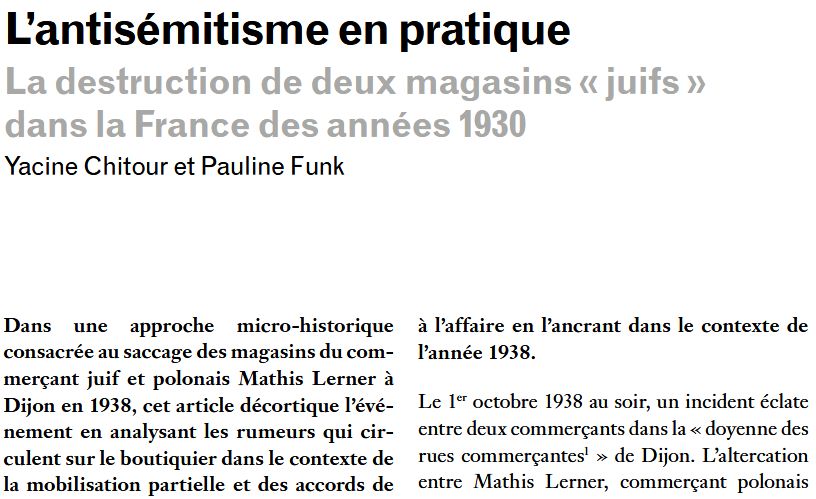
“Antisemitism in Practice: The Destruction of Two 'Jewish' Stores in 1930s France”
by Yacine Chitour and Pauline Funk
by Yacine Chitour and Pauline Funk
May 9, 2025 at 6:09 PM
“Antisemitism in Practice: The Destruction of Two 'Jewish' Stores in 1930s France”
by Yacine Chitour and Pauline Funk
by Yacine Chitour and Pauline Funk
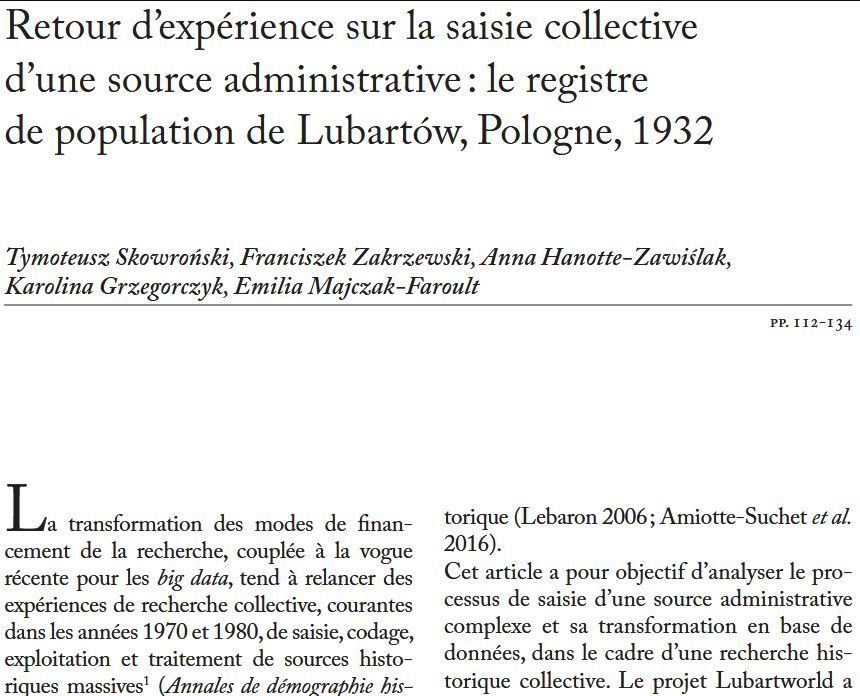
"Retour d’expérience sur la saisie collective d’une source administrative : le registre de population de Lubartów, Pologne, 1932" (Genèses, 2021)
Par Tymoteusz Skowroński, Franciszek Zakrzewski, Anna Hanotte-Zawiślak, Karolina Grzegorczyk et Emilia Majczak-Faroult
Par Tymoteusz Skowroński, Franciszek Zakrzewski, Anna Hanotte-Zawiślak, Karolina Grzegorczyk et Emilia Majczak-Faroult
May 5, 2025 at 3:00 PM
"Retour d’expérience sur la saisie collective d’une source administrative : le registre de population de Lubartów, Pologne, 1932" (Genèses, 2021)
Par Tymoteusz Skowroński, Franciszek Zakrzewski, Anna Hanotte-Zawiślak, Karolina Grzegorczyk et Emilia Majczak-Faroult
Par Tymoteusz Skowroński, Franciszek Zakrzewski, Anna Hanotte-Zawiślak, Karolina Grzegorczyk et Emilia Majczak-Faroult
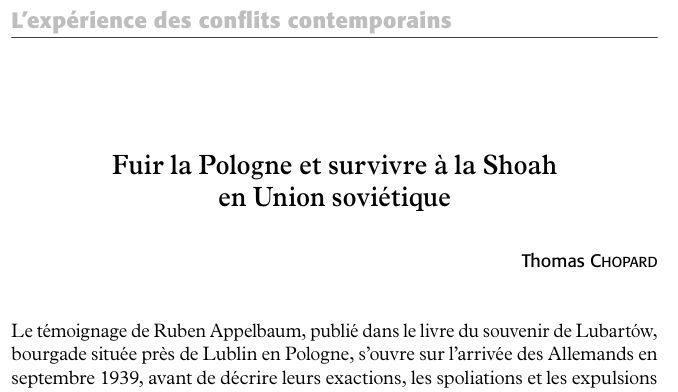
"Fleeing Poland and surviving the Holocaust in the Soviet Union" by @thomaschopard.bsky.social
"This article analyses the flight and survival of Polish Jews during the Second World War in the Soviet Union, which was the main place of survival for Polish Jews."
"This article analyses the flight and survival of Polish Jews during the Second World War in the Soviet Union, which was the main place of survival for Polish Jews."
May 1, 2025 at 4:16 PM
"Fleeing Poland and surviving the Holocaust in the Soviet Union" by @thomaschopard.bsky.social
"This article analyses the flight and survival of Polish Jews during the Second World War in the Soviet Union, which was the main place of survival for Polish Jews."
"This article analyses the flight and survival of Polish Jews during the Second World War in the Soviet Union, which was the main place of survival for Polish Jews."
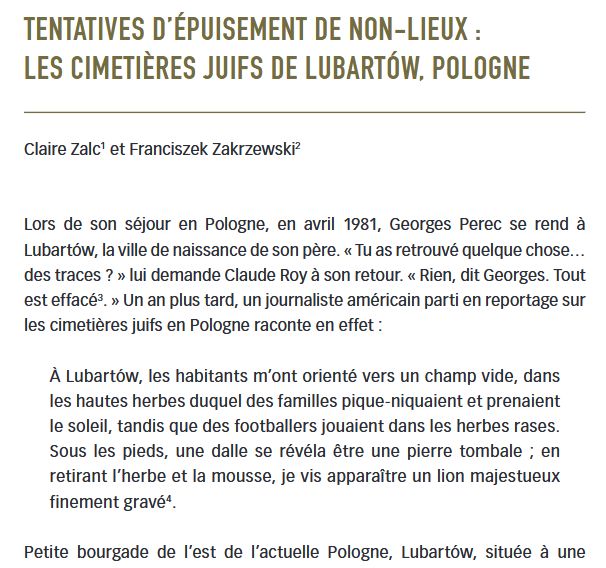
"During his travels in Poland in April 1981, Georges Perec visited Lubartów, his father’s birthplace. After he returned, Claude Roy asked, 'Did you find anything? Is there any sign?' 'Nothing,' said Georges. 'It’s all been wiped away.'"
By Claire Zalc and Franciszek Zakrzewski.
By Claire Zalc and Franciszek Zakrzewski.
April 28, 2025 at 4:05 PM
"During his travels in Poland in April 1981, Georges Perec visited Lubartów, his father’s birthplace. After he returned, Claude Roy asked, 'Did you find anything? Is there any sign?' 'Nothing,' said Georges. 'It’s all been wiped away.'"
By Claire Zalc and Franciszek Zakrzewski.
By Claire Zalc and Franciszek Zakrzewski.
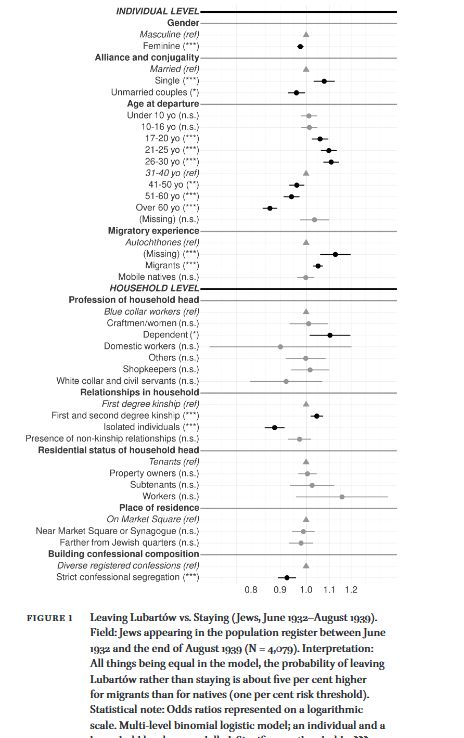
How does antisemitic violence affect the dynamics of mobility among Jewish and Catholic inhabitants from a small Polish town during the interwar period ? 👀
Check out our paper in the Journal of Migration History: 'The Dynamics of Mobility and Immobility in the Face of Danger'
Check out our paper in the Journal of Migration History: 'The Dynamics of Mobility and Immobility in the Face of Danger'
April 23, 2025 at 6:34 PM
How does antisemitic violence affect the dynamics of mobility among Jewish and Catholic inhabitants from a small Polish town during the interwar period ? 👀
Check out our paper in the Journal of Migration History: 'The Dynamics of Mobility and Immobility in the Face of Danger'
Check out our paper in the Journal of Migration History: 'The Dynamics of Mobility and Immobility in the Face of Danger'