




Lisa Archibald
@larchiba.bsky.social
Researcher & SLP interested in the different reasons why some children have trouble learning to talk & how to help; #devlangdis #WesternDLD2
Thank you to the RADLD international committee for leading such a great day!
October 20, 2025 at 2:17 AM
Thank you to the RADLD international committee for leading such a great day!
Young children can be engaged in making decisions. Clark & Moss described the MOSAIC approach for listening to young children (us.jkp.com/products/lis...)

Listening to Young Children, Expanded Third Edition
Viewing children as 'experts in their own lives', the Mosaic approach offers a creative framework for understanding young children's perspectives through talking, walking, making and reviewing materia...
us.jkp.com
October 11, 2025 at 2:02 PM
Young children can be engaged in making decisions. Clark & Moss described the MOSAIC approach for listening to young children (us.jkp.com/products/lis...)
Great tip was to engage children in activity FIRST & THEN talking. Kids love activity - they don't want to just sit & talk. Also, they wonder why we (adults) all ask them the same questions ... like what grade are you in? Do you do sports? (Yup, those are the questions I ask!)

October 11, 2025 at 1:58 PM
Great tip was to engage children in activity FIRST & THEN talking. Kids love activity - they don't want to just sit & talk. Also, they wonder why we (adults) all ask them the same questions ... like what grade are you in? Do you do sports? (Yup, those are the questions I ask!)
Thank you to Kent-Welsh with Binger's research group for this paper describing generative language intervention for AAC users. Appendix A describes the techniques & includes links to video examples. pubs.asha.org/doi/10.1044/...

Generative Language Intervention for Young Children With Down Syndrome Using Augmentative and Alternative Communication: A Randomized Controlled Trial
Purpose: Children with Down syndrome often have poor speech intelligibility, which
can mask expressive language competence; this, in turn, can le...
pubs.asha.org
July 18, 2025 at 1:46 PM
Thank you to Kent-Welsh with Binger's research group for this paper describing generative language intervention for AAC users. Appendix A describes the techniques & includes links to video examples. pubs.asha.org/doi/10.1044/...
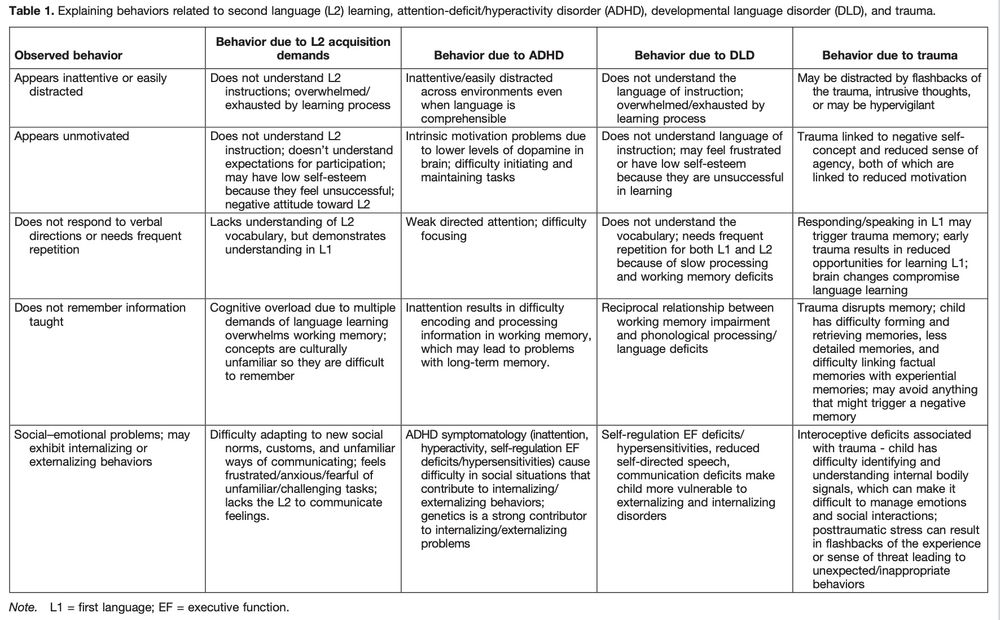
Watson & Westby (2025) nicely capture the varying reasons that a child may show behaviour differences related to language and learning. Converging assessment evidence is a necessary part of identification! pubs.asha.org/doi/10.1044/...
July 17, 2025 at 6:44 PM
Watson & Westby (2025) nicely capture the varying reasons that a child may show behaviour differences related to language and learning. Converging assessment evidence is a necessary part of identification! pubs.asha.org/doi/10.1044/...
Scott (2025) Explored SLP perspectives on cultural humility in therapeutic relationships between school-based SLPs & their students. She offered some helpful questions for self-reflection. pubs.asha.org/doi/10.1044/...

July 17, 2025 at 3:12 PM
Scott (2025) Explored SLP perspectives on cultural humility in therapeutic relationships between school-based SLPs & their students. She offered some helpful questions for self-reflection. pubs.asha.org/doi/10.1044/...
Monroe & Soto Cont'd - Culturally responsive resources for AAC are available here: aac.sfsu.edu/content/mult...
Culturally Responsive AAC | Augmentative and Alternative Communication Studies
aac.sfsu.edu
July 9, 2025 at 2:24 PM
Monroe & Soto Cont'd - Culturally responsive resources for AAC are available here: aac.sfsu.edu/content/mult...
Monroe & Soto - Multilingual AAC for the Monolingual Therapist. Some great tips on adopting a culturally responsive approach & becoming a 'translingual therapist'! pubs.asha.org/doi/10.1044/...

Multilingual Augmentative and Alternative Communication for the Monolingual Therapist
Purpose: The purpose of this article is to discuss strategies that speech-language
pathologists (SLPs) can use when supporting augmentative and a...
pubs.asha.org
July 9, 2025 at 2:21 PM
Monroe & Soto - Multilingual AAC for the Monolingual Therapist. Some great tips on adopting a culturally responsive approach & becoming a 'translingual therapist'! pubs.asha.org/doi/10.1044/...
Lund et al (2025) Provide a AAC assessment protocol (see their supplemental materials) corresponding to Beukelman & Light's 'The Participation Model'. Looks like a helpful assessment resource! pubs.asha.org/doi/10.1044/...

Augmentative and Alternative Communication Assessment for Children on the Autism Spectrum: Protocol Development and Content Validation
Purpose: Previous research has shown that many speech-language pathologists (SLPs)
lack confidence in conducting augmentative and alternative com...
pubs.asha.org
July 9, 2025 at 12:51 PM
Lund et al (2025) Provide a AAC assessment protocol (see their supplemental materials) corresponding to Beukelman & Light's 'The Participation Model'. Looks like a helpful assessment resource! pubs.asha.org/doi/10.1044/...
This website shares the 'Promoting Communication Tools for Advancing Language in Kids' (PC TALK). It is out of Kentucky University by Walker & Bigelow: talk.ku.edu
Home - TALK
talk.ku.edu
July 7, 2025 at 3:47 PM
This website shares the 'Promoting Communication Tools for Advancing Language in Kids' (PC TALK). It is out of Kentucky University by Walker & Bigelow: talk.ku.edu
Hadad & Segel - Examined theory of mind abilities in autism #DevLangDis & typical development. 'Findings...suggest that the development of ToM is closely intertwined with language, particularly the ability to use and understand mental cognitive terms...' pubs.asha.org/doi/10.1044/...

Theory of Mind Abilities and Comprehension of Mental Terms in Subgroups of Children With Autism Spectrum Disorder and Developmental Language Disorder
Purpose: This study examined how subgroups of children with autism spectrum disorder (ASD) and developmental language disorder (DLD) perform on t...
pubs.asha.org
July 6, 2025 at 7:14 PM
Hadad & Segel - Examined theory of mind abilities in autism #DevLangDis & typical development. 'Findings...suggest that the development of ToM is closely intertwined with language, particularly the ability to use and understand mental cognitive terms...' pubs.asha.org/doi/10.1044/...
Social justice within SLP: Be careful of income-based resources for language enrichment (e.g., puzzles, books, museum trips). Recommend cooking or enlisting older siblings for language rich opportunities. Frame language abilities of SEE kids as average. Higher ed homes may use above-average language
May 25, 2025 at 2:20 PM
Social justice within SLP: Be careful of income-based resources for language enrichment (e.g., puzzles, books, museum trips). Recommend cooking or enlisting older siblings for language rich opportunities. Frame language abilities of SEE kids as average. Higher ed homes may use above-average language
Grammar markers required for everyday language vary less with socioeconomic environments. Why are we so focused on lexical diversity? Obligatory skills like phonological processing (nonword rep), word-learning (fast mapping) & finiteness marked are better suited for disentangling DLD & SEE.
May 25, 2025 at 2:15 PM
Grammar markers required for everyday language vary less with socioeconomic environments. Why are we so focused on lexical diversity? Obligatory skills like phonological processing (nonword rep), word-learning (fast mapping) & finiteness marked are better suited for disentangling DLD & SEE.
The Conversational Language Profile of Children in Low Socioeconomic Environments: A Systematic Review. Important finding: it's a profile of difference not disorder. Academic language features (e.g., number of different words) do not differentiate difference & disorder) pubs.asha.org/doi/10.1044/...

The Conversational Language Profile of Children in Low Socioeconomic Environments: A Systematic Review
Purpose: Children from low socioeconomic environments (SEEs; i.e., families with
parental education of high school or less and/or household incom...
pubs.asha.org
May 25, 2025 at 2:12 PM
The Conversational Language Profile of Children in Low Socioeconomic Environments: A Systematic Review. Important finding: it's a profile of difference not disorder. Academic language features (e.g., number of different words) do not differentiate difference & disorder) pubs.asha.org/doi/10.1044/...
Results suggest need for cognitive-linguistic indices to support differential diagnosis of DLD & ADHD. Wording reading difficulty in DLD or ADHD is an early indicator of dyslexia risk. Close research-to-practice gap on misconception of ADHD effects on word reading & refer for dyslexia assessment!
May 25, 2025 at 1:03 PM
Results suggest need for cognitive-linguistic indices to support differential diagnosis of DLD & ADHD. Wording reading difficulty in DLD or ADHD is an early indicator of dyslexia risk. Close research-to-practice gap on misconception of ADHD effects on word reading & refer for dyslexia assessment!
DLD status significantly positively associated with working memory, phon memory, word reading & (to a lesser extent) ADHD symptoms. Neither ADHD symptoms or working memory was predictive of reading ability.

May 25, 2025 at 12:58 PM
DLD status significantly positively associated with working memory, phon memory, word reading & (to a lesser extent) ADHD symptoms. Neither ADHD symptoms or working memory was predictive of reading ability.