




Taro Kitazawa
@kitazawa-taro.bsky.social
Group Leader at DANDRITE Nordic-EMBL/Aarhus Univ.
ERC Research, FensKavli Scholar.
Molecular basis of neuroplasticity.
New genomics technologies.
https://www.kitazawa-lab.com/home
ERC Research, FensKavli Scholar.
Molecular basis of neuroplasticity.
New genomics technologies.
https://www.kitazawa-lab.com/home
In summary, we established whole-genome, multimodal single-cell history tracing, applicable to a wide range of experimental systems.
Our lab is now applying HisTrac to study id specification and plasticity (e.g., memory) and we look forward to sharing exciting results soon!
Our lab is now applying HisTrac to study id specification and plasticity (e.g., memory) and we look forward to sharing exciting results soon!

August 16, 2025 at 7:15 AM
In summary, we established whole-genome, multimodal single-cell history tracing, applicable to a wide range of experimental systems.
Our lab is now applying HisTrac to study id specification and plasticity (e.g., memory) and we look forward to sharing exciting results soon!
Our lab is now applying HisTrac to study id specification and plasticity (e.g., memory) and we look forward to sharing exciting results soon!
We next explored the mechanisms underlying this hidden layer of developmental plasticity and found that identity jumps are associated with precocious activation of maturation programs, altered cell–cell interactions and downstream signaling, and resolution of enhancer bivalency.

August 16, 2025 at 7:15 AM
We next explored the mechanisms underlying this hidden layer of developmental plasticity and found that identity jumps are associated with precocious activation of maturation programs, altered cell–cell interactions and downstream signaling, and resolution of enhancer bivalency.
Time for biology:
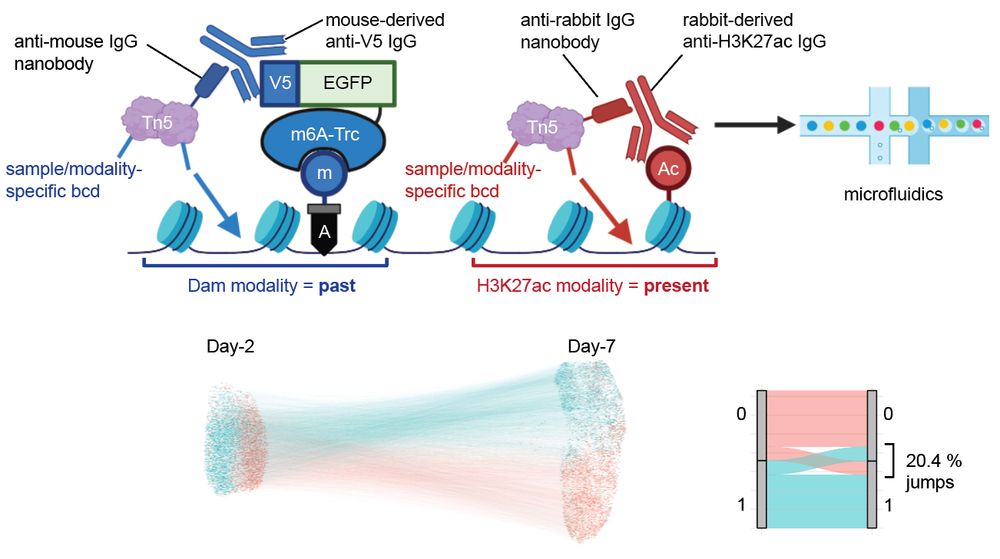
Using scHisTrac-seq to profile transcriptome, chromatin accessibility, and bivalency during neurodifferentiation, we analyzed over 90,000 single cells and uncovered drastic cell identity transitions—namely “identity jumps.
Using scHisTrac-seq to profile transcriptome, chromatin accessibility, and bivalency during neurodifferentiation, we analyzed over 90,000 single cells and uncovered drastic cell identity transitions—namely “identity jumps.

August 16, 2025 at 7:15 AM
Time for biology:
Using scHisTrac-seq to profile transcriptome, chromatin accessibility, and bivalency during neurodifferentiation, we analyzed over 90,000 single cells and uncovered drastic cell identity transitions—namely “identity jumps.
Using scHisTrac-seq to profile transcriptome, chromatin accessibility, and bivalency during neurodifferentiation, we analyzed over 90,000 single cells and uncovered drastic cell identity transitions—namely “identity jumps.
So far, so good—perhaps too good.
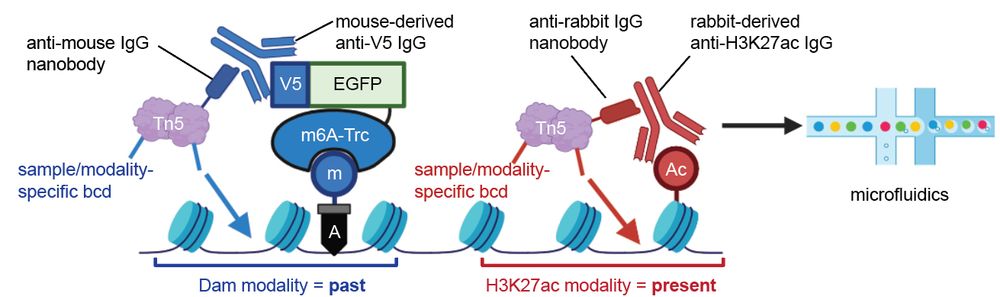
For the final form, we developed scHisTrac-seq, enabling simultaneous profiling of past and present multiomic states from the same single cells via a nanobody-mediated dual scCUT&Tag protocol (past = m6A, present = H3K27ac, transcription marker).
For the final form, we developed scHisTrac-seq, enabling simultaneous profiling of past and present multiomic states from the same single cells via a nanobody-mediated dual scCUT&Tag protocol (past = m6A, present = H3K27ac, transcription marker).
August 16, 2025 at 7:15 AM
So far, so good—perhaps too good.
For the final form, we developed scHisTrac-seq, enabling simultaneous profiling of past and present multiomic states from the same single cells via a nanobody-mediated dual scCUT&Tag protocol (past = m6A, present = H3K27ac, transcription marker).
For the final form, we developed scHisTrac-seq, enabling simultaneous profiling of past and present multiomic states from the same single cells via a nanobody-mediated dual scCUT&Tag protocol (past = m6A, present = H3K27ac, transcription marker).
To fully leverage history tracing, we developed a single-cell m6A detection method on the 10x Genomics platform. By targeting Tn5 transposase via the m6A-tracer, we captured in vivo sc profiles with 5–10K unique reads—among the highest quality achieved for 10x-based assays.

August 16, 2025 at 7:15 AM
To fully leverage history tracing, we developed a single-cell m6A detection method on the 10x Genomics platform. By targeting Tn5 transposase via the m6A-tracer, we captured in vivo sc profiles with 5–10K unique reads—among the highest quality achieved for 10x-based assays.
We next validated HisTrac-seq in vivo, pulse-labeling the neonatal brain and harvesting in adulthood (8 weeks).
This captured neonatal epigenome and transcriptome in the adult brain, demonstrating that HisTrac-seq remains effective for at least two months in vivo!
This captured neonatal epigenome and transcriptome in the adult brain, demonstrating that HisTrac-seq remains effective for at least two months in vivo!

August 16, 2025 at 7:15 AM
We next validated HisTrac-seq in vivo, pulse-labeling the neonatal brain and harvesting in adulthood (8 weeks).
This captured neonatal epigenome and transcriptome in the adult brain, demonstrating that HisTrac-seq remains effective for at least two months in vivo!
This captured neonatal epigenome and transcriptome in the adult brain, demonstrating that HisTrac-seq remains effective for at least two months in vivo!
We first demonstrated bulk HisTrac-seq in vitro, showing that transient Dam–POI activation in immature neurons beautifully reproduced their profiles after maturation!
In addition, we extended the validation to the mesodermal cardiomyocyte lineage.
In addition, we extended the validation to the mesodermal cardiomyocyte lineage.

August 16, 2025 at 7:15 AM
We first demonstrated bulk HisTrac-seq in vitro, showing that transient Dam–POI activation in immature neurons beautifully reproduced their profiles after maturation!
In addition, we extended the validation to the mesodermal cardiomyocyte lineage.
In addition, we extended the validation to the mesodermal cardiomyocyte lineage.
By transiently activating Dam fused to POIs (proteins of interest), HisTrac-seq can record whole-genome multiomic profiles, including transcriptome, open chromatin, LAD-heterochromatin, Trithorax, Polycomb, and even bivalency.

August 16, 2025 at 7:15 AM
By transiently activating Dam fused to POIs (proteins of interest), HisTrac-seq can record whole-genome multiomic profiles, including transcriptome, open chromatin, LAD-heterochromatin, Trithorax, Polycomb, and even bivalency.
We used Dam (DNA adenine methyltransferase) to label DNA with m6A, a mark absent from our genome.
Because previously shown that m6A can persist for several hours until the next DNA replication, we expected it to serve as a long-term ”bookmark” in neurons, potentially for months.
Because previously shown that m6A can persist for several hours until the next DNA replication, we expected it to serve as a long-term ”bookmark” in neurons, potentially for months.

August 16, 2025 at 7:15 AM
We used Dam (DNA adenine methyltransferase) to label DNA with m6A, a mark absent from our genome.
Because previously shown that m6A can persist for several hours until the next DNA replication, we expected it to serve as a long-term ”bookmark” in neurons, potentially for months.
Because previously shown that m6A can persist for several hours until the next DNA replication, we expected it to serve as a long-term ”bookmark” in neurons, potentially for months.
While single-cell sequencing such as scRNA-seq are powerful, they inherently capture only static snapshots, and trajectory inference can only approximate dynamic processes. This has created a long-standing need for sc observations across multiple time points—history tracing.

August 16, 2025 at 7:15 AM
While single-cell sequencing such as scRNA-seq are powerful, they inherently capture only static snapshots, and trajectory inference can only approximate dynamic processes. This has created a long-standing need for sc observations across multiple time points—history tracing.
This approach revealed previously unseen, drastic cell identity transitions, namely “identity jumps” in the Waddington landscape, during neurodifferentiation.
Following threads will elaborate on HisTrac-seq and and our findings.
Following threads will elaborate on HisTrac-seq and and our findings.

August 16, 2025 at 7:15 AM
This approach revealed previously unseen, drastic cell identity transitions, namely “identity jumps” in the Waddington landscape, during neurodifferentiation.
Following threads will elaborate on HisTrac-seq and and our findings.
Following threads will elaborate on HisTrac-seq and and our findings.
Please RP.
We are thrilled to announce that our lab’s first preprint is out!
”Whole-genome single-cell multimodal history tracing to reveal cell identity transition”
We report HisTrac-seq, a multiomic single-cell molecular recording platform.
www.biorxiv.org/content/10.1...
We are thrilled to announce that our lab’s first preprint is out!
”Whole-genome single-cell multimodal history tracing to reveal cell identity transition”
We report HisTrac-seq, a multiomic single-cell molecular recording platform.
www.biorxiv.org/content/10.1...
August 16, 2025 at 7:15 AM
Please RP.
We are thrilled to announce that our lab’s first preprint is out!
”Whole-genome single-cell multimodal history tracing to reveal cell identity transition”
We report HisTrac-seq, a multiomic single-cell molecular recording platform.
www.biorxiv.org/content/10.1...
We are thrilled to announce that our lab’s first preprint is out!
”Whole-genome single-cell multimodal history tracing to reveal cell identity transition”
We report HisTrac-seq, a multiomic single-cell molecular recording platform.
www.biorxiv.org/content/10.1...
Thrilled to announce @dandrite.bsky.social Symposium: Gene Expression in Brain (20-21 August 2025)!
World-class plenaries Mike Greenberg, Elly Nedivi, Anne Schaefer, Alex Schier + more speakers.
Why don't you travel to Denmark this summer? Travel grants prepared.
dandrite.au.dk/news/events/...
World-class plenaries Mike Greenberg, Elly Nedivi, Anne Schaefer, Alex Schier + more speakers.
Why don't you travel to Denmark this summer? Travel grants prepared.
dandrite.au.dk/news/events/...

April 15, 2025 at 12:12 PM
Thrilled to announce @dandrite.bsky.social Symposium: Gene Expression in Brain (20-21 August 2025)!
World-class plenaries Mike Greenberg, Elly Nedivi, Anne Schaefer, Alex Schier + more speakers.
Why don't you travel to Denmark this summer? Travel grants prepared.
dandrite.au.dk/news/events/...
World-class plenaries Mike Greenberg, Elly Nedivi, Anne Schaefer, Alex Schier + more speakers.
Why don't you travel to Denmark this summer? Travel grants prepared.
dandrite.au.dk/news/events/...