



@kaustubhmote.bsky.social
Reposted

The start of the upcoming Alpine Conference on Magnetic Resonance in Solids (in #Chamonix) is just a month away. Really looking forward to it - a nice variety of interesting science coming up, looking at the program and abstracts! ghttps://alpine-conference.org #ssNMR (and more) …
Alpine Conference on Magnetic Resonance in Solids
alpine-conference.org
August 13, 2025 at 7:29 PM
Reposted

Our latest publication in @jacs.acspublications.org is out: pubs.acs.org/doi/10.1021/...
We show clean ways to probe dynamics on microsecond time scales by relaxation-dispersion MAS #NMR. Microsecond motions are often essential for function e.g. in enzymes.
1/n
We show clean ways to probe dynamics on microsecond time scales by relaxation-dispersion MAS #NMR. Microsecond motions are often essential for function e.g. in enzymes.
1/n
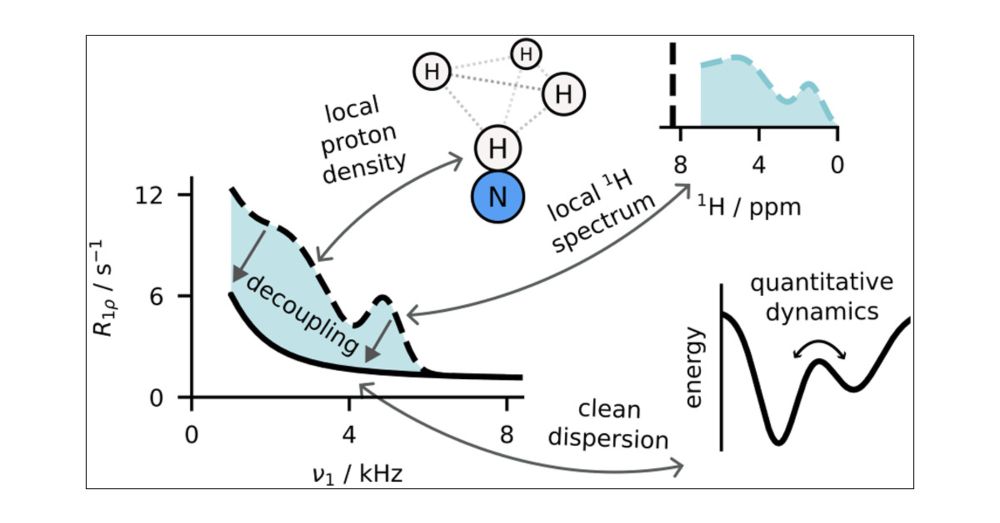
Bumps on the Road: The Way to Clean Relaxation Dispersion Magic-Angle Spinning NMR
Microsecond-to-millisecond motions are instrumental for many biomolecular functions, including enzymatic activity and ligand binding. Bloch-McConnell Relaxation Dispersion (BMRD) Nuclear Magnetic Resonance (NMR) spectroscopy is a key technique for studying these dynamic processes. While BMRD experiments are routinely used to probe protein motions in solution, the experiment is more demanding in the solid state, where dipolar couplings complicate the spin dynamics. It is believed that high deuteration levels are required and sufficient to obtain accurate and quantitative data. Here we show that even under fast magic-angle spinning and high levels of deuteration artifactual “bumps” in 15N R1ρ BMRD profiles are common. The origin of these artifacts is identified as a second-order three-spin Mixed Rotational and Rotary Resonance (MIRROR) recoupling condition. These artifacts are found to be a significant confounding factor for the accurate quantification of microsecond protein dynamics using BMRD in the solid state. We show that the application of low-power continuous wave (CW) decoupling simultaneously with the 15N spin-lock leads to the suppression of these conditions and enables quantitative measurements of microsecond exchange in the solid state. Remarkably, the application of decoupling allows the measurement of accurate BMRD even in fully protonated proteins at 100 kHz MAS, thus extending the scope of μs dynamics measurements in MAS NMR.
pubs.acs.org
August 6, 2025 at 10:54 AM
Our latest publication in @jacs.acspublications.org is out: pubs.acs.org/doi/10.1021/...
We show clean ways to probe dynamics on microsecond time scales by relaxation-dispersion MAS #NMR. Microsecond motions are often essential for function e.g. in enzymes.
1/n
We show clean ways to probe dynamics on microsecond time scales by relaxation-dispersion MAS #NMR. Microsecond motions are often essential for function e.g. in enzymes.
1/n
Reposted

Our book chapter on "Experimental Solid-State NMR of the Periodic Table" is out! This chapter could be a good starting point for anyone wanting to understand solid-state NMR techniques for materials characterization!
doi.org/10.1039/9781...
doi.org/10.1039/9781...
Experimental Solid-state NMR of the Periodic Table: Fundamentals and Advanced Methods
Nuclear magnetic resonance (NMR) spectroscopy is an integral structure determination technique for chemists, biologists and materials scientists. The deter
doi.org
April 1, 2025 at 2:34 PM
Our book chapter on "Experimental Solid-State NMR of the Periodic Table" is out! This chapter could be a good starting point for anyone wanting to understand solid-state NMR techniques for materials characterization!
doi.org/10.1039/9781...
doi.org/10.1039/9781...