




Kate Miroshnikova
@katemiro.bsky.social
Bioengineer interested in #mechanobiology of cell state regulation, cancer, genome integrity, #chromatin & nuclear mechanics
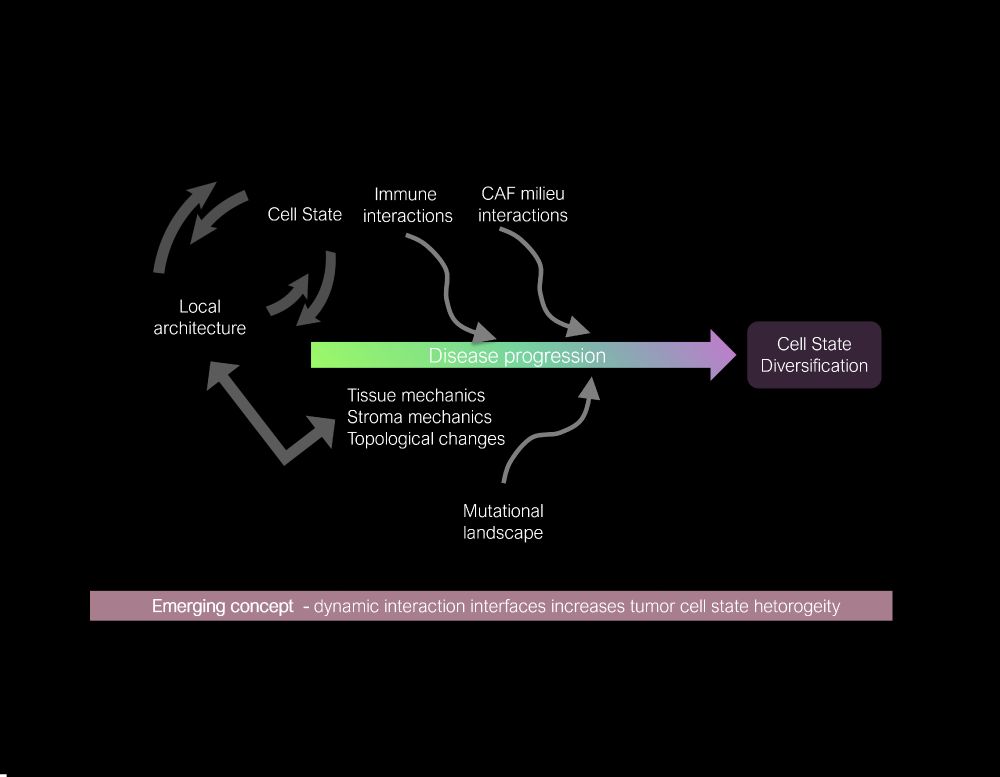
Collectively, our work supports a model where disruption of tissue architecture & stromal cues initiate a co-evolutionary feed forward loop that drives disease aggression & suggests that quantitative analysis of tumor heterogeneity with architecture as proxy may be the key to diagnostic precision
August 15, 2025 at 10:50 AM
Collectively, our work supports a model where disruption of tissue architecture & stromal cues initiate a co-evolutionary feed forward loop that drives disease aggression & suggests that quantitative analysis of tumor heterogeneity with architecture as proxy may be the key to diagnostic precision
Interestingly, while epithelial-to-mesenchymal transition states were also enriched in fragmented architectures, mechanical confinement was not sufficient to trigger #EMT. Combination of compression & soluble signals from the stroma drove further separation of regenerative stem cell and EMT states.

August 15, 2025 at 10:50 AM
Interestingly, while epithelial-to-mesenchymal transition states were also enriched in fragmented architectures, mechanical confinement was not sufficient to trigger #EMT. Combination of compression & soluble signals from the stroma drove further separation of regenerative stem cell and EMT states.
To figure out causation we turned to patient derived #organoids. Together with our #bioengineering colleagues in the Lutolf lab we generated topographies that mimic poor prognosis architectures. Indeed, regenerative stem cell states emerged in response to mechanical constraints and compression

August 15, 2025 at 10:50 AM
To figure out causation we turned to patient derived #organoids. Together with our #bioengineering colleagues in the Lutolf lab we generated topographies that mimic poor prognosis architectures. Indeed, regenerative stem cell states emerged in response to mechanical constraints and compression
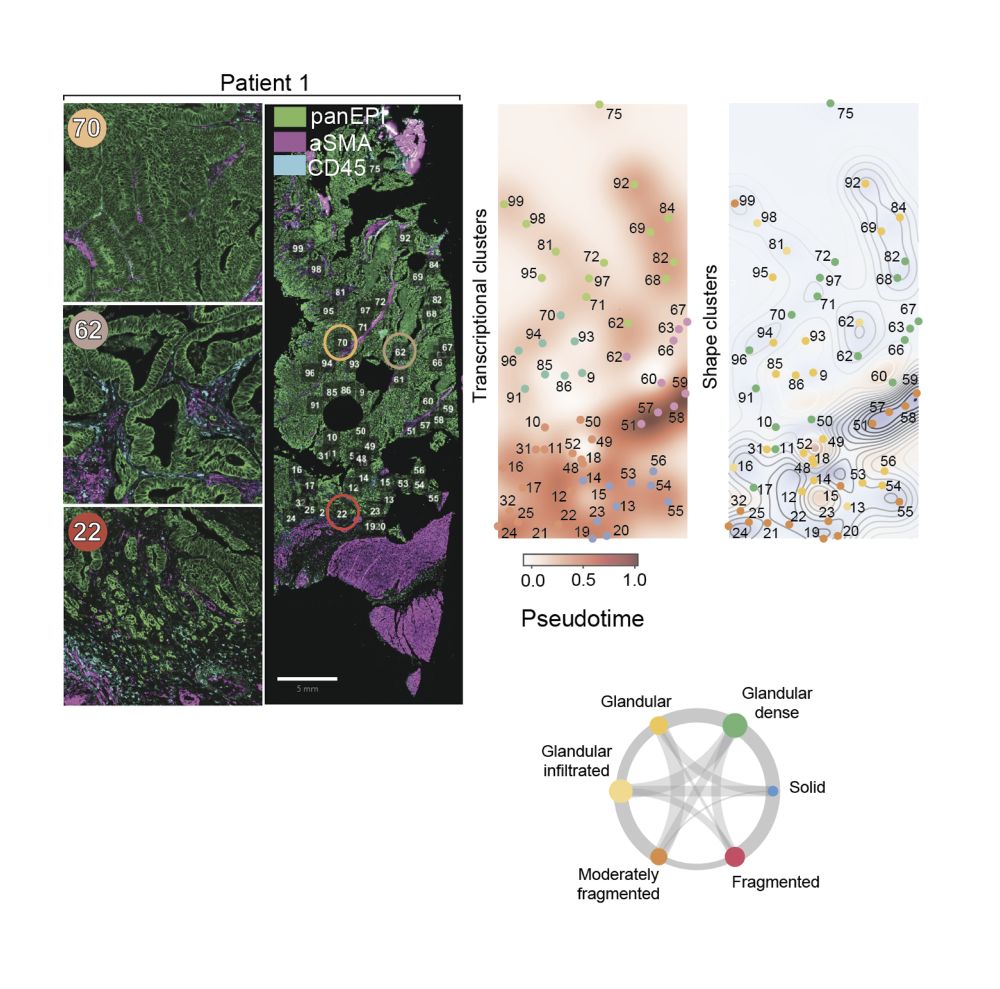
Analyzing single patient biopsies with heterogeneous architectures showed that cell states and architectures co-evolve, and we can predict likely tissue shape transitions based on the transcriptional signatures! So now the chicken & egg question: which comes first – abnormal shapes or cell states?
August 15, 2025 at 10:50 AM
Analyzing single patient biopsies with heterogeneous architectures showed that cell states and architectures co-evolve, and we can predict likely tissue shape transitions based on the transcriptional signatures! So now the chicken & egg question: which comes first – abnormal shapes or cell states?
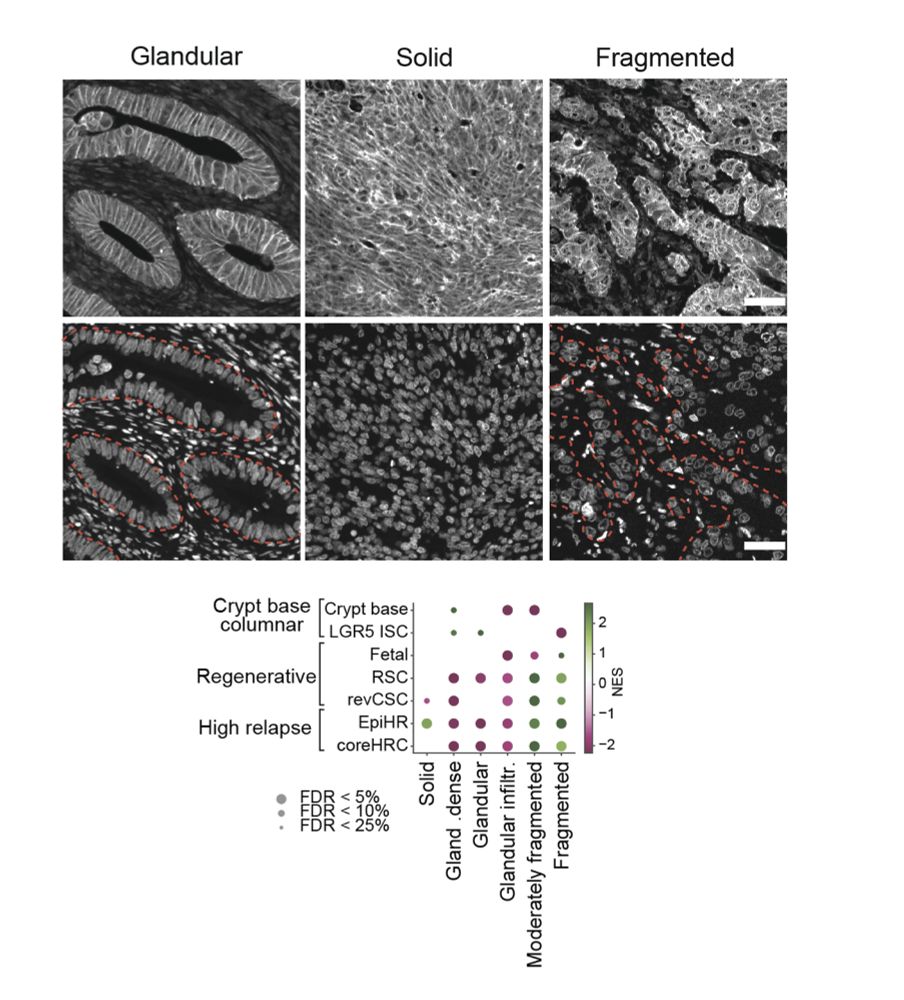
Intriguingly, nuclear shapes correspond with tissue architectures, both independently predicting patient survival. Overlaying this with #spatialtranscriptomics revealed that fragmented architectures associate with regenerative stem cell states that have been shown to drive metastasis.
August 15, 2025 at 10:50 AM
Intriguingly, nuclear shapes correspond with tissue architectures, both independently predicting patient survival. Overlaying this with #spatialtranscriptomics revealed that fragmented architectures associate with regenerative stem cell states that have been shown to drive metastasis.
Pathologists have used nuclear & tissue shapes to diagnose #cancer for decades, but what is the molecular basis for this? In our latest work, we develop a computational pipeline to figure this out in #colorectalcancer! Check out 🧵& preprint #mechanobiology #stemcells www.biorxiv.org/content/10.1...

August 15, 2025 at 10:50 AM
Pathologists have used nuclear & tissue shapes to diagnose #cancer for decades, but what is the molecular basis for this? In our latest work, we develop a computational pipeline to figure this out in #colorectalcancer! Check out 🧵& preprint #mechanobiology #stemcells www.biorxiv.org/content/10.1...
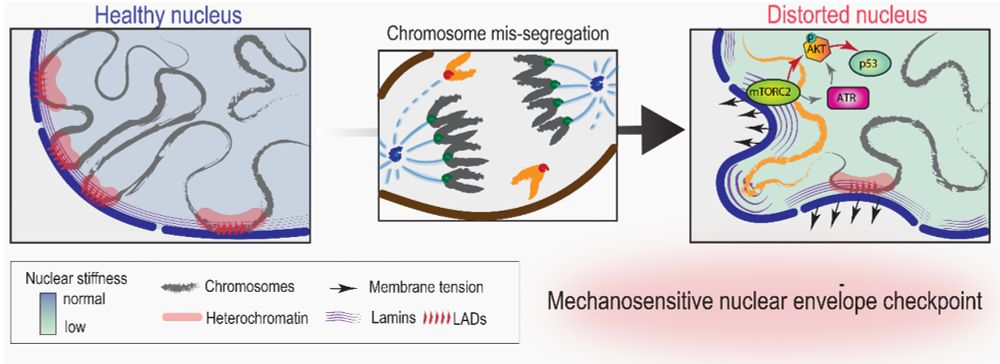
Finally, we addressed how nuclear envelope stress is sensed. Inhibitor screen revealed that AKT and ATR were required for p53/p21 activation. Importantly, this mechanosensitive #checkpoint is relevant in diseases associated with #genome instability and perturbed nuclear shape, such as #progeria.

January 8, 2025 at 12:14 PM
Finally, we addressed how nuclear envelope stress is sensed. Inhibitor screen revealed that AKT and ATR were required for p53/p21 activation. Importantly, this mechanosensitive #checkpoint is relevant in diseases associated with #genome instability and perturbed nuclear shape, such as #progeria.
Restoration of nuclear mechanophenotype indeed prevents p53/p21 activation and cell cycle arrest. Conversely, experimentally elevating nuclear envelope tension with mechano-osmotic forces is sufficient to trigger the pathway, directly linking nuclear envelope mechanics to p53 checkpoint.

January 8, 2025 at 12:14 PM
Restoration of nuclear mechanophenotype indeed prevents p53/p21 activation and cell cycle arrest. Conversely, experimentally elevating nuclear envelope tension with mechano-osmotic forces is sufficient to trigger the pathway, directly linking nuclear envelope mechanics to p53 checkpoint.
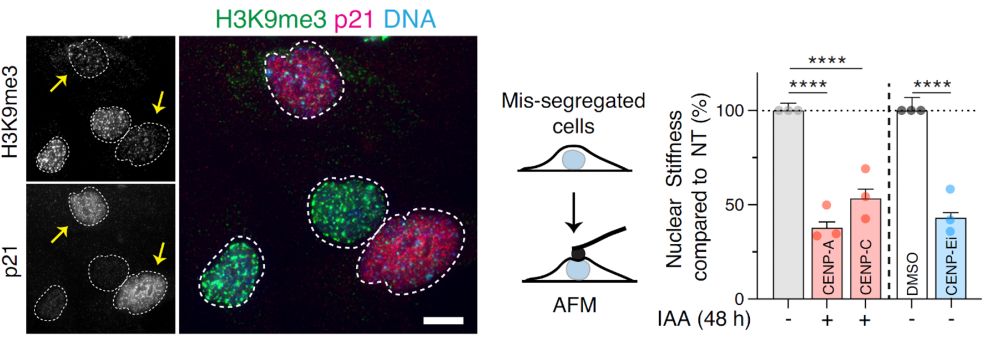
Nuclear shape abnormalities are caused by defective reestablishment of chromatin-nuclear lamina interactions upon mitotic exit. This leads to mechanically altered nuclei with decreased nuclear stiffness and increased nuclear envelope membrane tension. Does the cell care?
January 8, 2025 at 12:14 PM
Nuclear shape abnormalities are caused by defective reestablishment of chromatin-nuclear lamina interactions upon mitotic exit. This leads to mechanically altered nuclei with decreased nuclear stiffness and increased nuclear envelope membrane tension. Does the cell care?
P53 activation is a hallmark of genome instability, but what triggers it is unclear. Using a rapid degron-based system of chromosome mis-segregation we observe emergence of abnormal nuclear shape and mechanics, p53/p21 activation, and cell cycle arrest. Are these two processes are related and how?

January 8, 2025 at 12:14 PM
P53 activation is a hallmark of genome instability, but what triggers it is unclear. Using a rapid degron-based system of chromosome mis-segregation we observe emergence of abnormal nuclear shape and mechanics, p53/p21 activation, and cell cycle arrest. Are these two processes are related and how?
Excited to share the first paper from my lab 🤩 - a great collaboration with Dani Fachinetti lab - we discover a #mechanosensitive nuclear envelope #checkpoint that arrests cells directly post chromosome mis-segregation rdcu.be/d5AC9 👇🧵 #cancer #mechanics #p53 #chromatin
January 8, 2025 at 12:14 PM
Excited to share the first paper from my lab 🤩 - a great collaboration with Dani Fachinetti lab - we discover a #mechanosensitive nuclear envelope #checkpoint that arrests cells directly post chromosome mis-segregation rdcu.be/d5AC9 👇🧵 #cancer #mechanics #p53 #chromatin