



Congratulations @luke-sharp.bsky.social for receiving the best abstract prize for early career researcher in EASD 2025 for his work on MODY in population.

September 16, 2025 at 6:58 AM
Congratulations @luke-sharp.bsky.social for receiving the best abstract prize for early career researcher in EASD 2025 for his work on MODY in population.
Reposted by Kash Patel

Really cool work from @jacquesml.bsky.social and @kash-a-patel.bsky.social 🥳
24% common variant heritability for a rare disease (MODY)!
This very elegantly shows the overlap between MODY and T2D, and hints at some potential MODY phenocopies
24% common variant heritability for a rare disease (MODY)!
This very elegantly shows the overlap between MODY and T2D, and hints at some potential MODY phenocopies
Now out in @natmetabolism.nature.com! Excited to share our work showing how common genetic changes shape how diabetes presents in MODY (Maturity-Onset Diabetes of the Young). Our findings highlight the growing overlap between monogenic and polygenic forms of diabetes.
www.nature.com/articles/s42...
www.nature.com/articles/s42...

Common genetic variants modify disease risk and clinical presentation in monogenic diabetes - Nature Metabolism
In clinical and population-based cohorts, a strong contribution of polygenic risk for type 2 diabetes (T2D) significantly modifies the onset and phenotypic variability of maturity-onset diabetes of th...
www.nature.com
September 9, 2025 at 6:50 PM
Really cool work from @jacquesml.bsky.social and @kash-a-patel.bsky.social 🥳
24% common variant heritability for a rare disease (MODY)!
This very elegantly shows the overlap between MODY and T2D, and hints at some potential MODY phenocopies
24% common variant heritability for a rare disease (MODY)!
This very elegantly shows the overlap between MODY and T2D, and hints at some potential MODY phenocopies
Reposted by Kash Patel

Now out in @natmetabolism.nature.com! Excited to share our work showing how common genetic changes shape how diabetes presents in MODY (Maturity-Onset Diabetes of the Young). Our findings highlight the growing overlap between monogenic and polygenic forms of diabetes.
www.nature.com/articles/s42...
www.nature.com/articles/s42...
Common genetic variants modify disease risk and clinical presentation in monogenic diabetes - Nature Metabolism
In clinical and population-based cohorts, a strong contribution of polygenic risk for type 2 diabetes (T2D) significantly modifies the onset and phenotypic variability of maturity-onset diabetes of th...
www.nature.com
September 9, 2025 at 1:25 PM
Now out in @natmetabolism.nature.com! Excited to share our work showing how common genetic changes shape how diabetes presents in MODY (Maturity-Onset Diabetes of the Young). Our findings highlight the growing overlap between monogenic and polygenic forms of diabetes.
www.nature.com/articles/s42...
www.nature.com/articles/s42...
Reposted by Kash Patel

MODY is prevalent in later onset diabetes. Really proud to announce the release of a preprint of our paper assessing MODY in people diagnosed with diabetes later in life!!
#MonogenicDiabetes
#MonogenicDiabetes
MODY is prevalent in later-onset diabetes, has potential for targeted therapy but is challenging to identify https://www.medrxiv.org/content/10.1101/2025.06.17.25329143v1
June 19, 2025 at 12:05 PM
MODY is prevalent in later onset diabetes. Really proud to announce the release of a preprint of our paper assessing MODY in people diagnosed with diabetes later in life!!
#MonogenicDiabetes
#MonogenicDiabetes
Reposted by Kash Patel

Population prevalence, penetrance, and mortality for genetically confirmed MODY https://www.medrxiv.org/content/10.1101/2025.06.30.25330354v1
July 1, 2025 at 1:57 AM
Population prevalence, penetrance, and mortality for genetically confirmed MODY https://www.medrxiv.org/content/10.1101/2025.06.30.25330354v1
Reposted by Kash Patel

Really proud of this Exeter–Stanford collaboration identifying bi-allelic variants in PAX4 as a novel cause of transient neonatal diabetes—the first new genetic cause of this subtype described in over a decade. This work expands our understanding of beta cell development.
🔗 doi.org/10.1016/j.mo...
🔗 doi.org/10.1016/j.mo...
Complete Loss of PAX4 causes Transient Neonatal Diabetes in Humans
Gene discovery studies in individuals with diabetes diagnosed within 6 months of life (neonatal diabetes, NDM) can provide unique insights into the de…
www.sciencedirect.com
July 3, 2025 at 2:23 PM
Really proud of this Exeter–Stanford collaboration identifying bi-allelic variants in PAX4 as a novel cause of transient neonatal diabetes—the first new genetic cause of this subtype described in over a decade. This work expands our understanding of beta cell development.
🔗 doi.org/10.1016/j.mo...
🔗 doi.org/10.1016/j.mo...
Reposted by Kash Patel

New Research:
Non-autoimmune, insulin-deficient #diabetes in children and young adults in #Africa: evidence from the Young-Onset Diabetes in sub-Saharan Africa (YODA) cross-sectional study thelancet.com/journals/lan... #T1D
#OpenAccess
#MedSky #EndoSky
Non-autoimmune, insulin-deficient #diabetes in children and young adults in #Africa: evidence from the Young-Onset Diabetes in sub-Saharan Africa (YODA) cross-sectional study thelancet.com/journals/lan... #T1D
#OpenAccess
#MedSky #EndoSky

Non-autoimmune, insulin-deficient diabetes in children and young adults in Africa: evidence from the Young-Onset Diabetes in sub-Saharan Africa (YODA) cross-sectional study
In sub-Saharan Africa, clinically diagnosed type 1 diabetes is heterogeneous, comprising
classic autoimmune type 1 diabetes and a novel, non-autoimmune, insulin-deficient
diabetes subtype. There is ev...
thelancet.com
July 22, 2025 at 6:01 AM
New Research:
Non-autoimmune, insulin-deficient #diabetes in children and young adults in #Africa: evidence from the Young-Onset Diabetes in sub-Saharan Africa (YODA) cross-sectional study thelancet.com/journals/lan... #T1D
#OpenAccess
#MedSky #EndoSky
Non-autoimmune, insulin-deficient #diabetes in children and young adults in #Africa: evidence from the Young-Onset Diabetes in sub-Saharan Africa (YODA) cross-sectional study thelancet.com/journals/lan... #T1D
#OpenAccess
#MedSky #EndoSky
Reposted by Kash Patel

🚨Big news! Excited to share my first PhD paper!🎉
We validated & improved a T1D risk model using TrialNet data (originally from TEDDY), boosting accuracy 📈
bmcmedicine.biomedcentral.com/articles/10....
Try the web tool 👉 t1dpredictor.diabetesgenes.org
#T1D #RiskPrediction #PrecisionMedicine #TrialNet
We validated & improved a T1D risk model using TrialNet data (originally from TEDDY), boosting accuracy 📈
bmcmedicine.biomedcentral.com/articles/10....
Try the web tool 👉 t1dpredictor.diabetesgenes.org
#T1D #RiskPrediction #PrecisionMedicine #TrialNet
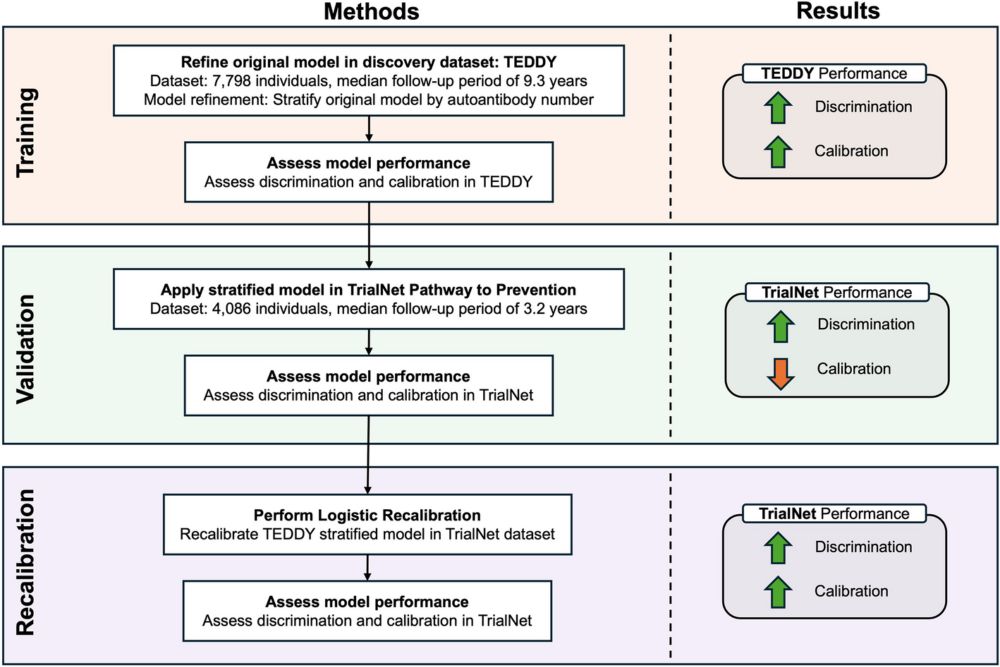
Development and recalibration of a multivariable type 1 diabetes prediction model for type 1 diabetes across multiple screening studies - BMC Medicine
Background Accurate type 1 diabetes prediction is important to facilitate screening for pre-clinical type 1 diabetes to enable potential early disease-modifying interventions and to reduce the risk of...
bmcmedicine.biomedcentral.com
July 23, 2025 at 1:50 PM
🚨Big news! Excited to share my first PhD paper!🎉
We validated & improved a T1D risk model using TrialNet data (originally from TEDDY), boosting accuracy 📈
bmcmedicine.biomedcentral.com/articles/10....
Try the web tool 👉 t1dpredictor.diabetesgenes.org
#T1D #RiskPrediction #PrecisionMedicine #TrialNet
We validated & improved a T1D risk model using TrialNet data (originally from TEDDY), boosting accuracy 📈
bmcmedicine.biomedcentral.com/articles/10....
Try the web tool 👉 t1dpredictor.diabetesgenes.org
#T1D #RiskPrediction #PrecisionMedicine #TrialNet
Reposted by Kash Patel
New preprint out now! We show polygenic background shapes GCK-MODY clinical presentation. In >1,000 cases, higher polygenic risk increased the chance of exceeding diagnostic diabetes thresholds, highlighting how monogenic & polygenic factors jointly shape disease. #Genetics
Polygenic Background Contributes to GCK-MODY Clinical Presentation and Glycaemic Variability https://www.medrxiv.org/content/10.1101/2025.08.04.25332935v1
August 11, 2025 at 4:57 PM
New preprint out now! We show polygenic background shapes GCK-MODY clinical presentation. In >1,000 cases, higher polygenic risk increased the chance of exceeding diagnostic diabetes thresholds, highlighting how monogenic & polygenic factors jointly shape disease. #Genetics
Reposted by Kash Patel

Our paper is now out on Diabetes!
diabetesjournals.org/diabetes/art...
diabetesjournals.org/diabetes/art...

Rare Variants in NEUROD1 and PDX1 Are Low-Penetrance Causes of MODY, Whereas Those in APPL1 and WFS1 Are Not Associated With MODY
An accurate genetic diagnosis of maturity-onset diabetes of the young (MODY) is critical for personalized treatment. To avoid misdiagnosis, only genes with
diabetesjournals.org
August 27, 2025 at 1:42 PM
Our paper is now out on Diabetes!
diabetesjournals.org/diabetes/art...
diabetesjournals.org/diabetes/art...