



Kamil Hupało
@kamilhupalo.bsky.social
Postdoctoral researcher @ University of Duisburg-Essen
| #eDNA #parasites #freshwater @impact-parasites.bsky.social
| Studying biodiversity & ecology with #DNA
| #eDNA #parasites #freshwater @impact-parasites.bsky.social
| Studying biodiversity & ecology with #DNA
It has been a collective effort with a great contributions by Isabel Blasco-Costa, Alejandro Trujillo González & @leeselab.bsky.social. It is also related to our activities within the IMPACT project! Make sure to follow @impact-parasites.bsky.social and check out all other fascinating chapters! 🤩
May 20, 2025 at 7:48 AM
It has been a collective effort with a great contributions by Isabel Blasco-Costa, Alejandro Trujillo González & @leeselab.bsky.social. It is also related to our activities within the IMPACT project! Make sure to follow @impact-parasites.bsky.social and check out all other fascinating chapters! 🤩
Finally, we provide a roadmap for implementation of eDNA-based parasite into routine biomonitoring. It requires a thorough validation through testing & optimisation, currently missing for the majority of parasites. The outcomes need to be discussed with relevant stakeholders & decision-makers...

May 20, 2025 at 7:48 AM
Finally, we provide a roadmap for implementation of eDNA-based parasite into routine biomonitoring. It requires a thorough validation through testing & optimisation, currently missing for the majority of parasites. The outcomes need to be discussed with relevant stakeholders & decision-makers...
With multiple ways of collecting eDNA, also including automated solutions, eDNA can be a promising source of information for studying aquatic parasites non-invasively i.e. without the need for sacrificing the hosts. In the long run, it can become a part of routine biomonitoring...

May 20, 2025 at 7:48 AM
With multiple ways of collecting eDNA, also including automated solutions, eDNA can be a promising source of information for studying aquatic parasites non-invasively i.e. without the need for sacrificing the hosts. In the long run, it can become a part of routine biomonitoring...
Nevertheless, parasites DNA traces are in the water and they derive from different sources including adult organisms, larval stages and parasite eggs. Detecting them depends on the methodological choices like choice of filters, amount of water filtered, primers used and DNA extraction method...

May 20, 2025 at 7:48 AM
Nevertheless, parasites DNA traces are in the water and they derive from different sources including adult organisms, larval stages and parasite eggs. Detecting them depends on the methodological choices like choice of filters, amount of water filtered, primers used and DNA extraction method...
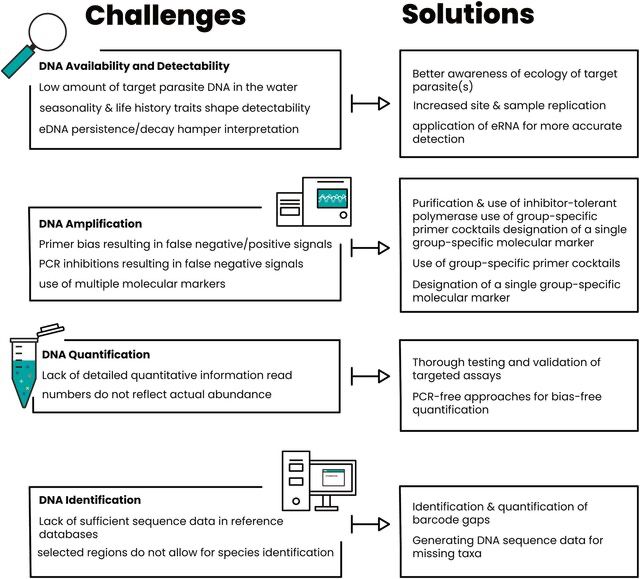
This is understandable in light of methodological challenges that using eDNA for studying aquatic parasites brings. Those primarily include the low amount of target parasite DNA in the water, lack of specific and general eDNA-oriented primers & lack of sufficient data in public DNA repositories...
May 20, 2025 at 7:48 AM
This is understandable in light of methodological challenges that using eDNA for studying aquatic parasites brings. Those primarily include the low amount of target parasite DNA in the water, lack of specific and general eDNA-oriented primers & lack of sufficient data in public DNA repositories...
In this chapter, we investigated the application of eDNA-based methods in aquatic parasitology. We found that even though the number of studies using eDNA in aquatic parasitology is recently rising, its overall number is lagging behind other more charismatic aquatic organisms...

May 20, 2025 at 7:48 AM
In this chapter, we investigated the application of eDNA-based methods in aquatic parasitology. We found that even though the number of studies using eDNA in aquatic parasitology is recently rising, its overall number is lagging behind other more charismatic aquatic organisms...
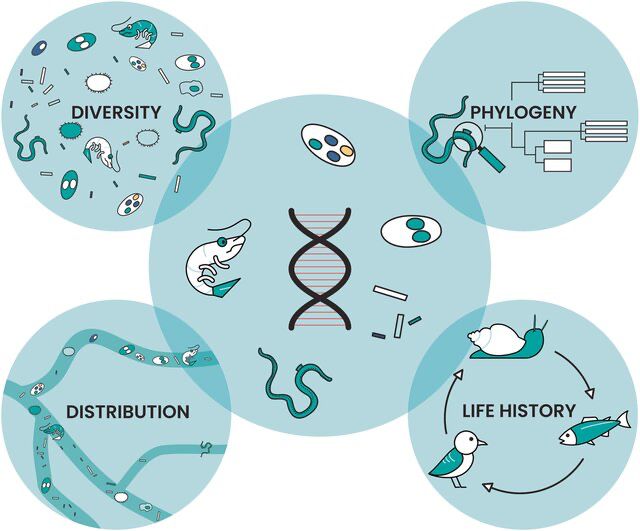
DNA-based methods have been applied in aquatic parasitology for quite some time now. An increasing number of parasitological studies apply molecular methods for studying parasite diversity and distribution as well as reconstructing their phylogenies and their life cycles...
May 20, 2025 at 7:48 AM
DNA-based methods have been applied in aquatic parasitology for quite some time now. An increasing number of parasitological studies apply molecular methods for studying parasite diversity and distribution as well as reconstructing their phylogenies and their life cycles...
Environmental DNA has been applied in aquatic ecosystems worldwide primarly for biodiversity assessments, monitoring the spread of invasive species or investigating pathogens in aquaculture, slowly but surely making its way into routine biomonitoring…

May 20, 2025 at 7:48 AM
Environmental DNA has been applied in aquatic ecosystems worldwide primarly for biodiversity assessments, monitoring the spread of invasive species or investigating pathogens in aquaculture, slowly but surely making its way into routine biomonitoring…
Can you also please add me too? 🤓
December 16, 2024 at 8:50 AM
Can you also please add me too? 🤓