




@kabalak.bsky.social
A proteomics adventurer on the multiple social media road(s). Interested in proteolysis research, likes human plasma
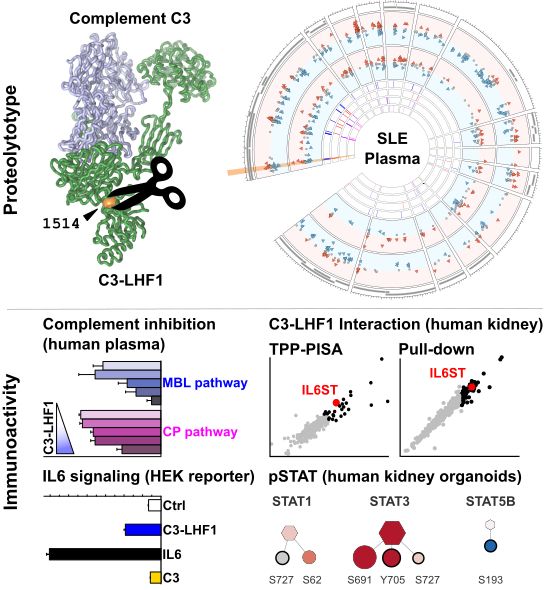
To summarize: we identified the C3-LHF1 cleavage in a large-scale N-terminomics screen of a cross-sectional cohort which is increasingly present in SLE patients, inhibiting the CP & MBL pathways of the complement system while at the same time being a trigger for a IL6 response. Thanks for reading.

October 30, 2025 at 9:11 PM
To summarize: we identified the C3-LHF1 cleavage in a large-scale N-terminomics screen of a cross-sectional cohort which is increasingly present in SLE patients, inhibiting the CP & MBL pathways of the complement system while at the same time being a trigger for a IL6 response. Thanks for reading.
For further testing this interaction, we performed C3-LHF1 application to HEK-Blue IL6 reporter cell lines. We could observe a triggered IL6 response, albeit lower than IL6 agonist levels. The C3-LHF1 IL6 response can't be blocked by tocilizumab. There is even a little competition for IL6 & C3-LHF1.

October 30, 2025 at 9:11 PM
For further testing this interaction, we performed C3-LHF1 application to HEK-Blue IL6 reporter cell lines. We could observe a triggered IL6 response, albeit lower than IL6 agonist levels. The C3-LHF1 IL6 response can't be blocked by tocilizumab. There is even a little competition for IL6 & C3-LHF1.
Next, we screened putative interacting proteins for our rec. C3-LHF1 in human kidneys by classical pull-down assays and Thermal Proteome Profiling, PISA style): One of the top candidates is the IL6ST (aka gp130), a very important (co-)receptor for IL6 signalling.

October 30, 2025 at 9:11 PM
Next, we screened putative interacting proteins for our rec. C3-LHF1 in human kidneys by classical pull-down assays and Thermal Proteome Profiling, PISA style): One of the top candidates is the IL6ST (aka gp130), a very important (co-)receptor for IL6 signalling.
We produced C3-LHF1 as a rec. protein & performed complement assays, revealing an inhibitory effect of C3-LHF1 on the classical and MBL pathway of the complement system. These assays were done with the SVAR Complement ELISA kits. Inhibiting complement can come in handy, but do we see other effects?

October 30, 2025 at 9:11 PM
We produced C3-LHF1 as a rec. protein & performed complement assays, revealing an inhibitory effect of C3-LHF1 on the classical and MBL pathway of the complement system. These assays were done with the SVAR Complement ELISA kits. Inhibiting complement can come in handy, but do we see other effects?
Combining all of this data into a fabulous circle plot clearly pointed towards an important role of the cleavage at pos. 1514, generating C3-LHF1. This became the focus of our future efforts. #LHF1 #CirclePlot

October 30, 2025 at 9:11 PM
Combining all of this data into a fabulous circle plot clearly pointed towards an important role of the cleavage at pos. 1514, generating C3-LHF1. This became the focus of our future efforts. #LHF1 #CirclePlot
Knowing this, we wanted to know, if these cleavages could be generated by four proteases of the complement system: MASP-1/-3, C1r/s. We generated substrate profiles for these proteases & identified common substrates as well as intriguingly present cleavages at the C-terminus of C3, alike C3-LHF1

October 30, 2025 at 9:03 PM
Knowing this, we wanted to know, if these cleavages could be generated by four proteases of the complement system: MASP-1/-3, C1r/s. We generated substrate profiles for these proteases & identified common substrates as well as intriguingly present cleavages at the C-terminus of C3, alike C3-LHF1
Generating mass spec data is trivial, but deriving conclusions is difficult, thus we applied the MOFA2 framework for analysis of our data. It yields significant correlations between some MOFA factors and clinical parameters and interestingly the presence of our C3-LHF1 cleavage in one of the factors

October 30, 2025 at 9:03 PM
Generating mass spec data is trivial, but deriving conclusions is difficult, thus we applied the MOFA2 framework for analysis of our data. It yields significant correlations between some MOFA factors and clinical parameters and interestingly the presence of our C3-LHF1 cleavage in one of the factors
Looking at proteolytis in human plasma, we observed a lot of cleavages in complement C3, with known cleavages for C3a, C3b, and C3(d)g - but also a cleavage at pos. 1514, which represented a quite intriguing lupus-enriched cleavage, thus we named it C3-LHF1 for complement "C3 Lupus Human Fragment 1"

October 30, 2025 at 9:03 PM
Looking at proteolytis in human plasma, we observed a lot of cleavages in complement C3, with known cleavages for C3a, C3b, and C3(d)g - but also a cleavage at pos. 1514, which represented a quite intriguing lupus-enriched cleavage, thus we named it C3-LHF1 for complement "C3 Lupus Human Fragment 1"
Starting with an unbiased screening in human plasma, we needed to optimize our already published HUNTER method (doi.org/10.1074/mcp....) for high-throughput and the demands of handling a larger cohort with > 100 patients, optimizing efficiency. Stream-lined "label-free-like" N-terminomics. #SHUNTER

October 30, 2025 at 11:09 AM
Starting with an unbiased screening in human plasma, we needed to optimize our already published HUNTER method (doi.org/10.1074/mcp....) for high-throughput and the demands of handling a larger cohort with > 100 patients, optimizing efficiency. Stream-lined "label-free-like" N-terminomics. #SHUNTER
After a looong journey, here the results of a deep investigation of human plasma proteolysis by MS: SLE N-terminomics paper with a complement C3 fragment at the core, EMBOJ: www.embopress.org/doi/full/10.... - highlights: a resource on proteolytically processed N-termini in human plasma #LHF1 #SLE🧪
October 30, 2025 at 10:52 AM
After a looong journey, here the results of a deep investigation of human plasma proteolysis by MS: SLE N-terminomics paper with a complement C3 fragment at the core, EMBOJ: www.embopress.org/doi/full/10.... - highlights: a resource on proteolytically processed N-termini in human plasma #LHF1 #SLE🧪
There is for sure a better way to make the prime Blue Sky message more useful, but having a Google Scholar word cloud with your own publications might be a good one. So, let's see how the blue things evolve here #proteomics Kidneys in Arabidopsis would be a thing, I guess

October 9, 2023 at 7:41 AM
There is for sure a better way to make the prime Blue Sky message more useful, but having a Google Scholar word cloud with your own publications might be a good one. So, let's see how the blue things evolve here #proteomics Kidneys in Arabidopsis would be a thing, I guess