



John Thorp
@johnthorp.bsky.social
psychology phd candidate at columbia studying how catecholamines guide memory updating
in sum, we generalize the RME to both schematic and episodic relations, also showing that individual differences mediate that inference process when the paradigm allows them to. if you're still with me, i really appreciate being a part of me procrastinating both grading and packing up my apartment
December 9, 2025 at 6:42 PM
in sum, we generalize the RME to both schematic and episodic relations, also showing that individual differences mediate that inference process when the paradigm allows them to. if you're still with me, i really appreciate being a part of me procrastinating both grading and packing up my apartment
Cue soap box about fear generalization being adaptive, with even our dirty harrys detaching their memories from the particularities that might stop them from properly pattern-completing when a similar cue rides into town.
December 9, 2025 at 6:42 PM
Cue soap box about fear generalization being adaptive, with even our dirty harrys detaching their memories from the particularities that might stop them from properly pattern-completing when a similar cue rides into town.
that's not the case for the high confidence recognition, but interestingly we do see that our non-generalizers have worse location memory for the items within the shocked scene, relative to the unshocked scene (bottom right).

December 9, 2025 at 6:42 PM
that's not the case for the high confidence recognition, but interestingly we do see that our non-generalizers have worse location memory for the items within the shocked scene, relative to the unshocked scene (bottom right).
but what about differences between the two scenes? remember we didn't see any differences between the shocked and unshocked scene in the main effects – maybe our cool hand lukes who best know the difference between them actually treat them differently?
December 9, 2025 at 6:42 PM
but what about differences between the two scenes? remember we didn't see any differences between the shocked and unshocked scene in the main effects – maybe our cool hand lukes who best know the difference between them actually treat them differently?
First, on the top, we show that our nervous nellies who become afraid of beaches generally recreate our effect from experiment 1, down to mostly decreasing false alarms to congruent foils. bass drop.
December 9, 2025 at 6:42 PM
First, on the top, we show that our nervous nellies who become afraid of beaches generally recreate our effect from experiment 1, down to mostly decreasing false alarms to congruent foils. bass drop.
ok so if something about the consent procedure where I walk you through that I'm going to shock you and it's not supposed to be painful but i'm going to make sure it's not fun – if that makes you nervous – you don't learn what causes that shock as well as you could. but does it affect memory?
December 9, 2025 at 6:42 PM
ok so if something about the consent procedure where I walk you through that I'm going to shock you and it's not supposed to be painful but i'm going to make sure it's not fun – if that makes you nervous – you don't learn what causes that shock as well as you could. but does it affect memory?
I then make a basic generalization measure based on the shock expectancy ratings (top). this generalization was related to the skin conductance response to the unshocked scene (bottom left, sick) as well as the state anxiety they reported at the beginning of the experiment (bottom middle, whoa)

December 9, 2025 at 6:42 PM
I then make a basic generalization measure based on the shock expectancy ratings (top). this generalization was related to the skin conductance response to the unshocked scene (bottom left, sick) as well as the state anxiety they reported at the beginning of the experiment (bottom middle, whoa)
what if i told you that participants ran the full gamut of attributing the shock fully to the shocked beach, attributing the shock fully to every beach, with some lying somewhere in the middle. we get this from the shock expectancy ratings of subjects 1, 2, and 3 (respectively) in the top figure
December 9, 2025 at 6:42 PM
what if i told you that participants ran the full gamut of attributing the shock fully to the shocked beach, attributing the shock fully to every beach, with some lying somewhere in the middle. we get this from the shock expectancy ratings of subjects 1, 2, and 3 (respectively) in the top figure
i admit, in a typical fear conditioning experiment where everyone has the same experience and reaches the same conclusion, this is where I leave you. but because this is a "weaker situation" i want to show you some individual differences in the inference process www.sciencedirect.com/science/arti...

What's wrong with fear conditioning?
Fear conditioning is one of the prime paradigms of behavioural neuroscience and a source of tremendous insight in the fundamentals of learning and mem…
www.sciencedirect.com
December 9, 2025 at 6:42 PM
i admit, in a typical fear conditioning experiment where everyone has the same experience and reaches the same conclusion, this is where I leave you. but because this is a "weaker situation" i want to show you some individual differences in the inference process www.sciencedirect.com/science/arti...
"ok, so you made all beaches scary and it messed with the general schema, and then you made a recent, specific beach scary and it reactivated all recent, specific associates. can i go now"
December 9, 2025 at 6:42 PM
"ok, so you made all beaches scary and it messed with the general schema, and then you made a recent, specific beach scary and it reactivated all recent, specific associates. can i go now"
but while confident recognition increased, we got a nice dissociation where participants had worse specific location memory for incongruent objects. if it walks like systems-level consolidation, and it talks like systems-level consolidation..

December 9, 2025 at 6:42 PM
but while confident recognition increased, we got a nice dissociation where participants had worse specific location memory for incongruent objects. if it walks like systems-level consolidation, and it talks like systems-level consolidation..
now on the memory test, we see a new pattern of results where high-confidence recognition is increased for both incongruent and congruent items. this effect is constant for the shocked and unshocked scene (which is unsurprising considering how bad participants were at the source memory)
December 9, 2025 at 6:42 PM
now on the memory test, we see a new pattern of results where high-confidence recognition is increased for both incongruent and congruent items. this effect is constant for the shocked and unshocked scene (which is unsurprising considering how bad participants were at the source memory)
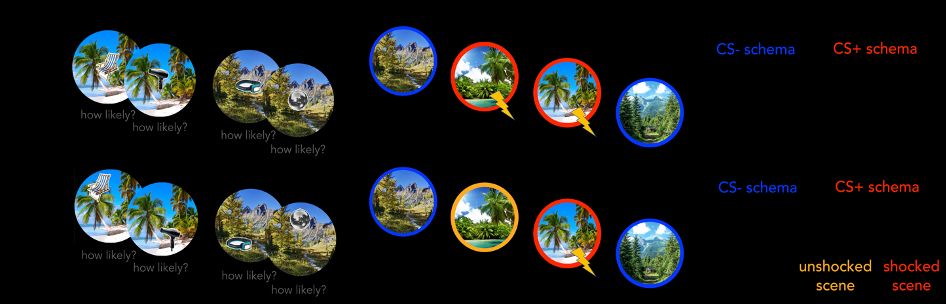
To get closer to the latter, we split our beach schema into a CS+ (shocked) scene and CS- (unshocked) scene. Ostensibly, one should be learning that "myrtle beach" (shocked) sucks and "wrightsville beach" (unshocked) rules (or is at least better than myrtle)
December 9, 2025 at 6:42 PM
To get closer to the latter, we split our beach schema into a CS+ (shocked) scene and CS- (unshocked) scene. Ostensibly, one should be learning that "myrtle beach" (shocked) sucks and "wrightsville beach" (unshocked) rules (or is at least better than myrtle)
Put colloquially, do you get home sunburned and dehydrated and infer "going to the beach" sucks, or do you get home with horsefly bites and an upset stomach from some bad seafood and infer that "myrtle beach" sucks (no hate). which things would you remember to stay away from, in each case?
December 9, 2025 at 6:42 PM
Put colloquially, do you get home sunburned and dehydrated and infer "going to the beach" sucks, or do you get home with horsefly bites and an upset stomach from some bad seafood and infer that "myrtle beach" sucks (no hate). which things would you remember to stay away from, in each case?
time for our true favorite buzzword: latent inference. what if our conditioning procedure only taught our participants something about the general schema of the beach? And the focus on and restructuring of this schema deprioritized their recent episodic experiences at the beach?
December 9, 2025 at 6:42 PM
time for our true favorite buzzword: latent inference. what if our conditioning procedure only taught our participants something about the general schema of the beach? And the focus on and restructuring of this schema deprioritized their recent episodic experiences at the beach?
weird.. plenty of evidence tells us humans can reactivate and generalize information between one-shot paired associates.. and if this was really about reactivation and upregulated systems-level consolidation, then decreased false alarms wouldn't really be my first guess..
December 9, 2025 at 6:42 PM
weird.. plenty of evidence tells us humans can reactivate and generalize information between one-shot paired associates.. and if this was really about reactivation and upregulated systems-level consolidation, then decreased false alarms wouldn't really be my first guess..
to be specific, those congruent foils are objects that belong at the beach but that you didn't actually see on day 1 (so on day 2 I show you a beach pail and shovel and you correctly say you didn't see it)
December 9, 2025 at 6:42 PM
to be specific, those congruent foils are objects that belong at the beach but that you didn't actually see on day 1 (so on day 2 I show you a beach pail and shovel and you correctly say you didn't see it)
now, two interesting things: 1) no effect on the incongruent items, so, seemingly, the way we structured conditioning didn't touch those one-shot, episodic encounters. and 2) the effect in the congruent items was mostly driven by a reduction in false alarms to the congruent foils

December 9, 2025 at 6:42 PM
now, two interesting things: 1) no effect on the incongruent items, so, seemingly, the way we structured conditioning didn't touch those one-shot, episodic encounters. and 2) the effect in the congruent items was mostly driven by a reduction in false alarms to the congruent foils
24 hours later on a surprise memory test for the objects, we generalized the RME such that participants showed improved recognition for the congruent items from the schema that went on to be shocked. critically, as for all retroactive effects, the objects were neutral at the time of encoding.
December 9, 2025 at 6:42 PM
24 hours later on a surprise memory test for the objects, we generalized the RME such that participants showed improved recognition for the congruent items from the schema that went on to be shocked. critically, as for all retroactive effects, the objects were neutral at the time of encoding.
we set up the experiment as the cleanest combination of a typical RME and a schema congruent vs. incongruent study as we could. participants saw a scene of a beach come on screen, rated a bunch of objects as congruent or incongruent, and after 60 trials of this were conditioned to fear the beach.
December 9, 2025 at 6:42 PM
we set up the experiment as the cleanest combination of a typical RME and a schema congruent vs. incongruent study as we could. participants saw a scene of a beach come on screen, rated a bunch of objects as congruent or incongruent, and after 60 trials of this were conditioned to fear the beach.
is it a coincidence my first project in new york was called TGiF and consisted of collecting 120 pictures of objects you would see during a weekend beach or camping trip in north carolina? regardless, fight to make your cope into your work, kids.
December 9, 2025 at 6:42 PM
is it a coincidence my first project in new york was called TGiF and consisted of collecting 120 pictures of objects you would see during a weekend beach or camping trip in north carolina? regardless, fight to make your cope into your work, kids.
now, how the memory literature often operationalizes these schemas (e.g., objects found while going to the beach) overlaps with how "thematic categories" are discussed in the category and conditioning literature, spawning my name for the project: Thematic Generalization in Fear
December 9, 2025 at 6:42 PM
now, how the memory literature often operationalizes these schemas (e.g., objects found while going to the beach) overlaps with how "thematic categories" are discussed in the category and conditioning literature, spawning my name for the project: Thematic Generalization in Fear
the specific new connection I found was linking our known retroactive memory enhancement (below) to psychology's second-favorite buzzword: schemas www.sciencedirect.com/science/arti...

Tag and capture: how salient experiences target and rescue nearby events in memory
The long-term fate of a memory is not exclusively determined by the events occurring at the moment of encoding. Research at the cellular, circuit, and…
www.sciencedirect.com
December 9, 2025 at 6:42 PM
the specific new connection I found was linking our known retroactive memory enhancement (below) to psychology's second-favorite buzzword: schemas www.sciencedirect.com/science/arti...
(a web that, of course, can be particularly sidelined in fear conditioning when directly generalizing rodent behavioral paradigms with well-specified biological mechanisms to how humans think, learn, and feel)
December 9, 2025 at 6:42 PM
(a web that, of course, can be particularly sidelined in fear conditioning when directly generalizing rodent behavioral paradigms with well-specified biological mechanisms to how humans think, learn, and feel)
After staring at bar graphs until I was *literally* dreaming about them, I was particularly struck by this paper with the great Greg Murphy that pointed out just how expansive the web of knowledge that humans might leverage to avoid threats really is. pubmed.ncbi.nlm.nih.gov/25577706/

Categories, concepts, and conditioning: how humans generalize fear - PubMed
During the past century, Pavlovian conditioning has served as the predominant experimental paradigm and theoretical framework to understand how humans learn to fear and avoid real or perceived dangers. Animal models for translational research offer insight into basic behavioral and neurophysiologica …
pubmed.ncbi.nlm.nih.gov
December 9, 2025 at 6:42 PM
After staring at bar graphs until I was *literally* dreaming about them, I was particularly struck by this paper with the great Greg Murphy that pointed out just how expansive the web of knowledge that humans might leverage to avoid threats really is. pubmed.ncbi.nlm.nih.gov/25577706/