



John Thorp
@johnthorp.bsky.social
psychology phd candidate at columbia studying how catecholamines guide memory updating
that's not the case for the high confidence recognition, but interestingly we do see that our non-generalizers have worse location memory for the items within the shocked scene, relative to the unshocked scene (bottom right).

December 9, 2025 at 6:42 PM
that's not the case for the high confidence recognition, but interestingly we do see that our non-generalizers have worse location memory for the items within the shocked scene, relative to the unshocked scene (bottom right).
First, on the top, we show that our nervous nellies who become afraid of beaches generally recreate our effect from experiment 1, down to mostly decreasing false alarms to congruent foils. bass drop.
December 9, 2025 at 6:42 PM
First, on the top, we show that our nervous nellies who become afraid of beaches generally recreate our effect from experiment 1, down to mostly decreasing false alarms to congruent foils. bass drop.
I then make a basic generalization measure based on the shock expectancy ratings (top). this generalization was related to the skin conductance response to the unshocked scene (bottom left, sick) as well as the state anxiety they reported at the beginning of the experiment (bottom middle, whoa)

December 9, 2025 at 6:42 PM
I then make a basic generalization measure based on the shock expectancy ratings (top). this generalization was related to the skin conductance response to the unshocked scene (bottom left, sick) as well as the state anxiety they reported at the beginning of the experiment (bottom middle, whoa)
what if i told you that participants ran the full gamut of attributing the shock fully to the shocked beach, attributing the shock fully to every beach, with some lying somewhere in the middle. we get this from the shock expectancy ratings of subjects 1, 2, and 3 (respectively) in the top figure
December 9, 2025 at 6:42 PM
what if i told you that participants ran the full gamut of attributing the shock fully to the shocked beach, attributing the shock fully to every beach, with some lying somewhere in the middle. we get this from the shock expectancy ratings of subjects 1, 2, and 3 (respectively) in the top figure
but while confident recognition increased, we got a nice dissociation where participants had worse specific location memory for incongruent objects. if it walks like systems-level consolidation, and it talks like systems-level consolidation..

December 9, 2025 at 6:42 PM
but while confident recognition increased, we got a nice dissociation where participants had worse specific location memory for incongruent objects. if it walks like systems-level consolidation, and it talks like systems-level consolidation..
now on the memory test, we see a new pattern of results where high-confidence recognition is increased for both incongruent and congruent items. this effect is constant for the shocked and unshocked scene (which is unsurprising considering how bad participants were at the source memory)
December 9, 2025 at 6:42 PM
now on the memory test, we see a new pattern of results where high-confidence recognition is increased for both incongruent and congruent items. this effect is constant for the shocked and unshocked scene (which is unsurprising considering how bad participants were at the source memory)
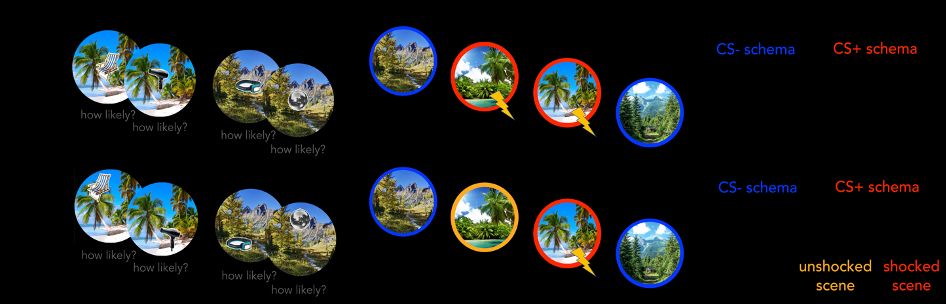
To get closer to the latter, we split our beach schema into a CS+ (shocked) scene and CS- (unshocked) scene. Ostensibly, one should be learning that "myrtle beach" (shocked) sucks and "wrightsville beach" (unshocked) rules (or is at least better than myrtle)
December 9, 2025 at 6:42 PM
To get closer to the latter, we split our beach schema into a CS+ (shocked) scene and CS- (unshocked) scene. Ostensibly, one should be learning that "myrtle beach" (shocked) sucks and "wrightsville beach" (unshocked) rules (or is at least better than myrtle)
now, two interesting things: 1) no effect on the incongruent items, so, seemingly, the way we structured conditioning didn't touch those one-shot, episodic encounters. and 2) the effect in the congruent items was mostly driven by a reduction in false alarms to the congruent foils

December 9, 2025 at 6:42 PM
now, two interesting things: 1) no effect on the incongruent items, so, seemingly, the way we structured conditioning didn't touch those one-shot, episodic encounters. and 2) the effect in the congruent items was mostly driven by a reduction in false alarms to the congruent foils
24 hours later on a surprise memory test for the objects, we generalized the RME such that participants showed improved recognition for the congruent items from the schema that went on to be shocked. critically, as for all retroactive effects, the objects were neutral at the time of encoding.
December 9, 2025 at 6:42 PM
24 hours later on a surprise memory test for the objects, we generalized the RME such that participants showed improved recognition for the congruent items from the schema that went on to be shocked. critically, as for all retroactive effects, the objects were neutral at the time of encoding.
we set up the experiment as the cleanest combination of a typical RME and a schema congruent vs. incongruent study as we could. participants saw a scene of a beach come on screen, rated a bunch of objects as congruent or incongruent, and after 60 trials of this were conditioned to fear the beach.
December 9, 2025 at 6:42 PM
we set up the experiment as the cleanest combination of a typical RME and a schema congruent vs. incongruent study as we could. participants saw a scene of a beach come on screen, rated a bunch of objects as congruent or incongruent, and after 60 trials of this were conditioned to fear the beach.