




Johan Ajnabi
@johanajnabi.bsky.social
PhD Scholar | Institute for Stem Cell Science and Regenerative Medicine
Prof. Colin Jamora's Laboratory | SNIoE
#CellBiology #Epigenetics #Mechanobiology #Skin #WoundHealing
Prof. Colin Jamora's Laboratory | SNIoE
#CellBiology #Epigenetics #Mechanobiology #Skin #WoundHealing
Pinned

Actin-dependent mechanotransduction controls nucleocytoplasmic partitioning of DNMT3a through ERK1/2 signaling during cutaneous wound healing https://www.biorxiv.org/content/10.64898/2026.01.15.699481v1
How do mechanical cues at wounds reprogram skin cells?
Our new study shows that actin remodeling regulates ERK1/2 signaling to allow DNMT3a nuclear entry, linking mechanotransduction to epigenetic control in early wound healing.
#Mechanobiology #Epigenetics #WoundHealing #bioRxiv
Our new study shows that actin remodeling regulates ERK1/2 signaling to allow DNMT3a nuclear entry, linking mechanotransduction to epigenetic control in early wound healing.
#Mechanobiology #Epigenetics #WoundHealing #bioRxiv
Reposted by Johan Ajnabi

Feed: "JCI Insight -- New Articles"
By: Sunny Kataria, Isha Rana, Krithika Badarinath, Rania F. Zaarour, Gaurav Kansagara, Sultan Ahmed, Abrar Rizvi, Dyuti Saha, Binita Dam, Abhik Dutta, Ravindra K. Zirmire, Edries Yousaf Hajam, Pankaj Kumar, Akash Gulyani, Colin Jamora
By: Sunny Kataria, Isha Rana, Krithika Badarinath, Rania F. Zaarour, Gaurav Kansagara, Sultan Ahmed, Abrar Rizvi, Dyuti Saha, Binita Dam, Abhik Dutta, Ravindra K. Zirmire, Edries Yousaf Hajam, Pankaj Kumar, Akash Gulyani, Colin Jamora
Mindin regulates fibroblast subpopulations through distinct Src family kinases during fibrogenesis
Fibrosis results from excessive extracellular matrix (ECM) deposition, which causes tissue stiffening and organ dysfunction. Activated fibroblasts, central to fibrosis, exhibit increased migration, proliferation, contraction, and ECM production. However, it remains unclear if the same fibroblast performs all of the processes that fall under the umbrella term of “activation.” Owing to fibroblast heterogeneity in connective tissues, subpopulations with specific functions may operate under distinct regulatory controls. Using a transgenic mouse model of skin fibrosis, we found that Mindin (also known as spondin-2), secreted by Snail-transgenic keratinocytes, differentially regulates fibroblast subpopulations. Mindin promotes migration and inflammatory gene expression in SCA1+ dermal fibroblasts via Fyn kinase. In contrast, it enhances contractility and collagen production in papillary CD26+ fibroblasts through c-Src signaling. Moreover, in the context of the fibrotic microenvironment of the tumor stroma, we found that differential responses of resident fibroblast subpopulations to Mindin extend to the generation of functionally heterogeneous cancer-associated fibroblasts. This study identifies Mindin as a key orchestrator of dermal fibroblast heterogeneity, reshaping cellular dynamics and signaling diversity in the complex landscapes of skin fibrosis and cancer.
insight.jci.org
February 22, 2025 at 5:34 PM
Feed: "JCI Insight -- New Articles"
By: Sunny Kataria, Isha Rana, Krithika Badarinath, Rania F. Zaarour, Gaurav Kansagara, Sultan Ahmed, Abrar Rizvi, Dyuti Saha, Binita Dam, Abhik Dutta, Ravindra K. Zirmire, Edries Yousaf Hajam, Pankaj Kumar, Akash Gulyani, Colin Jamora
By: Sunny Kataria, Isha Rana, Krithika Badarinath, Rania F. Zaarour, Gaurav Kansagara, Sultan Ahmed, Abrar Rizvi, Dyuti Saha, Binita Dam, Abhik Dutta, Ravindra K. Zirmire, Edries Yousaf Hajam, Pankaj Kumar, Akash Gulyani, Colin Jamora
Reposted by Johan Ajnabi

Behind-the-scenes: Dr. Dyuti Saha at the confocal microscope at the Core Imaging Facility in the Department of Life Sciences and Shiv Nadar University (an Institution of Eminence) capturing images of the vasculature in the fibrotic skin.

August 4, 2025 at 2:41 PM
Behind-the-scenes: Dr. Dyuti Saha at the confocal microscope at the Core Imaging Facility in the Department of Life Sciences and Shiv Nadar University (an Institution of Eminence) capturing images of the vasculature in the fibrotic skin.
Reposted by Johan Ajnabi
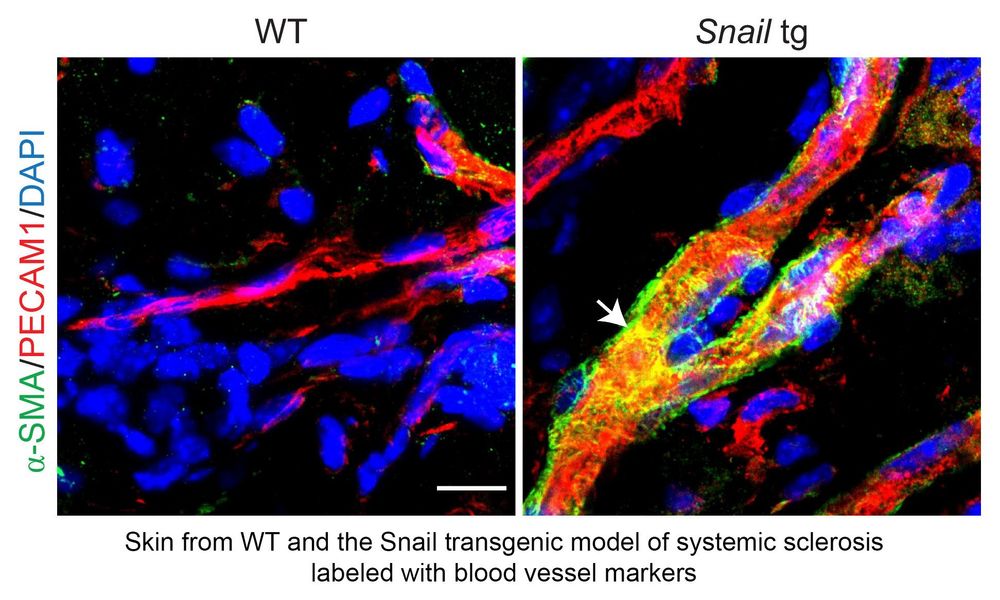
ICYMI: Vasculopathy occurs early in systemic sclerosis, but intervention strategies are lacking.
Colin Jamora & team reveal ANGPTL2 as an inducer of vasculopathy that drives cutaneous fibrogenesis in mice—mirroring SSc—and present a therapeutic approach: UAS03.
buff.ly/xNYvnRj
Colin Jamora & team reveal ANGPTL2 as an inducer of vasculopathy that drives cutaneous fibrogenesis in mice—mirroring SSc—and present a therapeutic approach: UAS03.
buff.ly/xNYvnRj
August 10, 2025 at 3:33 PM
ICYMI: Vasculopathy occurs early in systemic sclerosis, but intervention strategies are lacking.
Colin Jamora & team reveal ANGPTL2 as an inducer of vasculopathy that drives cutaneous fibrogenesis in mice—mirroring SSc—and present a therapeutic approach: UAS03.
buff.ly/xNYvnRj
Colin Jamora & team reveal ANGPTL2 as an inducer of vasculopathy that drives cutaneous fibrogenesis in mice—mirroring SSc—and present a therapeutic approach: UAS03.
buff.ly/xNYvnRj
Reposted by Johan Ajnabi
Vasculopathy occurs early in systemic sclerosis, but intervention strategies are lacking.
Colin Jamora & team reveal ANGPTL2 as an inducer of vasculopathy that drives cutaneous fibrogenesis in mice—mirroring SSc—and present a therapueutic approach: UAS03:
buff.ly/SpOiuCc
Colin Jamora & team reveal ANGPTL2 as an inducer of vasculopathy that drives cutaneous fibrogenesis in mice—mirroring SSc—and present a therapueutic approach: UAS03:
buff.ly/SpOiuCc

August 4, 2025 at 1:20 PM
Vasculopathy occurs early in systemic sclerosis, but intervention strategies are lacking.
Colin Jamora & team reveal ANGPTL2 as an inducer of vasculopathy that drives cutaneous fibrogenesis in mice—mirroring SSc—and present a therapueutic approach: UAS03:
buff.ly/SpOiuCc
Colin Jamora & team reveal ANGPTL2 as an inducer of vasculopathy that drives cutaneous fibrogenesis in mice—mirroring SSc—and present a therapueutic approach: UAS03:
buff.ly/SpOiuCc
Reposted by Johan Ajnabi

Actin-dependent mechanotransduction controls nucleocytoplasmic partitioning of DNMT3a through ERK1/2 signaling during cutaneous wound healing https://www.biorxiv.org/content/10.64898/2026.01.15.699481v1
January 16, 2026 at 1:30 AM
Actin-dependent mechanotransduction controls nucleocytoplasmic partitioning of DNMT3a through ERK1/2 signaling during cutaneous wound healing https://www.biorxiv.org/content/10.64898/2026.01.15.699481v1
How do mechanical cues at wounds reprogram skin cells?
Our new study shows that actin remodeling regulates ERK1/2 signaling to allow DNMT3a nuclear entry, linking mechanotransduction to epigenetic control in early wound healing.
#Mechanobiology #Epigenetics #WoundHealing #bioRxiv
Our new study shows that actin remodeling regulates ERK1/2 signaling to allow DNMT3a nuclear entry, linking mechanotransduction to epigenetic control in early wound healing.
#Mechanobiology #Epigenetics #WoundHealing #bioRxiv
Actin-dependent mechanotransduction controls nucleocytoplasmic partitioning of DNMT3a through ERK1/2 signaling during cutaneous wound healing https://www.biorxiv.org/content/10.64898/2026.01.15.699481v1
January 16, 2026 at 6:19 PM
How do mechanical cues at wounds reprogram skin cells?
Our new study shows that actin remodeling regulates ERK1/2 signaling to allow DNMT3a nuclear entry, linking mechanotransduction to epigenetic control in early wound healing.
#Mechanobiology #Epigenetics #WoundHealing #bioRxiv
Our new study shows that actin remodeling regulates ERK1/2 signaling to allow DNMT3a nuclear entry, linking mechanotransduction to epigenetic control in early wound healing.
#Mechanobiology #Epigenetics #WoundHealing #bioRxiv