


John Murph
@jknm.bsky.social
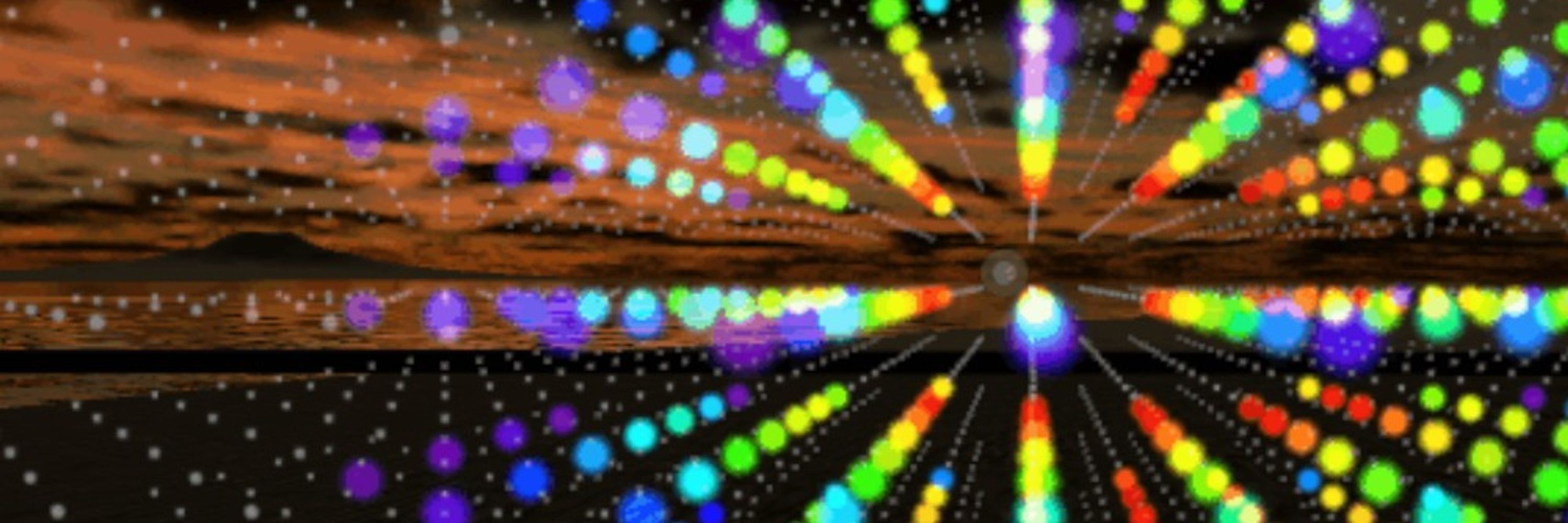
Aotearoa: Creating VR simulations based on William Duane's model of quantum scattering, and its later integration with quantum theory by Carolyne Van Vliet almost 90 years later.
A short clip shot in my VRChat world vrchat.com/home/world/w.... The simulation implements a quantum scattering model proposed by Carolyne Van Vliet in 2010, in which the matter in the slit screen momentarily interacts coherently to 'kick' particles as they pass through the apertures.
January 11, 2026 at 10:57 PM
A short clip shot in my VRChat world vrchat.com/home/world/w.... The simulation implements a quantum scattering model proposed by Carolyne Van Vliet in 2010, in which the matter in the slit screen momentarily interacts coherently to 'kick' particles as they pass through the apertures.
William Duane's 1923 quantum scattering model challenges the particle paradigm because it doesn't involve incident particles undergoing classical wave diffraction. Carolyne Van Vliet derived from contemporary quantum theory by treating the slit screen as undergoing a distributed, quantum interaction
December 30, 2025 at 10:23 AM
William Duane's 1923 quantum scattering model challenges the particle paradigm because it doesn't involve incident particles undergoing classical wave diffraction. Carolyne Van Vliet derived from contemporary quantum theory by treating the slit screen as undergoing a distributed, quantum interaction
A fantastic explanation of this experiment was obscured when Niels Bohr's dismissal of the photon played into the hands of those preoccupied with suppressing Einstein's brilliance.
October 29, 2025 at 2:27 PM
A fantastic explanation of this experiment was obscured when Niels Bohr's dismissal of the photon played into the hands of those preoccupied with suppressing Einstein's brilliance.
Van Vliet's work yields an accurate model of molecular diffraction by considering the scattering object as a distributed quantum entity interacting with a free particle. Note that in free space, QM probability distributions evolve in a way that is mathematically equivalent to ballistic diffusion.
October 28, 2025 at 11:49 PM
Van Vliet's work yields an accurate model of molecular diffraction by considering the scattering object as a distributed quantum entity interacting with a free particle. Note that in free space, QM probability distributions evolve in a way that is mathematically equivalent to ballistic diffusion.
A 3D particle scattering simulation in Somnium Space. somniumspace.com/world/4182 Although at odds with some quantum interpretations, the model was shown to align with modern quantum physics by Carolyne Van Vliet in 1967 (crystals & gratings) and 2010 (aperiodic gratings such as the double slit).
October 27, 2025 at 12:51 PM
A 3D particle scattering simulation in Somnium Space. somniumspace.com/world/4182 Although at odds with some quantum interpretations, the model was shown to align with modern quantum physics by Carolyne Van Vliet in 1967 (crystals & gratings) and 2010 (aperiodic gratings such as the double slit).
In 1967 Carolyne Van Vliet showed that Duane's model of quantum scattering of electrons/photons by periodic gratings and crystals could be derived from quantum theory by treating the array of scatterers as a quantum object. The clip shows a VR simulation of Duane's rule.
somniumspace.com/world/4182
somniumspace.com/world/4182
October 14, 2025 at 1:24 AM
In 1967 Carolyne Van Vliet showed that Duane's model of quantum scattering of electrons/photons by periodic gratings and crystals could be derived from quantum theory by treating the array of scatterers as a quantum object. The clip shows a VR simulation of Duane's rule.
somniumspace.com/world/4182
somniumspace.com/world/4182
Carolyne Van Vliet's insight cuts through Everett and Bohr's word salads. Her straightforward development of Duane's model of quantum scattering shows how treating the scattering object as a quantum system could make the narrow set of popular quantum interpretations redundant.

October 14, 2025 at 12:22 AM
Carolyne Van Vliet's insight cuts through Everett and Bohr's word salads. Her straightforward development of Duane's model of quantum scattering shows how treating the scattering object as a quantum system could make the narrow set of popular quantum interpretations redundant.
When we try to solve the 'measurement problem' with ad hoc measures like 'wavefunction collapse' or 'many worlds', we miss that the 'problem' may stemfrom assuming we can treat the scattering object as a statistical average of its internal quantum states and interactions.
October 14, 2025 at 12:01 AM
When we try to solve the 'measurement problem' with ad hoc measures like 'wavefunction collapse' or 'many worlds', we miss that the 'problem' may stemfrom assuming we can treat the scattering object as a statistical average of its internal quantum states and interactions.
My SomniumSpace world : somniumspace.com/world/4182 .
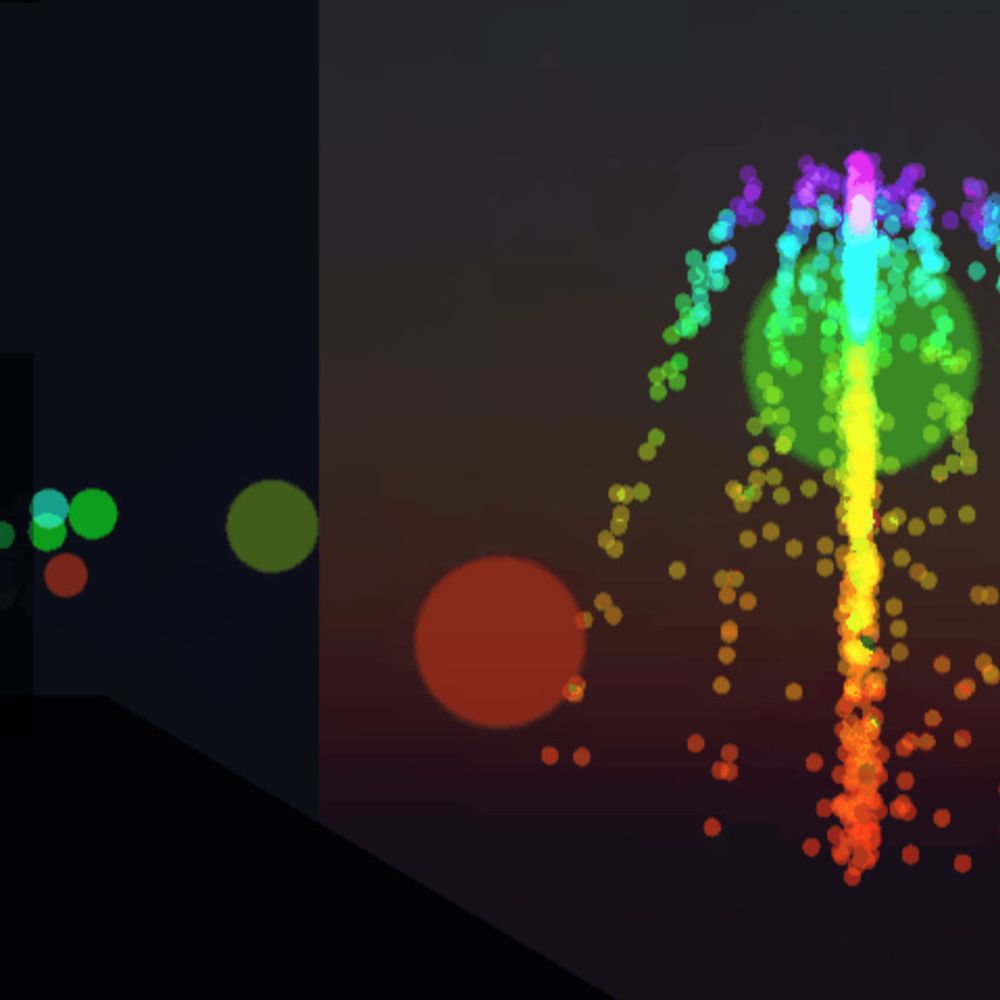
Shows a quantum particle simulation without a wave function, tracks classical wave interference. Able to run in VR by utilising a GPU to implement a quantum scattering derived from the 1923 work of William Duane by Carolyne Van Vliet in 2010.
Shows a quantum particle simulation without a wave function, tracks classical wave interference. Able to run in VR by utilising a GPU to implement a quantum scattering derived from the 1923 work of William Duane by Carolyne Van Vliet in 2010.
September 14, 2025 at 4:06 AM
My SomniumSpace world : somniumspace.com/world/4182 .
Shows a quantum particle simulation without a wave function, tracks classical wave interference. Able to run in VR by utilising a GPU to implement a quantum scattering derived from the 1923 work of William Duane by Carolyne Van Vliet in 2010.
Shows a quantum particle simulation without a wave function, tracks classical wave interference. Able to run in VR by utilising a GPU to implement a quantum scattering derived from the 1923 work of William Duane by Carolyne Van Vliet in 2010.
In the past weeks I've been building a new VR experience in Somnium Space, a powerful new platform for VR. The clip here shows an compute shader wave simulation running below two models of quantum scattering, the upper a probability map, the middle a particle simulation.
September 2, 2025 at 11:29 AM
In the past weeks I've been building a new VR experience in Somnium Space, a powerful new platform for VR. The clip here shows an compute shader wave simulation running below two models of quantum scattering, the upper a probability map, the middle a particle simulation.
A 1923 quantum scattering model by Ukrainian/American physicist Gregory Breit adapted William Duane's quantum model of crystal diffraction to the double slit. My VRChat world features GPU simulations of the wave model alongside Breit's particle model.
vrchat.com/home/world/w...
vrchat.com/home/world/w...
August 12, 2025 at 4:12 AM
A 1923 quantum scattering model by Ukrainian/American physicist Gregory Breit adapted William Duane's quantum model of crystal diffraction to the double slit. My VRChat world features GPU simulations of the wave model alongside Breit's particle model.
vrchat.com/home/world/w...
vrchat.com/home/world/w...
I've been fine-tuning my virtual reality simulations in VRChat and slowly working to put the assets into GitHub. It's remarkable that a 100-year-old model, ignored by theorists of the time, could produce such striking results.
vrchat.com/home/world/w...
vrchat.com/home/world/w...
January 25, 2025 at 2:10 PM
I've been fine-tuning my virtual reality simulations in VRChat and slowly working to put the assets into GitHub. It's remarkable that a 100-year-old model, ignored by theorists of the time, could produce such striking results.
vrchat.com/home/world/w...
vrchat.com/home/world/w...
#VRChat simulation showing how an early model of quantum scattering generates patterns that align with wave diffraction patterns even though the mechanisms are quite different. The clip shows a double-slit pattern, then a nine-slit pattern to show how both mechanisms produce a Talbot effect.
January 2, 2025 at 9:14 AM
#VRChat simulation showing how an early model of quantum scattering generates patterns that align with wave diffraction patterns even though the mechanisms are quite different. The clip shows a double-slit pattern, then a nine-slit pattern to show how both mechanisms produce a Talbot effect.
I've just published a new world in #VRChat to help illustrate a model of quantum scattering proposed in 1923 by William Duane. Dismissed in favor of wave-particle duality, it was later shown to be consistent with quantum theory by Carolyne Van Vliet in 1967 and 2010.
vrchat.com/home/launch?...
vrchat.com/home/launch?...
December 5, 2024 at 5:17 AM
I've just published a new world in #VRChat to help illustrate a model of quantum scattering proposed in 1923 by William Duane. Dismissed in favor of wave-particle duality, it was later shown to be consistent with quantum theory by Carolyne Van Vliet in 1967 and 2010.
vrchat.com/home/launch?...
vrchat.com/home/launch?...
I am quite proud of my user-interactable immersive wave interference simulations running in VR Chat.
#MadeWithVRChat vrchat.com/home/launch?...
#MadeWithVRChat vrchat.com/home/launch?...

January 27, 2024 at 3:29 PM
I am quite proud of my user-interactable immersive wave interference simulations running in VR Chat.
#MadeWithVRChat vrchat.com/home/launch?...
#MadeWithVRChat vrchat.com/home/launch?...