SK
banner
intemporaliter.bsky.social
SK
@intemporaliter.bsky.social
I read a lot. Sometimes I try to write. I crochet eldritch horrors. I've tried many crafts and art types and enthusiastically suck at most of them. Brit in the US. ¿Mature? Engineering student. Museum geek.
Pinned
🪐📚
Sharing a list of a few pieces of my microfiction - Enjoy!

Includes mermaids, dinosaurs, and a washing machine that really does eat your clothing:

medium.com/@intemporali...
List: My Stories | Curated by Intemporaliter | Medium
9 stories · My microfiction writing
medium.com
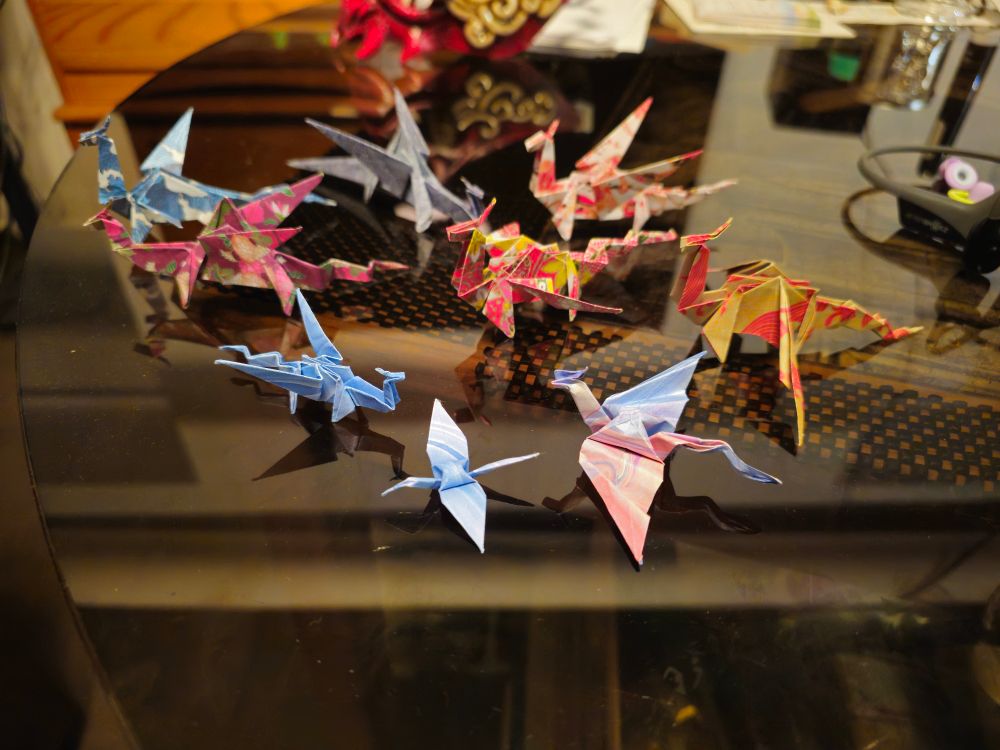
Trying to deal with the stress of a university assignment by making origami dragons is healthy, right?
December 10, 2025 at 3:40 AM
Reposted by SK
I love micro photography (and birds,so this is an article full of win)

www.newscientist.com/article/2506...
Incredible close-up of spider silk wins science photo prize
Duelling prairie chickens, a snake-mimicking moth and a once-a-year sunrise at the South Pole feature in the best images from the Royal Society Publishing Photography Competition 2025
www.newscientist.com
December 4, 2025 at 8:40 PM
Reposted by SK
"A great opportunity for children to have access to an outdoor space that maybe they don't have at home"

See our #ChristmasChallenge video for more on Wild Things, our family gardening club, & what impact it can have in urban London. Your support helps us keep this FREE in 2026. vist.ly/4h3ha
December 3, 2025 at 4:58 PM
Reposted by SK
A huge thank you to everyone who’s donated to our Big Give Christmas Challenge so far! 🎉

We still need your help to reach £7,500 and keep our family programme free in 2026.

If you haven’t donated yet, please consider supporting the campaign today:
vist.ly/4h8pf
December 4, 2025 at 5:30 PM
I honestly think the butterfly was harder to make, except for the bit where I lost one of the components of the other and was wondering why it didn't all fit together properly...
December 4, 2025 at 1:31 AM
Reposted by SK
It's day 2 of the #ChristmasChallenge! Excitingly, we've already passed our first £1000 milestone.

All donations will be DOUBLED this week, thanks to the Big Give's matchfunding model - and everything we raise will go towards keeping our families activities free in 2026!

vist.ly/4gzu4
December 3, 2025 at 10:00 AM
I found this explainer of american english idioms and had to share. There are a few that are new to me/ that I've only encountered in american media, but most cross the pond. (Not that "across the pond" is in the list - is that just a British-ism?)

languageaccess.courts.ca.gov/system/files...
languageaccess.courts.ca.gov
December 2, 2025 at 5:43 PM
I like the contrasts in this - to me it feels like the woods are on their way to attack the buildings, and they are going to win. Puts me in mind of the scottish play. I took it a couple of years ago at a light show (hence the strange reds and blues). The moon was full and the aesthetic appealed.
November 30, 2025 at 11:11 PM
Reposted by SK
How Ferrari's Formula One Pit Stop Team saved the lives of thousands of children
Ferrari's Formula One Handovers and Handovers from Furgery to Intensive Care [Great Ormond Street Hospital for Children]
The American Society for Quality www.asq.org Page 1 of 5 Making the Case for Quality Ferrari’s Formula One Handovers and Handovers From Surgery to Intensive Care Great Ormond Street • Hospital for Children (GOSH) benchmarked its handoff from cardiac surgery to the intensive care unit against pit stop techniques of the Ferrari Formula One race car team. Process improvements • resulted in increased patient safety and decreased error rates. This case study is • excerpted from chapter 10 of Benchmarking for Hospitals: Achieving Best- in-Class Performance Without Having to Reinvent the Wheel, by Victor E. Sower, Jo Ann Duffy, and Gerald Kohers. At a Glance . . . Seldom does a hospital receive front page coverage in the Wall Street Journal, especially in an article about Ferrari racing crews, and seldom are a hospital’s physicians invited to speak to boards of directors of multi- million dollar corporations. Great Ormond Street Hospital for Children (GOSH), London, England, did both. Why? Because they had successfully benchmarked their handoff from cardiac surgery to the intensive care unit (ICU) against pitstop techniques of the famous Ferrari Formula One race car team. About the Hospital GOSH has long been recognized for its care of children from throughout the world. Founded in 1852 during a time of high infant mortality and malnutrition, GOSH was the first children’s hospital in the English-speaking world. According to Sir Cyril Chantler, Chairman of GOSH Board of Directors, “GOSH cannot be average.”1 This echoes the mission of the hospital: To improve the health of children by being a leading centre of excellence in Europe for special pediatric services and for research, evaluation, and education in the field of child health.2 The 335-bed hospital has 315 doctors, 900 registered nurses and healthcare assistants, and 135 allied healthcare professionals, representing the widest range of children specialists under one roof in the United Kingdom. GOSH is the largest pediatric epilepsy surgery center in the United Kingdom, the second largest in Europe, the largest unit treating children’s brain tumors (over 100 per year), and the largest pediatric intensive care unit in the United Kingdom (48 beds, plus eight high dependency beds and five transitional beds). The rating of excellent is the highest possible rating given by the independent Healthcare Commission. Only six trusts out of 157 in the United Kingdom received this rating with GOSH being one. The rat- ing is based on the level of care delivered to hospitalized children in five areas: access to child-specific service, access to care near their homes, appropriate levels of trained staff, staff having child-specific training, and opportunities for staff to maintain their skills. Why Focus On the Handover? External and internal drivers made GOSH aware of dangers in handover procedures. In the mid-1990s in Bristol, England, there was very high mortality for surgery in congenital heart disease followed by contentious public inquiry. One of the important findings of a subsequent study was that the journey from the operating room to the intensive care unit (ICU) was high risk. This external environment impetus to change was followed by an internal driver for change. Interest in human factors led staff physician, Professor Marc de Leval to question whether staff-related factors, such as exhaustion, were more important than patient-related factors, such as the position of the coronary arteries. De Leval reviewed all the arterial switch procedures done in the United Kingdom over a two-year period with by Victor E. Sower, Jo Ann Duffy, and Gerald Kohers August 2008 a psychologist watching the operation. Once again, the journey from the operating room to the ICU was demonstrated to be a high risk factor. This knowledge created a heightened awareness of the danger. Staff came to accept that there was an element of danger associated with what they were doing so they were recep- tive to change. Moving From the Operating Room To the ICU So many things can go wrong, and sometimes do, as the tiny vulnerable person is transferred from the surgery to intensive care. Moving the little body from one bed to another is only one part of the complex set of movements that must take place. Wires, equipment, people, and information move about in an intricate dance where a misstep can place the child in mor- tal danger. Within 15 minutes all the technology and support systems, including ventilation, two to four monitoring lines, mul- tiple vasodilators, and inotropes, are transferred two times: going from operating theatre system to portable equipment to intensive care systems. Intimate knowledge of the patient gained during a procedure lasting up to eight hours must be transmitted from the surgical team to the intensive care unit team. How Was the Benchmark Selected? In the GOSH case, there was no survey or directed search for a benchmark to guide changes in the changeover procedure. The proverbial light bulb went on as two tired doctors, Alan Goldman and Martin Elliott, sat down to relax after lengthy surgeries. Martin Elliott, MD, FRCS, Professor of Cardiothoracic Surgery, University College London, and Chairman of Cardiothoracic Services, recalls: “I’d done a transplant, then an arterial switch in the morning and we were both pretty knackered [exhausted]. The Formula One came on TV just as we were sitting down . . . at the end of surgery, and we just realized that the pit stop where they changed tyres and topped up the fuel was pretty well identical in concept to what we do in handover—so we phoned them up.” The two doctors recognized the importance of teamwork in transforming the highly risky pit stop operation into one that was both safe and quick. They wondered: “If they can do it, why can’t we?” In Formula One motor racing, the pit stop team completes the complex task of changing tires and fueling the car in about seven seconds. The doctors saw this as analogous to the team effort of surgeons, anesthetist, and ICU staff to transfer the patient, equip- ment, and information safely and quickly from the operating room to ICU. Initiating the Program The GOSH benchmarking effort was not driven from the top down nor can it be tied to an individual person or team. A number of individuals contributed to birthing this change initia- tive. Awareness of the need to look at human factors in cardiac surgery was initiated by de Leval. The idea that a pit stop was a good parallel to what happened in a handover can be attributed to Goldman and Elliott, while the development of a more formal protocol was led by human factors expert Ken Catchpole, MD, Senior PostDoctoral Scientist, Nuffield Department of Surgery, John Radcliffe Hospital, Oxford, UK. What served to unite them was a common interest in reducing error and improving quality. Benchmarking to improve handoffs also fit well with the mission of the hospital. Moreover, it was supported by both the culture of the department and organizational structure of the hospital. What Was Learned From Benchmarking? GOSH doctors visited and observed the pit crew handoff in Italy. While visiting the Formula One pit crew the GOSH doc- tors became interested in the way they addressed possible failure. The crew sat around a big table analyzing and reanalyzing, ask- ing, “What could go wrong?” and “What are we going to do if it does go wrong?” and “How important is it if it goes wrong?” Everyone’s ideas were given equal weight until the group ranked them using the failure modes and effect analysis (FMEA). This anticipatory planning made the pit crew more prepared than the medical team whose strategy tended to be waiting until something went wrong to work out what they should have done. Observing the pit crew, the GOSH doctors noted the value of process mapping, process description, and trying to work out what people’s tasks should be. They learned the keys to a suc- cessful pit stop: The routine in the pit stop is taken seriously•฀ What happens in the pit stop is predictable so problems can •฀ be anticipated and procedures can be standardized Crews practice those procedures until they can perform •฀ them perfectly Everyone knows their job, but one person is always in charge•฀ Following the trip to Italy, the GOSH team videotaped the handover in the surgery unit and sent it to be reviewed by the Formula One team. The GOSH research team and observers from the Formula One team analyzed the film and noted a great difference in the process map (flowchart). The handover process of the pit crew was a very short process map compared to the hospital’s process map. The process in the hospital was much, much longer because the level of complexity of the medical process was much greater. From the analysis came a new 12-page handover protocol (a short version, showing the four main stages of the new protocol, is shown in Figure 1). A copy of the protocol was laminated and put by the bedside. If a staff member had not received training in the new process or if someone needed a quick refresher, the posted protocol could be read through in five minutes, leading to understanding of what needed to be done. Other aspects of the Formula One training process noted by the GOSH researchers were the repetition of filming from differ- ent angles and the multiple rehearsals of the handover. These rehearsals ensured that each person knew their responsibilities down to the smallest details. The GOSH observers were struck The American Society for Quality www.asq.org Page 2 of 5 by not only how fast, but also how quiet and disciplined the pit crew was. Every crew member knew the role and responsibili- ties and kept out of the way of others as they fulfilled their roles. To help the medical team manage the same feat, a dance chore- ographer was involved to help the team position themselves to stay out of the way of others. They also learned to recognize the need for space around where they are standing. This meant that the movement around some of these events in handovers was modified. Working with the choreographer also introduced the discipline of quietness and calm. Professor Elliott noted that the handover team tended to talk a lot. After the new process was introduced the handover became one of the quietest activities in the hospital, especially during hand-off briefings. While the main theme changes were more sophisticated pro- cedures and better choreographed teamwork, another aspect of the Formula One handover process easily transferred to the hospital setting. The lollipop man is the one who waves the car in and coordinates the pit stop. He maintains overall situation awareness during the pit stop. In the old hospital handover there was no one like the lollipop man so it was unclear who was in charge. Under the new handover process, the anesthetist was given overall responsibility for coordinating the team until it was transferred to the intensivist at the termination of the handover. These same two individuals were charged with the responsibil- ity of periodically stepping back to look at the big picture and to make safety checks of the handover. Ferrari caused the hospital to view its own practice from a com- pletely different perspective. Ferrari didn’t tell them exactly what needed to be changed or how to make the change. The hospital, however, was able to take what Ferrari did well and adapt it to fit their situation. What Wasn’t Transferable? Some aspects of the Formula One handover were not transfer- able to the medical handover process. When the consultant from Formula One went to GOSH and looked at the whole handover process, he said it would be best to engineer out parts and get new equipment. He noted the complex technical problems with the handover. In the operating room, the child is connected to a lot of equipment and statically powered through an AC cord with wires. There is a ventilator, which is a special anesthetic ventilator, on the operating table, which is very stable. Moreover, there is equipment to control the baby’s temperature. So when the infant needs to be moved from the operating table, all this equipment must be disconnected and converted from AC to DC power. At that point there is no ventilator so the anesthetist must use a bag to blow the lungs up and down. The child is moved to a cold trolley, covered with a blanket, and wheeled down a cor- ridor. Upon reaching the intensive care unit, everything has to be once again dismantled and remantled and reconnected to other monitors and a ventilator. The Formula One consultant asked, “Why don’t you just have one thing that does both and has its own power supply and its own ventilator?” This was obviously what needed to be done, but it turned out not to be feasible since manufacturers were not interested in producing the needed equipment. They were not interested because the market is very small (only children) and hospitals would never be able to replace all its beds at the same time due to the exorbitant cost of the proposed new equipment. While the Formula One crew can count on using technology to improve their handover process, the hospital team could not; they had to rely more on human beings and less on state-of-the-art technology. The lack of resources as well as inherent differences in the nature of the handover meant that the transferability of multiple rehearsals and exhaustive contingency planning was not possible. Adequate time and money allowed motor car racing to have rehearsal after rehearsal after rehearsal. In healthcare those resources are scarce, so one of the things GOSH had to do was design a new process that was simple, easy to learn, and didn’t need a lot of practice. The reason the motor car racing team can do everything in such a short period of time is that The American Society for Quality www.asq.org Page 3 of 5 Figure 1 Summary of the new handover protocol.3 Phase 0: Pre-Handover The Patient Transfer Form is completed by the anesthetist and collected from theatres at least 30 minutes before the patient is transferred to the ICU. The receiving nurse ensures the bed space is set up according to the monitoring, ventilation, and other requirements specified on the Patient Transfer Form. The receiving doctor ensures that all appropriate paperwork is ready. Phase 1: Equipment and Technology Handover On arrival the team transfers the patient ventilation, monitoring and support from portable systems used during the transfer to the ICU systems. Consultant Anesthetist Pump Ventilator Anesthetic Registrar PumpDrain Urine Nurse Nurse ODA Monitor CCC Reg/ Nurse Surgeon Power SAFETY CHECK: The anesthetist checks the equipment and that the patient is appropriately ventilated and monitored and is stable. The receiving nurse and doctor are identified and confirm their readiness. Phase 2: Information Handover The anesthetist, then the surgeon, speak alone and uninterrupted, providing the relevant information about the case, using the Information Transfer Aid Memoir. SAFETY CHECK: The receiving nurse and doctor should use the Information Transfer Aid Memoir to check that all necessary information has been obtained, and ask appropriate questions. Phase 3: Discussion and Plan The surgeon, anesthetist, and receiving team discuss the case as a group. The receiving doctor manages the discussions, identifies anticipated problems, and anticipated recovery is discussed. The ICU Team now has responsibility for patient care and confirms the plans for the patient. The American Society for Quality www.asq.org Page 4 of 5 everything is very carefully choreographed and each person is very well rehearsed in performing the small number of tasks assigned. They complete their work very accurately in precisely 6.9 seconds. The GOSH handover takes somewhere between 8 and 15 minutes because they are dealing with a living person, not a piece of machinery. While the Formula One team could identify all of the contingencies and practice how to deal with them, this was not possible for the GOSH team. There are too many permutations of what could go wrong for the healthcare team to practice every contingency. Although it was true the GOSH team could emulate Formula One’s handover process in some aspects, they could not address all possible contingencies in their training program. The healthcare handover team had to be far more flexible than the motor car racing team because of the complexity of the surgical handoff. Benchmarking against the Formula One team pushed the hospital to anticipate problems rather than wait until something goes wrong to deal with it. The GOSH researchers tried to build into the process the importance of anticipating and being prepared to respond . . . even if they didn’t know quite what would happen, even if they couldn’t rehearse every little detail. Gauging the Gains A number of broad categories were measured. Technical errors were monitored and scored. Information omissions were moni- tored and scored, as was the duration of the handover. Team performance, leadership and teamwork, task management work space and equipment, and situational awareness were all observed and analyzed by psychologists. It is clear that gains have been achieved; for example, error rates have continued to go down. In order to see whether improvements are being sus- tained there are plans to repeat the study. The real gain for patients was safety. Results showed that the new handover procedure had broken the link between technical and informational errors. Before the new protocol was introduced, patients who had experienced less than perfect equipment had a higher rate of information omissions in the briefing. With the new protocol, just because someone made a mistake with the equipment didn’t make it any more likely that somebody was going to forget to relay an important piece of information to the ICU team. Before the new handover protocol, approximately 30 percent of the patient errors occurred in both equipment and information; after- ward, only 10 percent of the patient errors occurred in both areas. Even though it was not perfect, the hospital did improve. Separating the time when the equipment was changed and the information was exchanged into different stages in the protocol severed the link between errors in equipment handling and briefings. Dr. Catchpole found the hospital’s reaction to the success of the benchmarking effort interesting. People did not react to the improvement in handover by saying, “This is great, we don’t need to do anything more.” What they did say was, “This is great, but we can do even better.” Future Challenges The real problem facing the GOSH cardiac unit in the future is keeping the new handover process in place. The European Working Time Directive and normal staff turnover means new members are added to the team over time. Some of them are inexperienced and need training. Even the more experienced ones who come to GOSH from other hospitals need retraining because handoffs are done differently in the cardiac unit at GOSH. Training is always time consuming and therein lies the challenge. Another type of challenge is replicating the handover in other areas of the hospital. There are more hand-offs now because of changing working hours, changing staff rotation systems, and less-experienced junior staff due to shorter working hours. According to Professor Elliott, there is an ongoing challenge to “review our practice and see if we can do it any better and institute new handoff procedures whenever we need them. . . . We will continue to monitor error. Our aim is to have error at zero, or as close to zero as possible in every area we are capable of measuring it.” He continued, “You know how close we are already? Miles away. You never get to zero, but just having it as an aspiration keeps it immersed in the culture.” References 1. Annual Report 2005/2006, Chairman’s Foreword, www.gosh. nhs.uk 2. www.ich.ucl.ac.uk/patients_fam/ppweb/didyouknow/index. 3. Catchpole, K., M. De Leval, A. McEwan, N. J. Pigott, M. J. Elliott, A. McQuillan, C. MacDonald, and A. J. Goldman. 2007. Patient Handover from Surgery to Intensive Care: Using Formula 1 Pit-Stop and Aviation Models to Improve Safety and Quality. Pediatric Anesthesia, 17(5), 470–478. For More Information This case study is excerpted from chapter 10 of •฀ Benchmarking for Hospitals: Achieving Best-in-Class Performance Without Having to Reinvent the Wheel, by Victor E. Sower, Jo Ann Duffy, and Gerald Kohers. Included in the book are additional details on organizational •฀ support, obstacles faced, and results at GOSH, plus four more benchmarking case studies. The excerpted version offered here is provided for readers of •฀ ASQ’s Healthcare Update. To subscribe, visit www.asq.org/healthcare/update_info.html. •฀ About the Authors Victor E. Sower (Ph.D., University of North Texas) is professor of operations management at Sam Houston State University. He The American Society for Quality www.asq.org Page 5 of 5 is a Senior member of ASQ, a Certified Quality Engineer (CQE), member of the Quality Management and Healthcare divisions of ASQ, and member of the Health Care Management Division of the Academy of Management. He previously co-authored two books and has published articles in journals such as Quality Management Journal, Health Care Management Review, Benchmarking for Quality Management & Technology, and Quality Progress. He recently co-edited a special edition on benchmarking in services for Benchmarking: An International Journal. Jo Ann Duffy (Ph.D., The University of Texas at Austin) is professor of management and director of the Gibson D. Lewis Center for Business and Economic Development at Sam Houston State University. She is editor of the Journal of Business Strategies and past president of the Southwest Academy of Management. She has published articles on patient satisfaction, service quality, and productivity in Health Care Management Review, Benchmarking: An International Journal, Journal of Operations Management, Journal of Service Marketing, Journal of Aging Studies, and Journal of Gerontological Social Work. Gerald Kohers (Ph.D., Virginia Tech) is professor of informa- tion systems at Sam Houston State University, where he has been a faculty member since 1994. He has consulted with numerous hospitals in quality assessment and improvement efforts and con- tributes in publishing the quarterly Hospital Quality Newsletter. Kohers has also assisted in conducting quality control workshops. In addition to having more than 60 refereed proceedings/presen- tations at regional and national academic conferences, he has published numerous peer-reviewed articles in diverse areas such as corporate finance and investments to healthcare, including one in Health Care Management Review.
gwern.net
November 25, 2025 at 2:15 PM
Isambard Kitten Brunel! Have you considered that the museum needs a cat @brunelmuseum.bsky.social ?
I reckon you can learn a lot about the atmosphere in various Oxford colleges by looking at what they choose to name their cats (courtesy of @oxfordclarion.bsky.social ). We should all aspire to the energy of a Teabag, Isambard Kitten Brunel, or an Admiral Flapjack

oxfordclarion.uk/college-cats...
November 22, 2025 at 5:59 AM
Reposted by SK
I reckon you can learn a lot about the atmosphere in various Oxford colleges by looking at what they choose to name their cats (courtesy of @oxfordclarion.bsky.social ). We should all aspire to the energy of a Teabag, Isambard Kitten Brunel, or an Admiral Flapjack

oxfordclarion.uk/college-cats...
November 21, 2025 at 1:01 PM
I have been making origami winged hearts and origami cranes for years. I decided to increase my repetoir, so here are my first attempts at modular origami.
November 20, 2025 at 3:02 AM
I've loved the poem "Still I Rise" by Maya Angelou since I was young. As I age, it gets more context and hits even harder.

poets.org/poem/still-i...
Still I Rise
Discover the meaning behind Maya Angelou's inspiring poem, with an audio recording of actress Rosie Perez reading this classic work, which has been celebrated by Serena Williams, Cory Booker, and othe...
poets.org
November 15, 2025 at 4:08 PM
Maybe *these* will be the journals that finally cause me to be organised and productive?

(At least they're pretty...)
November 12, 2025 at 3:37 AM
Halloween neans not actually having to get dressed...
November 1, 2025 at 1:23 AM
The sky looks bruised tonight
October 18, 2025 at 10:24 PM
Working with @brunelmuseum.bsky.social has me paying attention to engineering exhibits, but I blame
@museumbums.bsky.social for the attention I now pay to some of the statuary. This is from the @metmuseum.org in the British area (Landsdowne House)
September 8, 2025 at 7:19 PM
This is cheering me up today
open.spotify.com/track/3DOqvD...
What music is helping you deal with life at the moment?
All Summer Long
open.spotify.com
September 3, 2025 at 7:26 PM
Reposted by SK
Our #ObjectOfTheWeek is this watercolour by George Yates, which shows the Brunel Museum as it looked when it was a construction site in the 1820s.

On the left is a mural of the tunnelling shield - perhaps to show the method to those who didn't fancy going underground...

vist.ly/44fqm
August 25, 2025 at 8:38 AM
Reposted by SK
Catch our Director, Katherine McAlpine, on Hazel Baker's London History Podcast, to find out more about the intriguing history of the Thames Tunnel reshaped London’s transportation history!

Listen here: vist.ly/44kyn

August 26, 2025 at 2:30 PM
Reposted by SK
Pelicans just look like dinosaurs.
September 2, 2025 at 5:53 AM
It's taken a while this time, but every partner eventually learns that sometimes I need to be cut off from my Redbull supply...
August 22, 2025 at 12:26 AM
Reposted by SK
As a species we do not deserve the animals we have convinced to live with us.

That said, I am so glad they have chosen this level of commensal living.
so, to understand this story there are a few things you need to know

- my cat, Gus, believes he is a trained support animal
- he is not (he has relatives who are, but he is not)
- he believes he is a seizure-detecting dog
- he is not a dog
- I do not get seizures
August 21, 2025 at 6:52 AM
Reposted by SK
GigaDeath
i am done slightly diminishing bands. we must increase bands. the mountain range goats
August 14, 2025 at 2:24 AM
The French Windows
i am done slightly diminishing bands. we must increase bands. the mountain range goats
August 14, 2025 at 2:32 AM